
For a film that’s an improbably exciting ode to libraries, books and scholarship, Chronovisor, the tour de force narrative debut from New York-based filmmakers Kevin Walker and Jack Auen, took me back to the early days of the internet. For those old enough, remember the feeling of the early to mid ‘90s, when evenings could be spent spiraling down intellectual and subcultural rabbit holes by clicking on one hyperlink to another — obsessional nights leading to dream-inspiring 4:00 AM epiphanies?
Such excitement is precisely the experience summoned by Walker and Auen’s film, which focuses on a French academic haunting a series of libraries — the filmmakers shot at four institutions across New York, Philadelphia and Baltimore — while researching the history of the Chronovisor, a quasi-mythical time-travel photography device “created by” real-life 20th-century Italian Benedictine monk (as well as music professor and exorcist) Father Pellegrino Ernetti. Chronovisor follows the academic, Beatrice Courte (played by an actual professor of behavioral sciences at HEC Paris, Anne Laure Sellier), as she methodically follows a series of clues contained within rare books, old Italian newspapers and journals and YouTube clips, seeking to determine whether the Chronovisor – which picks up on electromagnetic waves to retroactively “film” world events going back to the crucifixion of Christ — was ever more than a Catholic legend. Much of the film’s running time takes place in those libraries, as Courte turns page after page, with the various breadcrumbs of discovery ingeniously highlighted for the reader by English translations superimposed over the actual texts, passages which hypnotically fade up and down to the swells of Gustav Holst’s early 20th-century orchestral composition, The Planets.
While there are debate-filled dinner scenes with Beatrice and her colleagues and one transfixing nighttime sequence through New York’s Central Park, one often reads Chronovisor as much as watches it — that is, until the film’s triumphant final stretch, which takes Beatrice away from dimly-lit reading rooms all the way to the seaside of Portugal, where images from the past do indeed flicker and smear across the screen. (As fictional as this tale sounds, what’s also remarkable about Chronovisor is that the texts and visual materials used throughout the film are, with only a couple of exceptions, entirely real.)
I spoke with Baltimore natives Walker and Auen at the International Film Festival Rotterdam, where they world premiered Chronovisor before a festival run continuing at this weekend’s New Directors/New Films and Los Angeles Festival of Movies. The film was also acquired last week by Grasshopper Films for North American distribution, proof positive that boldly conceived work that marches to its own filmic rhythms and intellectual preoccupations can still happily succeed in today’s independent marketplace.
Macaulay: I didn’t know anything about the real story of the Chronovisor when I first spoke with you about your film last Spring. Since then, I’ve discovered that there’s a real group of people obsessed by it.
Auen: We’re definitely not the first.
Macaulay: When did you first discover the story of the Chronovisor?
Walker: I came across it in a book called Angels, Archons and Aliens, by Ambrose Andreano. [The book is subtitled, “An Assessment of the Theological Implications and Psychological Impact of the Close Encounters Phenomenon.”] It’s this huge tome about exo-theology, which is the study of UFOs as it pertains to religious philosophy. I shared it with Jack immediately because it checked so many boxes — academia, religion — of stuff that we were obsessed with. We cover religious themes in a lot of our films, and we really wanted to shift into a more genre-y space. And obviously the [concept of] the Chronovisor is cinematic immediately in both a science-fiction way but also as a mystery, an enigma.
Auen: It was probably Summer of 2024 when you first reached out to me about the book, and it was not in the context of a movie at all. It was just a cool thing that our shared interests overlapped into. And then you made a proof-of-concept short version of the film’s ending sequence.
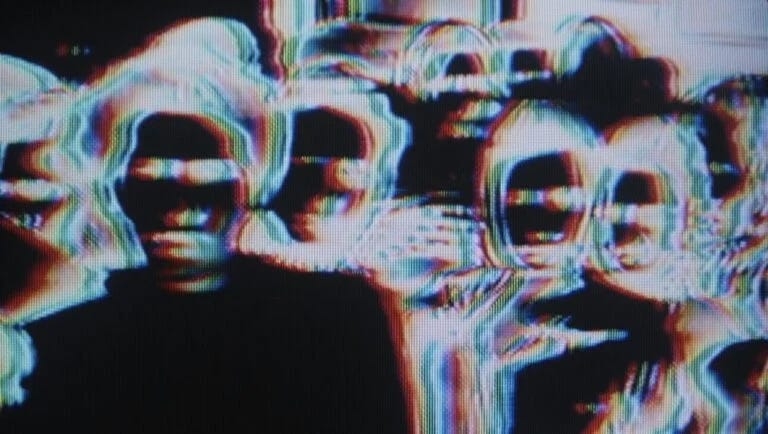
Macaulay: Tell me about that sequence. What did you use to create it?
Walker: It was made in Adobe Premiere. We’re not particularly skilled VFX artists, although we did do the VFX for the film — hopefully, it’s convincing! But with that sequence, we want to maintain some movie magic around it. Jack, what’s the best enigmatic way of [talking about it]?
Auen: I would just say there’s raw footage that is being processed and then filmed through analog media so that ultimately what you see is of a piece with all of the VHS videos, cassettes, books and stuff [in the film]. We didn’t want [the Chronovisor footage] to feel totally digital and made in a non-linear editing software — we wanted it to actually have some tactile quality to it. So, it started real with some processing and then ended real again.
Walker: We started looking into Blender and doing 3D stuff, and then we realized that what’s interesting about this [Chronovisor] technology is that they claim to have invented it in the ‘50s. That’s also what’s scary about it to me, like how old-time-y photos sometimes have an eerie quality. It’s like this old tech that’s so powerful and still so analog. Capturing that part of it, making it sure it didn’t look contemporary, was the most important part of all.
Macaulay: Which is why you also chose to shoot on 16mm.
Auen: Definitely. That was always the plan from the very beginning, but it was obviously budget dependent. There was a version of the film where if we couldn’t have raised the funds to purchase the 16mm film we’d have come up with something else. Thankfully we never had to entertain that hypothetical. But there was no better way to capture the analog qualities of the archival material than to keep the [whole film] tactile.
Macaulay: You made this film relatively quickly. You shot in 2025 and premiered in Rotterdam in January, 2026.
Walker: We shot between June and August of 2025, but very intermittently. If you count every day we shot something, it was 13 shooting days. Five days at the beginning of June, four days at the end of June, four days in August. That [schedule] was based on our lead actor, [Anne Laure Sellier], who is an actual professor. She was free in the summer, but she visited New York as a visiting NYU professor every June. She only teaches one day a week, and the rest of her week is just her reading and research and stuff. So, she was able to carve out time for us.
Macaulay: And was it through NYU that you first came across Anne-Laure?
Auen: Yes, because she’s listed on the NYU faculty.
Macaulay: But what about discovering her in the first place? It’s an unusual choice to have a working academic as a lead actor. At the same time, she has a lot of experience presenting in front of audiences.
Walker: The role was extremely difficult to cast. We did look into traditional actors, but we hadn’t found anyone who convincingly could do the intellectual dialogue and sound like a bona fide academic. And most everyone couldn’t speak the four languages necessary to match what we’d written through the script.
Macaulay: And the four languages are English, French, German and Italian?
Walker: Yes. And technically, I guess, Latin for stretches. She quotes Latin and a little Greek, but she doesn’t speak it.
Auen: We were scouring the faculty list at Columbia, NYU, Fordham — pretty much anywhere in New York City.
Walker: We were looking at CVs and headshots. We wanted people with at least a tangential academic relationship to the material in the film. Also, we thought it would be easier for us to sell ourselves [as filmmakers] to someone who might be interested in the subject matter. If someone was a STEM professor, we would still reach out to them, but we knew the likelihood [they would do it] was lower than someone who was interested in the humanities, history, psychology or philosophy. We saw [a photo] from a TED talk Anne-Laure gave. She was on stage speaking about creativity and social cognition and was wearing a black turtleneck, kind of like Steve Jobs or something.
Auen: When we saw a headshot we liked, we’d go search them on YouTube. Almost all professors at these prestigious institutions have done some Zoom meetings or conferences or something, so we could usually get a little taste. But Anne Laure had this incredible TED Talk where we really got to see her full performance.
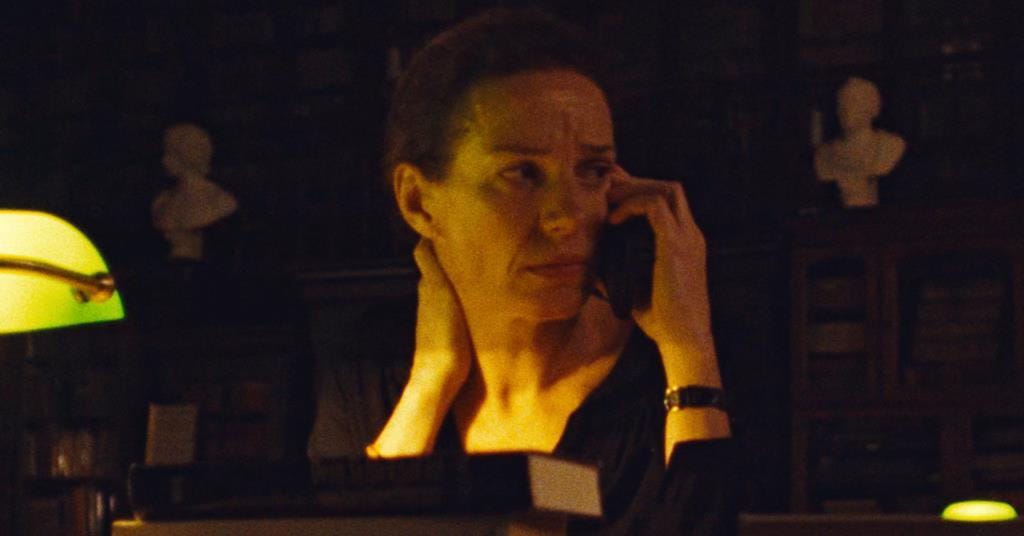
Walker: Up there in her sort of performative mode, she was just exuding the exact energy that we wanted from the character.
Auen: That she had so much [professional] overlap [with the character] really helped with the jargon. She just got what we were going for in terms of capturing the research [process].
Walker: And hearing her French accent – that did a lot of work for us. She became our top choice as soon as we saw [the video of her TED Talk].
Macaulay: Making a first film is often about figuring out how to have the maximum impact with a specifically constrained set of resources. In Chronovisor there is not much sync dialogue, and there aren’t complicated scenes that would have taken all day to shoot. You’ve leaned into a storyline around research and intellectual discovery. And for a film that takes place in, as you say, a bit of a genre space, you’ve made an unusual choice for a lead actor. In terms of making an ultra-low-budget feature that stands out in today’s marketplace, this all feels quite strategic in how it differs from so much other arthouse as well as genre work of the moment. How much were you thinking in these terms when developing the film?
Auen: It’s definitely something we were aware of. We knew whatever first feature opportunity would come our way would not be super well resourced. So, in the writing process that constrained us in the scope of ideas we were thinking about. Once we got into the actual Chronovisor side of things and the archive material, though, one of the things that excited us so much was that it felt like very little compromise was required in order to achieve the idea on modest means. If we had two or three times as much money to make this film, it probably would have ended up very similarly in terms of the finished product.
Walker: Everyone would have been paid better. We would have had better food for lunch.
Auen: It would have been easier on us, in some ways, but the idea was so exciting, cinematic and achievable, there’s nothing we [needed to have] spent money on that we didn’t. So, yes, of course for a debut you’re always trying to stand out with whatever means you can stand out with, and if the budget’s not one then you try to get creative. That freedom is one of the exciting things about working with so little money, both in terms of not having certain interests to answer to but also, in some ways, because you get more time to work on things because each new day on set isn’t $150,000 like it would be on a bigger-budget film.
Macaulay: The texts in the movie are all authentic, I believe. You didn’t write them, is that right? But did you have to recreate them, or are what we see in the film the actual books?
Walker: They are all authentic texts and actual books except for one single text. We’re letting people do a treasure hunt to try and figure out which one it is.
Macaulay: It’s a text you made up or just one that you had to recreate because you couldn’t get a physical copy?
Auen: I wouldn’t quite call it fiction. We wanted a specific headline to really get a point home, but [the text itself] is not fiction. It’s all information that’s out there, and it was useful for us in one particular instance to have it consolidated into one single document. We just consolidated a few separate but real pieces into one story that could make a crucial narrative point that we needed.
Macaulay: Were all these texts ones you found in libraries?
Walker: There were a few we checked out from libraries, and a few books we bought online, and the large majority of texts were possessed by random people in Europe. Those were insanely difficult to track down. Probably 70% of the texts that we bought for the film, whether they were magazines or newspapers or books, were the only copies available on the internet. If somebody tried to make this movie next year, they would basically have to buy [these texts] from us.
Auen: We probably have the most comprehensive library about this subject in the world. I don’t know if that’s something to be proud of or not, if it makes us crackpots or something. But it was six months of sourcing these texts.
Walker: And about that process — you buy something from eBay, the shipping cost is like five times what the book actually costs and it takes two months for it to arrive. And then half the time, we’re buying every issue of this magazine that was published in, say, 1972 in the hopes that one issue has one article about [the Chronovisor]. So, there was a lot of sifting through.
Macaulay: Fascinating. So the pre-production of the film is essentially a mirror of the process we see in the film.
Walker: Yeah. That’s something we didn’t understand at first — prior to [making the film] we did everything that Beatrice does in the movie.
Macaulay: And then how did you handle the language issues during the research and scripting process? I presume you do not speak four languages?
Walker: No. I took high school Spanish, Jack took high school French. We both have a little bit of Latin. A little bit of Greek. And we have a little Italian.
Auen: Just enough to be able to read a headline and get a keyword or two to send us in the right direction. [We had] enough knowledge that we didn’t feel like we were looking at an alien language or anything. But I wonder if this film could have been made without these new apps that can take a picture of a text and visually translate it. We had real translators come in once we had selected all the text to put on film, but for the initial discovery phase, being able to on the fly turn a page and in a second [receive a translation], I don’t know how we would have made the film otherwise. We’d have spent a tremendous amount of money to have people translating entire books. I don’t think the film could have been made ten years ago.
Macaulay: As I’m talking to you, I’m comprehending the complexity of the process. Yes, you have some language skills, but at the same time, you’re looking through entire books, and these books could be hundreds of pages long, and you don’t know where in the book a reference to the Chronovisor might be.
Auen: Sometimes you would be blessed with a chapter heading that would have a key word, like “Ernetti.” But there were instances where Kevin would do that translation process for every page in the book. Two-hundred and 20 pages for just two paragraphs.
Walker: I can’t describe how daunting it was to receive in the mail every single edition of a magazine from an entire year and sometimes there wouldn’t be anything [relevant].
Auen: But then sometimes you would go through a 600-page book and on page 450 there would be the best “this has to go in the movie” quote ever. So, you couldn’t flick through the books because every page was potentially a gem and a key shot in the film. The [process] was very rewarding, but it was not one we would want to do again tomorrow.
Macaulay: Tell me about how you landed on the way in which you visualized and then translated that text for the viewer. You don’t do traditional subtitles. I saw Joshua Minsoo Kim referencing Michael Snow’s film, So Is This, which I’ve actually never seen.
Auen: We had not seen that either. Anything remotely new that we thought we were doing Michael Snow beat us to it 50 years ago – not surprising! But superimposed titles as opposed to [normal] subtitles was actually a pretty early [decision] that came out of the experience of doing the live translation. It was like we’re showing the research process because that was just how we were ingesting the material the first time we were ingesting it.
Walker: We’re very happy with it, but first we thought it would seem gimmicky. You know when [in a film] people are texting and their text messages pop up on screen rather than [the film] showing the phone itself? I was like, “Are we just going to be another one of those [films where] you can tell they’re trying to make something uncinematic cinematic?” But when we started editing we tried it out with both subtitles and superimposition, and it was so much more seamless an experience having [the titles superimposed].
Auen: [Being able to] bold, highlight or underline certain sections, especially one sentence at a time in the same shot, unlocked a whole new set of tools to guide people’s attention through each scene and keep those sequences engaging.
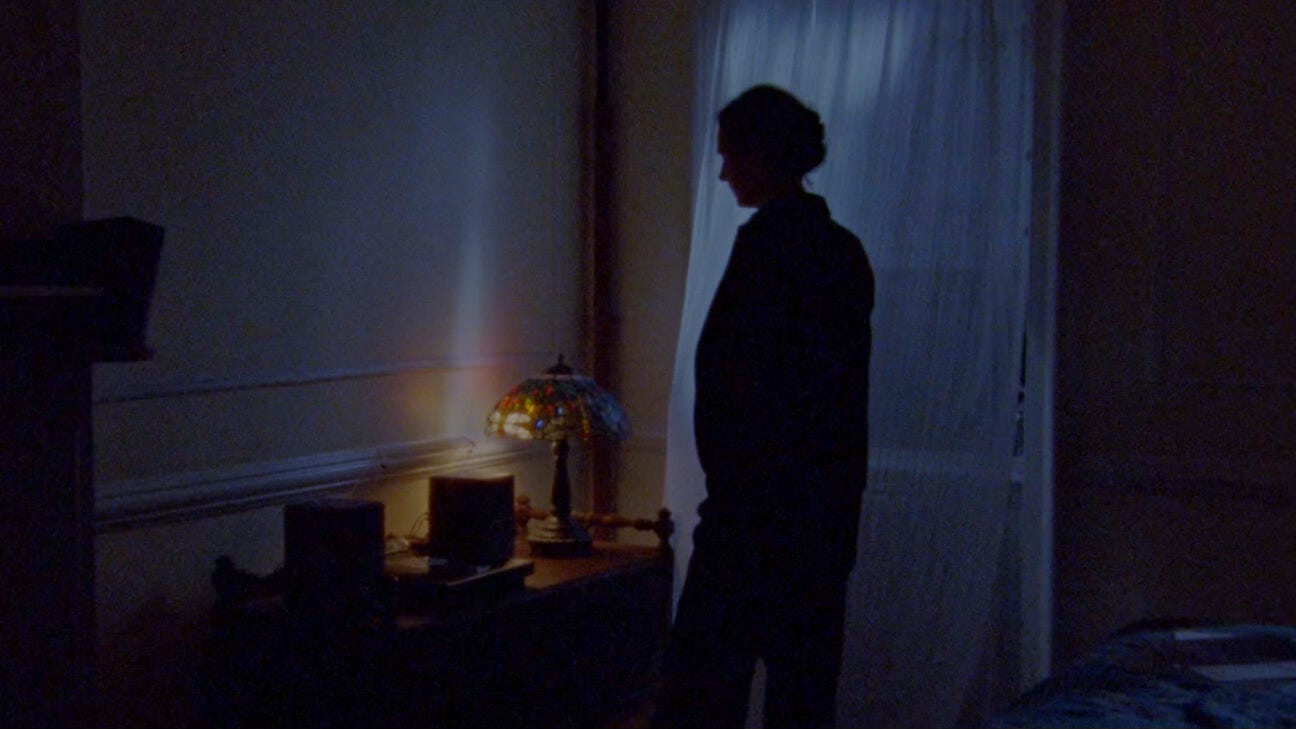
Macaulay: When did you decide to license Holst’s The Planets for the score?
Walker: We shot some exteriors in February and March, 2025, because it’s a winter set film. And when we were putting those into our edit system, we were looking for music to set [these shots] to because there was no sync sound. We stumbled on The Planets pretty early. It has this cosmic, grand quality, which is interesting as counterpoint to a story that’s so intimate. I mean, the film takes place primarily within a span of three feet — [between Beatrice’s] face and the books. A suite called The Planets that’s about the vastness of outer space as it pertains to human life — it’s a really interesting combination that I think is reflective of the internal experience of being a researcher. Externally it seems so simple and so small but internally it’s this mission to Mars, almost.
Auen: The grandeur was the first thing that struck us as feeling like an interesting counterpoint to the other elements of the film. You really feel like you’re in some Gothic library at 3:00 AM. If we were going to go with any other music it would just be trying to aspire to what The Planets was doing for us.
Macaulay: Was the decision to end the film in Portugal driven by the research?
Walker: That was serendipitous. We shot our previous short film in Greece, where my wife’s parents live, and we were going to shoot [the ending of Chronovisor] there because we have a place to stay and it’s the cheapest place to shoot. But just fortuitously Anne-Laure told us she has a summer home in Portugal. And then we remembered there’s a very heavily featured figure in the Ernetti story: one of the 12 scientists he claims to have worked with on the device happened to be Portuguese. In a lot of texts he’s referred to as “the Portuguese scientist” or “the Portuguese physicist.” What are the odds [Anne Laure] would have a house that could fit so well into the story? We had to contrive a few aspects in order to take [the story], which is obviously not a documentary, where it goes to at the end, and the [Portugal setting] was this perfect little connection that allowed us to tie a bow on the mystery.
Auen: We knew early on that Beatrice was going to leave New York and her ivory tower and head into the real world, so it was just a matter of where. Filmmaking is always a combination of practical and narrative choices, and we were so lucky that [Portugal] ended up being the ideal place given all the research. When the opportunity to shoot there presented itself to us, we realized that’s where it should have been set all along.
Macaulay: She walks uphill past this incredible religious procession all going downhill — was that planned?
Walker: That was dumb luck.
Auen: It’s in Santa Maria, and it’s a local religious ritual where, every year, there’s a procession that goes from the church at the top of the town down to the water, and then the whole town moves the statue [of the Virgin Mary] and everyone gets on these ornately beautiful decorated boats. We had already bought our tickets [to Portugal], and Anne Laure mentioned to us that there was a religious ritual on one of those days. “All the shops will be closed and that might ruin your plans,” she said. We were like, “Maybe we can get lucky and find a way to incorporate it.” We went in without too much of a plan and scouted the path of the procession that morning, trying to find the best vantage point for the camera and where to place her. We had just one take.
Walker: We were trying to figure out how her story would work into this event, and as soon as we envisioned her walking upstream, that was the perfect metaphor. It was as simple as that.
Macaulay: In terms of references, I thought about Benjamin Labutut’s book, When We Cease to Understand the World, which also has the mingling of scientific research and the metaphysical.
Auen: We actually read it in preparation for the film. It was as we were going into shooting, just kind of last-minute cramming anything that could inspire us.
Walker: Anne Laure read it as well for the same reasons you thought of it. I was incredibly impressed with that book. It was fascinating, but I don’t know if we ended up pulling any direct ideas.
Macaulay: I thought of it because you talked earlier about the bits of fiction elements in Chronovisor. I think that book, which is comprised of a series of stories about pioneering scientists, starts off with about 5% fiction and by the end it’s almost entirely fiction.
Auen: That was part of the reason we picked it up. We were nervous, thinking, “Is this going to work, taking this real story and putting our own spin on it?” Novelizing what would otherwise be very straightforward science non-fiction. I thought, if this [book] works, then I feel pretty confident that our film will work. And what’s so interesting is that it’s even harder in that book to tell what is real and what isn’t, and that’s its beauty. What that book accomplishes and what we hoped to accomplish with our film is to combine documentary and fiction to be capture a truth larger than either could accomplish by itself.
No posts
Comments
Nothing yet. Say the first thing.
Sign in to join the conversation.