
Many product teams know they should spend more time with customers.
They know interviews matter. They know customer needs matter. They know product decisions should be grounded in evidence rather than internal opinion, executive preference, competitive anxiety, or the loudest customer request.
But the hard part is not usually convincing a team that customer discovery is valuable.
The hard part is knowing how to do it well.
Who should we interview?
What market are we actually studying?
What customer job are we trying to understand?
How do we keep the interview from turning into a feature-request session?
How do we probe beyond what customers first say?
And after the interviews are complete, how do we turn a collection of conversations into product insight that can actually guide strategy?
That is what DISCOVER is about.
DISCOVER: From Customer Noise to Product Signal is a practical guide to customer interviews, Jobs-to-Be-Done thinking, and product insight. It was written for product managers, product leaders, researchers, marketers, innovation teams, and executives who believe customer understanding matters, but need a more disciplined way to plan discovery work, conduct interviews, and use what they learn.
At its core, DISCOVER is about the first step toward clear product strategy: developing customer evidence strong enough to support better product decisions.
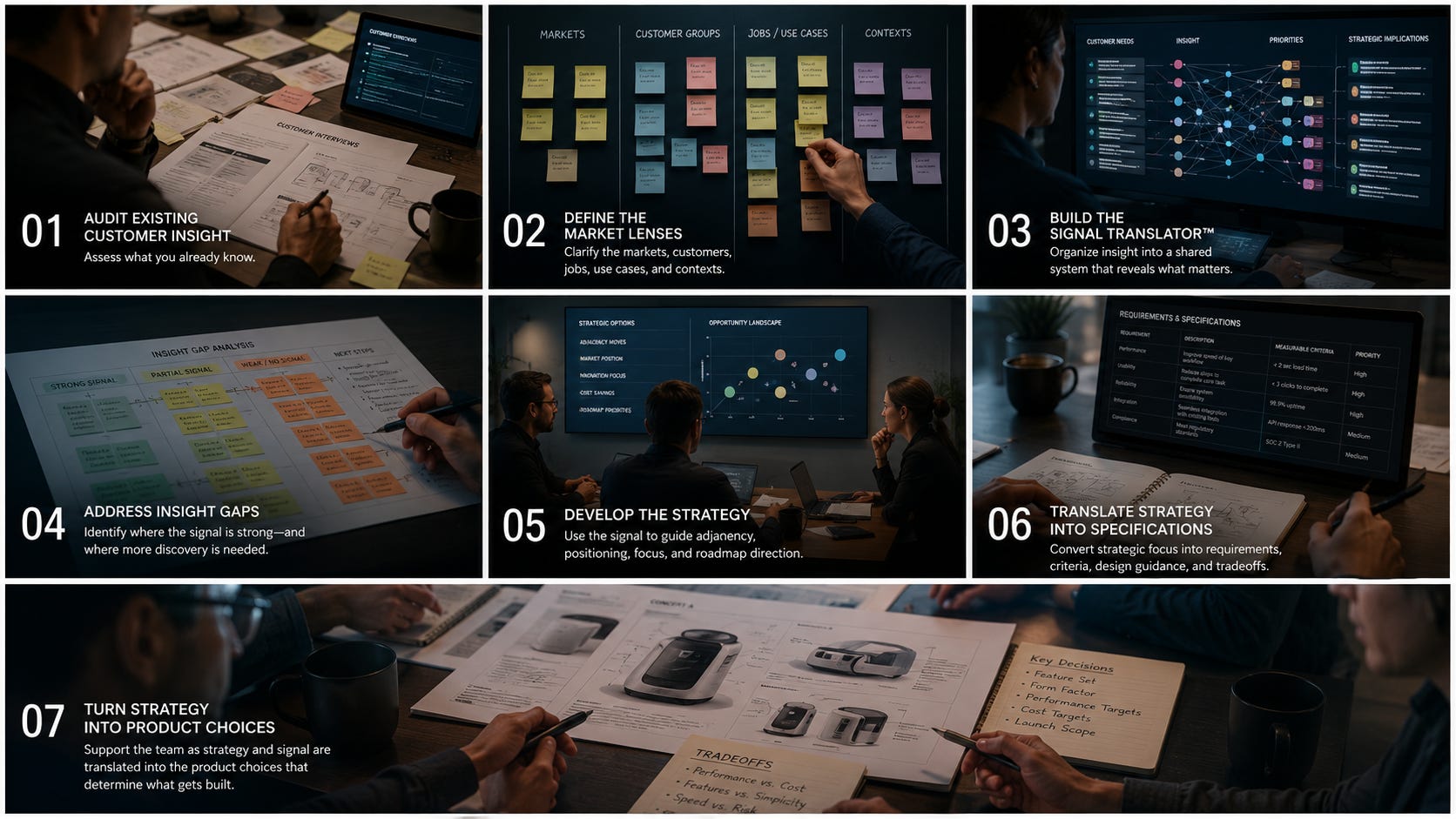
A great customer interview does not begin with the first question.
It begins with framing.
Before a team can ask good questions, it needs to define the market it is studying. That sounds simple, but it is often where discovery work begins to drift.
A market is not just a product category. It is not just an industry. It is not just a customer segment. For discovery work to be useful, the team has to understand which customers it wants to study, in what context, while they are trying to accomplish which job.
DISCOVER introduces the Market Lens as a way to clarify this before the interviews begin.
The Market Lens helps teams focus discovery around the right customers, situations, and jobs. It prevents the team from blending together people who may buy similar products but are actually trying to accomplish different things. It also helps avoid the opposite problem: defining the market so narrowly that the team only studies its current product category and misses broader opportunities.
This matters because interviews only produce useful insight when they are aimed at the right target.
If the market is poorly framed, even well-run interviews can produce confusing evidence. The team may hear complaints, stories, and ideas that sound useful, but struggle to know whether they point toward a real opportunity, an isolated preference, or a mismatch in who was interviewed.
DISCOVER begins here because better product insight starts before the interview begins.
DISCOVER is organized around three moves: uncover, rank, and synthesize.
The first move is to uncover what customers need.
This includes defining the Market Lens, mapping the customer job, choosing better interview targets, preparing interview guides, conducting Jobs-to-Be-Done interviews, and translating what customers say into clearer need statements.
The second move is to rank which needs matter most.
Not every customer need deserves equal attention. Some needs are important but already well satisfied. Some are frustrating but not central. Some are interesting but not widely shared. Others reveal opportunities that should influence product strategy, roadmap priorities, concepts, requirements, or innovation investment.
DISCOVER explains how qualitative and quantitative evidence can be used together to evaluate needs, including the use of importance and satisfaction to identify stronger opportunity areas.
The third move is to synthesize what the team has learned.
This is where many discovery efforts struggle. Interviews may be completed. Notes may be written. A list of needs may exist. But the team still has to determine what the evidence means.
DISCOVER introduces the Signal Translator as a structured way to bring together multiple sources of evidence: interviews, surveys, support data, sales feedback, competitive observations, win-loss notes, technical knowledge, and other inputs. The premise is simple but important: you should not trust any one study, any one interview, or any one source of customer evidence too much.
The strongest product insight often comes from triangulation.
DISCOVER is a Jobs-to-Be-Done book, but it is written for practitioners who need to use JTBD in real product work.
The focus is not on slogans. It is not on abstract debate. It is not simply telling teams to “focus on the job” or “listen for needs.”
The book shows how to use JTBD thinking in the actual mechanics of discovery.
That means asking about real situations rather than hypothetical preferences. It means listening for what customers are trying to accomplish, what makes the job difficult, how they judge success, where existing solutions fall short, and what constraints shape their choices.
It also means moving beyond feature requests.
Customers often describe needs in the language of solutions. They ask for a dashboard, a button, a report, a faster workflow, a different material, a lower price, or a specific feature. Sometimes those requests are useful. But if a team simply collects and prioritizes requests, it may miss the deeper need behind them.
DISCOVER helps teams translate customer language into Job Success Criteria: clear, measurable, solution-agnostic statements of how customers judge success while trying to get a job done.
This translation step is essential.
A feature request tells the team one possible solution.
A Job Success Criterion helps the team understand the customer’s underlying measure of success, which may be addressed in multiple ways.
That distinction is what allows customer interviews to become input for product strategy rather than merely a backlog of suggestions.
One of the challenges in customer interviewing is that the most important information rarely appears in the first answer.
Customers may begin with surface-level complaints. They may describe what happened, but not why it mattered. They may state a preference without explaining the tradeoff behind it. They may mention a frustration that seems small until the interviewer probes and discovers its effect on time, confidence, safety, quality, status, revenue, or risk.
DISCOVER introduces the 3D Probing Model to help interviewers explore needs across functional, identity, and emotional dimensions.
The functional dimension concerns what the customer is trying to accomplish in practical terms.
The identity dimension concerns what the situation means for the customer’s role, reputation, credibility, or sense of competence.
The emotional dimension concerns the feelings created by the struggle: confidence, anxiety, frustration, relief, trust, pride, embarrassment, or uncertainty.
This does not mean every interview becomes a therapy session. It means that product teams should understand the full human context of the job, especially when the customer’s decision is shaped by risk, accountability, professional identity, or fear of getting something wrong.
In B2B markets, these dimensions can be easy to miss. Teams often focus on technical requirements, economic value, or workflow efficiency. Those matter. But the customer is still a person operating inside an organization, making decisions under constraints, and trying to avoid bad outcomes.
Better probing helps reveal that fuller picture.
For teams familiar with The AIM Institute’s New Product Blueprinting, DISCOVER should feel complementary.
Blueprinting begins with the premise that successful innovation starts with disciplined customer understanding. DISCOVER begins from the same belief and adds a focused practitioner guide to the discovery work that surrounds customer interviews, Jobs-to-Be-Done thinking, customer need translation, opportunity ranking, and evidence synthesis.
It is not a replacement for Blueprinting. It is a deeper companion for teams that want to strengthen the front end of their insight work.
In particular, DISCOVER helps teams think more carefully about how a market is framed, how interviews are prepared, how probing works in live conversations, how customer language becomes usable criteria, and how multiple forms of evidence can be combined into a clearer view of opportunity.
For Blueprinting teams, this can strengthen the work that happens before, during, and after customer interviews.
DISCOVER was written for the people who have to turn customer conversations into product decisions.
That includes product managers shaping roadmaps, concepts, or requirements. It includes researchers and Voice-of-Customer practitioners using Jobs-to-Be-Done methods. It includes product marketers and strategists evaluating markets and opportunities. It includes innovation and growth leaders guiding new product work. And it includes executives who want better evidence behind product strategy.
The book is practical enough for teams conducting interviews and building customer needs inventories. But it is also strategic enough for leaders who need to understand what decision-grade customer evidence looks like.
That phrase matters: decision-grade evidence.
Not all customer evidence is strong enough to guide product decisions. A quote may be interesting. A complaint may be real. A request may be urgent. A story may be memorable. But product teams need a way to determine what the evidence actually supports.
DISCOVER is about building that discipline.
Throughout the book, DISCOVER follows a realistic product case involving Big Sky Outdoors, a company exploring opportunities around backpacking tents.
The case is included to show the process in action.
Rather than presenting discovery as a set of disconnected tools, the case helps readers see how the pieces connect: defining the market, understanding the job, preparing for interviews, probing customer situations, translating needs, ranking opportunities, and synthesizing evidence into insight that can inform product decisions.
The goal is not only to explain the method, but to make it easier to imagine using it.
DISCOVER is the first book in the Prismatic Product System.
That larger system continues beyond discovery into strategy, product specifications, development decisions, and concept testing. But DISCOVER starts where product strategy has to start: with disciplined customer understanding.
A product strategy built on weak evidence is fragile. A roadmap built on scattered requests is reactive. A concept built on untested assumptions is risky. And a team that cannot distinguish customer noise from customer signal will struggle to make confident decisions.
DISCOVER gives teams a way to begin differently.
It shows how to prepare more carefully, interview more effectively, translate more rigorously, rank more thoughtfully, and synthesize more honestly.
Most discovery advice stops at “talk to customers.”
DISCOVER begins there, but goes further.
It is about turning customer conversations into product insight, and turning product insight into a stronger foundation for strategy.
DISCOVER is available on Amazon, or click here to read a sample chapter.
No posts
Comments
Nothing yet. Say the first thing.
Sign in to join the conversation.