
Sublimation may be Isabel J. Kim’s first novel, but she has won numerous awards for her short fiction, and this is a strong work of narrative art. It’s built on an intriguing premise. What if, each time you crossed an international border, you could create a new instance of yourself. (Shades of the TV show Severance here but taken in a much different direction.) Your new self carries memories of the old you but then develops a new life in a different country. Your older self remains behind to pursue life as before.
And what if the two of you could reintegrate simply by touching skin to skin. To prevent that from happening accidentally, should you be near each other in the future, there is a device to strap on your wrist, called Mergebreak.
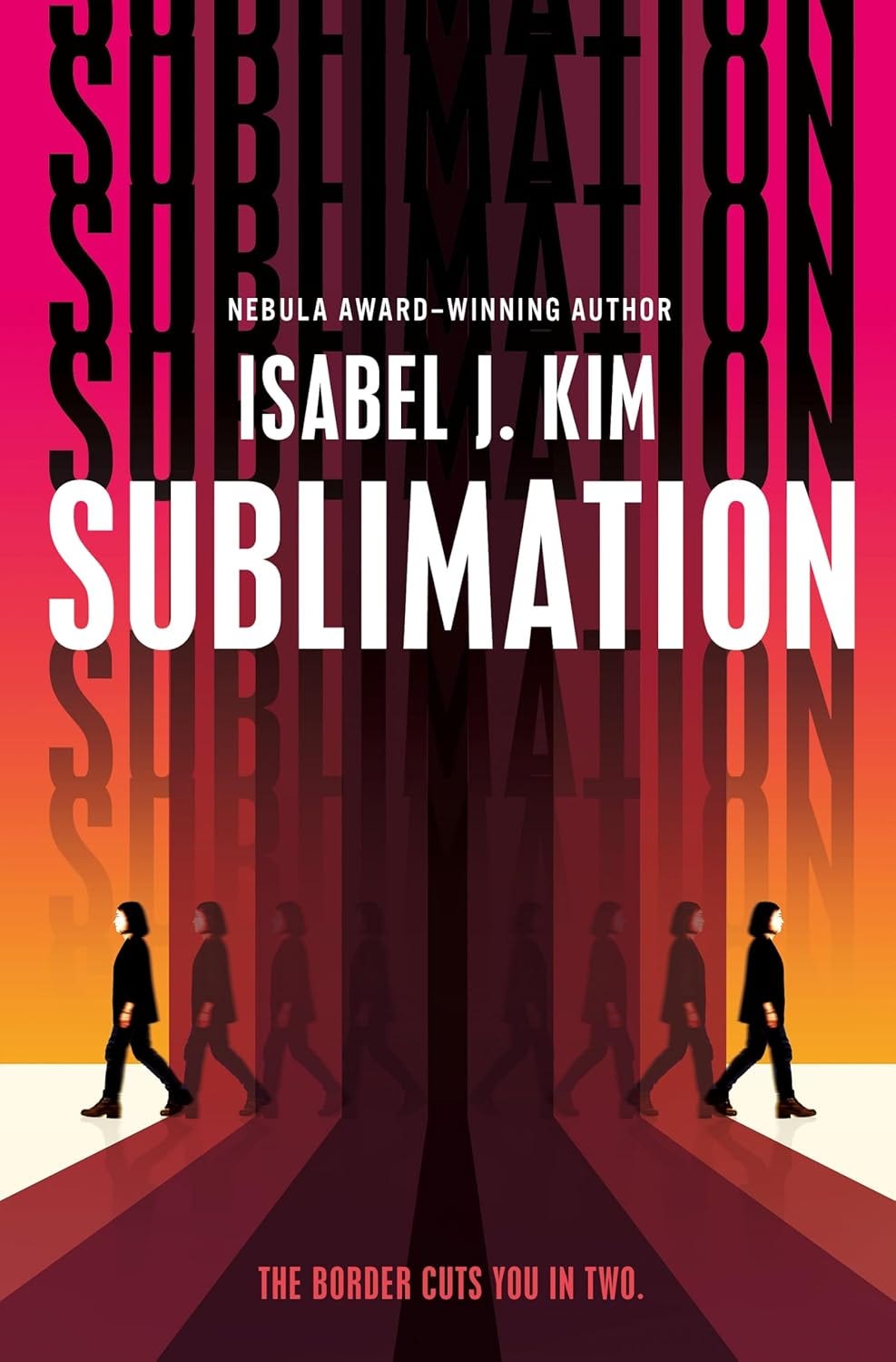
Kim deeply explores the human impacts of this system of instancing. It is not something new in the world of Sublimation but has been with humankind since the beginning. Kim draws in Korean folktales, an instanced version of Odysseus’s epic journey, and even a version of the story of Adam and Eve in which these first humans leave their instances behind when they are cast out of Paradise. The author has also worked out how instancing has been built into the laws of citizenship, and how reintegration is dealt with. This is a thoroughly imagined world that nicely balances the emotional effects on people and the social impacts of new technologies that threaten to change everything.
Kim tells the story primarily through the experience of two characters, Soyoung and Yujin. Both have instances who have made new lives for themselves in the United States. Yujin’s instance is called YJ and works for the company that makes the Mergebreak device. He is frequently in touch with his instance in Korea, and the two plan to reintegrate at some point. Soyoung remained in Korea while Rose, her instance, emigrated in childhood with her mother, who also instanced. Rose grew up in the New York area and has a whole life of her own that Soyoung knows little about.
The story begins when, at 30 years of age Rose, returns to Korea for the funeral of their grandfather. Rose and Soyoung awkwardly get to know each other again, but then learn that the grandfather had bequeathed his house to Rose, rather than to the Korean family, and also expressed the wish that she and Soyoung should reintegrate. That sets in motion a complex story of memory, identity, the scope of personal choice and yearning for different lives.
The Rose and Soyoung chapters in the first part of the novel explore the many facets of their lives that resemble or differ from each other and the deep longings each has for what the other lacks. Soyoung decides she wants to reintegrate, and while Rose objects, she momentarily softens, thinking her only feeling is one of regret for what she’ll lose.
It’s not giving much away to say that they reintegrate, and Soyoung-Rose soon feels that the strange melange of memories of two lives that have developed differently for twenty years just isn’t working. Especially since Soyoung has a fiancé, a childhood friend whom she has stayed with more out of habit than love. The Rose part of Soyoung-Rose is especially uncomfortable trying to fit into Korean life, but the Soyoung part of her now has all of Rose’s American memories as well. As the story makes clear, instancing is primarily a psychological and emotional state that depends on intention:
“Instancing is not a physical phenomenon. It is not a cleft of meat and bone, there is no physical severance. It is the cleave of one future from another. It is psychological change as denoted through physical reality; it is metaphor made flesh. The physical effects are downstream from the higher-order changes taking place.”
Kindle edition, Page 198
While Soyoung-Rose is trying to work out this combined new life, the narrative turns to Yujin and his instance in New York, YJ. These two have been online together almost every day, trading stories, playing computer games. YJ has been summoned to a meeting with his boss, a peripatetic figure who isn’t in one company location long enough to have a permanent office. YJ has been dreading the meeting, convincing himself he is about to be fired, but his boss surprises him with a promotion to head a project of a new technology that could profoundly change the world.
This technology is known as Mitosis and would put instancing and reintegration under the control of a machine. Mitosis is likely to be owned either by the state or a single corporation. Much as we try to imagine now how AI will transform life as we know it, the characters of Sublimation grapple with a new revolutionary technology and have to decide who should control it. Instancing and reintegration as matters of personal choice could become obsolete, as these states could be produced by the Mitosis machine without regard to human preference.
There is a lot in this novel about love, but this is not a romance. And there is potential for a thriller about control of the new technology, but the story doesn’t really go too far in that direction. This is speculative fiction of the highest order, a novel that stays in the mind and draws me back for repeated readings. It’s very much a story about the impossibility of fulfilling dreams of future happiness, of creating as many problems as solutions when reaching for an ineffable idea of emotional fulfillment. Sublimation is a deeply honest portrayal of searching elsewhere for a new life, a new you, and the difficulty of fulfilling that longing.
One of the most interesting aspects of Kim’s writing is her ability to make the familiar seem new, forcing us to see different facets of questions that face us every day. For example, she describes what it would be like to live without instances. Of course, that is the reality we live with, but so rendered in the context of this novel that it feels like something quite new, as it would feel to the characters:
“Imagine a world without instances. A world where leaving is perfect absence, where there is no ghost left behind. Imagine never knowing the parallel, leaving the past in the past, a world where desire doesn’t matter, where there is no blunt knowledge of the implicit truth of the human heart. Imagine a world where leaving is a single choice, where there is the kind blindness of never knowing and the cruel promise that you will stay singular.”
Kindle edition, Page 202
Sublimation can also be read as the real story of immigration. All the angst, the hope, the regret, the difficulty of feeling at home in your own skin in a different land, and of facing displacement when returning to what used to be your homeland - all that is real for many immigrants as it is for the fictional characters in this powerful drama. Yet there is much more here than a comment on the current problem facing so many countries and individuals seeking safety in today’s real world. It is one of the most compelling science fiction stories I’ve read in years.
Comments
Nothing yet. Say the first thing.
Sign in to join the conversation.