
Alan Moore’s I Hear a New World, second novel in the Long London series, has an interesting lineage. In a recent interview, Moore, who retired from comics some years ago and now claims to disown most of the classic graphic novels he is best known for, described the inspirations that got him started on this series. Primary among them was a story by Arthur Machen that talked about the London that we see as a shabby curtain of the true and blazing reality.
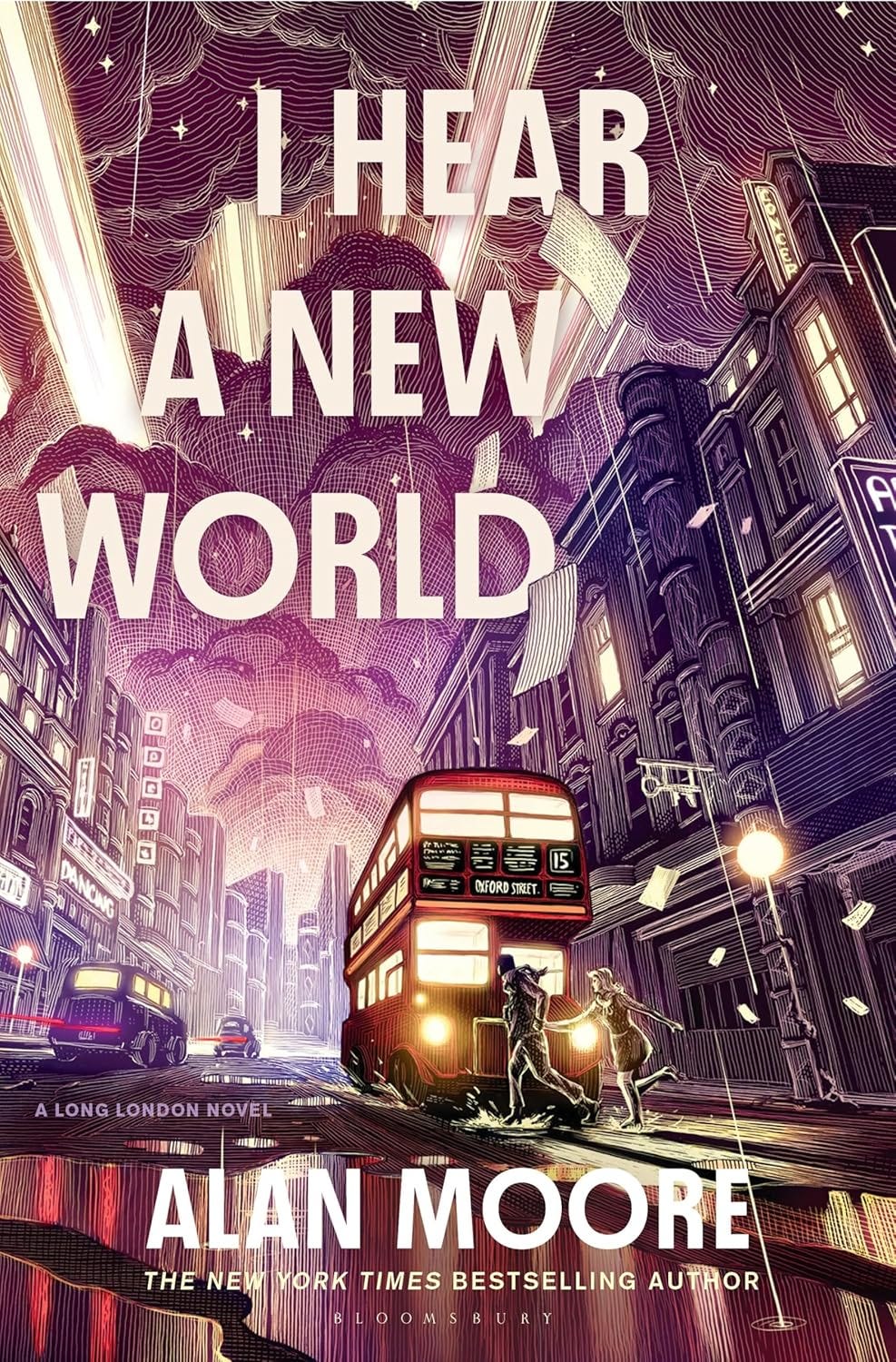
But he also said he was fascinated by the forgotten figures of London’s recent cultural and underworld past and needed a strange setting that could allow him to bring them to life. There are at least half a dozen of these people in The Great When and just as many in I Hear a New World. Each of them becomes a sharply drawn and unforgettable character in Moore’s fiction.
The title of the second novel in the series is that of a concept album, I Hear a New World, of the early 1960s by the recording genius and music producer, Joe Meek. He may be forgotten now, but he originated the modern idea of the recording studio as a musical instrument and created the technology and concepts of recording individual performances on separate tracks and then blending them together. He also experimented with blending electronic sounds into pop music.
When Joe Meek, the character in Moore’s novel, is introduced to the visually dazzling other side of London, it is not what he sees that captures him but what he hears that gives him a whole new inspiration. (You can download his album on Apple Music, or whatever service you use.)
In its blending of genres, the Long London series is part historical fantasy, as it captures the city at key moments of the decades leading up to the turn of the century. So The Great When is set mostly in 1949, I Hear a New World in 1959 and early 1960, and Moore says that subsequent books will cover the later decades. The extraordinary prose of the first two novels interweaves references not just to real people but to historical trends, the strange amalgam of wild fantasies and mythic figures in the “other” London, and a lot of humor. The language is a brilliant melange, all of it tied together by the story of the nascent writer, Dennis Knuckleyard.
Near the end of The Great When, Dennis receives a mysterious iron key from the evanescent, brush stroke figure of a young woman known as Slenderhorse, who always appears riding a horse of bones. I Hear a New World begins with the origin story of that horse in a flashback to pre-World War I. A huge old shire horse is pulling a heavy load to a construction site but stumbles and collapses in its last gasp of life. The remains are buried right where the horse fell, and it gradually decays down to its massive bones. But the writing conveys much more than that, as the remains transform into something mythic.
“the dead legend has become a thing of secret beauty, stripped by maggots to a pearly stylisation, resting on one side, the separated bones made a mosaic of racing motion, legs outstretched as though towards some further finish line, ahead in that tight-packed jet silence.”
I Hear a New World, Kindle edition, Page 3
Before the main story gets underway, we learn about the early career of Joe Meek. He steps into the world of Long London when he takes a key from a journalist (Dennis Knuckleyard) and drops it down his shirt one night when he’s having a bad nosebleed. The key sends a shock up his back but also stops the bleeding. The key behaves in other remarkable ways, and Joe is convinced it has special powers and repeatedly refuses to give it back to Dennis, who has been charged by Slenderhorse to return it to her.
At this point in his life, Dennis Knuckleyard is an aspiring writer, though at the moment his only work is producing fictitious letters, describing imaginary sexual exploits, to the editor of a soft porn magazine. The gig has at least enabled him to get a flat of his own, and he has long escaped his dependence on his ghastly former landlady, Coffin Ada. However, she invades his apartment one night in the company of the formidable giant of a woman named Commotion Venables.
Strapping him to a chair, Coffin Ada, perpetually smoking while discharging her “pulmonary fusillade” of coughs, accuses him of abandoning his friend of ten years earlier, Grace Shilling. She’s been searching for Dennis, and, after failing to find him, must take his place on a mission into the Great When to face the managing “heads” of that wild other world.
Dennis sets out to catch up with Grace, who was a fifteen year-old prostitute when he knew her and is now a dancer at one of Soho’s strip clubs. Though nervous about possibly repeating the hideous experience of his last visit, when he caused the horrific death of a serial killer pursuing him, Dennis stumbles into the surreal world of Long London once again.
“he’s reeling in amid skyscraper horticulture under fifty billion stars, and it’s as if he only left this state an instant since; as if the last ten years … have been no more than a momentary dream; as if this endless yet immediate Now is far more true than time . . . through big grass of an unaccustomed green, Dennis wades belly-deep, ascending the same slope and awestruck by the same huge pregnancy of coloured glass as last time he was here . . .”
Kindle edition, Page 91
He catches up to Grace just as she is about to enter the place where the Great When’s heads are assembled. That’s when she discovers what Dennis well knows that these ladies and gentlemen are actual preserved heads of some of London’s most famous victims of English history, like William Wallace, Anne Boleyn and Oliver Cromwell. The grotesque scene is made worse by the fact that they are all in a state of fear because a breach has occurred. That is, one of the Arcanum, a destructive powerhouse, has entered short London, thus endangering both cities. It may be the end of everything unless Dennis and Grace can find this unknown being and bring it back to Long London.
Then the story gets into high gear as Grace and Dennis set about finding the breach and trying to save both Londons. The two couldn’t be less well equipped to carry out this mission. They feel totally lost when they find out that the breach is none other than Button Dainty, passing himself off as a tiny man but who is a homunculus that can transform into a hideous storm of violence. Moreover, he has become the companion and guiding voice of the murderous Ronnie Kray, just now killing his way to dominance in London’s gangland.
There’s a lot of excitement, along with Moore’s unfailingly brilliant prose, with its combination of comedy, danger and the forays into the dazzling jumble of Long London’s swirling mix of all history into a perpetually changing now. Moore has an amazing range in his ability to capture the language of crooks, historical characters of all classes and purely mythic figures. This is all set off against the straight-man bumbling of Dennis Knuckleyard as he tries to find true love while blundering his way through the most fantastical adventures.
Comments
Nothing yet. Say the first thing.
Sign in to join the conversation.