
Listen, I love science fiction. I think we all know that, but today, in our month of August where we’re looking at the state of science fiction, I’m going to knock it down a peg.
Science fiction is a wonderful genre, it gives us spaceships, time machines, killer robots, parallel worlds, what if’s, and more variations on the ‘humanity is the real monster’ that we probably deserve. Science fiction lets us examine our present, our future, and experience that wonderful moment when we realize its picked up a few bad habits…
So, without further ado, for this Sci-Friday I’m taking a look at the seven deadly sins, and calling our genre out to confess its transgressions;
I am guilty of this one too, but once-upon-a-time, a science fiction movie could simply be a movie. It would introduce a strange world, tell a complete story, and then end. If the movie was good (and even sometimes when it was bad) you might leave the theater wanting more, but “more” wasn’t a foregone conclusion, and there wasn’t a post-credits scene with a shadowy figure assembling the next six installments that I had to go look up online who that was supposed to be.
Now, no story is permitted to stand alone. It needs a cinematic universe, which it will milk until is beaten it to death. There will be tie in mobile games, special printed cereal boxes with the same cereal inside it, and eventually a fan wiki (and a competing fan wiki).
Science fiction is particularly vulnerable to this because worldbuilding is part of the appeal of science fiction (as we’ve discussed before on SciFi Camp, and we actually do here at JAMR, llc). The problem becomes when the world building becomes more important than the story itself. This is where characters stop having conversations and start planting series clues, or mysteries are added with no solution, meant just to fuel online discussion. Entire installments become nothing more than a connective tissue between something we already watched and what is supposed to come next — and you better not miss any of it! Sin, sci-fi, that’s a sin.
A universe should grow because the stories grow, not assembled in advance. And sometimes, a story should be allowed to end.
Nostalgia didn’t used to be a curse word. Seeing a familiar space ship cross the screen is a nice nod to fans. Or hearing the right musical cue, it can bring back memories. But modern science fiction treats our memories like the western world treats an oil deposit — and it will drill it until the ground beneath collapses and kills us all.
Every recognizable character must return, every object that has become a relic requires a backstory, every returning prop needs its own glamour shot, and every famous line must be repeated ad nauseam. There are literal pauses in movies now, waiting for the audience to cheer or clap, despite nobody from the performance actually being there.
This is not the same as honoring the past. To honor the past is to understand the time and place it took place in the past and why that worked. Then using that knowledge to create something new. Nostalgia harvesting doesn’t do that, it just reminds us the old thing exists and says, “love me because I made this reference you know.”
The part that frustrates me about this, and this is one that actually gets me a little hot under that ol’ collar, but science fiction should be the genre most willing to move past this drivel. Its entire purpose is to ask what comes next! Yet, we keep returning to the same planets, the same villains, the same heroes, all coughed up again and again and played just to cash in on the all mighty dollar.
Modern science fiction loves a good mystery, and so does my Aggie1 lovin’ heart. But the problem begins when the mystery is no longer a narrative device, but the entire strategy.
In the last two decades, popular science fiction had been heavily shaped by what is often called the “mystery box” approach. This is most famously associated with J.J. Abrams. The idea is simple: present an enigma, promise that the answer is meaningful, rely on audience speculation and theorizing, and then don’t answer the question. The execution has, historically, has often revealed a more troubling pattern: mysteries designed to be compelling in the moment but without a satisfying resolution actually kind of sucks. Ask Aggie, the best mysteries can be solved by the reader (and not spoon fed to them), but they need to actually have a solution.
We saw this most infamously in Lost, where early intrigue about the island’s secrets (the smoke monster, the numbers, etc) generated enormous cultural momentum, but as the series progressed, it became increasingly clear that many of these questions were not planned narrative threads, but just hooks. They were devices to keep viewers invested while the writers improvised their way through the story. And then, as if he didn’t learn his lesson from Lost, J.J. Abrams did it again with Star Wars, introducing mysteries for the internet in stark contrast to a plot that he didn’t even have a plan for.
The puzzle box seduces us with symbols, cryptic dialogue, hidden identities, unexplained flashbacks, and all manners of mystery … but when the mystery becomes the product rather than the story, something essential is lost (pun intended). Look at any good Agatha Christie mystery, its’ only a meaningful mystery if its built on a foundation that can support its own answer. Without that, the reveal becomes either underwhelming or incoherent, and it’s not because audiences are too demanding, but because the narrative was never constructed to resolve what it introduced.
A good mystery deepens a story. It shouldn’t replace one.
Somewhere along the way, “serious” science fiction became synonymous with “miserable.”
The future must be dirty, corrupt, corporate controlled, and everyone must hate each other. And, usually, the lack of lighting indicates that electricity has become the scarest of resources… 🙄
Don’t misread me, dystopian science fiction has its place. Some of my favorite science fiction is ether dystopian or takes place in the world I described above. It’s also very valuable for its social exploration of our world today. Stories like 1984, The Handmaids Tale, RoboCop, and Twilight Zone/Black Mirror episodes endure because their darkness illuminates something real.
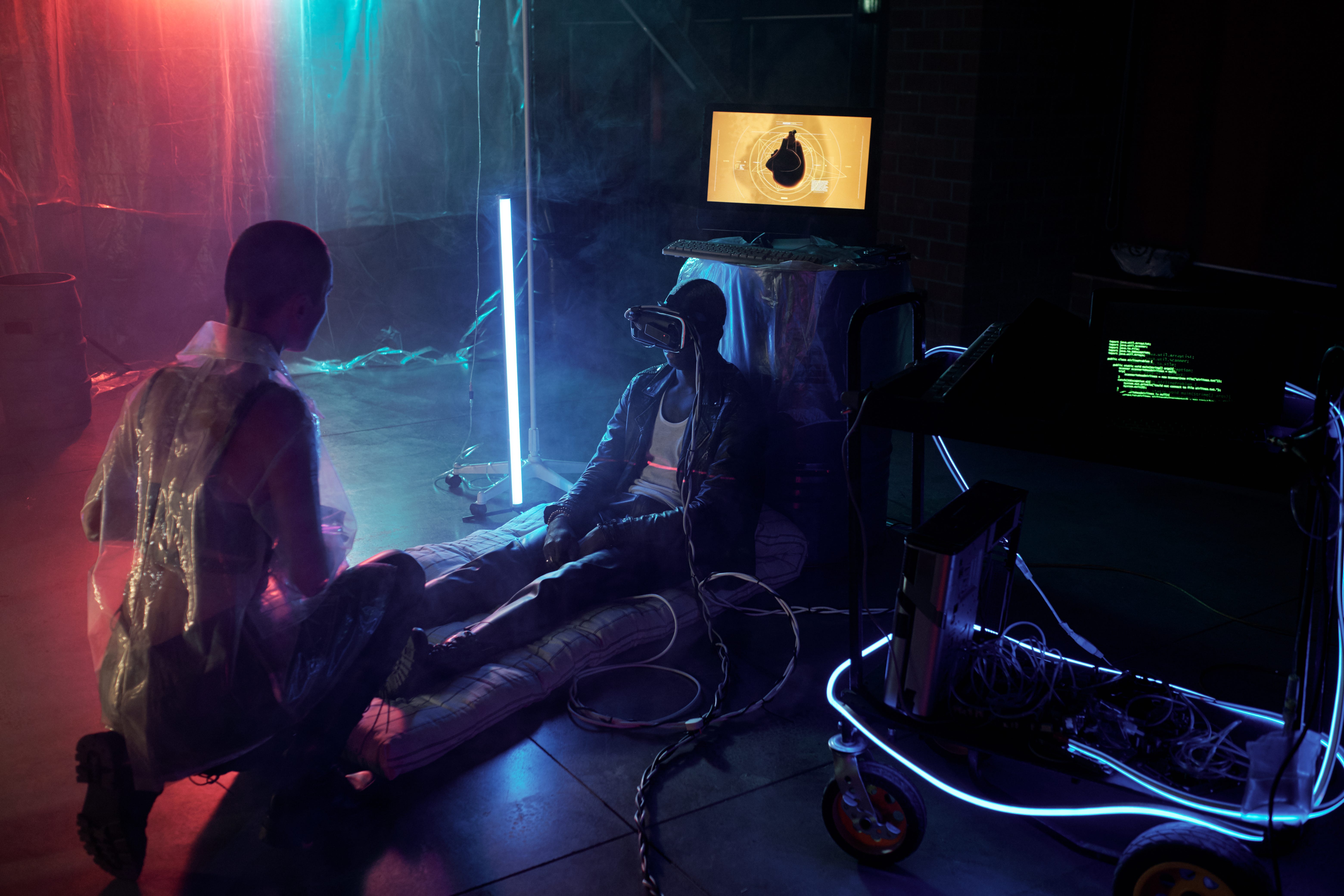
So, this sin isn’t so much about the fact that dystopians exist (it’s weird not to call that fact a sin), but the sin comes when a story is placed in a dystopia needlessly. When the author places it there just for vibes, or cultural recognition. It’s easy to co-opt the bleakness of dystopia, rather than build it yourself. And I think that’s a shame. Not because using cultural short hand is inherently bad, but because we’ve almost gone out of our way to treat optimism as childish, when in reality it’s anything but.
I want my science fiction to have futures worth fighting for, or explorers who are excited to discover something. I want the ‘competent’ characters who use intelligence, cooperation, and courage to solve their problems. Because, the thing is, darkness can be a powerful force in a story, but it’s only worth anything in a story if we remember there is light too.
When a story descends that the fate of a single ship isn’t enough, it tends to ramp up the threat quickly. Suddenly, the problem includes the entire planet, or even the entire solar system. If that’s not enough drama, then it streaches across the galaxy, or reality itself!
I’ve originally coined this the Stargate Problem back in the day, but I think it’s been superseded by the Superhero Movie Problem today.
As each movie/book/episode increases the stakes, our emotional investment begins to wane.
It is difficult to comprehend the destruction of a billion fictional lives. It’s much easier to care about one frightened person trapped on the wrong side of an airlock. Science fiction sometimes forgets this, and assumes that Michael Bay had it right all along, so by adding more explosions, you are automagically adding more meaning to the plot.
But stories don’t just do this with explosions, the same gluttony can be applied to ships-on-screen. Look at the last Star Wars movie. It was comical how many ships showed up after there “had been none” at the end of the eighth movie. Or look at the end of the first season of Picard. I laughed when the fleet of identical Starfleet ships arrived. Even Serenity fell victim to this with the Reaver vs Alliance battle.
Look, I get it, spectacle is part of the fun. We still want to enjoy our stories, and I’m never going to complain about a well-made space battle, but spectacle needs to be comprehendible. If the reader/viewer cannot understand who/what/why is happening, then you have a problem. You don’t need to destroy an entire universe to create suspense, and the best stories don’t.
The modern science-fiction villain rarely admits to being evil. Instead, the villain wants to save humanity (by removing half of humanity 🙄). Their goal is to remove free will, or release a deadly virus, or putting the whole species into tanks of fluid and running an elaborate simulation for them…
And, look, I get it. Villains should think they are justified, and science fiction is the perfect place to explore how a seemingly reasonable idea can become horrifying when taken to the extremes.
But we’ve reached the point where every villain has a tragic backstory (looking at you Stranger Things). Or, worse, I am tired of the “people can not be trusted to make their own choices.” Really, I just miss villains who just wanted to conquer Mars or be an evil Billionaire.
Worse, stories occasionally work so hard to make their antagonists sympathetic that they forget those antagonists are committing atrocities. The villain identifies a real problem, proposes mass murder as the solution, and then earns approving internet comments because they “kind of had a point.” Are you kidding me? Yeah, they had a point … but then they built a death machine!
We can have complicated villains without pretending that genocide is simply an aggressive form of therapy.
This may be the greatest sin of all because it feeds every other one. Science fiction is the literature or possibilities, yet with so many new science fiction movies and stories … they feel so familiar.
There is the cyberpunk city with neon signs, crowded streets, and holographic advertisements. There is the authoritarian government with enormous concrete buildings. There is the desert wasteland populated by scavengers. There is the suspiciously clean utopia hiding a terrible secret. There is the spaceship crewed by the same collection of archetypes we met on the previous spaceship.
Even our aliens often look flat with cultures that can be summarized as “warriors,” “scientists,” or “diplomats.” Reduced to a common denominator. I know repetition is inevitable. Science fiction has accumulated an enormous vocabulary, and creators use familiar elements because audiences immediately understand them. A starship bridge does not need to be reinvented every time someone wants to tell a story aboard a starship.
I’d argue tho, the genre cannot survive solely by rearranging its existing stories. Where are the futures built around technologies we haven’t already seen a hundred times? Where are the alien societies that don’t fit neatly into human political categories? Where are the stories that make us pause and say, “I have never thought of that before”?
The good news is that science fiction is far from doomed. For every unnecessary sequel, there is a new writer on Substack creating an independent world. For every gloomy dystopia, there is someone imagining a future where humanity survives. For every familiar franchise returning for another round, there is a small film, novel, game, or series taking a risk on something wonderfully new.
And, honestly, even these sins can produce great stories; nostalgia can reconnect generations, a puzzle box can keep us guessing, a sympathetic villain can force us to question our assumptions, and darkness can make the light more meaningful. The sin is not using these ideas, it’s using them without having a reason why.
Science fiction should challenge us, frighten us, amuse us, and stay with us long after the story ends. Most of all, it should imagine.
So that is my confession on behalf of modern science fiction.
Now it is your turn: Which of these sins bothers you most?
What would you add to the list?
And which favorite movie, book, show, or game are you willing to admit is guilty of all seven?
For our newer subscribers, I’m a huge Agatha Christie fan, particularly the Hercule Poirot mysteries. I reference her a lot, and I call her Aggie. May wife says I bring her up too much ¯\_(ツ)_/¯
Comments
Nothing yet. Say the first thing.
Sign in to join the conversation.