
Image: NASA
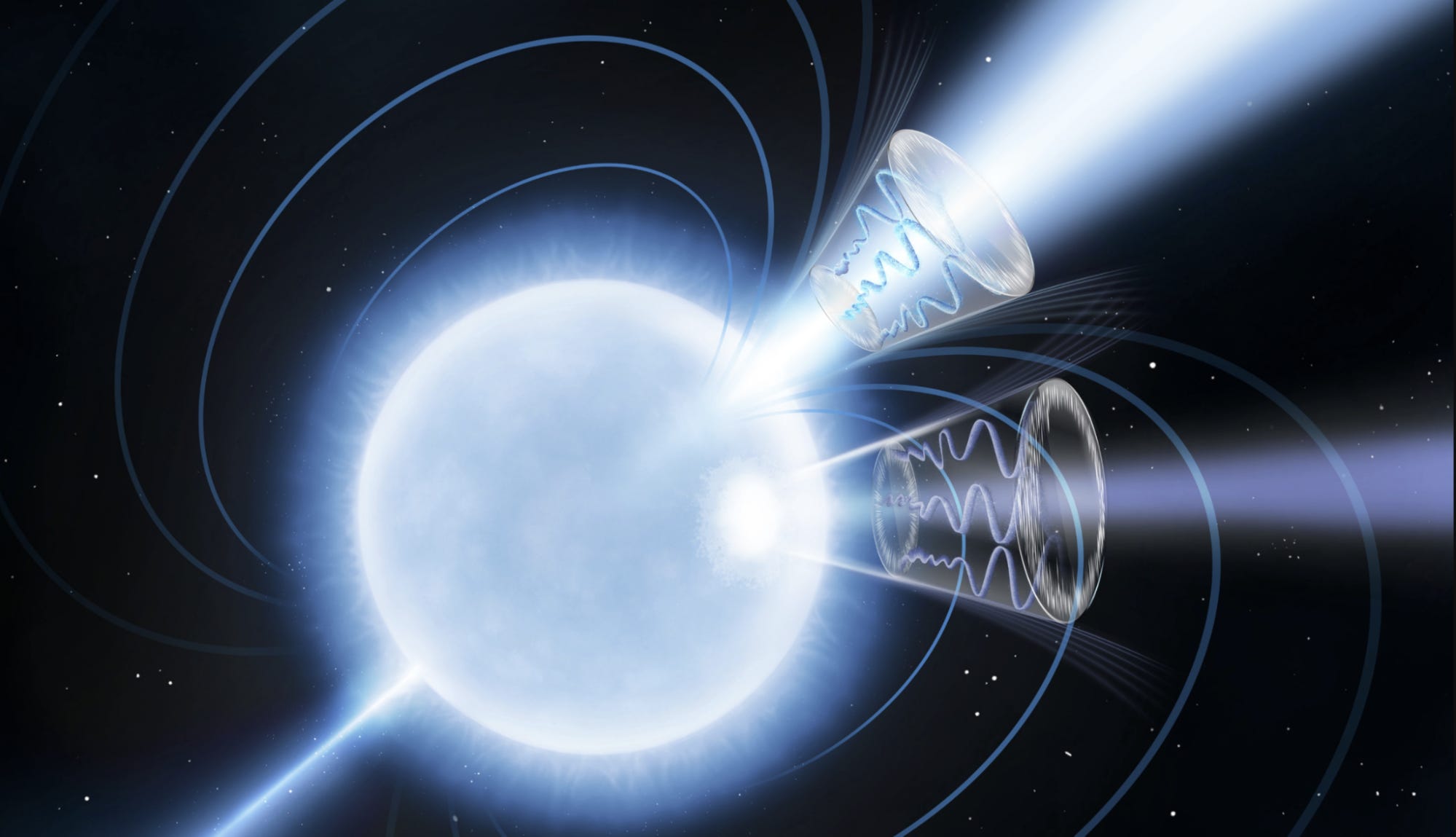
Researchers from George Washington University in the US have found strong evidence for vacuum birefringence, that is when the different polarizations of light travel differently. Birefringence is an effect also seen in some types of crystals, i.e. in the presence of matter. However, the new observations confirm it can also happen in vacuum.
The researchers confirmed this by observing the X-ray emission from a magnetar about 15,000 light-years away in the constellation Norma. Such magnetars are neutron stars with extraordinarily strong magnetic fields, in this case more than a trillion times stronger than Earth’s. The X-rays which they observed were up to 82% polarised, which is far more than one expects.
However, a 90-year-old prediction of quantum electrodynamics says that extremely strong magnetic fields change how light travels through vacuum depending on its polarization, hence causing birefringence. In this case this causes the polarizations to line up and get stronger rather than washing out. When the team modelled the X-rays with vacuum birefringence, they could reproduce the observed polarisation; without it, they could not. This effect is a prediction of standard quantum electrodynamics, and Paper
Researchers from the University of Glasgow in the UK have come up with a new idea to search for alien life. They suggest that rather than arguing about whether one or the other molecule that has been observed in the atmospheres of exoplanets is or isn’t a signature of life, we should instead simply calculate the complexity of the molecules. Their reasoning is that the more complex the molecules, the more likely they came about through already existing environmental complexity that is an indicator, if not for life, then at least for, well, complex structures. Concretely, they use a mathematical quantification of complexity called “assembly theory” which they previously proposed. Loosely speaking they argue that molecules requiring more than about 15 assembly steps are unlikely to arise without biological selection. The benefit of this method is that it does not require assumptions that life on other planets must be in any way similar to life on earth.
Paper here.

Image: Screenshot of author positions on sale. Source: Richardson et al, arXiv:2604.24576
A team led out of Northwestern University in the US have documented a large international trade in scientific authorship. They collected more than 18000 advertisements for authorship on scientific authors in seven countries. First authorship on a scientific paper cost a median $788, second authorship $676 and fifth authorship $420, with first-author prices reaching $5,631. More than 12,000 adverts mentioned Scopus and more than 5,000 mentioned Web of Science, suggesting that publication in recognised academic journals is a central part of the business. The businesses which the authors studied were operated in, or registered in India, Iraq, Uzbekistan, Latvia, Russia, Ukraine and Kazakhstan.
The researchers stress that their sample was not systematic, so it cannot tell us what fraction of published papers contain purchased authorships, but it demonstrates that this is an organised market operating on a scale of thousands of papers rather than a handful of isolated cases. Paper
No posts
Comments
Nothing yet. Say the first thing.
Sign in to join the conversation.