
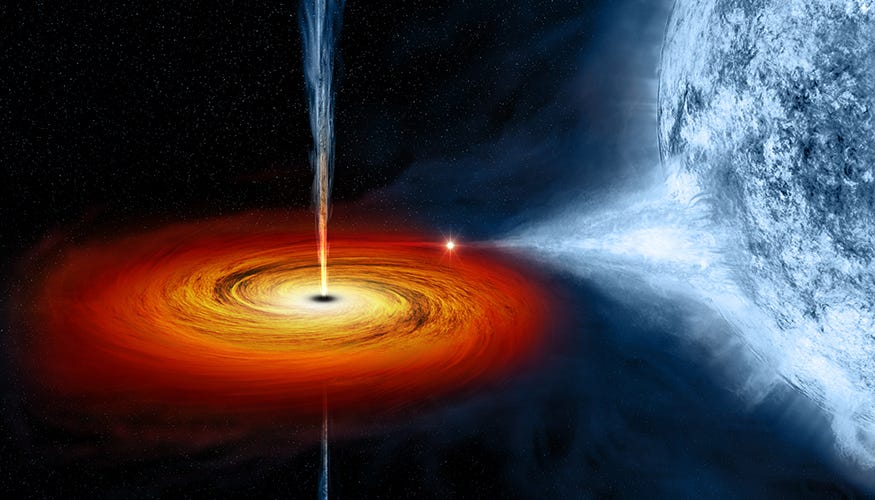
Image courtesy of NASA/CXC/M.Weiss.
Scientists have built a new type of laser based on the physics of black holes. Yes, this is real, and it’s a lovely example of how seemingly useless observations can turn out to have a practical use. Let’s have a look.
The defining property of black holes is their event horizon, that’s a surface from within which nothing, not even light can escape. But where is the event horizon in these depictions of a black hole? You might think it is here, at the boundary of the bright region. But no, this is not what is going on. The horizon is actually somewhat inside of the dark region.
This bright region here is what is called the photon sphere. It’s where light can go around the black hole. The curvature of space is so strong that the light gets bent completely around, so the photons basically pile up there. Light can escape from this gap in between, in principle, but in reality it basically never gets there without falling into the black hole. This is why this region looks so dark.
This is also one of the reasons why the question of whether black holes exist is still not 100% settled. Because really you can’t observe the horizon, so what are we even talking about?
But about the new paper; the authors said, look, this is a fascinating effect. There is something about this geometry near black holes which bundles the light in a particular region. It’s not like a lens: a lens has a focus point or a plane, and then the light diverges again. Here you have something like an attractor for the light. And couldn’t this come in handy for something?
So what they do is that they create a 2-dimensional analogue of the black hole geometry. Of course it’s not really a black hole, but basically it’s a medium in which the curves on which light moves behave similar to the photon sphere. Concretely, it’s a small 3D-printed structure made from a polymer. It contains what is called a laser dye. If you shine light of a certain frequency into this dyed material, then the dye absorbs some of the light and stores the light until the atoms in the dye are fully packed with the energy from the light. Then they hit the material with a different frequency of light, and that basically creates a cascade of highly coherent amplified light. That’s the laser. Yes most of optics is basically bullying photons.
Now, around a black hole, the orbits of the light are unstable. But light is a wave, and if the orbits are small enough, like they are in this material, then the waves form standing patterns. And the researchers can selectively laser with this region.
So what they have is a new way to trap and amplify the light. Usually one does this with a cavity like some sort of mirror-pair, but this is an entirely new idea. Let me be clear that this is a lab demonstration, a proof of principle. It’s not that you’ll be able to buy better lasers next year or something. But who knows what will come out of this.
This experiment falls into a broader research area known as analogue gravity. This is recreating the gravitational effects of a curved spacetime in a medium. One can do this either for light or for sound waves. The reason this works is that mathematically, the way that these waves behave in the medium is the same way they would behave in a gravitational field. It’s an interesting research direction because it makes you wonder, if light traveling in a medium behaves like it would in curved space, then maybe the thing we call curved space *is a sort of medium?
Physicists have previously used analogue gravitational media to study the expansion in the early universe and also the quantum effects near a black hole horizon. This way they have demonstrated that indeed Hawking’s prediction that the black hole horizon creates pairs of entangled particles is correct. Then again, maybe it is just that: an analogy.
I give this paper a 2 out of 10 on the bullshit meter. I think the experiment is fine and it’s a neat idea. The issue is that the link to actual black holes is somewhat overstated. I don’t doubt that they took their inspiration from black hole physics. But like most of these gravitational analogies, this one works in a lower number of dimensions. The photon sphere is not so much a sphere but a ring.
I think the big lesson here is that any scientific discovery will eventually end up in office equipment.
Comments
Nothing yet. Say the first thing.
Sign in to join the conversation.