
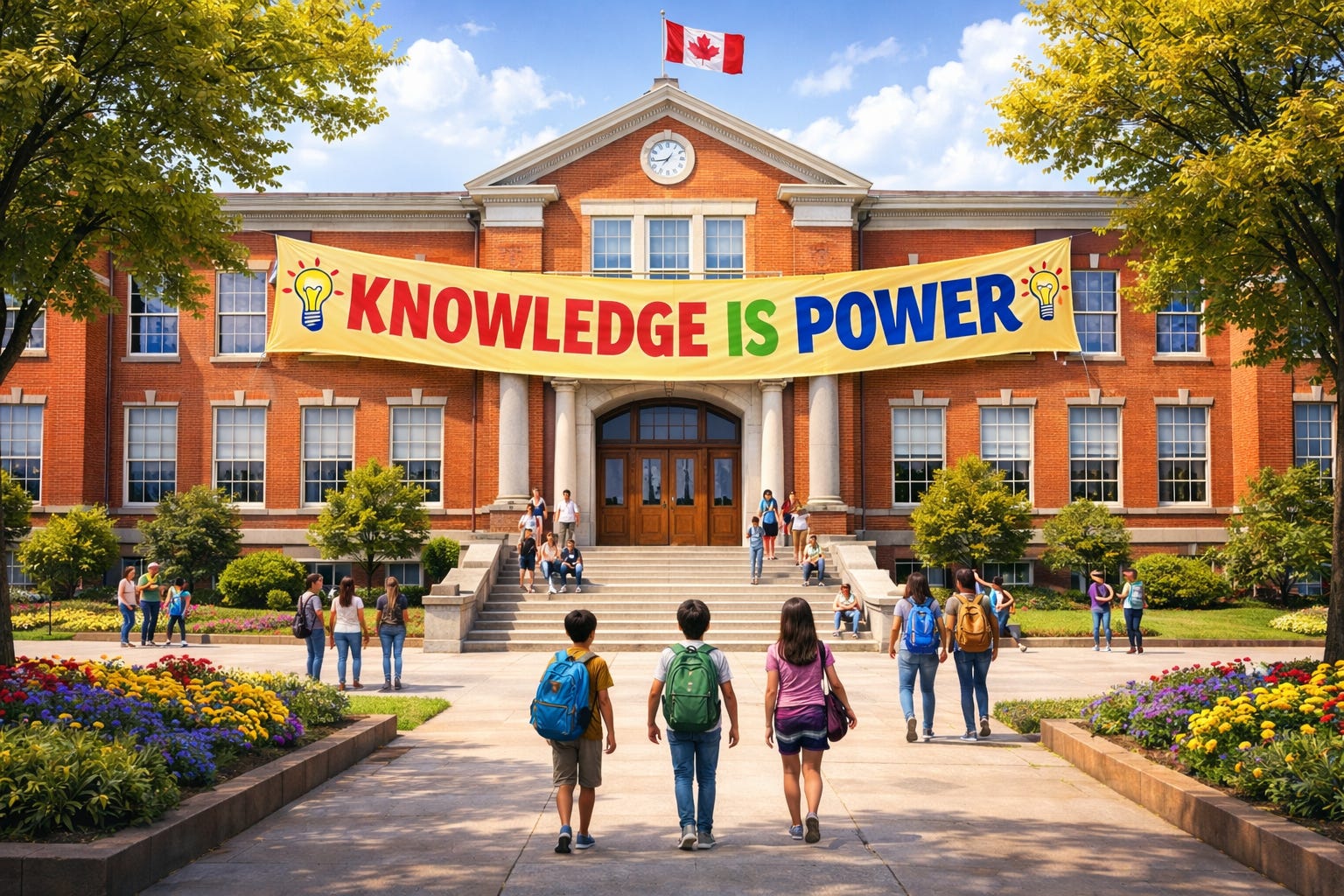
At some point, a teacher may hear a student ask some version of this question:
Why do I need to know this?
It is often attached to content the student believes is obsolete or unnecessary. You might hear this question asked in any subject, but it is perhaps most often heard in mathematics.
Why do I need to know the multiplication tables? Everyone has a phone. If I ever need the answer, I can just look it up.
How should a teacher respond to this?
One approach is to take the question literally and invent a hypothetical future scenario. The student might be asked to imagine that they are stranded without technology, or their phone battery has died, and they suddenly need to calculate something important. Essentially, the teacher tries to impress upon the student that there could be unusual situations where this knowledge might come in handy.
Other teachers, after reflecting on the question, might find themselves agreeing with the student. After all, few adults multiply numbers by hand in daily life. Maybe the student has a point. Maybe the curriculum is outdated. Teachers who find themselves agreeing with the student may be tempted to reduce their emphasis on the topic, since it appears to have little practical utility.
Neither response is particularly satisfactory. Teachers often struggle in this situation because the question itself is subtly misleading. It contains a hidden assumption: that each lesson should provide students with knowledge or skills that have immediate, real-world applications. From a cognitive-science perspective, that assumption is simply false.
In fact, if we reflect on the kinds of things schools teach, it becomes clear that much of what students learn is not justifiable on narrow, short-term utility grounds. You can live a perfectly functional life without factoring a quadratic, analyzing a poem, or explaining the phases of the moon. Students routinely learn about ancient civilizations they will never visit, literary texts they will never quote, algebraic techniques they will never use in their jobs, and scientific theories they will never personally test.
Yet few of us conclude from this that history, literature, mathematics, or science should be removed from the curriculum. We accept that schooling serves broader purposes: building background knowledge about the world, cultivating habits of disciplined thinking, developing the capacity to reason abstractly, and giving students access to powerful cultural and intellectual tools that shape how they interpret experience. Much of what students learn is valuable not because it will be used directly tomorrow, but because it changes what they are able to understand, notice, and think about for the rest of their lives.
These broader purposes are not vague or mystical. From a cognitive-science perspective, they arise from a simple fact about how learning works.
New knowledge is like a ratchet: once knowledge and skills are securely stored in long-term memory, they don’t just sit there — they make the next layer of learning possible. Each new concept builds on what came before, allowing students to handle ideas that would have been impossible or overwhelming a few years earlier. As this accumulated knowledge grows, it frees up working memory, supports deeper reasoning, and enables increasingly complex thinking over time.
This brings us back to the multiplication example.
We teach the multiplication tables not because adults need to multiply numbers by hand, but because multiplication is a gateway concept. Automaticity in basic operations frees up working memory, which in turn facilitates the learning of fractions, ratios, proportional reasoning, algebra, and much of higher mathematics. Math is “relentlessly hierarchical” (Stokke, 2024); later learning continually builds on earlier concepts. When students fail to master foundational math knowledge in the early grades, their difficulties begin to snowball. By the time they reach high school, advanced coursework becomes inaccessible, post-secondary options narrow, and career choices are reduced long before students are old enough to understand what they are losing (Geary, 2011).
Learning can be likened to the construction of a multi-storey building. For weeks, all that seems to happen is digging, pouring concrete, laying rebar, and checking measurements. To an outside observer — especially one who doesn’t understand construction — it can look as though nothing useful is being done. But the crew is constructing the foundation that will support everything that comes later. If the early stages are rushed or done poorly, the upper floors will crack or collapse.
Seen this way, schooling can be understood as the gradual construction of mental structures that make later learning easier, richer, and more flexible. We teach something not because students will need this exact skill every day, but because it enables them to learn more powerful ideas later.
From this perspective, a better response to the student might be something like:
It’s important to learn this now, because it will help you understand more advanced ideas in later grades.
There is another layer to the question that deserves attention.
When students ask, “Why do we need to know this?”, they are not always asking a philosophical question about curriculum design. More often, it is a sign they are experiencing confusion, fatigue, or frustration. In those moments, a speech about relevance misses the point. The student is not really seeking a justification. They need help.
For teachers, this reframes the moment. The real task is to determine why the student is struggling. This is likely a situation where the student could benefit from clear explanations, reduced cognitive load, worked examples, and explicit attention to missing prerequisite knowledge — the most common hidden cause of confusion. The goal should be to design conditions in which the student can experience success.
A student who understands what is going on is less likely to wonder why the content matters. When students experience clarity, progress, and competence, effort begins to feel worthwhile. They feel a sense of accomplishment and can appreciate their new understanding. When they are lost or overwhelmed, questions about relevance and value are more likely to surface (Ryan & Deci, 2000; Willingham, 2009).
Understanding itself creates meaning. When students can see, feel, and use their growing competence, the question “Why do I need to know this?” often disappears on its own.
Geary, D. C. (2011). Cognitive predictors of achievement growth in mathematics: A 5-year longitudinal study.Developmental Psychology, 47(6), 1539–1552.
Ryan, R. M., & Deci, E. L. (2000). Intrinsic and extrinsic motivations: Classic definitions and new directions.Contemporary Educational Psychology, 25(1), 54–67.
Stokke, A. (Host). (2024, November 8). How to build automaticity with math facts: A practical guide (No. 36) [Audio podcast episode]. In Chalk and Talk. https://www.annastokke.com/podcast/episode/3ad86860/how-to-build-automaticity-with-math-facts-a-practical-guide-ep-36
Willingham, D. T. (2009). Why Don’t Students Like School? Jossey-Bass.
No posts
Comments
Nothing yet. Say the first thing.
Sign in to join the conversation.