
I recently wrote a post about Pat Grady (new Sequoia Partnership Steward) after listening to all his interviews. This is a similar piece on Martin Shkreli.
Martin grew up working class in Brooklyn. His parents are Albanian immigrants. His dad was a janitor. He started working on Wall Street as a teenager and built a pharmaceutical company from $2 million to $500 million.
I respect him tremendously for being an unabashed champion for capitalism. He said,
“I didn’t care about the party or anything like that. What I cared about was that ever since I studied economics it is a company’s right to charge whatever price it wants for its products and services. [...] The idea that a company chooses its price is holy to me. [...].
That’s what makes capitalism/economics in America great. The day that you say that you’re going to look at my portfolio and decide what the prices are going to be, you might as well move to another country. It’s over.”1
He might be one of the most disobedient people in the world. The entire media, Congress, and public turned against him. He did not change his position.
Most people think drugs should be free. Martin illustrates this with Vertex, which developed a cure for cystic fibrosis.
“Miracle product. Literally a cure for cystic fibrosis. Cystic fibrosis is no longer a medical problem for 90% of people with it. This company should have parades every year. But instead they get shit for it. One of my friends in high school died of cystic fibrosis at 19. These guys are doing - I use this term very carefully - God’s work.”2
Bernie Sanders asked “why is it so expensive?” They just cured a disease that killed 30,000 people.
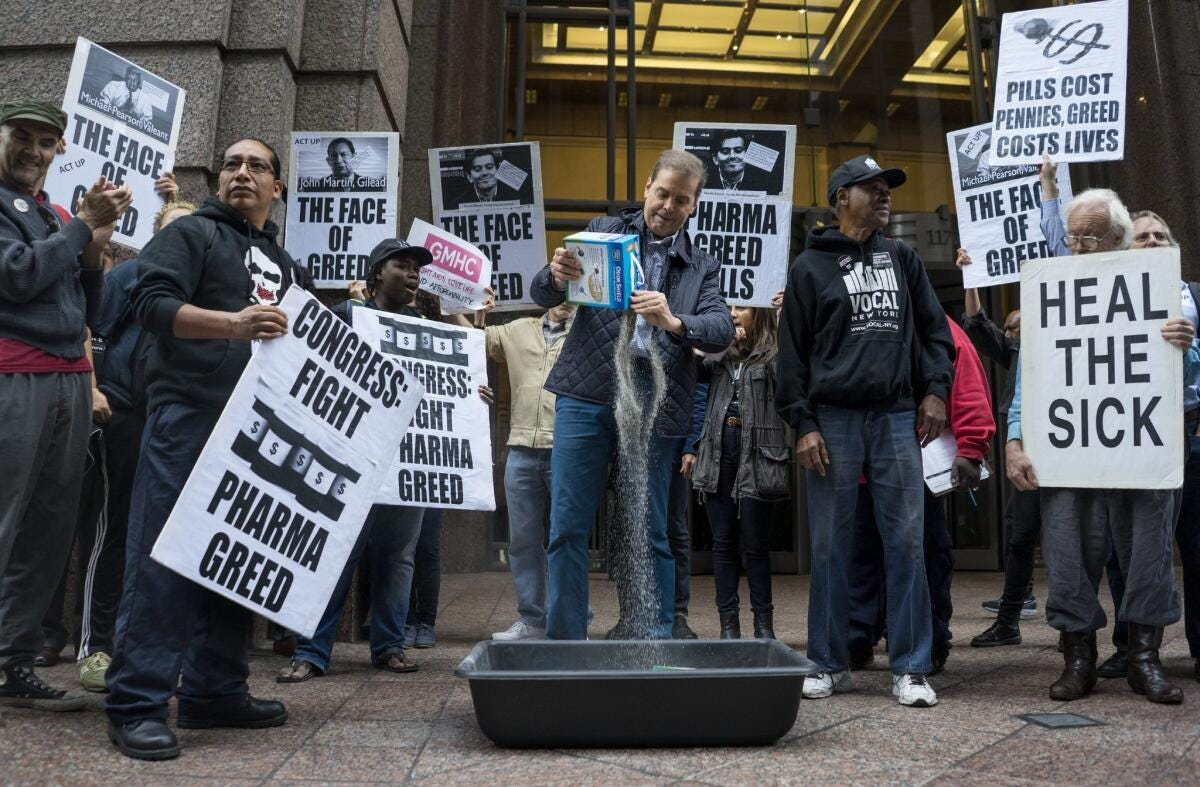
I think this is Economic Creationism. The belief that goods and services can be legislated into existence. That you can wave a magic wand and they appear. Applied to drugs, education, or any essential service.
No value is directly created by the state. Drugs included. Only individuals create value. Entrepreneurs and employees who take enormous risk to research a drug and build a company that distributes it.
If you are excited about what Vertex did for cystic fibrosis, look into Sana Biotechnology (my writeup here). They are engineering pancreas cells to be immune-evasive, so they can be transplanted into type 1 diabetes patients to produce insulin. A one-time cure. I think the company is severely undervalued.
Most people do not understand that increasing the price of a drug can actually increase its access. Insurances pay for most of the cost. Higher profits incentivize more production.
Martin on his own drug:
“I 20x’d the price of a drug and the number of people on the drug went up. If you think the price of drugs and access to drugs are related - I hate to say this - but they’re not.”3
The demand for marginal healthcare is virtually infinite. You would sacrifice marginal clothing or marginal food. You would not sacrifice marginal healthcare. We have gone from 5% to 20% of GDP on healthcare and he thinks it will go to 50%.
Why? Because once our basic needs are met we ultimately just want to live forever. I have argued before that wanting to be immortal is rational. Healthcare is not like other goods. It is the one thing demand never saturates for.
Martin is friends with Vivek Ramaswamy. They ran rival companies with the same model: find underappreciated drug assets, buy them, and commercialize them. They both searched for underappreciated drugs in PubMed, a database of 38 million biomedical papers. Martin had a team of 18 PhDs reading papers. Vivek had 80.
“If you sit there long enough and you have the passion you can become a billionaire. It’s just a matter of sitting there and sifting and sifting and sifting.”4
Finding an undervalued drug is a creative task. It requires generating new conjectures about what a molecule could do, which drugs are undervalued, what disease they could treat, and what market they could serve.
It is not just ‘pattern matching’ across existing literature. LLMs can summarize papers. They cannot deeply understand a disease and conjecture a novel use for an existing compound. This is what I argue in Why LLMs Will Never Be Creative.
Comments
Nothing yet. Say the first thing.
Sign in to join the conversation.