
This is satirical commentary drawing on today’s front pages and the sources behind them. Allegations in live proceedings remain allegations unless and until established.
Good morning Leg’ends,
The sun is out and most of the sky has agreed to be blue, although there are a few clouds hanging around with the non-committal expression of contractors waiting to discover whether rain was included in the tender. The garden looks darker than it did yesterday and I have now been reliably informed that it did actually rain overnight, which saves me conducting a forensic examination of the paving in slippers before breakfast.
Thankfully, I slept really, really well. Proper sleep. The kind where you wake up and briefly have no idea what day it is, which may be the healthiest relationship currently available with British politics.
Kat has been fed and has once again rejected the cat flap. It works perfectly well and Kat knows it works perfectly well, but she continues to regard the approved entrance with the expression normally seen on somebody discovering their rail-replacement bus terminates outside Didcot and there will be no onward transport. The window has therefore been opened, which is how infrastructure reform works when the service user has claws.
Outside, everything looks reasonably civilised. Inside, the papers have arrived with the familiar atmosphere of a motorway-services newsstand where somebody has emptied Britain’s anxiety drawer across the counter and wedged a betting voucher underneath to stop it wobbling. There is cancer and homelessness alongside war and government debt, while the commercial furniture cheerfully offers racing tips and discounted chocolate as though civilisation has simply forgotten to scan its Clubcard.
So, without any further ceremony, let us inspect the bunch of crud being offered for installation into the national brain this Wednesday.
No single story owns the morning. The Sun, Express, Mirror and Telegraph give major space to Queen Camilla’s remarks about the King’s cancer. The Guardian and i turn towards rough sleeping. The Times gives Andy Burnham a large patch of carpet on which to rearrange the British economic state, while Metro and the Independent are looking towards Russia. The Financial Times is staring at borrowing costs with the expression of a man who has opened the mortgage renewal letter and discovered the mortgage now expects its own bedroom.
The Daily Mail leads with something much worse than politics. Members of the same family died after getting into difficulty in the sea at Shoreham-by-Sea, while a younger girl was left critically ill. Several papers also carry the deaths of British honeymooners Alexander Cromie and Marie Ebert in a helicopter crash in Greece.
There is nothing to improve there with satire. People went out expecting the future to remain available and it didn’t, and families are waking inside that reality this morning. The jokes can wait outside.
What is striking is the commercial machinery surrounding those stories. A front page can tell you that people have died and then, a few inches away, remind you that a FREE £3 SHOP BET is available for York. Nobody necessarily designed the collision as comedy, which somehow makes it darker. Modern newspaper economics can place bereavement beside a betting voucher with the emotional smoothness of a self-checkout asking whether you need a receipt after your house has burned down.
The headline tells you something unbearable has happened while the commercial department leans through the hatch to mention the Ebor Festival.
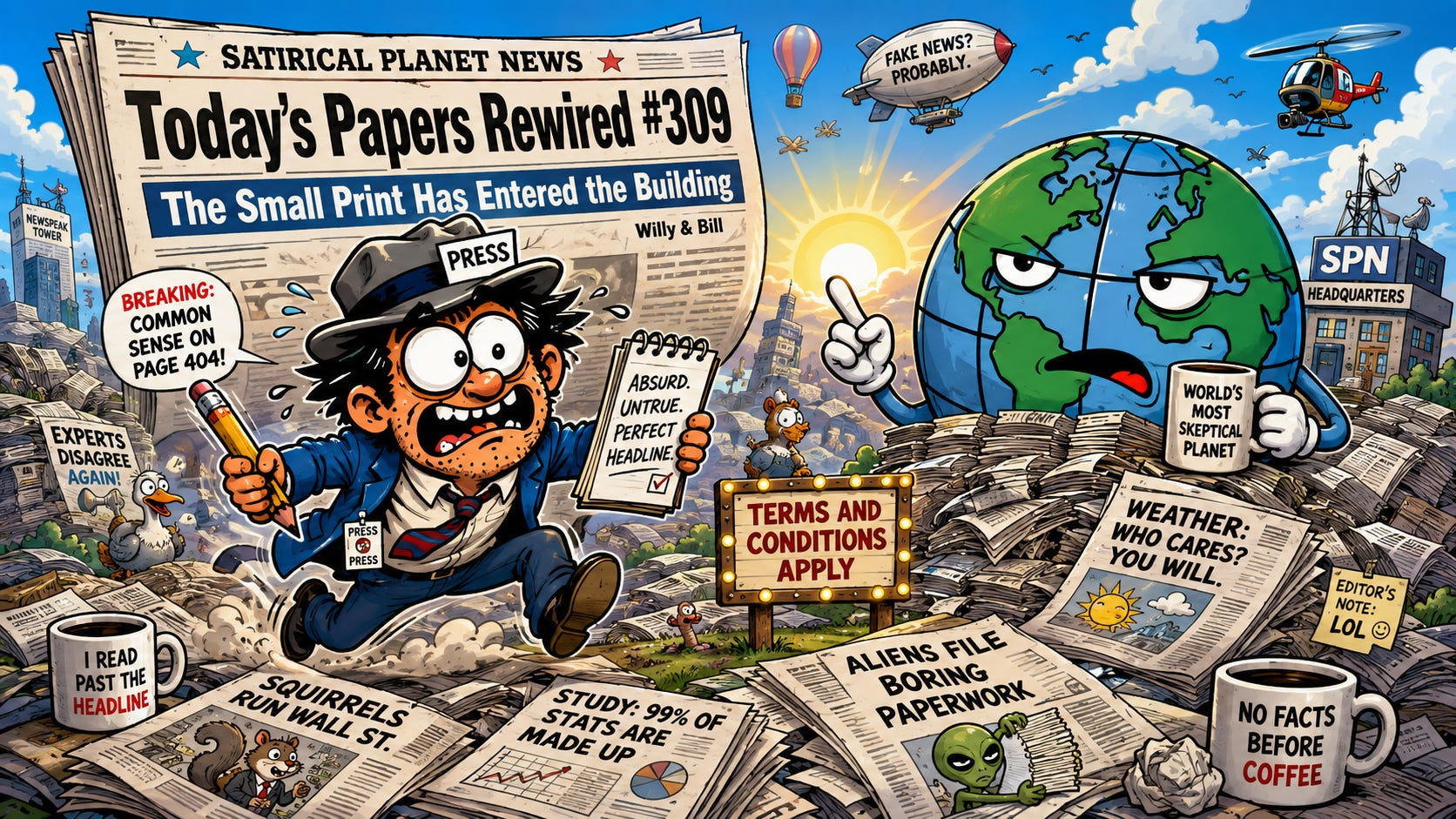
The world may be ending, but terms and conditions still apply.
That may be the organising principle of the entire rack.
The royal material comes from a film connected with Maggie’s cancer charity. Camilla describes visiting one of its centres in January 2024 while knowing Charles had been diagnosed with cancer but before the diagnosis had been announced publicly. She said she was “longing to let it out”, and spoke about how suddenly the experience she had spent years discussing with other families had arrived at home.
Nobody sane wishes cancer on anyone, King included. I am glad Charles has been able to continue his public duties. Public reporting says he is still receiving treatment, which had previously been scaled back. Beyond the medical information the Palace has chosen to make public, I am not going to speculate about his care.
What we can see is the structure around him. A monarch becomes seriously ill inside a household designed around continuity, where appointments can be rearranged and an institution already exists to absorb disruption. Most of us former serfs encounter serious illness through whatever capacity happens to exist when the body starts issuing its own emergency bulletin. Sometimes that means wonderful NHS care delivered by people working their backsides off. Sometimes it means sitting beside a phone while an appointment system behaves like a council website designed during a power cut.
That does not mean Charles should receive worse care. It means everybody else should receive better.
Cancer is impressively democratic about whose body it enters. The infrastructure waiting outside the consulting room is rather more familiar with the British class system.
The newspaper rack makes that contrast difficult to ignore because the Telegraph can tell us about the King coping with cancer while elsewhere on the same front page it reports patients dying after serious delays inside an NHS referral process. Those cases are not medically comparable and I am not pretending they are. The point is what happens around the patient once illness arrives.
There is something peculiar about royal health stories becoming universal lessons in resilience while the material conditions enabling resilience remain mostly beyond the crop marks. The King can be brave, and so can somebody in a semi in Coventry waiting for the hospital to ring while refreshing an NHS app with all the reassuring warmth of an Argos stock checker.
The radical proposition is not that Charles should receive less support. It is that the frightened person in Coventry should not require a crown before the machinery around their illness starts behaving as though time matters.
Fleet Street, meanwhile, has fed Camilla’s remarks through the emotional sausage machine. The Sun finds courage and the Express concentrates on the secret, while the Mirror brings out ROYALS’ SECRET TURMOIL and the Telegraph prefers Charles coping stoically. One human conversation goes in and several branded feelings come out wearing different cardigans.
The underlying experience is simpler. Someone you love gets frightening news and you want to talk about it, but for a while you cannot. Cancer does not become more profound because somebody in a newsroom has located the 96-point font.
And because British newspapers apparently maintain a cupboard marked DIANA: BREAK GLASS WHEN REQUIRED, the Mail also trails Earl Spencer’s new book about his sister, while the Independent finds space for it too.
Diana is back in the papers, although “back” is doing the kind of heavy lifting normally subcontracted to a bloke called Mick with a forklift licence. She never really left the machine.
There is something fairly rancid about a media culture that spent years converting Diana’s movements into commercial inventory and can still, decades after her death, discover another few pages of editorial yield. She died in Paris in 1997 after the car carrying her crashed while being pursued by paparazzi. The circumstances involved more than that pursuit, so I am not going to flatten a complicated history into the easy claim that “the press killed Diana”.
The pursuit remains part of the record, and that matters. The same industry that could turn her presence into circulation can still reopen her memory whenever another “definitive” account arrives.
At last, the final word on Diana.
Again.
The phrase “definitive Diana account” now has roughly the same relationship with finality as a DFS sale. There will always be another one, freshly upholstered and ending Sunday.
There is a familiar echo in the treatment of Meghan Markle, whatever anybody thinks of her personally. Like her or dislike her, think she has made mistakes or think the whole circus is grotesque, but there comes a point where the sheer volume of coverage becomes part of the phenomenon being covered.
The newspapers can produce enormous attention around somebody and then treat the existence of that attention as evidence that another article is urgently required. No smoky conspiracy basement is necessary. The commercial loop works perfectly well in daylight.
It is perpetual-motion journalism, powered by its own exhaust.
You know I do not approach the Mail, Express, Telegraph or Sun carrying incense. They are newspapers, not tablets recovered from Mount Sinai. A right-leaning editorial tradition does not make every factual sentence wrong, but a stern photograph and enormous type do not transform framing into divine revelation either.
A headline is an invitation, not a court order for your frontal lobe.
Then we arrive at Andy Burnham, who appears to be running Britain through several simultaneous expansion packs this morning. The Guardian has his drive to get rough sleepers off the streets, with the Mirror trailing what it calls his “moral mission”. The i puts Housing Secretary Angela Rayner’s part of the plan front and centre. Move further along the rack and The Times has Burnham removing economic growth from the Treasury’s immediate custody, while Metro and the Independent have Moscow waiting in his inbox over reported British-made drones used by Ukraine.
Busy morning.
Start with rough sleeping because the language Burnham uses is unusually direct. He told the Guardian that people sleeping in doorways or outside stations have become so familiar that rough sleeping risks feeling “like part of the scenery”.
That phrase lands because cities really can train us into moral wallpaper. A human being is lying outside a station with everything they own beside them while the commuter flow moves around the sleeping bag with the efficiency of water going round a bollard. Eventually something that should still shock us becomes part of the route to work.
Burnham’s government is putting £442 million behind a national drive intended to ensure people sleeping rough are offered a route off the streets by Christmas. He points back to the pandemic, when emergency action got large numbers of people indoors quickly, and argues that the country can mobilise again.
Good. Do it.
There is no medal available for being cynical about getting somebody out of a doorway and into somewhere safe. If the money produces secure accommodation and keeps people there, excellent. The questions begin when Everyone In for Christmas has to stop being a slogan and become an actual key.
The Guardian notes there is no concrete national numerical target for ministers to hit, while the i concentrates more heavily on delivery. Local authorities will have to find suitable accommodation using whatever capacity actually exists rather than whatever capacity looked attractive in the launch document. That is where political language removes its tie and discovers the building has plumbing.
Looking beyond the splash, official figures cited in the material for today estimated that 7,541 people slept rough at some point during March 2026. The single-night estimate was 3,461, which measures something different and should not be casually swapped around merely because one number fits better into a paragraph.
Either way, this is not a matter of ringing every Travelodge in England and declaring homelessness defeated before the Christmas lights come down. Emergency accommodation matters, but what follows the emergency matters more. If somebody is back outside in January because the festive mission came with a checkout time, the photograph worked better than the policy.
There is some history attached to Burnham’s promise as well. As Greater Manchester mayor, he previously said he wanted to end rough sleeping by 2020 and did not achieve it. Reporting cited in the material supplied for today also says rough sleeping in Greater Manchester fell by roughly a quarter during his mayoralty while rising nationally.
Both facts fit on the same table. He missed the ambition, but progress happened.
Now he has put a much larger promise in public and attached Christmas to it, which is politically brave because Christmas has an irritating habit of arriving on schedule.
A mission is useful, but a room is better.
The purest political comedy arrives next door in The Times, where Burnham explains his plan for **No 10 North** to take responsibility for economic growth from the Treasury as part of what he calls a “huge transfer of power” away from Whitehall.
His argument is that the Treasury has traditionally been expected to encourage growth while also controlling the public finances, and that worrying about balancing the books can sometimes “cloud” the growth mission.
I have read that sentence more than once.
The Treasury’s problem, apparently, is that it keeps noticing the money.
There is a serious institutional argument underneath. Governments have complained about Treasury caution for years, and there is a legitimate question about whether long-term development gets strangled when the people guarding the purse treat every investment proposal like a teenager asking to borrow the car.
Burnham wants No 10 North to have enough clout to force blockages through Whitehall. Fine. But the plain-English version remains magnificent.
Britain has spent centuries wrestling with the awkward relationship between wanting things and paying for them. The new answer appears to be putting more of the wanting in Manchester and hoping the accounting feels less judgemental from 200 miles away.
If the spreadsheet says no in London, perhaps the cells become more growth-minded after a train journey to Piccadilly.
And just as The Times is moving the growth mission away from the Treasury, the Financial Times arrives with long-term borrowing costs behaving like somebody has fed Red Bull to a mortgage calculator. The global sell-off is not Burnham’s fault. The FT points to inflation concerns and government deficits, with higher oil prices and huge borrowing connected to AI investment adding pressure.
In Britain, the 30-year gilt yield printed on the front page had reached about 5.86 per cent, which gives the newspaper rack timing usually available only to sitcom writers and HMRC.
No 10 North can inherit the growth mission. The bond market has retained the calculator.
Economic growth may have been liberated from the Treasury, but arithmetic has declined the transfer and remains operational nationwide.
You can move responsibility around government like office furniture before an inspection, but the person lending you money is still outside with the invoice. Borrowing costs are what happens when phrases such as “unlocking growth” eventually have to remove the conference lanyard and acquire decimal places.
Burnham’s reform may yet prove useful. Separating growth policy from Treasury control does not, however, separate economic policy from arithmetic.
Sooner or later the PowerPoint meets the direct debit.
The Telegraph then gives us a story where the gap between administrative language and ordinary consequence becomes much darker. Its front page says NHS patients died after GPs were encouraged to refer fewer people to hospital. The underlying system is called Advice and Guidance, or A&G, and it lets a GP seek specialist input without automatically making a hospital referral.
There is a sensible idea inside that. Specialist advice can sometimes reach a patient faster, while an unnecessary hospital appointment may be avoided.
The safety investigation material also identified cases where implementation contributed to delayed or missed diagnoses and patient harm. HSSIB records an epilepsy patient who experienced lengthy delays around neurological advice and an urgent referral before dying after a seizure and cardiac arrest. The coroner identified multiple factors affecting his care and referenced the delayed Advice and Guidance response and referral. HSSIB also records another patient who died while waiting for cardiology treatment after delays connected with test results.
At that point the name Advice and Guidance starts sounding like a sign above a desk in a municipal leisure centre where someone can explain why locker 46 will not accept your pound coin. It does not sound like part of a system through which somebody with serious symptoms might spend weeks disappearing into administrative upholstery.
The Telegraph describes the watchdog as warning the NHS to pause the scheme. The underlying recommendation is more precise: HSSIB called for rapid evaluation and said risks should be addressed before further expansion.
That distinction matters because a system that works well for many patients but contains dangerous failure points does not need us kicking the whole machine down the stairs for dramatic effect. It needs the part trapping people found and fixed.
Waiting lists are numbers until your name goes on one. Behind the dashboard is somebody wondering why their body is frightening them and whether the specialist has even seen the request. Efficiency matters, but it cannot become a magician’s trick where the referral disappears while the illness remains sitting in the room.
And this is where the royal cancer coverage starts talking to the NHS story whether the newspapers intended it or not. Charles’s experience deserves sympathy, and so does the person staring at a silent phone while the system quietly composts their referral.
The answer is not to envy the King his support. It is to ask why security around illness can look like a constitutional entitlement at one end of society while somebody elsewhere is still wondering whether the message got through.
The Guardian offers a different health story with research into London’s ultra-low emission zone and children’s lung development. The study found improved lung growth among the London children as nitrogen dioxide exposure fell after Ulez was introduced.
There is an evidential caveat worth keeping visible. An independent statistician cited in the research notes that other factors cannot be ruled out completely, including wider pollution changes around the pandemic period.
Fine. Evidence does not become weaker merely because we stop forcing it to wear a cape.
The political reversal is still delicious because Ulez spent years being processed through the culture-war mincer until a roadside camera acquired roughly the emotional depth of a wrongfully imprisoned Labrador. Motorists were visible and children’s lungs were not, so naturally the camera got the better agent.
Then the children turned up with lungs.
Awkward.
The study does not prove every Ulez decision was perfect. It reminds us that pollution has a cost which does not arrive in a window envelope with PAY WITHIN 28 DAYS printed across the top.
For years, parts of the culture war managed to give a roadside camera a richer interior life than the child breathing the exhaust.
Spirometry has now wandered into the argument carrying a clipboard.
The Times and Guardian also put a major American court case against Meta on page one. Twenty-nine US states are suing the company over allegations concerning the effect of its platforms on children. The states say Meta designed Facebook and Instagram in ways intended to keep younger users returning and misled the public about safety.
Meta disputes the allegations and denies deliberately making its platforms addictive. It also contests the claimed causal connection between social-media use and poor adolescent wellbeing.
This is live litigation, so opening claims remain opening claims even when the wording is juicy enough to make an entire newsroom sit upright.
What is available for satire is the collision between corporate language and courtroom procedure. Meta spent years perfecting engagement and has now secured a lengthy engagement with a federal court, where the principal retention mechanic appears to be a judge.
There is no swipe gesture for the uncomfortable material.
The states make their case and Meta makes its case. Now everybody gets the old-fashioned user experience known as a trial.
Infinite Scroll meets finite proceedings.
Metro and the Independent, meanwhile, are staring at Russia. Both carry Andy Burnham responding to warnings after reports that British-made drones were used by Ukraine in long-range strikes inside Russia. Russia’s embassy accused Britain of escalating the conflict and warned that deeper involvement would carry consequences.
Burnham said the UK would continue supporting Ukraine “100%” and described Britain as not being a fair-weather friend. An important qualification stays bolted to the sentence: the Ministry of Defence had not confirmed the reports concerning the particular drones used in those attacks.
So reported British-made drones remains exactly that. The adjective does not get promoted simply because the front page has run out of room.
There were deaths and injuries in the attacks described by the papers, and that is where the comedy gets off. The diplomatic language can remain on board.
Vladimir Putin’s Russia has a particular affection for the word consequences, one of the Kremlin’s most reusable long-range systems because it sounds menacing from across the continent while remaining vague enough to contain almost anything later.
Moscow deploys the phrase, everybody else gets to wonder whether tracking information will be provided.
I do not like Putin. I do not need to invent a secret psychological dossier explaining why. Russia invaded Ukraine, and the public record gives us quite enough material without me climbing through a Kremlin window carrying a novelty stethoscope.
The i carries related material about the possibility of Russian hybrid activity affecting Britain through cyber operations or physical infrastructure. That is where language such as escalation stops belonging to embassy statements and lands in ordinary life. Conflict does not remain politely inside maps on television. It gets into systems people depend on, where somebody whose principal geopolitical activity was putting the bins out discovers the network has gone down.
The Financial Times gives Donald Trump his own patch of alliance anxiety. It reports that he has ordered a substantial reduction in joint military exercises with South Korea, deepening concern among US allies about American reliability in the region.
That is not equivalent to Putin’s invasion of Ukraine. Different conduct and a different context.
But other countries still have to calculate around decisions made by a larger power, and Trump approaches alliance management with the reassuring stability of a broadband contract whose introductory offer expired while you were asleep.
An alliance should ideally be boring. It should sit there doing its job without everybody waking each morning to check whether the terms have changed overnight because the man at the top became annoyed about something on another continent.
South Korea then has to work out what uncertainty means for its own defence, which is the part strongman theatre usually leaves outside the camera frame. When the powerful man moves unpredictably, everyone else starts measuring the exits.
The FT also gives us a small FIFA item that deserves precision rather than conspiracy cosplay. Kevin Lamour, a senior official who criticised Gianni Infantino’s aborted proposal to sell shares in a commercial entity to investors, has left football’s governing body.
That is what the material establishes. It does not establish that he left because he criticised Infantino, so the causal gap stays open.
I am not an Infantino fan. FIFA has spent enough years looking like a luxury airport lounge that accidentally acquired jurisdiction over football without me inventing an extra scandal for decorative purposes.
A senior official criticised a controversial commercial proposal and later left. The chronology can sit there looking awkward without us promoting it into a motive FIFA has not given.
FIFA has supplied enough furniture over the years. Willy does not need to arrive carrying a conspiracy starter kit.
The FT also reports Disney and ABC suing the US communications regulator, alleging retaliation by the Trump administration over broadcast content. The regulator rejects that characterisation.
Disney has therefore discovered a villain too bureaucratically complicated for a musical number.
Federal administrative law has entered the franchise and nobody has written a chorus.
Fortunately, The Independent supplies a national crisis we may actually be capable of solving.
Wetherspoons has asked customers to stop playing videos or music aloud on phones and to avoid speakerphone calls in its pubs following complaints about noise. Tim Martin reportedly described his pubs as an “oasis of tranquillity and contemplation”.
Wetherspoons.
An oasis of tranquillity and contemplation.
Thousands of years of religious thought have apparently been leading towards a carpet with an abstract brown pattern and a table number beside the ketchup.
I support this almost completely. Britain has spent years discovering that NHS reform is difficult while housing appears determined to remain impossible, yet somebody has finally looked directly at a bloke playing TikTok through his phone speaker in a pub and concluded that state capacity may not be entirely dead.
Darren, pipe down. Civilisation can begin again.
The phrase “oasis of tranquillity” is magnificent because it takes the vocabulary of a Himalayan retreat and applies it to somewhere you can order a curry and a pint before most people have opened Outlook. Still, if inner peace now requires somebody at the next table to use headphones, put me down as a convert.
The Times and i then bring us Charles Darwin, who appears to have been vindicated on the subject of tickling more than 150 years after proposing his theory.
Researchers recruited roughly 450 people and mapped where they found themselves most ticklish. Darwin’s idea that less frequently touched parts of the body tend to be more ticklish emerged as the strongest individual explanation, although other factors may contribute.
This is why I love science. Darwin spent part of the 19th century helping transform humanity’s understanding of life and apparently still found time to wonder why somebody touching your armpit turns a grown adult into a malfunctioning squeaky toy.
Modern science has now revisited the question with hundreds of volunteers, which means somewhere somebody had to write an ethics application using the phrase “ticklish areas” while maintaining a straight face.
We can build spacecraft and still be reduced to useless noises because somebody moves their fingers ominously near our ribs.
Progress has limits.
The Daily Star has chosen a different branch of applied science for its main splash.
Jeremy Clarkson’s lawn is green despite hosepipe restrictions affecting millions of people elsewhere, and the paper says he has kept the grass at his pub lush using water from a borehole.
Jeremy Clarkson has a borehole.
I have always suspected that word could save us quite a lot of biographical writing. He certainly bores me, anyway, although in fairness the one beneath the pub appears to serve a practical purpose.
The important point is that the material supplied for today does not establish that Clarkson broke a hosepipe ban. Water-company restrictions apply to the supplied water covered by those bans, while private borehole water may still be used, although conservation remains encouraged during drought.
So the story is not CLARKSON CAUGHT CHEATING HOSEPIPE BAN.
Good, because reality has produced something much funnier. The Daily Star has discovered a drought life hack whose opening requirement is access to subterranean water beneath your own land.
Having trouble with a brown lawn? Have you tried owning geology?
Most of us respond to a hosepipe ban by watching the grass slowly turn into the A34 verge. Jeremy has apparently moved on to private hydrology.
And there we can leave him. The borehole has already done a full shift.
The i has another feature that feels as though employment culture has swallowed its own LinkedIn motivational post.
I APPLY FOR JOBS FOR MY 28-YEAR-OLD DAUGHTER.
Welcome to “career co-piloting”, the phrase being used for parents becoming heavily involved in the working lives of adult children. Research supplied for today describes parents helping with applications and, in some cases, contacting employers directly.
There is an understandable reason for parental help. The graduate jobs market can be brutal, while some application systems have the emotional intelligence of a parking meter.
But there is a point where support becomes air-traffic control. Imagine asking a candidate where they see themselves in five years and Mum appears in the corner of the webcam holding prepared notes because apparently the applicant has arrived with their own Cabinet Office.
We used to call this your parents helping with the form. Now Mother appears to have been promoted to flight deck.
The same paper carries a projected rise in the State Pension for couples next year. The final increase has not yet been fixed because the triple-lock calculation still depends on future data.
The more interesting part is that the rising pension is approaching the frozen personal tax allowance, creating the wonderfully British sight of one policy lifting an income while another waits nearby to tax more of it.
The Government increases the pension and HMRC watches it approaching with the quiet concentration of a gull near somebody eating chips.
“Lovely little rise you’ve got there.”
No secret plan needs to be invented. Sometimes policy produces its own dark comedy simply by leaving two switches on at once.
The i also reports that fly-tipping is going to be treated more like organised crime, which initially sounds like an ITV detective drama whose opening scene contains a mattress behind B&Q.
The underlying problem is larger. Serious waste crime can involve organised businesses and substantial sums, while the government is looking at stronger intelligence work and surveillance. So an abandoned fridge beside a hedge can be the grubby end of a chain serious enough to interest financial investigators.
Even rubbish has professionalised. Somewhere, a detective is looking at half a bathroom suite in a lay-by and quietly asking for the accounts.
The Financial Times, meanwhile, has gone to the beach and discovered that the sea has winners too. Its front page carries a piece on jellyfish and related creatures thriving amid unusually warm European waters. The Portuguese man o’ war also appears in the discussion, although it is not technically a jellyfish. It is a siphonophore, effectively a colony of specialised organisms living together.
So the ocean has invented a residents’ association with venom.
Marine heat can create conditions in which some species struggle while other creatures cope better. Humanity warms the water and something with tentacles looks at the Mediterranean like a property developer spotting an up-and-coming postcode.
The FT can make ecological disruption feel faintly like a prospectus.
Elsewhere in the paper, major consumer brands are worrying about the growth of supermarket own-label goods. After decades of advertising designed to create emotional bonds between human beings and mayonnaise, shoppers have discovered that supermarkets can also put beige food in jars.
This is devastating news for brand mythology. A global company arrives in aisle seven carrying heritage and a purpose statement, while the own-label jar sits beside it being £1.80 cheaper.
There are very few advertising campaigns capable of defeating somebody who checked their bank balance before entering Lidl.
Diageo also appears after cutting nearly 2,000 jobs under Sir Dave Lewis, whose long-standing corporate nickname is “Drastic Dave”. People losing jobs are not a comic object, but the nickname has the brutal efficiency of a redundancy consultation already printed on the lanyard.
“Drastic Dave” does not require a 42-slide stakeholder presentation. You already know the meeting will not involve a complimentary biscuit.
The FT then finds a hedge fund with hundreds of millions of dollars exposed to loans connected with ultra-luxury Italian hotels because very wealthy travellers continue to want extremely expensive places to sleep.
At last, high finance translated into something understandable. Rich people like Italy and apparently this can be securitised.
The underlying assets have better bathrobes than most British households.
The Telegraph contributes one of the nicest pieces of the morning with bluefin tuna returning to waters off Yorkshire. A huge fish weighing hundreds of pounds was landed at Whitby, reviving memories of the days when the area attracted Hollywood stars for big-game tuna fishing before the species disappeared from those waters.
Scientists want to know where the returning fish have come from, while the tuna has so far declined to hold a press conference.
After decades away, it has returned to Britain and encountered No 10 North. Give it time.
Imagine leaving British waters around the era of Harold Wilson and returning to discover that the growth mission has migrated to Manchester while Jeremy Clarkson has secured his own groundwater.
I would turn round as well.
This is the sort of story every newspaper rack needs occasionally. An enormous fish appears near Yorkshire and scientists become curious. Nobody is demanding a resignation and no anonymous source close to the tuna has briefed the Telegraph.
Beautiful.
By this point the morning stops looking like a pile of unrelated headlines and starts looking like one argument about the distance between the thing printed large and the thing waiting underneath it.
That is where newspapers become useful. The big type announces a mission, while the smaller type quietly checks whether anybody brought the screwdriver.
Burnham can promise a route off the streets by Christmas and I genuinely hope it works, but the useful question begins when the national declaration reaches a council housing team staring at actual rooms rather than a launch slogan. No 10 North can inherit economic growth, but arithmetic does not have to move north with it.
The same principle keeps turning up across the rack. The King’s courage can be real while unequal infrastructure around illness remains visible. A study can produce interesting evidence without becoming scripture. A court allegation can remain serious without magically becoming a finding because the headline likes it.
That is not cynicism. It is what happens when you keep reading after the bit designed to frighten livestock.
The small print is not automatically where good ideas go to die. Often it is where the idea finally removes its tie, finds the fuse box and discovers whether anything in the building actually works.
A headline barges into the room wearing steel-toecap boots. Reality usually appears later in socks carrying the missing attachment.
That is why the free betting offer may contain the most honest political philosophy anywhere on this morning’s rack.
TERMS AND CONDITIONS APPLY.
Right there. No shame and no minister trying to stand in front of it.
Perhaps Whitehall should borrow the wording:
NATIONAL MISSION. TERMS AND CONDITIONS APPLY. PLEASE CHECK WHETHER ANYBODY HAS FOUND THE BEDROOMS AND WHETHER THE BOND MARKET HAS STOPPED LAUGHING.
Terrible on a podium.
Excellent on the fridge.
Well, Leg’ends, that is your Wednesday, which appears to have arrived while nobody was watching. Seriously, where does the time go? Monday feels as though it was issued about twenty minutes ago and suddenly Wednesday is standing in the doorway with the managerial expression of someone who has noticed my task list is still legally classified as fiction.
There is some good news from this end. The meeting I mentioned yesterday went really well, and the investigation team I’ve been working with are getting good use from the tools I built for them. More importantly, the tools are working properly in actual use, which is always reassuring after handing something to investigators whose natural instinct is to press every button until reality confesses.
I will be doing more work on those tools during the week when I can get to it because there is a fair bit on. I am also going to open a new Freedom of Information section here, built around the FOI requests I have been sending out and the material I am trying to obtain for future reporting.
I like the idea of making that process visible. Rather than a finished article appearing later with documents mysteriously materialising behind it like something from Blue Peter, you will be able to see some of the questions while the information is still being chased. Some FOIs may turn into full pieces, while others may simply clarify something useful, which is perfectly fine because the purpose of asking a question should be finding out the answer rather than screaming SCANDAL until an envelope feels pressured into containing one.
There is always the possibility, of course, that a carefully drafted request enters the machinery of the British state and returns weeks later with a PDF explaining that the information is actually held by another department whose shared mailbox appears to be supervised by Gerald whenever the moon is in the correct phase.
We shall see.
For the next couple of days I am mostly going to be working through things behind the scenes and making sure the important stuff is backed up properly. Backups are one of those jobs that feel profoundly boring until a hard drive makes a noise like a teaspoon entering a waste-disposal unit, at which point redundancy stops being an IT concept and becomes a religion.
Nothing gives you spiritual belief in multiple copies quite like seeing NOT RESPONDING beside months of work and realising your computer has chosen this exact moment to explore its creative independence.
Oh, Kat has just walked in.
No announcement required. She has entered the room with the serene authority of someone who contributes nothing whatsoever to the editorial process while remaining absolutely certain the organisation exists for her convenience.
Senior management, basically.
The cat flap remains operational, incidentally. I include that for the historical record because future researchers may otherwise conclude we never attempted reform.
So enjoy your Wednesday as best you can, Leg’ends. Read beyond the shouty bit and keep hold of the receipts. Back up anything you would be genuinely upset to lose because technology develops a strong independent personality at precisely the wrong moment.
The week is already disappearing down the corridor wearing your spare time.
We will chat soon.
Want to know how this was written? Click here
SPN is free to read, but not free to produce. If this helps you make sense of the circus, support the chaos.
💸 Go paid if you can.
☕ Buy me a coffee if you fancy a one-off thank you.
If money’s tight, share, like, restack, or comment. The paying Leg’Ends have you covered.
We’re at 806 Leg’Ends. Help us reach 1,000.
194 more readers gets us to 1,000. Send this to one friend who has ever paid extra for “eco” pants and ended up needing a chemistry degree to read the label.

Thanks for reading Satirical Planet News! This post is public so feel free to share it.
Comments
Nothing yet. Say the first thing.
Sign in to join the conversation.