
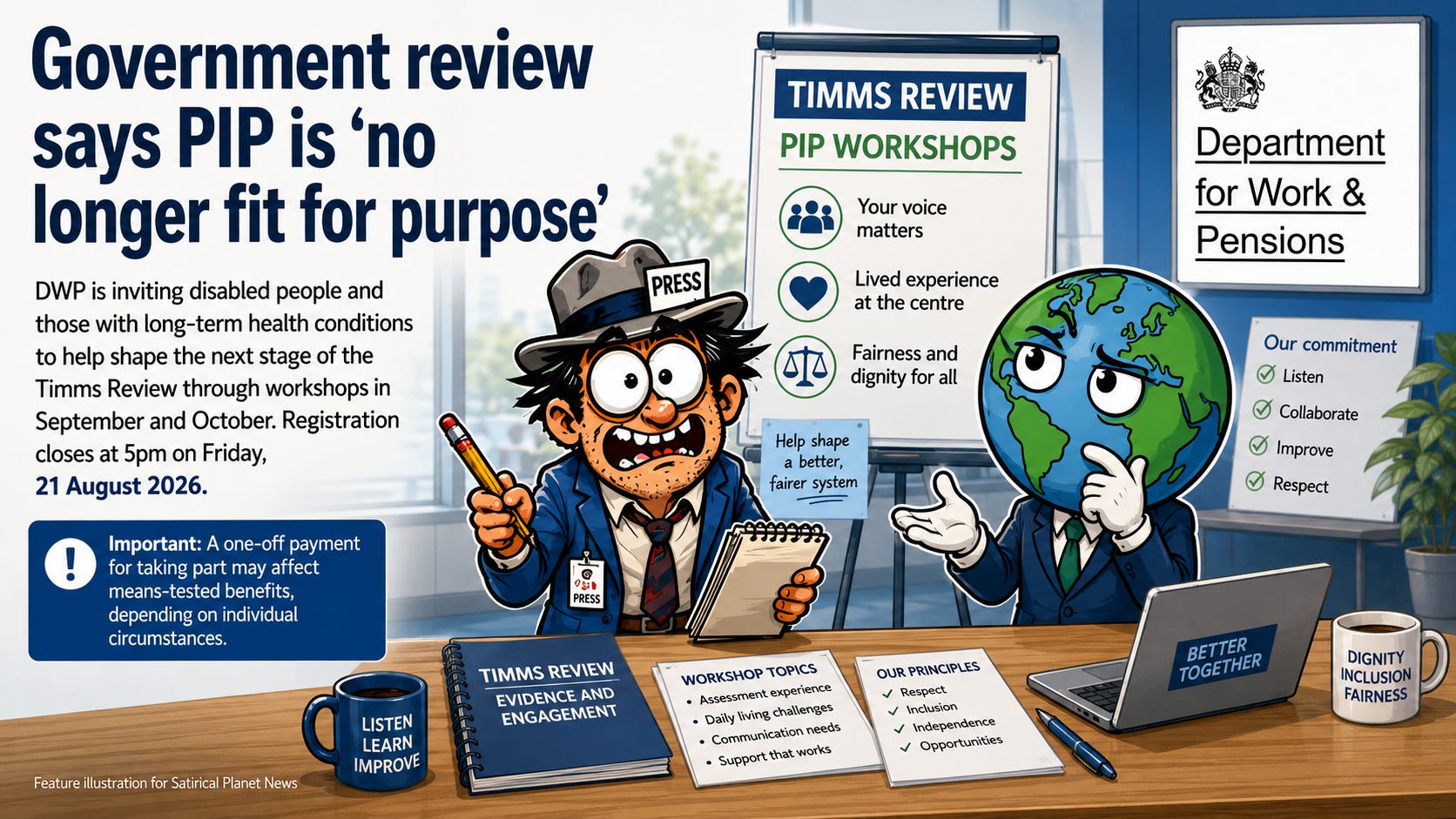
Disabled people and those with long-term health conditions can apply for one of 15 workshops helping to test the Timms Review’s emerging recommendations. Registration closes at 5pm on Friday, 21 August. And, because this is the benefits system, there is one particularly important warning if you are offered payment for taking part.
Well Leg’ends,
If you have experience of Personal Independence Payment, or live with a disability or long-term health condition, there is a genuine opportunity to get your voice into the room before the recommendations are finished. The Department for Work and Pensions is recruiting people for 15 workshops across the UK during September and October, where participants will be asked to discuss, test and refine emerging recommendations from the Timms Review into PIP. Registration closes at 5pm on Friday, 21 August 2026, with successful applicants expected to be told by 4 September.
So this is not one of those Government consultations you bookmark with noble intentions and rediscover three years later while looking for your council tax bill. The deadline is close, and the exercise matters because the Review has already reached a fairly brutal interim conclusion. Its July report says that although PIP remains widely valued, the evidence gathered so far indicates that it is “no longer fit for purpose”.
That is the Timms Review’s conclusion, and the attribution matters. The report records disabled people describing parts of the application and assessment process as dehumanising, complex and difficult to navigate, and says elements of the system are not operating as intended. That is rather more serious than discovering somebody has used the wrong font on the assessment form. The Government-launched review has reached the point where the argument is no longer simply about whether problems exist, but what should actually be done about them.
There is also one thing worth making absolutely clear before the internet straps a siren to this story and sends it hurtling around Facebook: there are no new PIP rules taking effect in September or October because of these workshops. Those are workshop dates. Nobody is waking up on 22 September to discover Bournemouth has become the ceremonial launch site for a new disability-benefits regime.
The recommendations have not even been published yet. The interim report contains none, and the steering group is only now developing the ideas these workshops are supposed to test and refine with people who may eventually have to live with the consequences. Final recommendations are due in the autumn, so September is not the beginning of a new PIP system. It is the bit beforehand, when there is still something left to argue about.
The workshops are intended primarily for disabled people and people with long-term health conditions, ideally including people with personal experience of dealing with PIP. You do not need previous experience of Government reviews or consultations, which is just as well because if Government consultation required previous consultation experience, we would eventually end up with the same 43 people touring Britain in lanyards, professionally agreeing to split into smaller groups.
That is not supposed to be the point here. The purpose is to hear from people who know what the system looks like because they have actually had to live with it.
Each workshop will run from 10am until 4pm, with regular breaks and no more than 20 participants. According to the official workshop guidance, selection will be random, followed by checks intended to produce a balanced range of characteristics. If a group is under-represented, people with that characteristic may then be randomly selected from the wider pool. Reasonable adjustments can also include accessible materials, communication support, personal assistants or carers and support animals.
The current schedule is:
15 September: London, in person
18 September: Newcastle, Middlesbrough and surrounding areas, online
22 September: Bournemouth, in person
22 September: England and Wales, all regions, online
24 September: Birmingham, in person
25 September: Cardiff, for South Wales, in person
29 September: Norwich and surrounding areas, online
29 September: Glasgow, in person
30 September: Bangor, for North Wales, in person
30 September: England and Wales, all regions, online
1 October: Liverpool, in person
1 October: Belfast, in person
2 October: Sheffield, for Yorkshire and the Humber, in person
6 October: Scotland, online
7 October: Northern Ireland, online
There are nine face-to-face sessions and six online. PIP is administered by the DWP in England and Wales; social security is transferred in Northern Ireland, while Scotland has replaced PIP with Adult Disability Payment. The Review is nevertheless seeking contributions from across the UK because different parts of the benefits system interact and some people in Scotland have previous experience of PIP.
All of which is fairly straightforward. Then we get to the payment.
Anyone attending a full workshop will be offered a one-off payment, and reasonable travel expenses and necessary costs can also be reimbursed for people attending in a personal capacity. Paying somebody for giving up a day and sharing their lived experience is entirely reasonable. The peculiar bit is what happens next.
DWP guidance says attending the workshop itself is not considered work for means-tested-benefit purposes, but the one-off payment is treated as earnings and could affect benefit entitlement depending on your individual circumstances.
Which means the Government can pay you to spend a day explaining what is wrong with the benefits system, after which you may need to consult the benefits system to discover what the benefits system thinks about the Government paying you to explain the benefits system. At that point the snake has not merely eaten its tail; it has asked the tail to complete an earnings declaration.
That is not a reason to avoid the workshops, and it is certainly not an argument against paying people for their time. It is a reason to check your own position before accepting the money. DWP advises people receiving benefits to speak to their work coach, Jobcentre or the office administering their benefit, while participants can also decline the payment or ask to receive a lower amount.
Please do check. The possibility that a payment for volunteering your experience could affect your benefit entitlement would be the sort of joke I would normally have to make up, except this one arrives with official guidance.
The Timms Review has already received 38,713 responses to its call for evidence, giving it a substantial body of qualitative evidence from disabled people, people with long-term health conditions, carers, charities, clinicians, academics and other organisations.
There is a methodological point here that matters more than it sounds. Those 38,713 responses are not a representative survey of every PIP claimant. The call for evidence was an open qualitative exercise, while the Review has separately commissioned NatCen to carry out representative quantitative research. So the number tells us the Review received a very large volume of evidence; it does not turn those submissions into 38,713 ballot papers in a national referendum on PIP.
What the interim report does record is repeated concern about the claims process, assessments, evidence gathering and the way people experience the system. The Review has heard a great deal about what people think is wrong. Now comes the part Governments traditionally find rather more difficult than listening sessions and summary documents: deciding what to change.
And that is where the politics underneath this service story becomes interesting.
The Review’s Terms of Reference say its purpose is to make PIP fair and fit for the future, and explicitly say the Review is not intended to generate proposals for further savings. At the same time, its recommendations must operate within Office for Budget Responsibility projections for future PIP expenditure.
So the Review is being asked to look seriously at a benefit it says is no longer fit for purpose, listen to disabled people, consider substantial reform and make the system fairer, while the financial envelope is already sitting on the table.
That does not prove cuts are coming. It does not mean the process is predetermined, and it tells us nothing yet about whether eligibility will eventually change or who might gain or lose. Those recommendations do not exist. But the constraint is real, explicit and written into the terms of the exercise, which leaves a perfectly legitimate question: how radical can a radical rethink be when the size of the envelope has already been written on the front?
That is why these workshops are worth more than a dismissive shrug about Government consultation. If the Review is to produce a system that better reflects disability and daily life, lived experience needs to be present while those choices are still being worked through, not merely quoted afterwards in a document explaining what somebody else decided.
For people dealing with PIP, none of this is an abstract policy seminar. It can mean gathering medical evidence, explaining the same condition again, navigating assessments, waiting for decisions and trying to make ordinary life fit around forms and descriptors. That is the human consequence beneath all the policy language, and it is the bit the satire should never flatten.
Taking part in one of these workshops does not mean every idea raised will make it into the final report, and participants are not being handed the keys to the benefits system for an afternoon. But the Review says it is now testing emerging recommendations and considering possible unintended consequences before its final report is produced. That makes this a meaningful point at which people with direct experience can contribute.
So the useful information is very simple: registration closes at 5pm on Friday, 21 August 2026. Applications can be made through the official Timms Review workshop page on GOV.UK.
And if you are selected and offered the one-off payment, check what accepting it could mean for any means-tested benefits you receive. Because there would be something magnificently British about being invited to help improve the benefits system and coming home with another benefits problem.
That bit, at least, really ought not require a workshop.
Want to know how this was written? Click here
SPN is free to read, but not free to produce. If this helps you make sense of the circus, support the chaos.
💸 Go paid if you can.
☕ Buy me a coffee if you fancy a one-off thank you.
If money’s tight, share, like, restack, or comment. The paying Leg’Ends have you covered.
We’re at 806 Leg’Ends. Help us reach 1,000.
194 more readers gets us to 1,000. Send this to one friend who has ever paid extra for “eco” pants and ended up needing a chemistry degree to read the label.

Thanks for reading Satirical Planet News! This post is public so feel free to share it.
Comments
Nothing yet. Say the first thing.
Sign in to join the conversation.