
In what officials are calling a "revolutionary leap forward in human cataloging," Immigration and Customs Enforcement (ICE) announced today it will begin deploying mobile iris-scanning technology that can identify individuals "in seconds from virtually anywhere" – because apparently fingerprints and facial recognition weren't invasive enough.
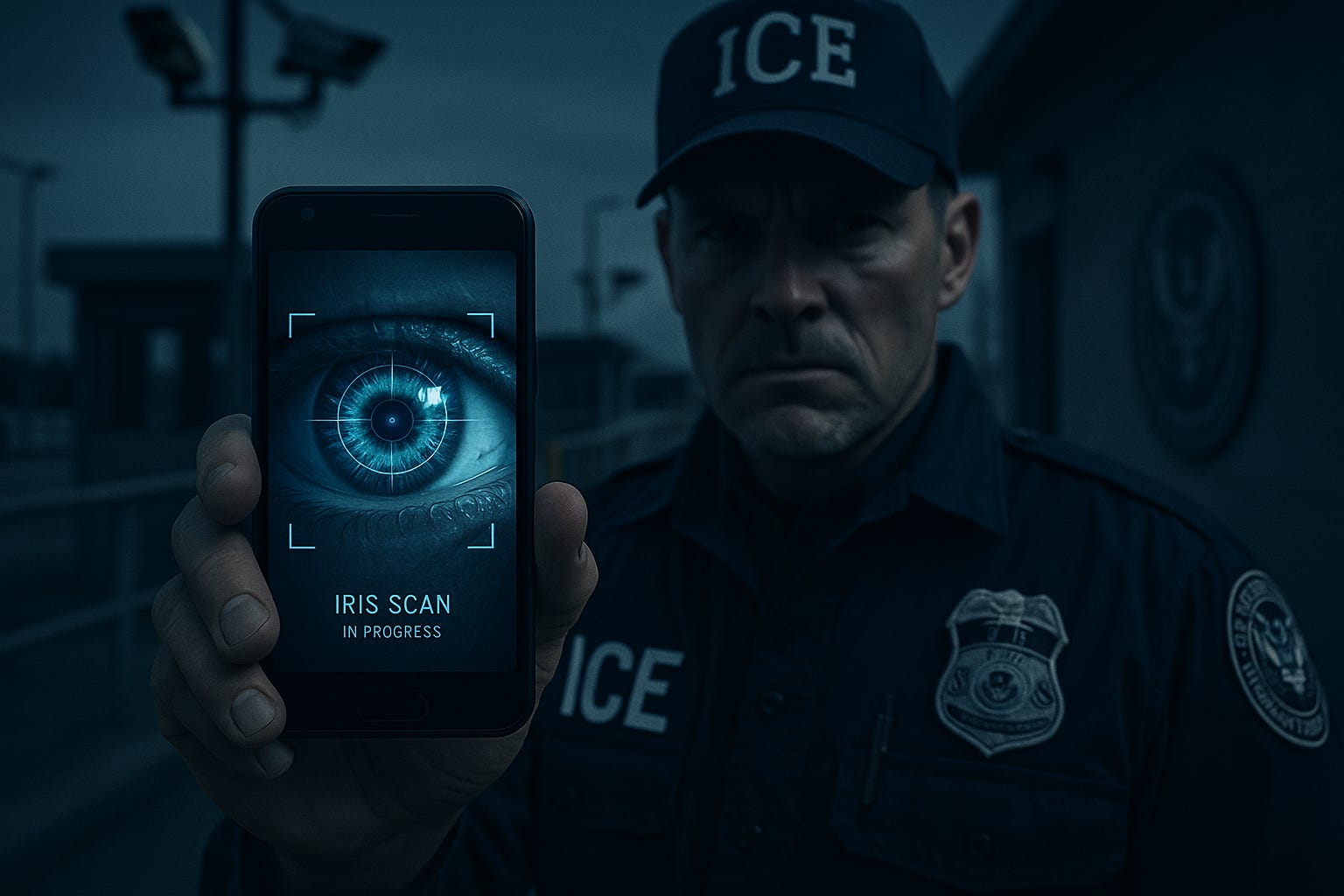
The new Mobile Offender Recognition & Identification System (MORIS) and Inmate Recognition & Identification System (I.R.I.S.) – whose acronyms were definitely not focus-grouped for their ominous undertones – will initially be deployed by ICE's Enforcement and Removal Operations division, the agency's deportation arm.
"This is strictly for identifying immigrants who have violated our laws," said an ICE spokesperson while unsuccessfully trying to hide a folder labeled "Phase 2: Everyone Else." "We absolutely have no plans to expand this technology to the general population, just like we never expanded other surveillance tools after 9/11. You can trust us."
The agency emphasized that the technology's 265 unique iris characteristics make identification foolproof, unlike those error-prone facial recognition systems that only occasionally misidentify innocent people.
"The beautiful thing about collecting biometric data from immigrants is that it lets us perfect the technology before rolling it out to citizens," whispered one official who requested anonymity because he wasn't supposed to reveal the actual plan. "It's like a beta test, but with human beings!"
Civil liberties experts note this follows a disturbing pattern where surveillance technologies are first deployed against vulnerable populations before being normalized for everyone else. In a related historical parallel, the government's COINTELPRO program initially targeted "subversive" civil rights leaders before expanding to monitor ordinary citizens.
The technology's manufacturer, BI2 Technologies, boasted about the system's connections to multiple databases, including sex offender registries and various law enforcement networks. "Once we have your iris, we basically own your digital identity," said a company representative before being yanked offstage by a PR manager.
Critics have pointed out that the 100-mile "border zone" where CBP claims jurisdiction encompasses nearly two-thirds of the U.S. population, raising concerns that "border" technologies invariably become domestic surveillance tools.
"Remember when TSA was just for airports?" asked one privacy advocate. "Now they're telling us we 'shouldn't travel' if we don't want our biometrics collected. Next they'll tell us we shouldn't exist if we don't want to be in their database."
Meanwhile, average citizens continue scrolling through social media, blissfully unaware that the surveillance infrastructure being built today will be their digital prison tomorrow.
*This satirical article was inspired by real reporting from 404 Media.
No posts
Comments
Nothing yet. Say the first thing.
Sign in to join the conversation.