
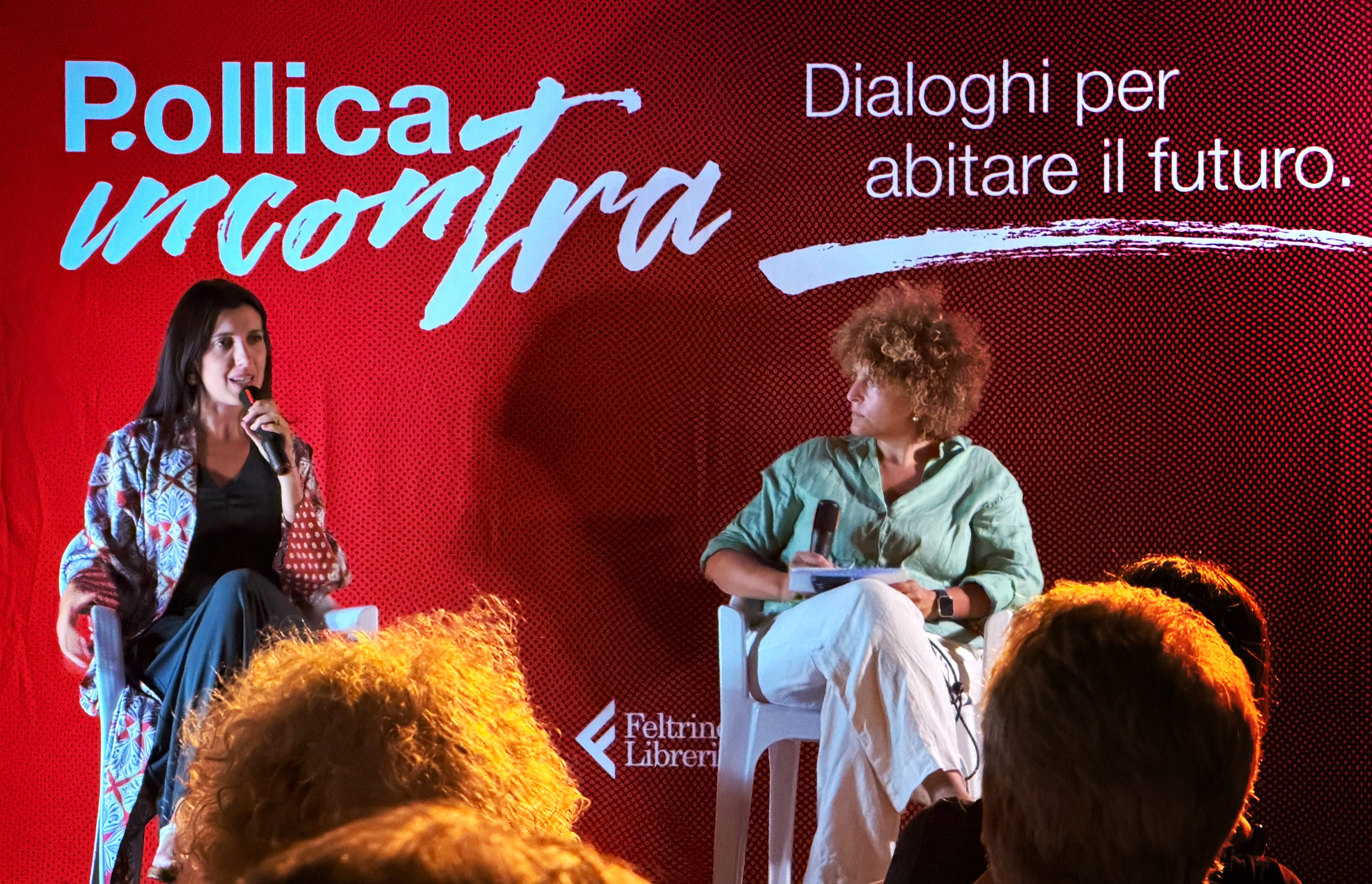
Some conversations do not end when the lights go out. They carry on the next morning—in the questions still being debated in the town square, in conversations over coffee at Bar Jerry, in the thoughts that stay with us long after an event has ended.
Yesterday, at Pollica Incontra, our summer series of dialogues on how we want to live, shape and inhabit the future, the conversation with Angelica De Vito, an expert in diplomacy, human rights and climate migration, brought us face to face with one of the defining questions of our time: what does it mean to inhabit a place as the climate changes? And, above all, what does it mean to have the right to remain there?
We started with climate migration. But we soon found ourselves much closer to home.
Because talking about people forced to leave an island threatened by rising seas inevitably means asking questions about those who leave rural and inland communities because services, opportunities, jobs, infrastructure and prospects have disappeared.
The causes may be different. But the underlying question is powerful: how free is the decision to leave when staying is no longer a viable option?
Climate change is no longer a future scenario. It is already reshaping how and where we live.
Our conversation explored data, international experiences, and different models for protecting people forced to move. Above all, one major gap emerged: international law still struggles to provide a clear, shared definition—and consistent protection—for people displaced by the impacts of the climate crisis.
Yet displacement caused by disasters and extreme events is already happening on a massive scale.
The discussion took us from Europe to Australia, from Tuvalu to Pollica, from Pacific island nations to Japan. We compared different approaches: protecting those forced to leave, developing new forms of legal protection, but also investing in adaptation so that vulnerable territories can remain habitable.
And this is where the conversation shifted.
We cannot simply become better at managing emergencies. We must become better at preparing, adapting and regenerating the places we love.
Adaptation does not mean surrendering to climate change. It means building more resilient communities, preparing people, redesigning infrastructure and production systems, protecting water, soil and biodiversity, and investing in knowledge.
Ultimately, it means making the future possible.
Another important part of the evening focused on the gap between the complexity of climate science and the way we often talk about it.
A cold day does not disprove global warming, just as a single heatwave, on its own, does not explain it. We need to learn to distinguish short-term weather fluctuations from long-term climate trends.
We talked about the oceans and their extraordinary capacity to store heat; about El Niño; about shifts in atmospheric and oceanic systems; and about the need to understand seemingly distant phenomena as interconnected parts of the same system.
Climate literacy has become a fundamental civic skill.
Because when we fail to understand a challenge of this scale, two things tend to happen: we deny it, or we become overwhelmed by it.
This is where another issue emerged strongly during the conversation: climate anxiety.
For younger generations in particular, a narrative built solely around catastrophe risks producing paralysis rather than action. Environmental education must do the opposite: turn fear into knowledge, knowledge into agency, and agency into action.
Then we came home.
To Pollica.
And the global question of climate migration met the reality of Italy’s inland and rural areas: depopulation, the abandonment of villages and the gradual erosion of communities.
Here, the right to stay takes on an even broader meaning.
Staying does not mean standing still. It does not mean preventing young people from leaving, discovering the world, studying elsewhere or experimenting with different lives.
It means making sure they can come back, too.
Above all, it means creating the conditions in which those who choose to stay do not have to pay for that choice by giving up their rights, ambitions or the possibility of building a fulfilling life.
This is deeply connected to the work Pollica has been pursuing for years: seeing the village not as something to preserve under glass, but as a Living Lab—a living space where heritage, education, research and innovation become tools for regeneration.
It is the same thinking behind Paideia Campus and Pollica 2050: starting with a territory’s resources, people and knowledge to build new forms of prosperity while addressing depopulation, agricultural abandonment, and social and cultural desertification.
Because villages do not simply need saving.
They need to be lived in.
Finally, there was a moment when the conversation took us back out into the world from Pollica.
The Mediterranean Diet.
Not simply as a diet, a food pyramid, or even a lifestyle and heritage to be celebrated. But as a potential language of diplomacy.
During the evening, we shared the work we are doing to help make the Mediterranean Diet an increasingly powerful platform for cooperation among the countries that share this sea.
The idea is both simple and radical: in a Mediterranean marked by war, climate crises, inequality and migration, food—and gastrodiplomacy—can once again create a space where people sit around the same table.
Because the Mediterranean Diet is, above all, about relationships: caring for the land, biodiversity, seasonality, conviviality, the intergenerational transmission of knowledge and the act of sharing.
Through the work developed in Pollica, we have come to see it as a model of integral ecology—one capable of connecting human health, ecosystem health and the prosperity of communities.
And perhaps this is one of the most powerful images the evening left us with:
The Mediterranean as a common table before it is a border.
A table around which we can once again talk about climate, peace, food, rights and the future.
What we take away from this conversation is that the right to stay cannot remain merely a legal concept.
It must become a political, educational, economic and cultural project.
It means giving communities the tools to adapt to the climate crisis. Creating jobs and opportunities in inland and rural areas. Protecting soil fertility and biodiversity. Safeguarding knowledge without reducing it to folklore. Educating young people not only to understand the challenges ahead, but to see themselves as capable of transforming them.
Ultimately, this is what Pollica Incontra is about: bringing the defining conversations of our time into the village—and discovering that Pollica is not on the margins of those conversations.
It can be one of the places where new answers are tested.
Because small places allow us to see entire systems more clearly. And because it is often in our most fragile territories that we have the greatest urgency—and perhaps the greatest freedom—to experiment with new ways of living, producing, learning, caring, and building community.
The future will not be determined solely by how many people we can protect once they are forced to leave.
It will also be determined by how many places we can make habitable, desirable, and fertile again.
By how many communities we empower with a genuine choice.
To leave. To return. And, above all, to stay.
No posts
Comments
Nothing yet. Say the first thing.
Sign in to join the conversation.