
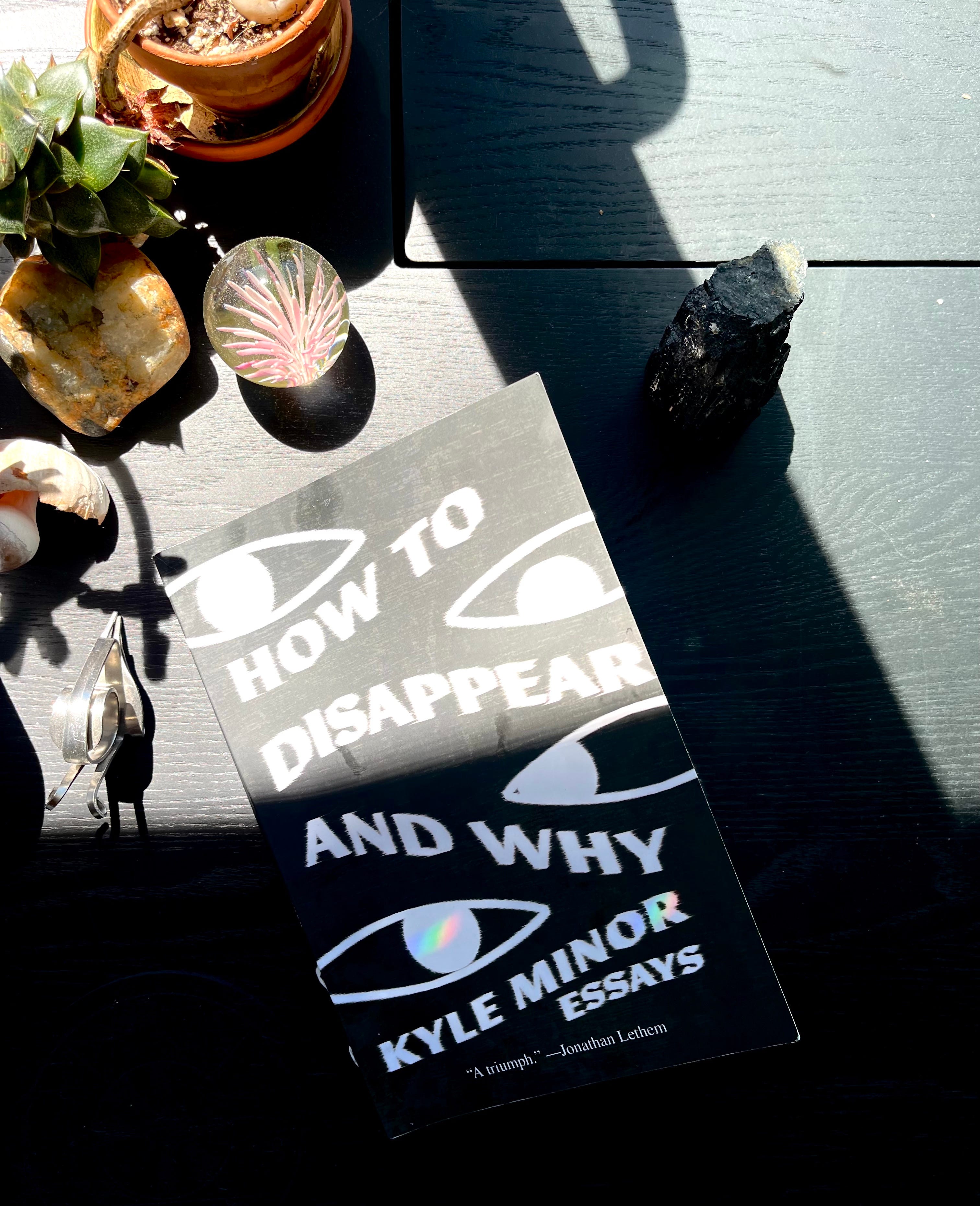
How How to Disappear and Why by Kyle Minor landed on my reading list:
I have been waiting for this book for forever, because
Praying Drunk, Minor’s previous book, was perhaps the most formative reading experience of my MFA1, and I’ve revisited it many times since, taught it, recommended it, underlined and annotated and diagrammed the shit out of it, wished I could write something just like it, wash rinse repeat at various cycles throughout the past decade.
I’ll confess: this is not the first book I’ve purchased recently with a title instructive of disappearance. It is very much a side effect of the chronically online society we exist in2 that I daydream about logging off forever and just———idk, getting a landline and killing the wifi router3 and disappearing into a life lived the way I might have in any decade previous to the last two. And there’s nothing really stopping me from doing so, except reality and maybe the nagging worry that I’m not putting myself out there enough. Which, as a writer, is a thing, even if you don’t want it to be a thing.
“Perhaps something in the culture has made you afraid.”
How to Disappear and Why, Kyle Minor’s recent book of essays, isn’t exactly about “going offline” but it’s not not about that either. Minor is a big thinker, too rangy to stay in any one fixed idea, and the book is—partly—about a writer on the verge of the success he craves as he puts himself through the sorts of rigors that make normal people (read: non-writers) ask questions like: “It’s just an enormous amount of effort, but what’s the return? All these years, all these miles on your body. Imagine if you had invested them in something easier when you had the chance. Something with reliable rewards, where the odds of success were greater. Law. Medicine. Neuroscience. Nuclear physics.”4 Rigors like taking a teaching job several hundred miles from the home where his family lives and traveling between job and family several times a week. Sleeping most nights in his car. Flying all over the country to visit universities where the faculty are self-absorbed or dismissive or worse. Flying all over the country for speaking gigs where maybe seven people show up and no one buys a book. Contracting a punishing intestinal bacterial infection and working through it—calling himself mudbutt to bully himself through it—until he “achieve[s] a new state of consciousness somewhere between half sleep and waking death.” Becoming an Uber driver in Indianapolis.
“Perhaps you are ashamed.”
If you are squeamish about such personal details, then this book might not be for you, because there is plenty of soul-searching going on in How to Disappear and Why, though there’s a lot else going on too. Minor’s draw toward disappearance is all over the subtext, but the text itself is also explicit about other disappearing acts—personal, political, theosophical, existential, morbid, irreverant, and points between. There’s a haunting5 essay addressed to the ghost of a dead friend. There’s a biographical essay about Jan Karski, a member of the Polish Underground whose testimonies about the atrocities happening in German concentration camps went disbelieved by British and American officials; eventually Karski landed in Washington D.C. where he lived “hiding in plain sight,” until the documentary Shoah6 premiered in the United States. There’s the story of nine British sailors who set out on a race to circumnavigate the globe. (“The eighth sailor won the race.”) And there’s a stunner of an essay called “Junk Temples”—itself a junk temple—assembled of synesthetic sections built (hoarded?) around biographical snippets of the folk artist Howard Finster. Perhaps the lines most deeply underlined in my copy of the book are here: “All temples derive their templeness from the esteem of those who deem them temples. Special architecture is not required. Only esteem is required.”
“Perhaps you had a true desire to commune with nature.”
How to Disappear and Why is formally experimental—think: lists and strikethroughs, poems and copious quotations of other authors collaged into the narrative—and tonally experimental as well. From one word, multiple registers sound; all bear interest, all have merit. We are not meant to make a decision, we are meant to hold all ideas in equal accord. An old idea—that it’s the journey, not the destination—finds unexpected new details here: “The race is not the thing. The present is the thing. The wind, the rain, the sea. The underwater putty knife scraping gooseneck barnacles from the hull bottom is the thing. …The myth is instructive.” Elsewhere, following a scientifically literal and hauntingly metaphorical description of a tree, Minor writes: “But there are other ways to be a tree.”
“Perhaps you wanted others to wonder where you went.”7
I’d expect no less than this raw, poetic refusal to arrive at an easy conclusion from Minor, whose previous book featured an essay told backwards8, an epistolary story, a story told entirely in dialogue, and the subtitle “stories, questions.”9 How to Disappear is more interior, more aching than its predecessor, but it’s no less exhilarating to be in the presence of his honest, erudite mind.
On theme, I’m outta here10 to revel in the long daylight and local berries of summer. See you back in September, and till then, don’t forget: it’s the perfect season to crack some mass-market11 spines and read promiscuously!

I started a really long post about my MFA reading list and then felt cowed by the task—I read 80 books for the program, on top of whatever else I was reading during those two years, and most of the titles on it feel formative to who I am as a writer—so the half-done post is in the drafts pile for maybe another day.
& which I participate in a fraction of a fraction of a percent, though oftentimes even that feels like too much.
Ironically, we do have a landline and—it is plugged into the wifi router, because that’s how it’s done these days.
Minor’s wife, as quoted (perfectly, hilariously) in the book.
https://en.wikipedia.org/wiki/Shoah_(film)
Block quotes throughout are pulled from the title essay, which opens the book.
This essay—“The Question of Where We Begin”—was the original reason I picked up Praying Drunk, after being recommended to me by not one, but two, MFA mentors. The essay is discussed briefly in How to Disappear and Why. It isn’t that the narrative is told backward, exactly, but that its force is generated by “chasing the cause-and-effect chain backwards” to where the trouble started. Brilliantly, this technique was inspired, Minor admits, by a reading of James Michener’s Hawaii, what he calls “an old mass market paperback pop novel that no one I knew would be caught dead reading,” a tome I most certainly recognize from the bookshelves of my youth.
As well as two pieces titled “Q&A”
I know, I know—there aren’t many to crack these days, but “trade paperback spines” just doesn’t have the same ring.
Comments
Nothing yet. Say the first thing.
Sign in to join the conversation.