
How Floodlines by Saleem Haddad ended up on my reading list:
The kind folks at Europa Editions sent me a review copy.1
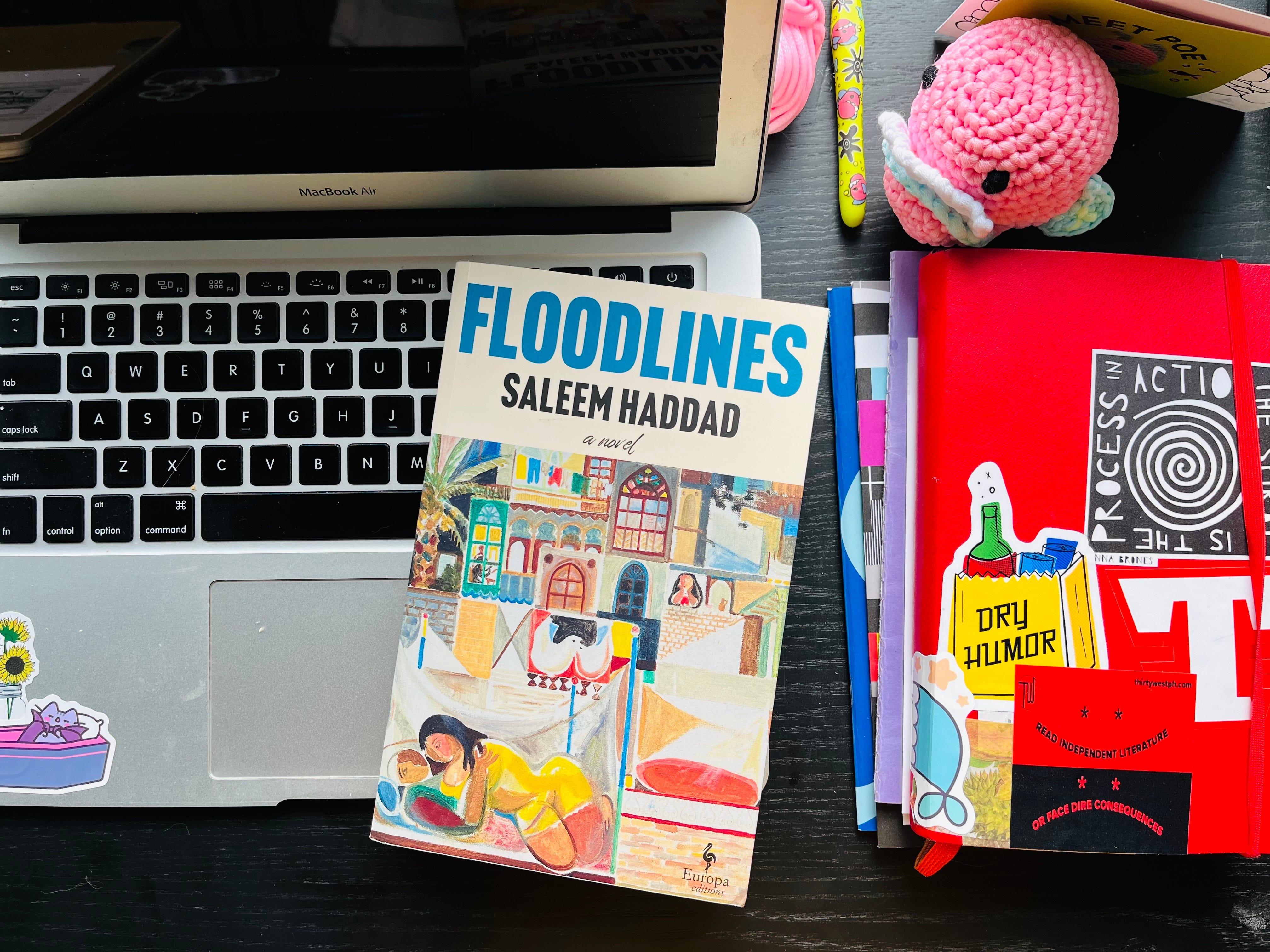
There was a time when family sagas were my bread and butter. The bigger the better. If a novel had a family tree in the front matter, I was all in. I wanted to trace lines of connection, to get a grasp on large-family2 dynamics, to make sense of what it meant to be from a people. Give me an intergenerational soap opera on pulpy mass-market pages and I’d happily get lost in it—I wasn’t choosy.3
Somewhere along the line, I stopped seeking investigations of the intricacies that bind a family. I can’t trace this shift to any particular reason. Families have a way of providing one’s life with a certain drag and maybe I grew tired of the literary version of it.4
Which is to say, when Floodlines arrived in my house, the cover5 caught my attention enough that it landed a (coveted6) spot on the small shelf next to my side of the bed, but I kept picking it up and putting it down, unsure if I was in the mood for a book about familial reckoning.
Eventually, I read past the first page, where I quickly discovered that Floodlines is more than a family saga. The novel is also an exquisite examination of the place art holds in personal lives and political fractures; it is a window into Iraq’s recent history (the bulk of the narrative takes place in 2014, with flashbacks that land us at pivotal moments between 1950 & 2013); it is an exploration of queerness within a restrictive, ever-shifting cultural milieu; it is an elegy for a country that has found itself at the mercy of Western forces; it is as multifaceted a narrative about how Iraqis—especially those in exile—feel about their homeland as I’ve ever read.
Floodlines is narrated in turns by Nizar, a war journalist mourning the loss of his only long-term relationship; his mother, Zainab, the family beauty, a folk artist widowed into extreme wealth in Dubai; Zainab’s sisters: Ishtar, the oldest, a brash, queer, conceptual artist, and Mediha, the youngest and most bitter7 of the three sisters, pushing the envelope with her Jihadi John photocollages; and Bridget, the three women’s British mother, an artist who fell in love with Haydar, their father, on the bank of the Thames and followed him to Baghdad in 1950, where she married him.
Haydar sits at the source of this family of artists, revered and regaled in Baghdad for his role in embracing a new direction for Iraqi art, one that incorporated modernity alongside tradition. But Haydar was a complicated man, and after his death, Bridget sold off most of his paintings. There are secrets upon secrets to be uncovered, each sister with her own difficult past searching for a way to makes sense of the central family secret, the truth of Haydar’s death, which Bridget has worked to protect them—and Iraq—from. Bridget’s actions, undertaken in an effort to conceal, have had resounding, unexpected ripple effects—when we first meet the sisters they are a beat away from estranged, hostile toward one another over one thing on the surface and many other things beneath.
In the wrong hands, this confluence of artists8 might easily turn unbearable, but Haddad is a masterful builder of character, with a nuanced ear for dialogue and subtle turns of fortune. Nizar, the sisters, and Bridget, rise off the page in their complex, difficult longings, circling one another and the truth until it is forced out into the open.
The title refers to projected boundaries indicating areas at risk of flooding during prolonged, unexpected rainfall, and it is apt for a book that literally and metaphorical inhabits those liminal places where flood waters might reach. The narrative builds to a climactic, cathartic denouement in which Nizar, Zainab, Ishtar, Mediha, and Bridget, have accomplished the seemingly impossible—they have converged in Baghdad to repair a trio of traditional Iraqi boats, floated down the Tigris—a real river and a river of memory—and arrived in Qurna, “the point where the rivers meet.” So much has changed: this once bountiful place is now parched and frail. “And yet, the marshes are magical.” Amid all this pain and fracture, beauty survives.
“How quickly life slips past, like a river deposited in a vast sea,” Bridget says in her final passage. “Even decay is a type of transformation.” Coming as this testament does from the far floodline—the boundary between life and death—it lands all the harder. We need hope to survive struggle, but we also need patience.
My mom’s side of the family is large, and despite my place in it, the dynamics have remained a mystery.
Notable exceptions in the recent past: Pachinko by Min Jin Lee and The Vanishing Half by Brit Bennett. I liked the latter more than the former.
Untitled, 1974 by Nazar Selim.
By the other books in my house, of course.
All three sisters are bitter—and its hard to blame them, given what they’ve been through—but Mediha, also called Middy, carries her bitterness like a badge of honor.
In the Author’s Note, Haddad mentions that Bridget and Haydar are inspired by Lorna and Jewad Selim: “Certain biographical details and creative works are drawn from their lives, serving both as a source of inspiration and a practical anchor… Ultimately, however, I have written a work of fiction. …I wanted to maintain echoes, not fashion replicas.”
Comments
Nothing yet. Say the first thing.
Sign in to join the conversation.