
It’s the middle of the night. You are tossing and turning and can’t sleep. Your heart races and your jaw is clenched as various thoughts, concerns, conversations running through your head, round and round like on a hamster wheel. You feel lonely and as if no one understands. You don’t want to trouble anyone, so you reach for your phone looking for answers, looking for reassurance. You type your thoughts into your favourite AI and instantly receive a response that feels validating and gratifying. Your friend Chat replies with soothing words and clear directions about how to handle the fight you are having with your partner or your boss.
How would this instant support not feel compelling?
Who doesn’t want to feel seen? Understood? To hear someone, even an AI bot, tell us: “you are not alone”.
And it’s available 24/7.
At the same time, my heart aches. Let me start by saying that I am a therapist and these words are heartfelt, rather than objective. There is a lot at stake here. Yes, for my professional life and subsistence. And, more importantly, for what it means to be human and to be in relationship.
When you hear “therapy”, what does it mean to you?
I know – because they tell me – that my clients are increasingly using Chat GPT as source of support and advice and find this helpful and satisfying in different ways.
I started my day this yesterday with a message from a colleague sharing a Times article (13/6/2026) citing Esther Perel saying that “Honestly, AI can be quite a good therapist”. She explains how people are looking for a quick fix, wanting someone to help them and tell them what to do.
Is therapy, however, all about giving advice and telling people what to do? Or solving puzzles using words? Is this what people who are not therapists think we do? We are also trained specifically not to give advice. Rather, I strive to honour and empower my clients, trusting in their capacity to make decisions and find the solutions that are right for them, although I may share insights and tools and techniques, whilst supporting them to explore.
Part of me, as a therapist trained in somatic experiencing and working with trauma, worries that we are missing out on a great deal if we rely on a machine as our emotional and relational support.
Let me cut to another scene that feels to me to be the opposite of our late night anxious frantic reaching for our phones.
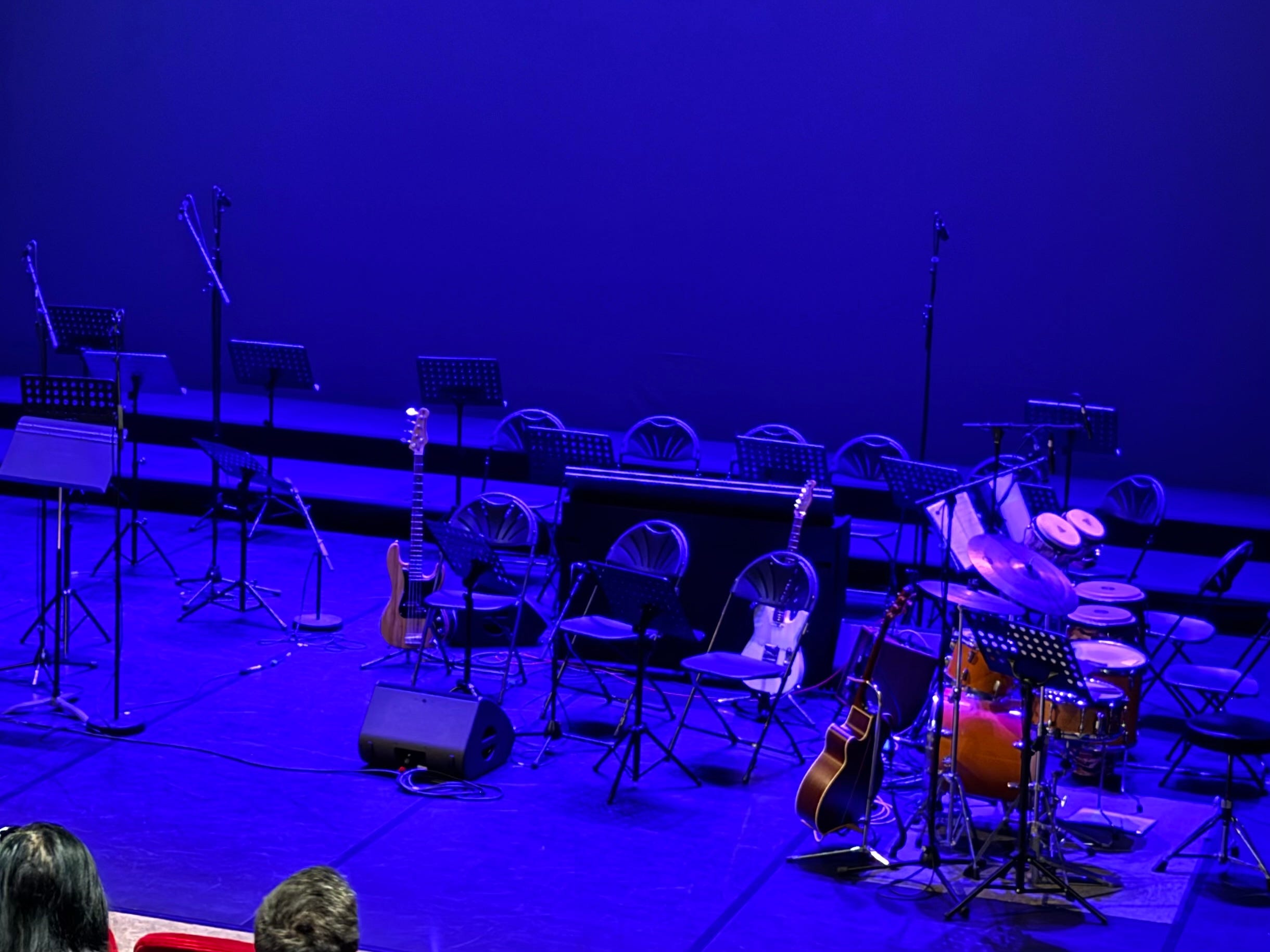
Waiting for the show to begin at our local music school.
June means music in France. The local concert hall is full of parents waiting to hear their children play instruments and sing for the end of year concert of the music school, where my children are learning the trumpet. Husband is away, so I’m sitting by myself next to a little girl dressed as a fairy with her sister and her dad, who is pointing out mummy who is one of the music teachers and plays the cello.
The room is humming. Lights come up on stage. Children appear with instruments. Someone has made videos to project during the music connecting image with sound. An amazingly talented young woman sings ‘Another Day of Sun’ from La La Land, her energy and joy radiating from the stage and filling the room. Wow! I feel it. My heart expands and softens. A slight tear in my eye. My children appear with their trumpets, two brothers together. They find me in the audience and our eyes meet. So proud.
I cast my eyes around the room. People are not looking at their phones. We are present, collected around this moment, celebrating our children and the music. I feel what Durkheim would have called collective effervescence, that bubbly sparkly feeling we get when we are with a group of people who are gathered for a common purpose, sharing an emotional experience. Communion with strangers who may or may not remain strangers. I smile at the fairy to my left.
My fear is that there will be fewer of these moments when we experience connection with others – whether that is a room full of parents of budding musicians or our romantic partner or parents. To me, therapy should be one of those moments.
Anthropologist Sherry Turkle has written at length about how we are increasingly alone although we are technically, physically together. Ever sat in a room, or at a family dinner, where everyone is sitting around the same table, yet light years apart teleported into another dimension as they are all on their phones?
Years of teaching media communications – and talking to my wonderful students about their use of technology – has taught me not to think of the digital world as “fake” or in distinction to the “real” world. The digital world is very real. Real friendships are made through social media and online games. Real skills can be learned like speaking a foreign language. Real money can be made (or lost). In these cases, technology creates a bridge bringing real humans together. What happens when the thing on the other side of the conversation is no longer another person?
Esther Perel has called this disconnectedness Artificial Intimacy: we have hundreds of connections on social media, our self-esteem feels linked with how we are perceived online, yet we have no-one to feed our cat when we are on holiday.
We are together, yet somehow far apart. No wonder we feel so lonely.
I wonder whether our reaching for interaction with Chat, Gemini and our other AI “friends” is a response to this longing for belonging, an artificial replacement for the real intimacy that is lost when we are disconnected from those present in real life.
Technology is also a bridge for me in my work. I frequently carry out, and have received myself, therapy sessions online. I also teach online. I tell my students that I can actually feel when they are really present and listening or not. They probably start by thinking I am crazy, but eventually understand the power of being fully present and connected. I am simply being human and noticing the real resonance in my nervous system, as I do with my clients. The human connection is real made possible using technology as a bridge.
Chat, Gemini and our other AI friends don’t have a nervous system. If we rely on them for our emotional and psychological support, we are missing out on opportunities for healing and growth that, I believe, require the presence of a real, warm, compassionate human, who can provide a safe container to support our healing and personal growth.
Esther Perel goes on to say herself in the same recent Times article, that therapists “do a lot of things that are not just talking” like “physical movement, somatic practices, music”.
As a therapist who practices somatic experiencing, I do many things that are not just talking too, whilst supporting my clients. I’m not just listening to words; I’m listening at a far deeper level, carefully tracking their nervous system, what the body is expressing, and my own, taking care so that the space feels safe, warm and compassionate. I see, literally in the hunched shoulder, the defensive hand held out, the shortened or shallowed breath, and feel, as my own breath suddenly shortens too or my heart speeds up, how you are feeling and can offer support.
We often hear that the relationship between therapist and client is the most important factor in successful therapy – far more significant than whatever approach or modality the therapist uses.
Healing and growth take place through this somatic awareness: the felt experience of being in relationship with someone. The meeting of two humans in presence.
Can we have this kind of relationship with a disembodied, nervous system-free AI, that is reading our words and yet unable to track any of this other precious information that can be such a source of self-understanding and growth?
This is usually not because they are physically alone; they often have families, friends and good, loving romantic partners. However, they have often been hurt by past relationships in which they were not able to receive the care and love that they deserved. They may have learned, unconsciously, that it is unwise to express emotions to another human and that this just leads to invalidation, dismissal or worse. They may be so busy caring for others that they have lost touch with themselves.
I can see from this perspective how asking an AI, who says the right words and feels “safe”, can seem easier, than trusting another human, especially after so many humans may have let you down in the past or caused you to feel ashamed.
Part of healing is discovering that another experience is possible. This is why meeting with a real human is all the more vital. Therapy can offer the opportunity to be in relationship with someone who is there for you, to rewrite what you know about human relationship and to then open up possibilities for how you relate in your life. It does this in real time, through the lived experience of being vulnerable, sharing our histories and emotions and being met with acceptance and empathy. You can feel that you do not have to carry all of this alone.
What are we learning, if we experience that we can only be truly heard and understood by a machine?
Will this experience validate all we have – unconsciously - learned about how relationships work and isolate us further from those close to us?
Part of me wonders whether therapists will increasingly need to coach people who increasingly lack the skills needed to build and maintain the deep, meaningful human relationships we all crave. This is the social atrophy that Perel also talks about in the Times article, as we stop going out and interacting with people and our social muscles grow weaker and weaker. Will we need relational coaching to support us with these skills, in the same way that we now need to go to the gym as an antidote to our sedentary lifestyles? My grandparents ran a farm and the idea of going to a gym to exercise would have been absurd to them.
I probably don’t need to tell you any of this at all. You already know.
My teenage son, as ever, gives me hope. He is all too well aware that AI is effectively smoke and mirrors, predictive text masquerading as a trusted friend and advisor.
When I asked him, what he thought about using AI as a therapist, for him the distinction between machine and human was clear, as are the real, tragic risks we see in newspaper stories of young people, whose lives ended in suicide after confiding in AI. How will we manage these real risks to prevent anyone else coming to harm, especially if we start to normalize the use of AI as a therapist without basic safeguards?
AI has rapidly become woven into our lives and seems to be here to stay. Whilst we explore and strive to get the best out of this remarkable technology, I keep asking some fundamental questions about life: what helps us feel most alive? What helps us feel at home?
I find myself returning, again and again, to relationships: family, friends, sitting in a concert hall with proud parents, laughter, tears, joy.
What does “therapy” mean to you?
Do you confide in AI or ask it for advice?
How do you feel about AI?
When do you seek out a human therapist v ask AI if you are feeling bad about something?
How do you feel compassion coming from AI v from a human friend or therapist?
Please do reach out and let me know!
Perhaps one of the questions at the heart of this article is: what helps us feel at home, connected and alive?
If you are curious to explore that question further, I would love to share my free Wild Nesting workshop with you. Together, we explore belonging, resilience and feeling at home in ourselves and in our lives, wherever we happen to be.
You can watch the workshop here.
If you would like more personalised support, I also offer one-to-one counselling for individuals and couples. It is often an honour to walk alongside people as they reconnect with themselves, navigate challenges in their relationships and discover greater calm, confidence and aliveness. Find out more and reach out here.
Comments
Nothing yet. Say the first thing.
Sign in to join the conversation.