
SBM is hiring standout talent in accounting, tax, and strategic finance who want to do deeper, more proactive work inside an integrated system. Learn more at https://www.santabarbaramanagement.com/careers/
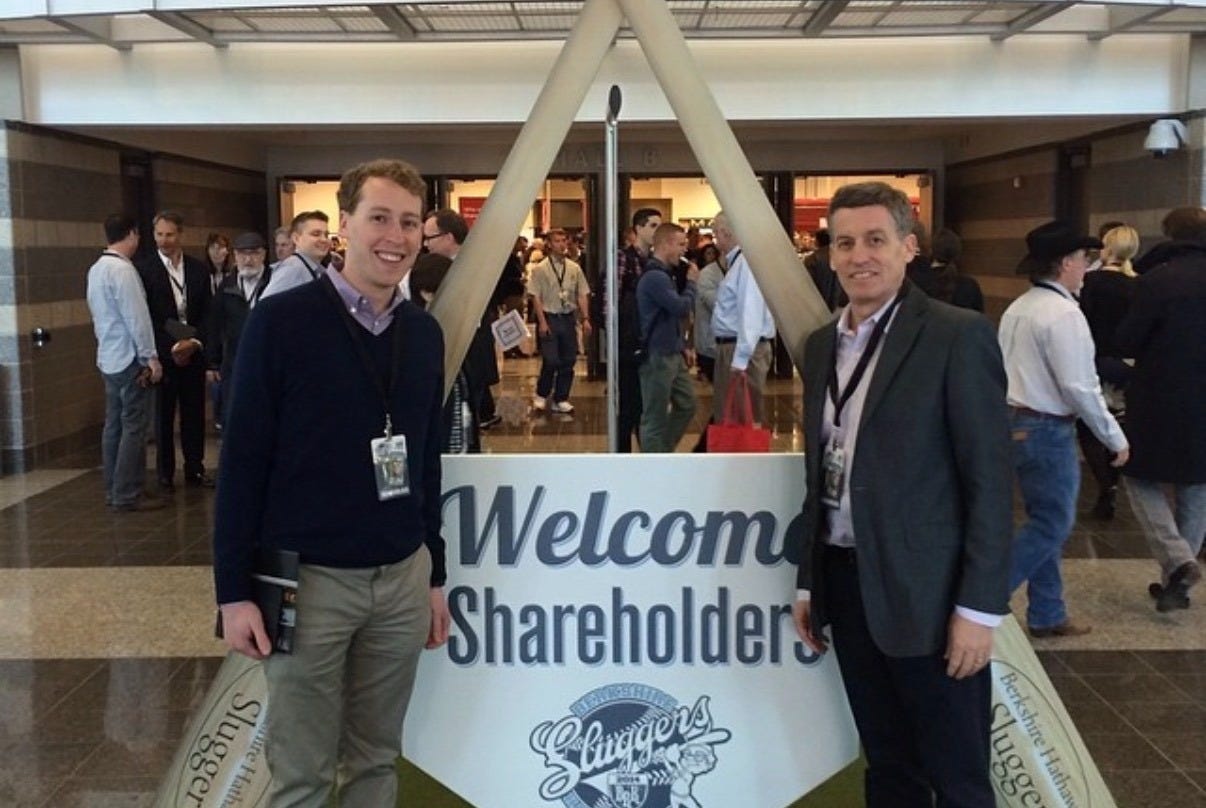
Warren Buffett stepped down yesterday as CEO of Berkshire Hathaway after 60 years at the helm. He’s been a titan of American finance and loomed large in my career. I read The Making of An American Capitalist as a kid, then The Snowball when it came out during college. I made the pilgrimage to Omaha for my first Berkshire meeting in 2013 - my Christmas gift to my Dad that year - and have returned several times since.
I’m grateful for what I’ve learned from Warren and Charlie. Their thinking is anchored in first principles. I love their long term orientation. Their optimism about the future of the United States and its economy. The focus on a tight circle of competence and putting everything else in the “too hard pile.” A bias toward quality. An assumption of the positive intent of others. And a drive for simplicity.
Their philosophy also shapes how I think about building Santa Barbara Management. A few themes in particular stand out:
Quality. It’s far better to buy a wonderful company at a fair price than a fair company at a wonderful price.
Competence. You don’t need to understand everything. Understand some things very well and avoid the rest.
Temperament. If you can’t control your emotions, you can’t control your money. Be fearful when others are greedy and greedy when others are fearful.
Leverage. Never risk what you have and need for what you don’t have and don’t need.
Beyond these themes, much of the investment advice we provide to families we work with reflects Buffett’s core investing principles.
The Paradox at the Heart of Buffett’s Investing Philosophy
Buffett holds what seem like contradictory views about investing. He clearly believes that skilled investors can outperform the market: his track record proves it - he has trounced the S&P 500 over the last sixty years. But he also believes that for most people, trying to outperform is a mistake. His advice to individual investors and even to the trustee of his own estate? Put 90% in a low-cost S&P 500 index fund.
How can both of these things be true? And what does it mean for the rest of us? Understanding that question is critical to building the right portfolio for a family.
Warren’s critiques of conventional behavior among investors were well articulated in his 2014 letter to Berkshire shareholders:
Investors, of course, can, by their own behavior, make stock ownership highly risky. And many do. Active trading, attempts to “time” market movements, inadequate diversification, the payment of high and unnecessary fees to managers and advisors, and the use of borrowed money can destroy the decent returns that a life-long owner of equities would otherwise enjoy. Indeed, borrowed money has no place in the investor’s tool kit: Anything can happen anytime in markets. And no advisor, economist, or TV commentator– and definitely not Charlie nor I - can tell you when chaos will occur. Market forecasters will fill your ear but will never fill your wallet.
The commission of the investment sins listed above is not limited to “the little guy.” Huge institutional investors, viewed as a group, have long underperformed the unsophisticated index-fund investor who simply sits tight for decades. A major reason has been fees: Many institutions pay substantial sums to consultants who, in turn, recommend high-fee managers. And that is a fool’s game.
There are a few investment managers, of course, who are very good– though in the short run, it’s difficult to determine whether a great record is due to luck or talent. Most advisors, however, are far better at generating high fees than they are at generating high returns. In truth, their core competence is salesmanship. Rather than listen to their siren songs, investors - large and small– should instead read Jack Bogle’s The Little Book of Common Sense Investing.
Buffett proved this point with his famous ten-year bet. In 2008, he wagered that a low-cost S&P 500 index fund would outperform a collection of hedge funds over the next decade. The index fund won handily - and that’s not just a fluke of a given ten year period or a selection issue with his bet. The broader corpus of data backs him up. Over the last 20 years, >90% of actively managed funds have underperformed their benchmark.
Buying and holding index funds has worked. It compounds reliably over decades. It’s not exciting. It doesn’t require expertise, but it does require patience and fortitude. As Buffett put it: “It is not necessary to do extraordinary things to get extraordinary results.”
But Outperformance Is Possible
Yet Buffett also knows and has proven that beating the market is possible. The question is: under what conditions?
Buffett is clear that you need a real edge in the form of deep knowledge of a strategy and the fundamentals of the individual investments. Operating outside of your zone of competency quickly becomes problematic. As Warren has been fond of saying, “I don’t invest in businesses I don’t understand.”
Buffett also argues that in order to outperform, you need substantial concentration, having said “Diversification is protection against ignorance. It makes little sense if you know what you are doing.” Look at Berkshire itself. As of the end of 2023, Apple accounted for roughly 50% of Berkshire’s public equity portfolio - nearly $175B. Burlington Northern Santa Fe generates nearly 25% of Berkshire’s operating income.
Other investors who’ve outperformed over long periods share this willingness to concentrate. Nick Sleep and Qais Zakaria at Nomad Partners. Chris Hohn at TCI. The pattern repeats.
Lastly, you need temperament. When you’re concentrated, as his model for outperformance prescribes, volatility can be high. You have to stick with your strategy through chaos - and that’s challenging for most people. This can require both temperament but also structure and risk control – it’s easier to stick with a bet if it is sized appropriately in the context of your overall portfolio (there is daylight between high concentration and unwise concentration).
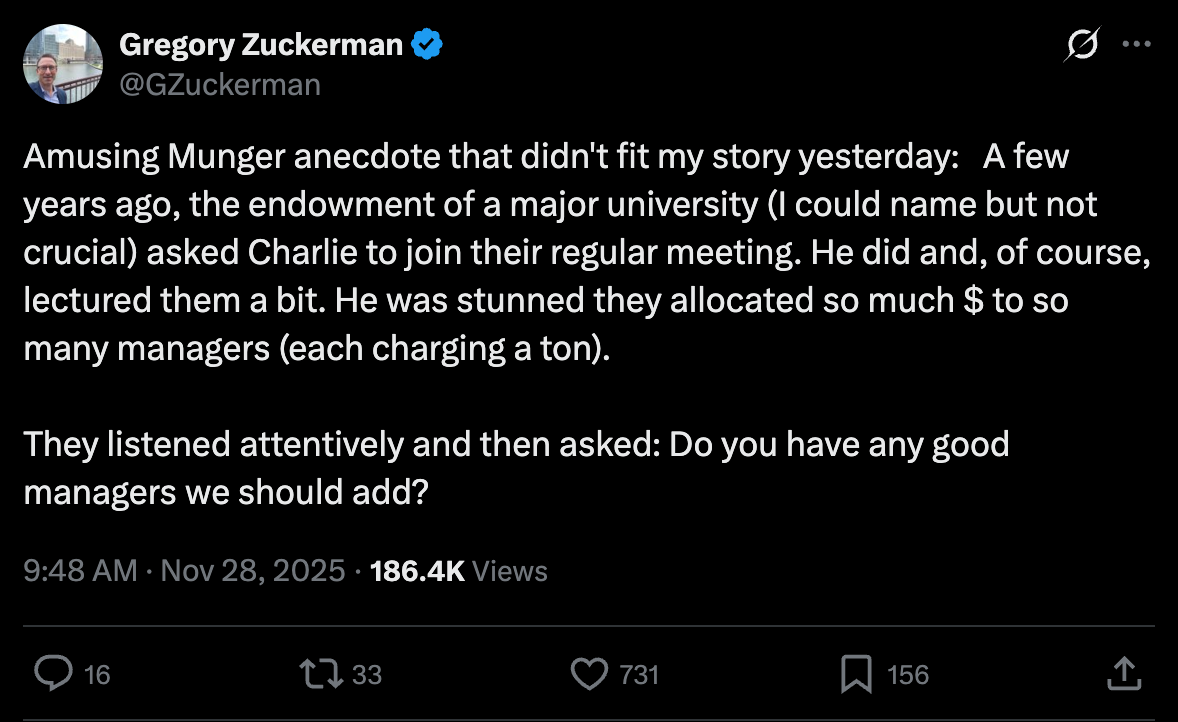
Here’s the additional problem: it turns out that what I just described is exceptionally hard to outsource. Many institutions and families rely on the supposed alpha of others rather than the edge they have themselves. As a result, they pay substantial fees and carried interest, which means that even if the headline results are strong, the net results (after taxes and fees) are often much lower. And hiring multiple managers to spread the risk cuts against the concentration that one needs in order to actually outperform. Charlie Munger had a word for it: “deworsification.”
What about Alternatives?
Families often tell me they don’t believe in active management for public stocks - particularly given tax implications - but they’re confident private equity and venture capital will outperform.
The data here is more nuanced than with public markets, but it’s far from black and white.
A recent Commonfund study found that the median venture capital fund failed to beat the MSCI ACWI in the majority of vintages across the last two decades. Top quartile managers during that period averaged just over 6% net annualized outperformance. That said, we view the MSCI ACWI as a poor comparison. If you compare against the S&P 500 - or better yet, the NASDAQ, which is a far better benchmark for venture - even many top quartile funds underperformed.
Private equity data looks somewhat better. According to data from Cambridge Associates, median US PE returns exceeded the S&P 500 for all periods longer than three years as of December 31, 2024. Top funds dramatically outperform. But dispersion is substantial - both across vintages and across funds within a vintage. Missing the winners dramatically impacts returns.
Another consideration: the illiquidity these strategies entail is substantial. While some families like the “volatility laundering“ that comes with illiquidity, private equity funds often tie up capital far longer than expected, and fund lives are lengthening. Carta has published data showing that in the 2017 vintage of venture funds, only 25% had started generating distributions after three years, and only 59% after five years. Newer vintages (2019, 2021) show even lower DPI. More than three out of five funds had not returned any capital five years in. Even for investors in a top decile fund, accessing those returns takes a long time.
How This Applies to Builders
This is where Buffett’s thinking becomes most relevant for the entrepreneurs and investors we work with, and where his seemingly contradictory views resolve themselves.
The core insight is simple but demanding: index everything outside your circle of competence, and concentrate deliberately within it.
Many investors fail because they try to be active everywhere. And many builders fail to clearly separate where they truly have an edge from where they don’t. Buffett understood this distinction as well as anyone. His advice to index is not an argument against skill. It’s an argument for humility. Markets are brutally efficient at punishing people who confuse confidence with competence. Outside a narrow set of domains, patience, low costs, and diversification are overwhelming advantages.
But inside that narrow set, the rules change. That is where concentration makes sense and where outperformance is possible. Builders, by definition, have already demonstrated exceptional judgment within a specific arena. They have navigated uncertainty, allocated capital under pressure, built teams, and made decisions where outcomes mattered. In doing so, they’ve developed something most people never acquire: a true circle of competence. When applied with discipline, it can lead to tremendous long term compounding..
This is why a one-size-fits-all portfolio framework doesn’t work for builders. Their balance sheets often reflect the very thing that made them successful: concentration. Founder equity. GP ownership. Long-held positions that grew far beyond their original size. These are not mistakes to be “fixed”, but sources of advantage. The goal then is to make the rest of the portfolio work intelligently around it.
For builders, the mistake isn’t owning too much of what they know best. The mistake is adding complexity, illiquidity, and high fees everywhere else in an attempt to manufacture sophistication. That impulse, to “do something” with capital, is strongest precisely when liquidity increases. But complexity does not create edge. It usually dilutes it.
Buffett’s answer is instructive: be boring where you don’t have an advantage, and unapologetically focused where you do. The boring part compounds quietly. The focused part reflects who you are, what you know, and where your judgment has already been proven. Together, they create a portfolio that is resilient, durable, and aligned with how builders actually create wealth.
At Santa Barbara Management, our role is not to replace our clients’ judgment; it’s to help them protect it. That means ensuring that the parts of the portfolio without a real edge are designed for simplicity, efficiency, and endurance, while leaving room for builders to lean into the areas where they genuinely know more than the market. When done well, this balance allows families to stay rational through volatility, patient through cycles, and confident that their capital is working in service of their lives, not distracting from them.
Knowing What You Don’t Know
The hardest part is being honest about where your circle ends. Being an exceptional software entrepreneur doesn’t mean you understand biotech or can time economic cycles. Success in one area doesn’t translate to insight in others. This is where most builders make portfolio mistakes.
Buffett’s answer? Put everything outside your circle of competence in the “too hard” pile. Don’t try to figure it out. Don’t hire someone to figure it out for you. Buy the index and move on.
Want to be active outside your circle? Take 5% or 10% of your liquid portfolio and have fun with it. Back a friend’s restaurant. Angel invest in something interesting. But practice intellectual honesty and label it as fun money. When clients bring us potential investments, this is one of the first questions we ask: are we underwriting this as an economic decision or a “fun bucket” decision?
We believe portfolios should have three buckets. The boring bucket: liquidity plus low-cost index exposure. The advantage bucket: investments where you have real edges within your circle of competence. And the fun bucket: One of the benefits of substantial wealth is that some things can be done for enjoyment, so long as they’re appropriately sized. In the best portfolios, the three buckets work together as a coherent whole to solve for relative sizing, liquidity, and tax characteristics.
How This Evolves Over Time
Strategy shifts as circumstances change. Early on, when most wealth is tied up in the business or firm, the liquid portfolio is smaller and simpler. We advise maintaining ample cash, basic index exposure, and maybe a handful of angel or fund investments where a builder has real insight.
As liquidity events happen - secondaries, GP stake sales, eventually exits - this balance shifts. Net worth moves from a concentrated position to liquid assets. This is when the temptation to “do something” with all that money becomes strongest. Add managers, build out alternatives, create complexity.
Our view: resist that temptation. The core strategy shouldn’t dramatically change. Keep substantial liquidity. Keep costs near zero on the indexed portion. Stay concentrated within the circle of competence.
What does change is scale and potentially time allocation. In addition to having more wealth, a founder who sold their company now has something many builders lack during their operating years: time. An investor who steps back from running their firm faces the same shift. This can be an opportunity to double down on investing - not by outsourcing to managers and expecting outperformance, but by doing it themselves.
We’ve seen many successful second acts. Entrepreneurs who use the competence they built running businesses to become exceptional investors. They understand what great execution looks like. They can evaluate teams and strategies. They have networks that create deal flow. And now they have time to dedicate to it.
But here’s what matters: they’re doing it themselves. They’re not hiring a team of managers and expecting those managers to have their edge. They’re applying their own judgment, making concentrated bets in areas they understand, and staying actively involved.
For builders who envision a different second act - who want to start another company, join boards, or simply spend time differently - the strategy remains simple. Keep the boring bucket boring. Keep the advantage bucket small and focused. Don’t let wealth management become a distraction from what matters, and don’t feel like you need to add complexity because you now have liquidity.
Instead, focus on what you love and what gives you energy. Find the people who fill you up and the work that makes you excited to start each day. Buffett famously said he tap dances to work. I feel the same way - in part because I get to work with people who feel that way too.
Santa Barbara Mgmt., LLC d/b/a Santa Barbara Management is an investment advisory firm registered with the Securities and Exchange Commission (“SEC”) under the Investment Advisers Act of 1940. SEC registration does not constitute an endorsement of the firm by the SEC, nor does it indicate that the adviser or investment adviser representative has attained a particular level of skill or ability. The oral and written communications of an adviser provide you with information about which you determine to hire or retain an adviser. Form ADV Part 2A can be obtained by visiting https://adviserinfo.sec.gov and searching for our firm name. ADV Form 2B is available upon request. Neither the information nor any opinion expressed is to be construed as solicitation to buy or sell a security or personalized investment, tax, or legal advice.
Comments
Nothing yet. Say the first thing.
Sign in to join the conversation.