
SBM is hiring standout talent in accounting, tax, and strategic finance who want to do deeper, more proactive work inside an integrated system. Learn more at https://www.santabarbaramanagement.com/careers/
Friends of SBM,
As Bob recently welcomed his third child, I am pinch-hitting for this month’s email.
We have read a lot about pricing power and pricing and packaging, and have recently found ourselves interested in a related topic: pricing opacity. Where most effort is spent unraveling how much businesses charge for their services and how they structure their price sheets, we have been thinking about two questions that underpin pricing power:
Is it clear how much a customer will end up paying?
How much does the customer feel it when they pay?
Is It Clear How Much a Customer Will End Up Paying?
Situations where the customer has little idea what they will end up paying are frustratingly common. Opaque pricing situations arise in surprising places across all arenas of life:
My wife and I recently had our second child. The biggest lesson from the hospital stay with our first was that, when the nurse asks, “do you want us to take the baby to the nursery tonight?” you should say “Yes!” We received the bill weeks later and learned that was a $5,000 choice we made while punch-drunk and sleep deprived. In healthcare settings, customers are rarely presented prices and rarely in a position to evaluate prices – the ultimate form of pricing opacity.
By the way, with insurance, we did not pay the $5,000 directly. Instead, it will be paid by the members of our plan at renewal, obscuring the pain that comes with payment (see #2 above).
Staying at a nice hotel is meant to be a relaxing endeavor, but an all-too-common question is “How much are we supposed to tip?” A hotel manager will probably tell you that tipping is not mandatory, but you know the right answer must be something more than $0. Ultimately, you guess the appropriate price. Once again, opaque pricing!
Another deeply frustrating form of pricing opacity comes from “mistakes” in applying signed contracts to billing. In the following two examples, multi-billion dollar household name businesses tried to bill SBM for more than our contracted amounts, and we caught it through diligent review of our contracts. Some vendors seem to make a habit of sloppy billing in their favor. It’s interesting that the mistakes always seem to occur in one direction.

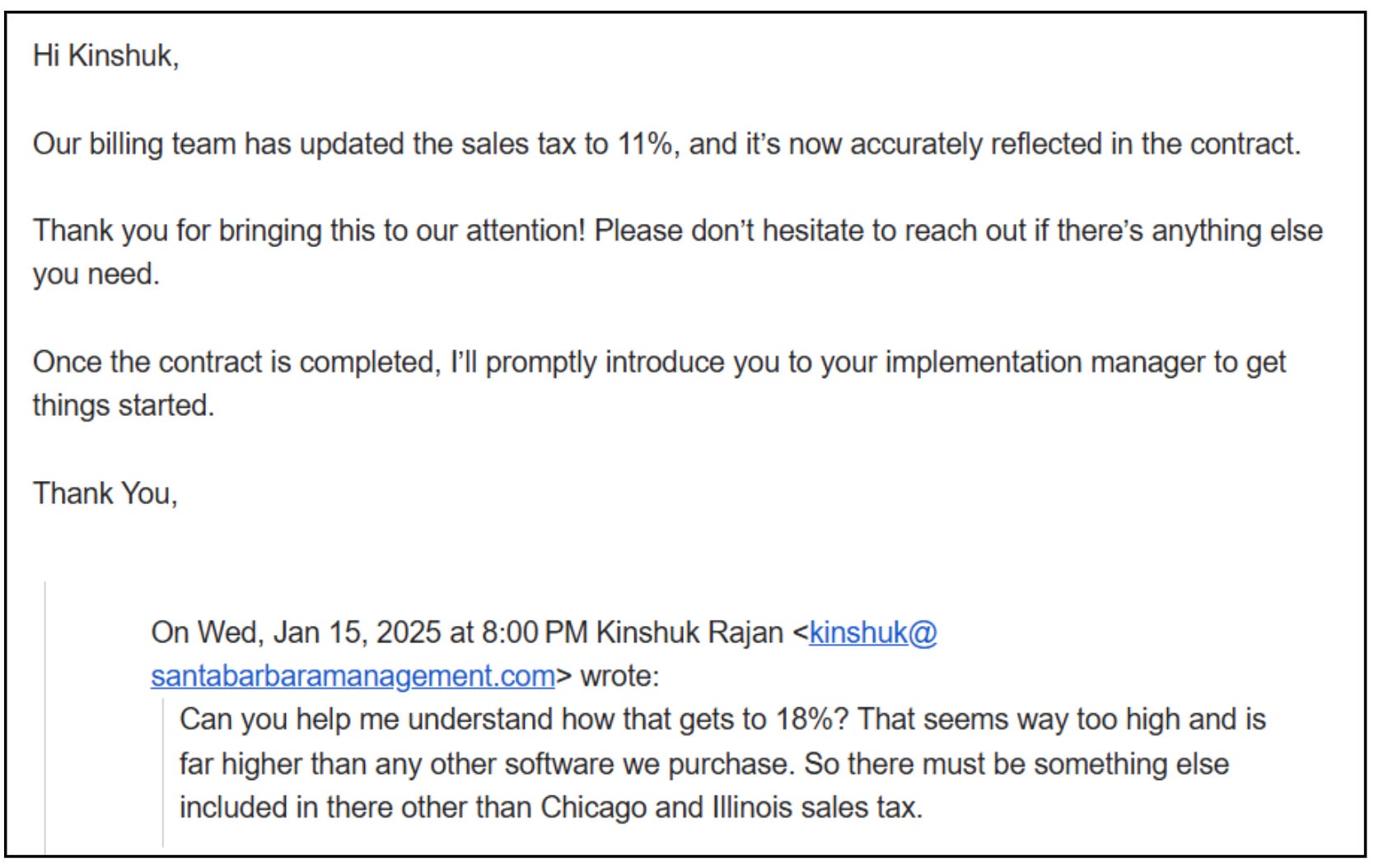
We also observe this dynamic and have caught these “overbillings” on behalf of the families we serve.
The examples above are mostly absurdist and honestly humorous, but there are very serious businesses we admire that have flavors of opacity to their pricing. Consider cloud computing: usage-based pricing is great for reducing startup costs and aligning price paid with services received, and hopefully value received. But it does leave many businesses guessing on their ultimate bill – just ask any software FP&A team. And it leaves businesses susceptible to surprise bills.
Pricing opacity can serve as an obstacle to customers making hyper-rational purchasing decisions, and when paired with high-value services with limited alternatives, pricing opacity can help drive pricing power.
How Much Does the Customer Feel It When They Pay?
Another way opacity can appear is at the point of sale. Most businesses, if they can help it, would prefer for their customers to make only one purchasing decision and then never think about it again. This is one of the powerful attributes of subscription business models. Strong gross retention can reflect great value from a product, but it can also reflect inertia in canceling.
If you had to make a decision each month to sign up for Netflix and re-enter your credit card to initiate a payment, would you do it? I bet far fewer consumers would choose to renew every month under this construct vs. the superior autopay construct (definitely superior for Netflix, but also more convenient for consumers). Consumers who may get annoyed or remember to cancel if Netflix sent them an invoice each month don’t “feel” Netflix billing them each month buried on page 4 of their credit card statement. In fact, as a longtime Netflix subscriber, I couldn’t tell you off the top of my head what my current monthly rate is.
Consumer subscription services (gyms, rental clothing, even dog toys) have mastered low friction billing as a way to reduce churn, but it also appears in B2B contexts. Back to our hypothetical software FP&A team, they have certainly dealt with a software or subscription that has auto-renewed with a contractual increase without anybody noticing.
Reducing the “impact” of billing is not just a tool used by shady software sellers who want to sneak through a renewal; it is also used by high-value high-quality services (such as Netflix). It comes back to the fundamental truth: in a perfect world, your customer has to buy only once rather than being forced to buy over and over again.
How We See Pricing Opacity in Our Industry
So far, I have gone easy on financial services, but for many people financial services would be the poster child of opacity. Consider:
When buying insurance for your business, the amount you pay your broker is embedded in the price of the policy. You may be able to figure out what it is, but it’s difficult for anyone who is not part of the insurance industry.
When trading stocks and bonds the pricing to your broker is baked into bid-ask spreads and also the cost to you of your broker selling your order flow.
Accounting, tax preparation, and fund administration businesses often charge by the hour. When you engage them on a project, can you guarantee how many hours they will spend on it? Of course not!
Closer to home, the SEC thankfully requires pricing to be clearly stated up front for investment advisers in ADVs and customer contracts, but once clients enter into a contract there are several ways for pricing to become opaque:
Advisers generally charge management fees directly to accounts they manage. Because they can auto-debit the accounts, they can do so in a way that the client does not feel and is rarely reminded of. We ask clients and prospects who are already with an investment manager what their fees are, and often they don’t know.
Investment advisers can put clients into high-fee products creating a second layer of fees (and a second layer of fees to the investment manager if they are their own in-house products). These fees are even less “felt” by the clients. When a VC fund charges their 2% annual management fee, the client does not write the fund a check – instead it shows up in the capital account updates. Same thing with carried interest, which is directly deducted from distributions.
Speaking of opacity, ask any VC or PE LP whether they truly understand the carry waterfall of the fund they are invested in. We would be surprised if many do.
How SBM Approaches Pricing Transparency
One of the reasons that we have been thinking about all of this is that SBM has taken a radical approach to pricing.
SBM prices as a percentage of our clients’ entire investible net worth. We do this so we can align incentives: rather than pricing on assets under management and creating incentives to pull more client assets under our management, our only incentive is growing our clients’ net worth. I would certainly rather spend my time strategizing how to make my clients wealthier vs. strategizing how to relocate their existing assets.
Our pricing model demands a form of radical transparency: each quarter we share with our clients a detailed ledger of all their assets and the line-item build up of their fees. Our clients are regularly reminded of our fees (they definitely “feel” the pricing), but we believe the transparency benefits all parties involved.
In addition to making sure clients understand our fees well, we help clients understand costs across their entire landscape. Where else are there opaque costs that may be difficult to identify? Two specific, recent examples illustrate the role we play for our clients:
One of our clients came to us with an existing Quantinno implementation in which they were overpaying to borrow on margin for the long extension and were not receiving a short rebate on the short extension. As we onboarded the client, we unearthed this by digging through their brokerage statements and transaction history and quickly moved to optimize their setup. We were able to save this client well north of $100k per year in excess interest and foregone income that they were unaware were underoptimized.
One of our clients has a family trust that had been paying a $2,000 per year bond for years. It was a huge annoyance for our client but fell below the threshold of something to investigate themselves. We were able to help the client identify that the conditions that required the bond had not been in place for years, and the trust had been paying this fee for no reason. We were able to cancel the bond and eliminate the expense.
We get excited about fighting opaque pricing structures on our clients’ behalf, and we have consciously aligned our incentive structure so that savings we drive for our clients also improve SBM’s bottom line.
Santa Barbara Mgmt., LLC d/b/a Santa Barbara Management is a federally registered investment adviser under the Investment Advisers Act of 1940. Registration as an investment adviser does not imply a certain level of skill or training. The oral and written communications of an adviser provide you with information about which you determine to hire or retain an adviser. Form ADV Part 2A can be obtained by visiting https://adviserinfo.sec.gov and searching for our firm name. ADV Form 2B is available upon request. Neither the information nor any opinion expressed is to be construed as solicitation to buy or sell a security or personalized investment, tax, or legal advice. Opinions expressed in this commentary reflect subjective judgments of the author based on conditions at the time of writing and are subject to change without notice.
Comments
Nothing yet. Say the first thing.
Sign in to join the conversation.