
H/t to Bernie for alerting me to this.
The journalist-psychiatrist Dr Max Pemberton has made a documentary, to be screened on the UK’s Channel 4 at 8 PM on 18 August:
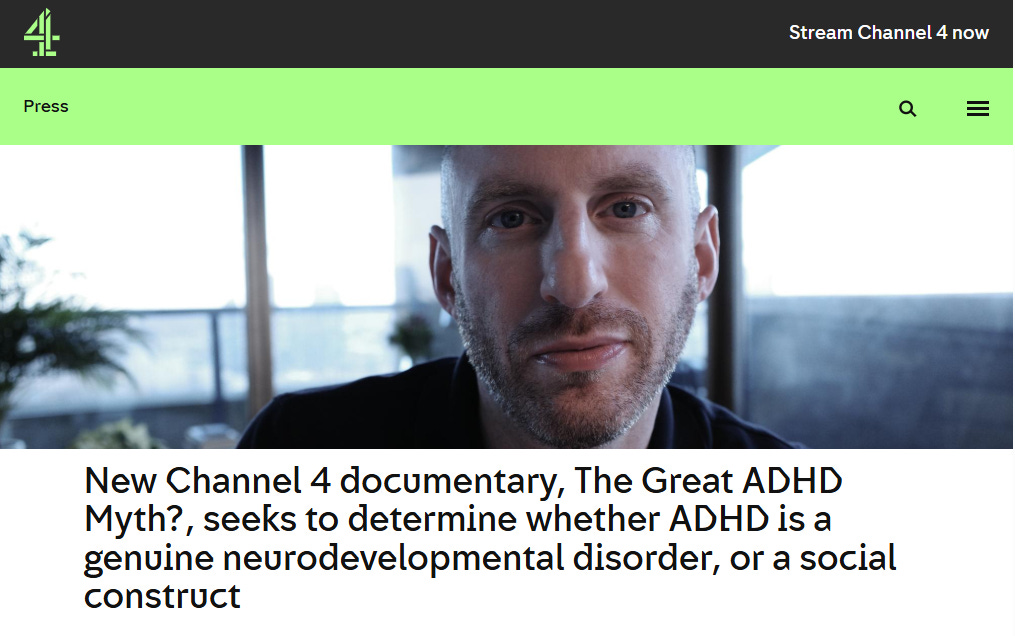
I have written very little about ADHD on this blog, but I have no doubt that regular readers could quite readily predict that I stand foursquare behind the thesis being put forward by this documentary:
ADHD is a made-up condition, or in Channel 4’s slighly less damning language “a social contstruct”
I also believe that it is scandalous that “ADHD” - with all its podcasts, celebrity endorsements, private clinics and tens of thousands of “worried well” seeking the diagnosis which will explain (and then cure) everything that’s wrong with their lives - has become a highly profitable and self-reinforcing industry peddling dangerous drugs to the gullible.
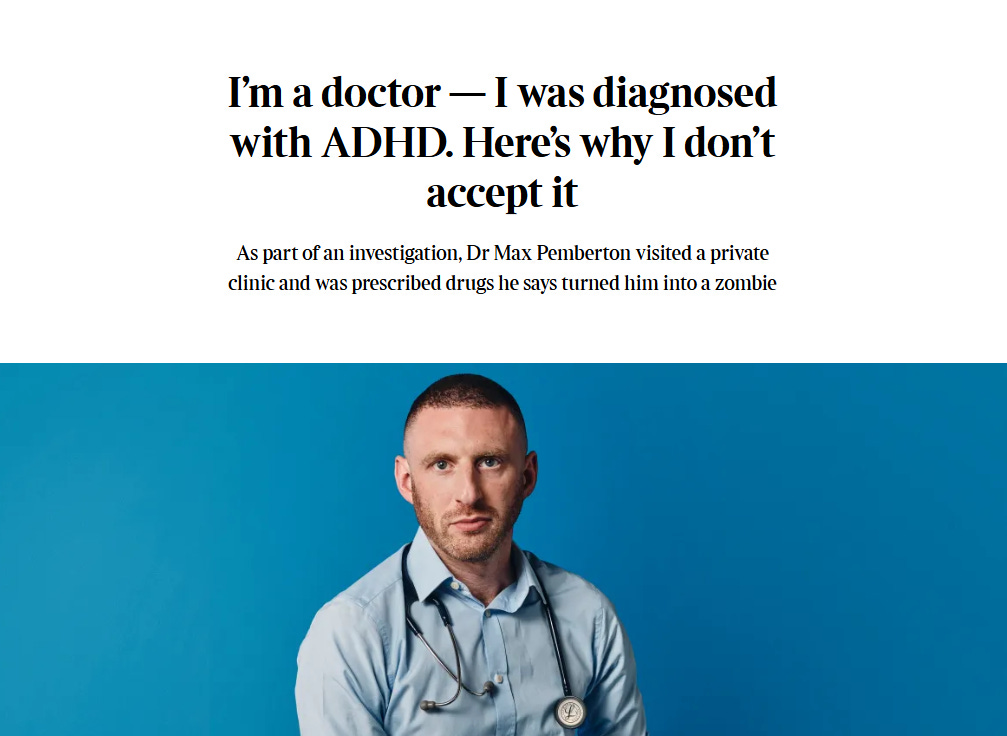
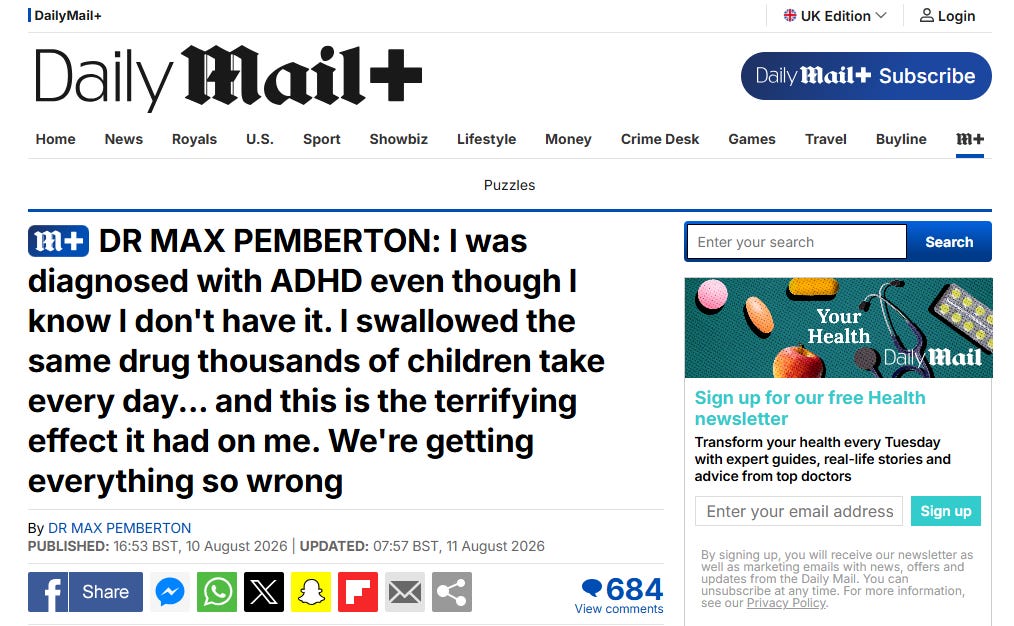
This story has been featured in several mainstream outlets. Here are two examples (in each case click on the image to go to a non-paywalled version).
The Times:
The Daily Mail:
In the Times piece in particular Pemberton outlined a mechanism which I think is applicable to much of modern medicine - and non-medical science actually - which is how the application of a label onto what is essentially normal then becomes self-reinforcing:
I don’t accept the diagnosis and I’ll come to why, but something happened in the days afterwards that I was not remotely prepared for.
I started to hear a little voice in my mind. I would forget where I’d put my phone, or realise I had read the same paragraph four times, or find myself talking over somebody and the voice would say, “Is that my ADHD?” Nothing about me had changed — I’d lost my phone the week before and thought nothing of it, but now every ordinary human failure or struggle or difficulty came with a footnote and things I had always taken to be simply me were being reclassified as symptoms.
Sociologists call this labelling; the process by which a description hardens into an identity and then begins to generate the very behaviour it claimed only to observe. Medicine has its own version— “diagnostic overshadowing”, where a label is attached and every subsequent difficulty is seen through this prism, so nobody looks for another explanation. What unsettled me was how quickly it got in my head. If it can work on me in the days after a diagnosis, I find it hard to imagine what it does to a nine-year-old told this is simply who he is and always will be.
This phenomenon is, quite clearly, closely linked to the notion of placebo and nocebo effects, about which I have written extensively (see articles here).
Other examples in modern medicine of the phenomenon whereby the labeling causes self-reinforcement include:
Functional Neurological Disorder (FND)
Chronic Lyme Disease
Adult "Autism Spectrum Disorder" (ASD) / Social anxiety
Mild traumatic brain injury, called by some “post-concussion syndrome")
Lumbar degeneration
Dysautonomia
Food intolerances and "histamine intolerance" / "Mast Cell Activation Syndrome" (MCAS)
Gender dysphoria
I am not - it must be emphasised - saying that all (or even most) cases of the above are necessarily social constructs exclusively caused by labeling and subsequent self-reinforcing mechanisms.
But what I do think is that in many cases this mechanism plays a part in the genesis and / or maintenence of the existence of these conditions.
To my list above I would of course add “covid”. I am still astonished that many critical thinkers I know well still believe a novel disease caused by a novel virus emerged in 2020, in the face of overwhelming evidence to the contrary:
No posts
Comments
Nothing yet. Say the first thing.
Sign in to join the conversation.