
The Joe Tippens Protocol is the most widely discussed fenbendazole-based regimen in the world. Since Joe Tippens shared his story of complete remission from stage IV small-cell lung cancer in 2017, hundreds of thousands of people have sought information about this protocol [1, 2].
Yet despite its popularity, reliable, comprehensive information about the protocol's practical details — dosing, monitoring, safety thresholds — is surprisingly fragmented. Much of what circulates online is incomplete, contradictory, or dangerously devoid of safety guidance.
This guide consolidates the current state of knowledge into a single, evidence-informed reference. We present the protocol as it exists in the community, alongside the safety monitoring framework that any responsible practitioner or informed patient should consider non-negotiable.
A critical caveat before we begin: The Joe Tippens Protocol is not FDA-approved, EMA-approved, or endorsed by any major oncology organization. There are no completed randomized clinical trials validating its safety or efficacy [3, 4]. All dosing information presented here is derived from anecdotal protocols and community-sourced data, not clinical evidence. This guide is educational, not prescriptive.
The classic Joe Tippens Protocol consists of four components, each targeting different theoretical anti-cancer pathways [1, 2, 5]:
What it is: A benzimidazole anthelmintic (antiparasitic) drug approved for veterinary use. Not approved for any human indication [6].
Theoretical rationale: Disrupts microtubules, inhibits glucose metabolism, activates p53, induces multiple cell death pathways [6, 7].
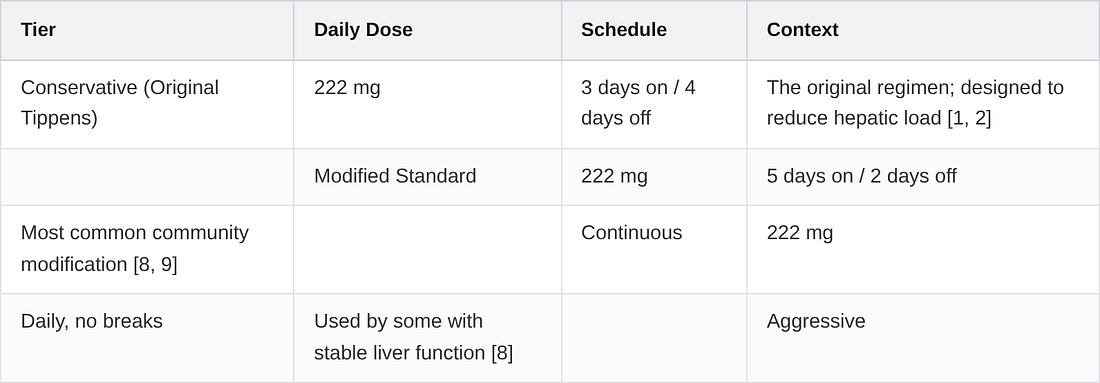
Standard dosing (anecdotal):
Key administration rules:
Always take with a high-fat meal. Fenbendazole is highly lipophilic with poor water solubility. A fatty meal can increase plasma absorption by 2-3x [5, 10]. Examples: avocado, olive oil, nuts, fatty fish.
Source matters. Veterinary-grade products (e.g., Panacur C®, containing 222 mg/gram) lack human pharmaceutical manufacturing standards. Third-party purity testing has revealed inconsistencies in some products [11].
Body weight consideration. The 222 mg dose is not weight-adjusted. A 60 kg person receives a proportionally higher dose per kilogram than a 100 kg person. This is an acknowledged limitation of the anecdotal protocol [8].
What it is: The primary bioactive polyphenol in turmeric (Curcuma longa).
Theoretical rationale: Anti-inflammatory (NF-κB inhibition), antioxidant, modulates multiple signaling pathways involved in cancer cell proliferation and survival [12, 13].
Critical issue — bioavailability: Unformulated curcumin has extremely poor oral absorption — it is rapidly metabolized and eliminated, achieving negligible plasma concentrations [12, 14]. Only enhanced-bioavailability formulations provide meaningful systemic exposure.
Protocol dosing: 600 mg of an enhanced-bioavailability curcumin formulation, taken twice daily (total: 1,200 mg/day) [1, 2].
Formulation types to look for:
Phytosome-based (e.g., Meriva®)
Nanoparticle formulations
Liposomal curcumin
Formulations with piperine (black pepper extract) — increases absorption ~20x
What it is: A non-intoxicating phytocannabinoid derived from Cannabis sativa.
Theoretical rationale: Anti-proliferative and pro-apoptotic effects demonstrated in preclinical models; supportive care role for pain, anxiety, and nausea [15, 16].
Protocol dosing: 25 mg of broad-spectrum CBD oil, taken sublingually, 1-2 times daily [1, 2].
⚠️ Critical safety warning — Drug Interactions: CBD is a potent inhibitor of CYP3A4 and CYP2C19 — the same liver enzymes that metabolize fenbendazole, many chemotherapy drugs, and dozens of common medications [16, 17]. This means CBD can:
Dramatically increase the concentration of co-administered drugs
Prolong the half-life of fenbendazole and its metabolites
Elevate the risk of toxicity from chemotherapy if used concurrently
If you are on any prescription medications, particularly chemotherapy, targeted therapy, or immunotherapy, the addition of CBD requires explicit discussion with your oncologist [16, 17].
What it is: A group of eight fat-soluble compounds — four tocopherols and four tocotrienols.
Current status: Joe Tippens reportedly stopped recommending vitamin E due to concerns about interference with oxidative stress-based treatments [1, 2].
Why it's controversial:
The SELECT trial (a large-scale prevention trial) found that vitamin E supplementation was associated with an increased risk of prostate cancer [18]
As an antioxidant, vitamin E may theoretically protect cancer cells from the oxidative damage that chemotherapy and radiation are designed to inflict [19, 20]
Many oncologists advise against high-dose antioxidant supplements during active treatment [20]
Our assessment: Given the controversy and potential for harm, the inclusion of high-dose vitamin E in the protocol is the least evidence-supported component. If used, tocotrienols may be preferable to tocopherols, but evidence is insufficient to make a definitive recommendation [21].
Published in 2024 by the International Society for Orthomolecular Medicine, the ISOM Protocol represents a more formalized metabolic approach that adds ivermectin to the mix [22, 23].
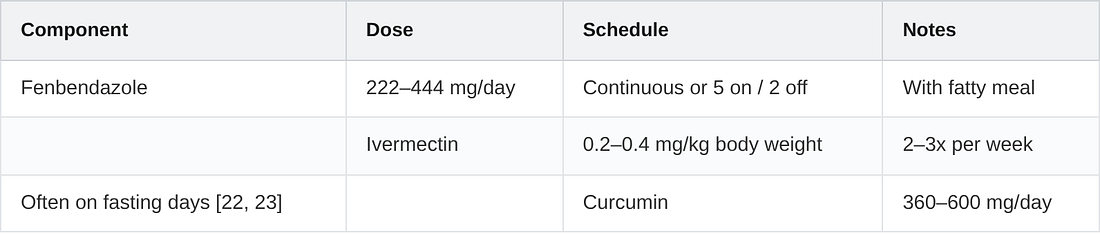
Ivermectin rationale: Inhibits Wnt/β-catenin and PI3K/Akt/mTOR pathways; may induce immunogenic cell death; targets cancer stem cells [24, 25].
Ivermectin safety considerations: Metabolized via CYP3A4 — significant interaction potential. Primary risk at high doses is neurotoxicity (dizziness, confusion, seizures) [24, 25].
If there is only one section of this article you take seriously, let it be this one.
These compounds are metabolized by the liver. Case reports of severe, biopsy-confirmed hepatotoxicity from fenbendazole exist in peer-reviewed medical literature [26, 27, 28]. Safety monitoring is not optional.
Before initiating any protocol, the following should be completed:
Comprehensive medical history
All current medications (prescription, OTC, supplements)
History of liver disease, hepatitis, or elevated liver enzymes
History of G6PD deficiency (critical if considering methylene blue)
Current or recent use of SSRIs/SNRIs (critical for drug interactions)
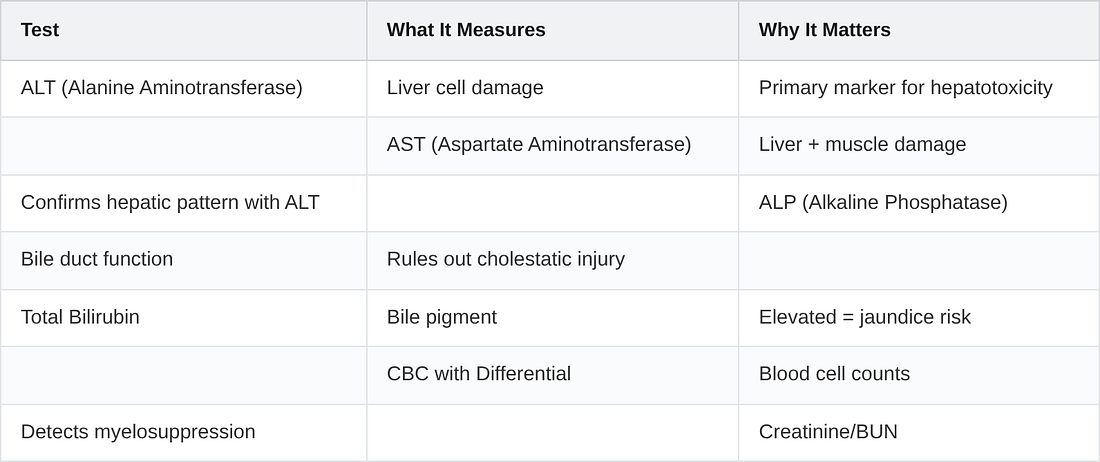
Baseline laboratory tests (mandatory):
Performance status assessment — document functional capacity at baseline for comparison.
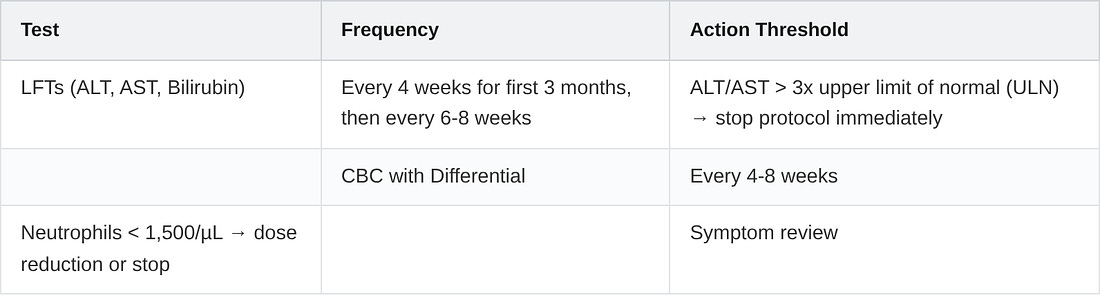
Stop the protocol and contact your physician immediately if you experience:
🔴 Jaundice — yellowing of the skin or whites of the eyes 🔴 Dark urine (tea/cola colored) — suggests bilirubin elevation 🔴 Unexplained persistent fatigue — beyond what is attributable to the underlying disease 🔴 Right upper quadrant abdominal pain — may indicate liver inflammation 🔴 Unusual bruising or bleeding — may indicate platelet suppression 🔴 Fever without clear cause — may indicate neutropenia or infection 🔴 Nausea, vomiting, loss of appetite — early signs of hepatotoxicity
If you suspect liver injury, the RUCAM (Roussel Uclaf Causality Assessment Method) is a validated clinical tool that your physician can use to assess the probability that a specific drug caused the injury [29].
The following interactions are well-documented and potentially life-threatening:
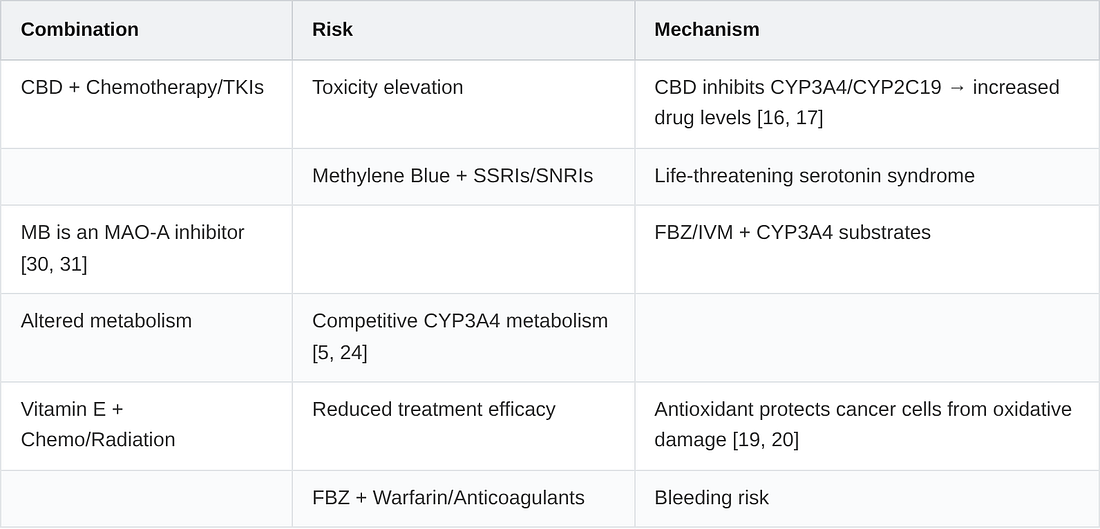
Rule of thumb: If you are on ANY prescription medication, consult your physician or pharmacist before adding any of these compounds.
Based on community experience and pharmacological principles:
Timing with food: Take fenbendazole with your fattiest meal of the day. A tablespoon of olive oil or a serving of avocado with the dose can significantly improve absorption [5, 10].
Cycling rationale: The original 3-on/4-off schedule was designed to give the liver a recovery period. If your liver enzymes remain stable on continuous dosing, some practitioners consider this acceptable — but only with regular monitoring [1, 8].
Dose escalation: If starting for the first time, consider beginning at the conservative tier (222 mg, 3 on/4 off) for at least 4-6 weeks. Confirm liver function is stable before escalating [8].
Storage: Fenbendazole should be stored in a cool, dry place away from direct sunlight. Capsule formulations may be preferable to powder for dosing consistency.
Documentation: Keep a log of:
Doses taken (dates, amounts)
All concurrent medications and supplements
Lab results with dates
Any symptoms or side effects
This log is invaluable if you need medical attention
It IS:
An experimental, community-sourced regimen with a theoretical basis in preclinical science
A framework that some patients and practitioners choose to explore alongside (not instead of) conventional treatment
A protocol that absolutely requires medical supervision and safety monitoring
It IS NOT:
A proven cancer treatment
A substitute for chemotherapy, immunotherapy, targeted therapy, surgery, or radiation
Safe to self-administer without laboratory monitoring
FDA/EMA-approved for any indication
The Joe Tippens Protocol exists because patients are searching for options — and because there is genuine preclinical science suggesting that repurposed antiparasitic compounds may have anti-cancer properties. These are legitimate reasons for interest.
But interest without caution is reckless. If you choose to explore this protocol, do so with eyes open: understand what is known, what is unknown, and what can go wrong. Work with your physician. Get your blood tested. Pay attention to your body.
We provide this guide not as an endorsement, but as an act of transparency. You deserve complete information — including the parts that are uncomfortable.
Medsbase. "Joe Tippens Protocol." Available at: https://medsbase.com/joe-tippens-protocol/
The Medicine Kart. "Joe Tippens Protocol: Complete Guide 2026." Available at: https://www.themedicinekart.com/post/joe-tippens-protocol-fenbendazole-complete-guide-2026
ClinicalTrials.gov. Search: "Fenbendazole." Available at: https://www.clinicaltrials.gov/ct2/results?term=FENBENDAZOLE
ASCO Clinical Notice (May 2026). Available at: https://connection.asco.org/do/asco-clinical-notice-recommending-against-ivermectin-and-fenbendazole-cancer-treatment
Science Insights. "Can Humans Take Fenbendazole?" Available at: https://scienceinsights.org/can-humans-take-fenbendazole-what-the-evidence-shows/
Anticancer Research. 2024;44(9):3725. Available at: https://ar.iiarjournals.org/content/44/9/3725
Dogra N et al. Nature Scientific Reports. 2018;8:11926. Available at: https://www.nature.com/articles/s41598-018-30158-6
Fenbendazole.org. "Fenbendazole Dosage Guide." Available at: https://www.fenbendazole.org/fenbendazole-information/fenbendazole-dosage-guide/
2the.life. "Fenbendazole Dosage Guide." Available at: https://2the.life/blogs/news/fenbendazole-dosage-guide
Medsbase. "Fenbendazole for Humans." Available at: https://medsbase.com/fenbendazole-for-humans-can-antiparasitic/
Makis W. "Fenbendazole on Amazon Tests 56% Pure." Available at: https://makisw.substack.com/p/fenbendazole-on-amazon-tests-56-pure
NCI. "Curcumin (PDQ) — Health Professional Version." Available at: https://www.cancer.gov/about-cancer/treatment/cam/hp/curcumin-pdq
MDPI. "Curcumin in Cancer." 2024. Available at: https://www.mdpi.com/1467-3045/47/9/716
Clinical Pharmacokinetics. "Curcumin Bioavailability." 2024. Available at: https://link.springer.com/article/10.1007/s00228-024-03764-9
PMC. "CBD and Cancer — Supportive Care." Available at: https://pmc.ncbi.nlm.nih.gov/articles/PMC8869992/
ASCO Journal of Clinical Oncology. "CBD Drug Interactions." Available at: https://ascopubs.org/doi/10.1200/JCO.23.02596
Cancer Cell International. "CBD + Chemotherapy Interactions." 2025. Available at: https://link.springer.com/article/10.1186/s12935-025-03870-3
Klein EA et al. "Vitamin E and the Risk of Prostate Cancer: The SELECT Trial." JAMA. 2011;306(14):1549-1556.
Frontiers in Nutrition. "Antioxidants During Cancer Treatment." 2024. Available at: https://www.frontiersin.org/journals/nutrition/articles/10.3389/fnut.2024.1480780/full
Cancer Choices. "Vitamin E." Available at: https://cancerchoices.org/therapy/vitamin-e/
PubMed. PMID: 18059122.
Sanare Lab. "ISOM Protocol." Available at: https://www.sanarelab.science/isom-protocol-a-modern-metabolic-strategy-using-repurposed-drugs/
Sanare Lab. "Ivermectin Dosage, Cancer Protocols & Safety Guide." Available at: https://www.sanarelab.science/ivermectin-dosage-cancer-protocols-safety-guide/
PMC. "Ivermectin: Anti-Cancer Mechanisms." Available at: https://pmc.ncbi.nlm.nih.gov/articles/PMC7505114/
Anticancer Fund. "Fenbendazole, Ivermectin, and Cancer." Available at: https://www.anticancerfund.org/en/blog/fenbendazole-ivermectin-and-cancer-why-anecdotes-arent-enough
PubMed. PMID: 38706451.
PubMed. PMID: 34248555.
PubMed. PMID: 41608149.
Cureus. "Drug-Induced Liver Injury: FBZ + IVM Case Report." Available at: https://www.cureus.com/articles/478304
PubMed. PMID: 20484716.
PubMed. PMID: 29984362.
Disclaimer: This article is for educational and informational purposes only. It is not intended as medical advice, diagnosis, or treatment recommendation. The protocol described is experimental, not FDA-approved, and should not be used as a substitute for professional medical care. Always consult a qualified healthcare provider before starting any new treatment.
📬 Subscribe to Sanare Lab on Substack — all content is free, always: sanarelab.substack.com
🔬 Full protocol breakdowns and research reviews at sanarelab.science
No posts
Comments
Nothing yet. Say the first thing.
Sign in to join the conversation.