
Besides one year spent travelling (and working to save up for more travelling), for the first time in ten years, I am no longer in photography education1, and I tell you what, it feels great. Now, don’t get me wrong, I absolutely loved my time on the BA programme at Arts University Bournemouth and the MA programme here at UWE, but I can’t help but feel that I’ve emerged from a cocoon spent over-conceptualising (and thus over-complicating) my photographic practice.
The way that arts (and photographic, if you want to separate the two) education in this country is handled is a much bigger topic than I’d like to cover now, but I will say that I feel it is inherently flawed. Having art be ‘gradable’ just doesn’t work.
Anywho, onto what I actually wanted to talk about (I swear, the inclusion of this intro will make sense): Peter Hujar’s Eyes Open in the Dark exhibition at London’s Raven Row gallery. I saw this show back in March, and I kid you not, I have thought about it every single day since. Perhaps I am a harsh critic, but there haven’t been many photographic exhibitions in that last couple of years that have particularly wowed me (there have been a few but not many), but this reset the time-since-last-wowed timer in incredible fashion. Not only did this show satiate my visual hunger, but it also stopped my current WIP in its tracks and made me rethink how I’ve been approaching my practice throughout the last few years.
At its core, this show was a series of incredible, touching, well-produced photographic prints, curated beautifully and existing within a sensational space. Of course, there is always a subtext that can be placed on any given work, and Hujar’s work definitely exists within a context, but there does not seem to be a conceptual framework he was working to (outside of the technical aspects, e.g. black and white film photographs, mostly square). There also does not seem to be a linear narrative of any kind. Instead, Hujar (and the curators) allow the photographs to speak for themselves2 — a sea of singular images that would work just as well on their own as they do together.
Seeing this show made me re-evaluate the body of work I was making, and had been making over the last 12 months or so, and honestly, got me to a point where I almost scrapped it entirely. I came to ‘fine art’ photography from a place of wonder and as a way to make sense of and document the world as I saw it. To illustrate the allegories I saw before me and as a medium of self-expression. For many years, this is how it manifested. I took a camera everywhere and was building an oeuvre (if you’ll permit me to call it that) of quasi-documentary imagery (photographing my everyday) whilst continuing to improve on my compositional and storytelling skills. This is what I want to go back to. As mentioned in the intro, I feel as if I’ve spent too much time in the last few years over-conceptualising the work I was making and in turn, the quality of the images themselves has diminished. In a weird way, I feel as if my compositional skills as a photographer have regressed, and to put it plainly, this makes me sad. This regression, if I’m honest with myself, comes purely from the lack of shooting caused by unenthusiasm towards the conceptual framework of whatever it is I have been working on at the time.
Now, it’s important to add that I am not blaming this shift in my practice’s approach solely on the photographic education system. It’s entirely likely I would’ve gotten to this same position without it. Correlation ≠ causation. What it has meant (particularly with the project I worked on throughout my MA programme) is that I felt trapped making work a specific way and/or with a singular vision, and did not feel free to change tack. I think this is the reason why I’ve not felt particularly satisfied with the practical works I’ve made throughout the last few years.
Actually, I should say that when I’ve tried to shoehorn images into a project or concept, that is when I have been unsatisfied. I’ve been, at times, tremendously happy with some of the singular images that I’ve made — which I think, again, drives home my point.
There were, however, so many benefits to studying that I will be eternally grateful for. I am doubtful that I would have ever read, researched, and written anywhere near as much about photography and wider mediums. Being forced to do this through the research journals and essays really opened my eyes to new ways of seeing (and being). I will also be incredibly grateful for all of the connections I’ve made: friends, mentors, industry folk. There is also an endless supply of inspiration and people to discuss this thing that we’re also so passionate about with. This I will really miss.
I say all this not with the intention of scrapping experimentation within my practice, but to reground myself in why I became so obsessed with this medium to begin with and to get back to that position again. I recently ran an image—text workshop with some undergraduate students down in Bournemouth, and the topic came up of how so many people come to photography as it is the intuitive way for them to express themselves and the medium that feels right for what it is that they are trying to say. This is exactly how I felt when I started documenting the world around me. This simple approach is what I’d like to go back to.
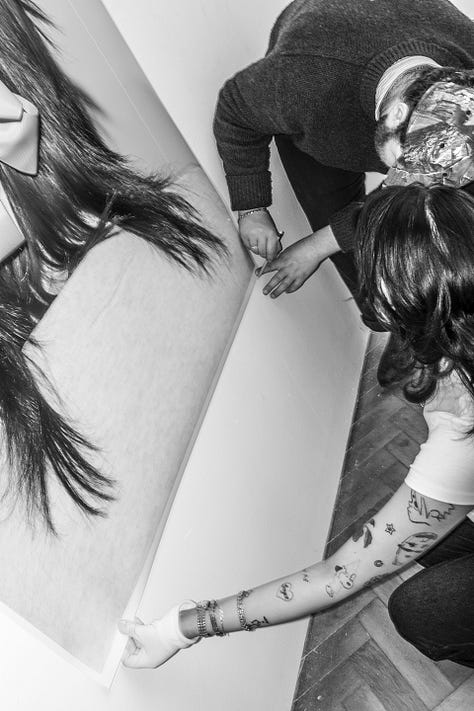
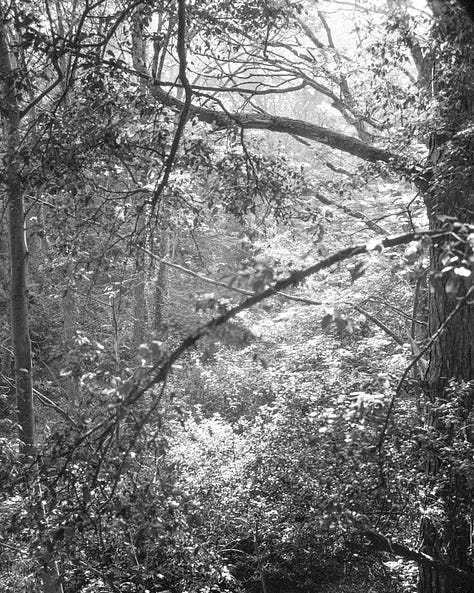
So, with this in mind, I wanted to share some photographs I’ve made recently. Some may take on a life outside of this post, others might not. Who knows. All I know is that I had fun making them.



Another caveat to add is that between Sept 2022 and Sept 2023 I was not a student of arts education but a brief facilitator; a graduate intern at the Arts University Bournemouth. I don’t quite count this as a break as I was still within this world.
I almost made the comparison of the individual photographs acting as their own poems but I’m trying really hard at the moment not to compare photography with other mediums and let it just be its own.
No posts
Comments
Nothing yet. Say the first thing.
Sign in to join the conversation.