
Gospel Reading | John 3:1-17 (NRSVue)
Early on the first day of the week, while it was still dark, Mary Magdalene came to the tomb and saw that the stone had been removed from the tomb. So she ran and went to Simon Peter and the other disciple, the one whom Jesus loved, and said to them, “They have taken the Lord out of the tomb, and we do not know where they have laid him.” Then Peter and the other disciple set out and went toward the tomb. The two were running together, but the other disciple outran Peter and reached the tomb first. He bent down to look in and saw the linen wrappings lying there, but he did not go in. Then Simon Peter came, following him, and went into the tomb. He saw the linen wrappings lying there, and the cloth that had been on Jesus’s head, not lying with the linen wrappings but rolled up in a place by itself. Then the other disciple, who reached the tomb first, also went in, and he saw and believed, for as yet they did not understand the scripture, that he must rise from the dead. Then the disciples returned to their homes.
But Mary stood weeping outside the tomb. As she wept, she bent over to look into the tomb, and she saw two angels in white sitting where the body of Jesus had been lying, one at the head and the other at the feet. They said to her, “Woman, why are you weeping?” She said to them, “They have taken away my Lord, and I do not know where they have laid him.” When she had said this, she turned around and saw Jesus standing there, but she did not know that it was Jesus. Jesus said to her, “Woman, why are you weeping? Whom are you looking for?” Supposing him to be the gardener, she said to him, “Sir, if you have carried him away, tell me where you have laid him, and I will take him away.” Jesus said to her, “Mary!” She turned and said to him in Hebrew, “Rabbouni!” (which means Teacher). Jesus said to her, “Do not touch me, because I have not yet ascended to the Father. But go to my brothers and say to them, ‘I am ascending to my Father and your Father, to my God and your God.’ ” Mary Magdalene went and announced to the disciples, “I have seen the Lord,” and she told them that he had said these things to her.
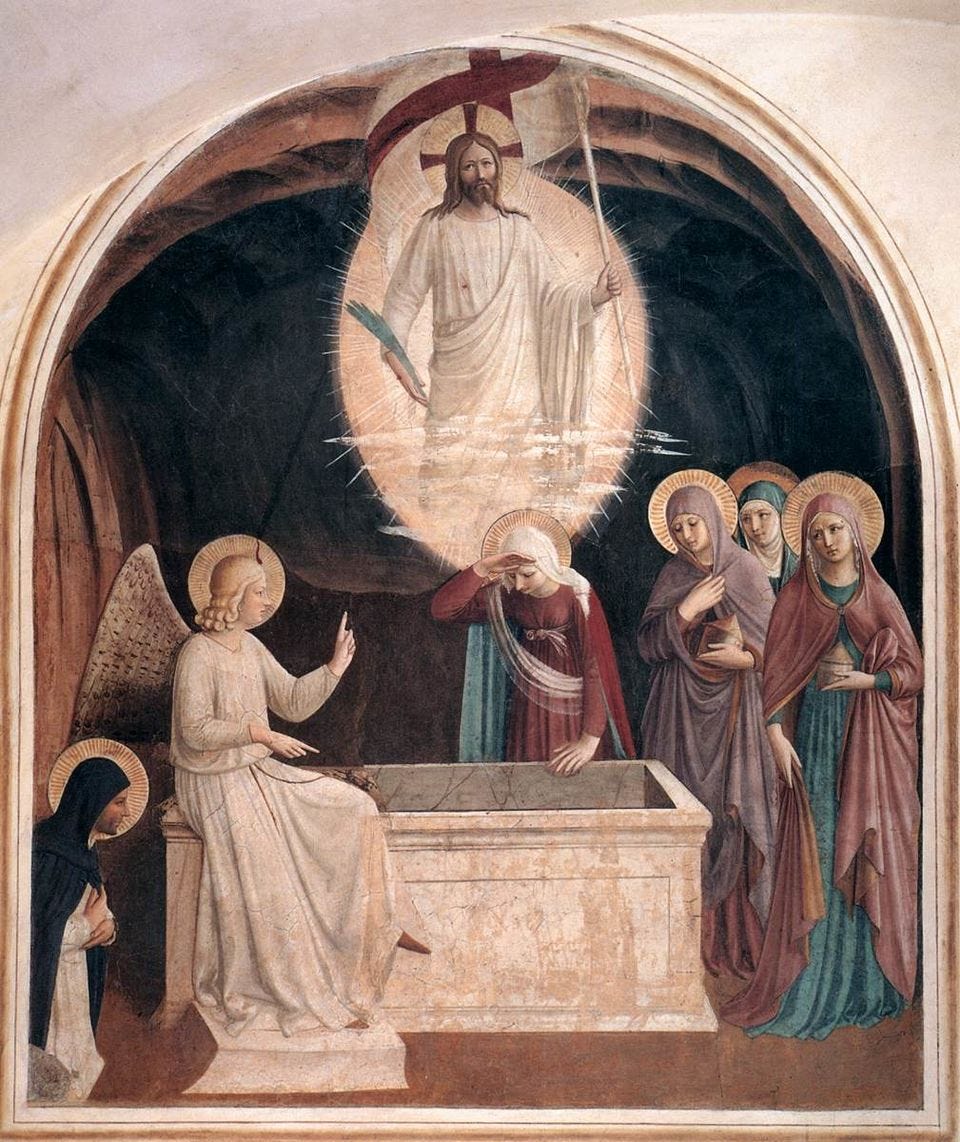
I learned this week that there is a well-known pastor who apparently never preaches on Easter. Or I shouldn’t say that she doesn’t preach, but apparently during the sermon portion of Easter Sunday, she simply gets up and says “Alleluia, Christ has Risen!…Christ has risen indeed, Alleluia!” and then sits back down.
And I should say that I’m not taking that approach this year, but I was shocked to learn that this was even an option.
But what I love about this practice of hers, is that she also makes the point that the Easter story speaks for itself.
The Easter story doesn’t need any extra fluff. It doesn’t need a funny little introduction story or any cute commentary from preachers.
It is enough that we hear the story of Jesus’ resurrection this morning. That we believe it with our whole selves so deeply that we don’t need anything else.
But, she is also the same pastor that texted me this week- and the context of this text really doesn’t matter- but she simply said “The powers and principalities can kiss my ass.”
And I’ve been toying with that funny, cheeky, little text this week. Not only because I spent the week debating if I could get away with saying the word “ass” during my Easter sermon, but also because it sums up how so many of us have been feeling lately.
Like I just really want to stick to the man. Stick it to the people in charge. Really tell them how I feel. Give them ear full. I have some pent up rage, I would love to offer those in charge right now.
And I really love the idea that at some point on Easter morning, as Jesus is resurrected, he has this happenstance meeting with a Roman soldier and he says this phrase to them too. Like maybe, that story didn’t get written down or it wasn’t quite as palatable as the version we now have.
But, the reality is that, Jesus’ resurrection, is snarky. There is an edginess to it. And that phrase, for some reason, just feels fitting this year.
Holy Week has felt different, heavier, even. There is an edginess to the story of Jesus’ death and resurrection anyways, but this year, it really has some teeth to it, in a way that maybe we sometimes skip over.
Because if we’re honest, we have a tendency to make Easter… polite.
We soften it with pastels.
We tidy it up with our Sunday best.
We turn it into something gentle and comforting, something full of chocolate bunnies and candy eggs, something that doesn’t disrupt too much.
But Easter is not polite. Despite how we may dress it up, it is anything but pastels and fluffy bunnies.
Because the world that Jesus was killed by, the empire that sought to silence him,
was not polite either.
The Roman Empire was brutal.
It was ordered by power, enforced by violence, and maintained by what the Apostle Paul later calls the powers and principalities; those systems and structures that decide who matters and who doesn’t, who is safe and who is disposable.
And those powers thought they had done their job.
They arrested Jesus.
They silenced him.
They executed him in the most public, humiliating way possible.
From the perspective of the empire, everything worked exactly as it was supposed to.
They won. The people got the message.
Which is why Easter is not just surprising, but subversive.
Because Easter is God breaking into that system and saying: No.
No, this is not how the story ends.
No, death does not get the final word.
No, the powers and principalities are not ultimate.
Easter is God overturning the verdict of the empire.
And here’s where the story refuses to be polite in another way, because when all of that happens, when the stone is rolled away, when death is undone: the first witnesses are not the powerful.
It’s not Pilate.
It’s not the religious authorities.
It’s not the disciples who ran and hid.
It is the women.
The ones who stayed.
The ones who watched where his body was laid.
The ones who showed up while it was still dark.
The ones who came not with power, not with answers,
but with spices.
With care, with grief, with love for a broken community that didn’t yet know how to go on.
While the powers and principalities were busy maintaining control, these women were doing something else entirely.
They were tending.
They were remembering.
They were holding together what little was left.
And that…that is where God meets the world.
Not in the halls of power.
Not in the machinery of the empire.
Not in the bombs dropped on innocents.
But in the quiet, stubborn acts of care that refuse to let love die.
Easter isn’t polite because it tells us that the future doesn’t belong to the powerful.
It belongs to those who remain.
Those who show up.
Those who keep loving when it would be easier to walk away.
Those who build community in the shadow of violence and call it hope anyway.
Because resurrection doesn’t just defeat death. It exposes the lie that the powers ever had the final say to begin with.
And it places the announcement of that truth into the mouths of those the world has already overlooked.
And this message couldn’t be more important to us right now.
Because we are living in a moment filled with fear and anxiety and grief.
We are watching war unfold in real time, with no clear end, with rising costs, rising tension, and a constant sense that things could spiral even further.
We are living under leadership that feels chaotic and unpredictable, by those who are more committed to power than to peace.
Many of us are living in a time when our very own bodies are being threatened and policed. Where safety from our own government is not guaranteed.
And it leaves so many of us wondering: what happens now? Who is safe? What kind of future are we walking into?
And Easter does not answer those questions with a neat plan or a polished reassurance.
Instead, it points us back to the women.
To those who stayed, who showed up in the dark, who carried love into a world shaped by violence.
Because resurrection does not begin with certainty.
It begins with people who refuse to let fear have the final word.
And this is where and what we are called to live right now.
Not in the illusion that everything is okay, but in the stubborn, defiant work of care, of community, of showing up for one another, even while the powers rage.
Because Easter isn’t polite. It isn’t apolitical.
It doesn’t wait for the world to calm down.
But it breaks in right here. In the fear, in the grief, in the uncertainty, and it dares to say that even now, even here, the powers and principalities do not get the final word.
So, all of that is to say:
“Alleluia, Christ has Risen!
Christ has risen indeed, Alleluia!”
No posts
Comments
Nothing yet. Say the first thing.
Sign in to join the conversation.