
My dad would have been 87 today, a version of him I find impossible to imagine, as to me, he’s a biographical construction of stories and pictures, around a pretty big void.
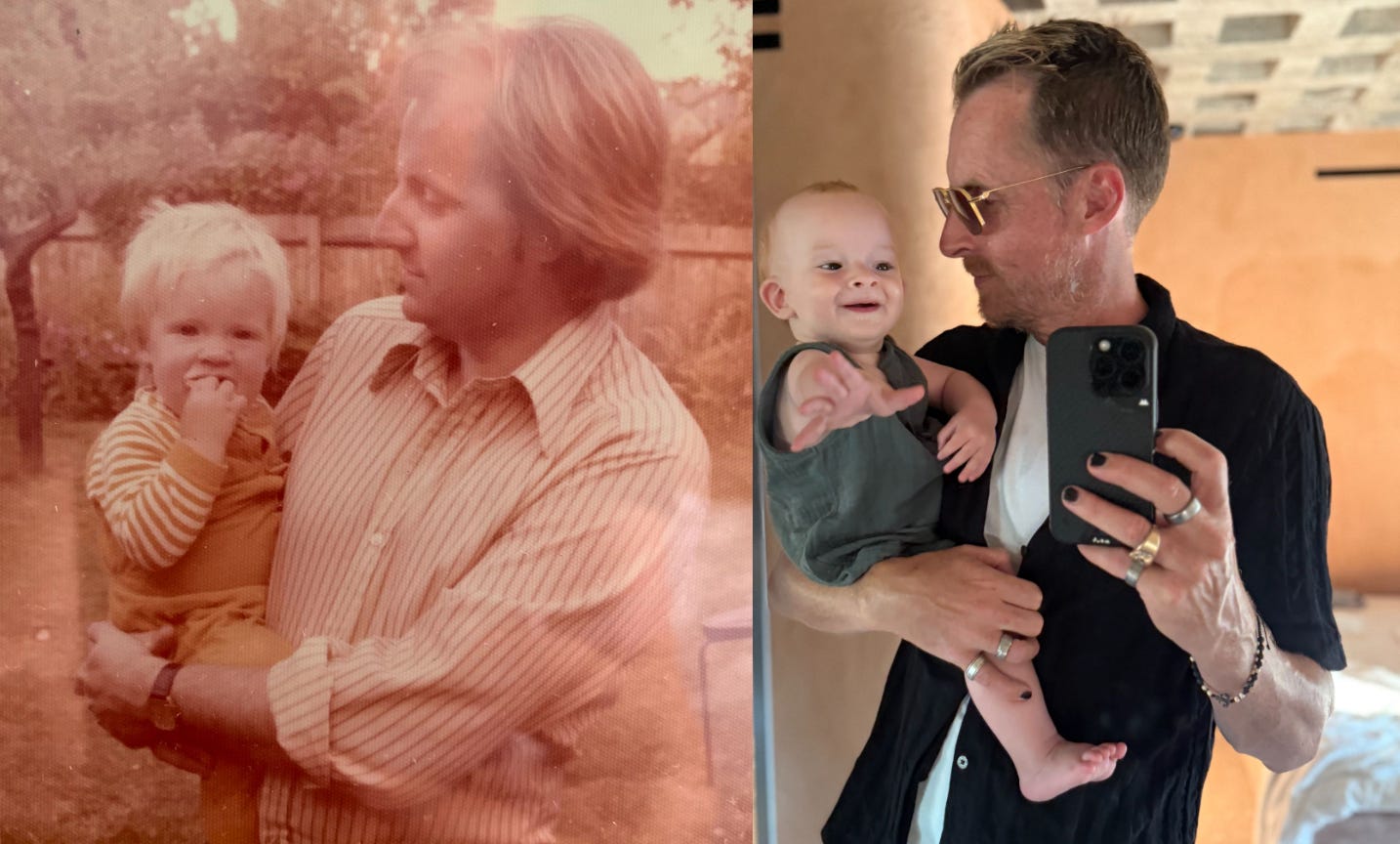
He died when I was five, so my early imagination did a lot with its emotional scrapbook to piece him together. Something, I’ve been trying to unpick ever since.
But I’m not sure you need to have lost your dad young to end up with a semi-fictional father, with both good and bad parts, whose real personality is something of a mystery.
Plenty of people grow up with a dad who is physically present but emotionally distant. Impossible to read, or loving but without language to be literal, the way kids need.
Many people assemble fathers from fragments, fumes, inherited habits and the odd flash of insight in therapy that makes you go, “Oh, for fuck’s sake. That explains a lot.”
In a spooky coincidence, my mum lost her dad when she was five too, and was told, in peak old-school semi-victorian parenting speak, that he had “gone on holiday.”
Emotional distance has a way of trickling down generations, just as love does. We inherit all sorts. Warmth, wit, fear, silence, the knack for not quite saying the thing.
As a teenager, I read Philip Larkin’s ‘They fuck you up, your Dad and Mum’ and felt oddly cheered. “Well, I never met him, I must be in the clear, I thought. What luck!”
Tell that to my therapist (s).
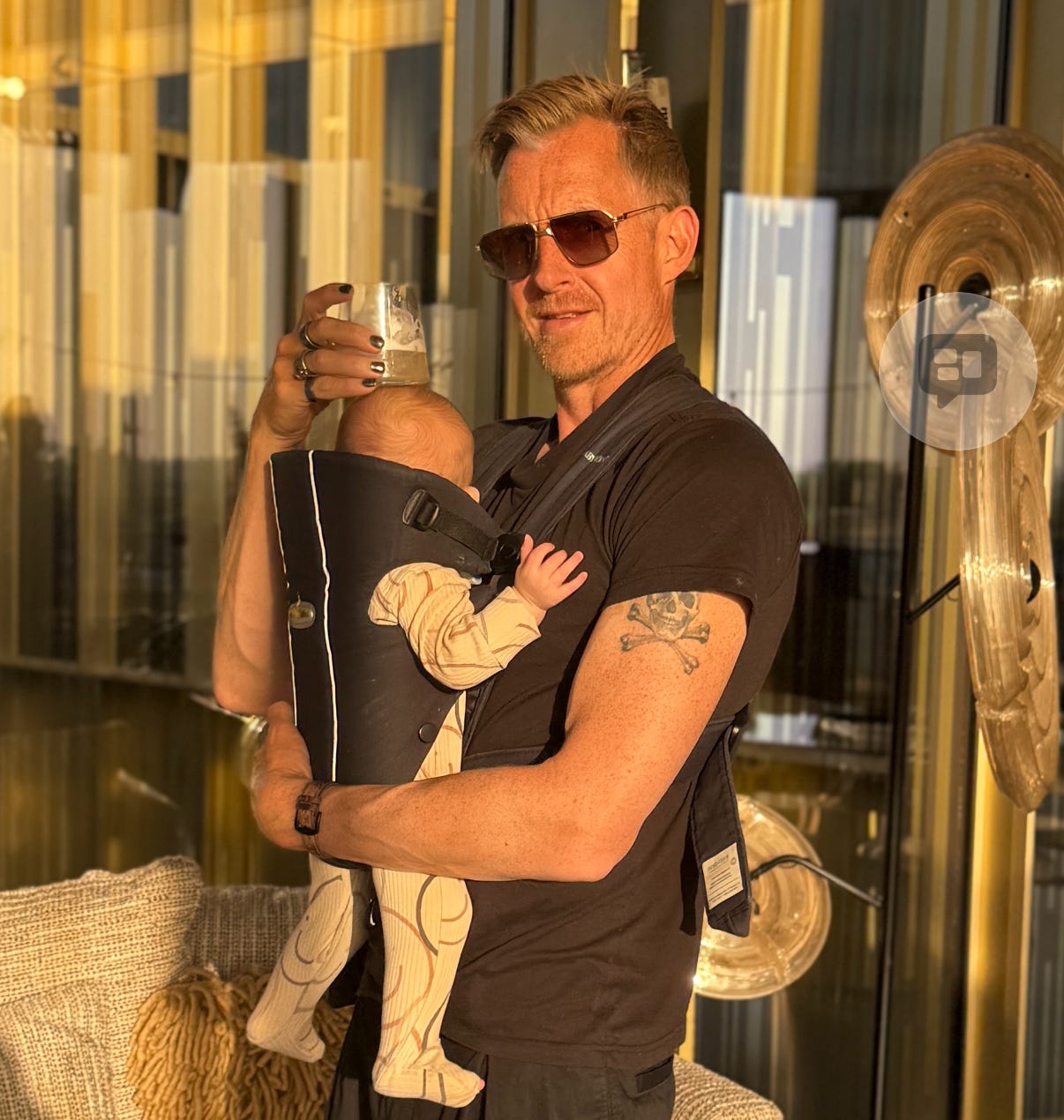
Anyway. Fast forward a few decades, and I now have a small son, Elvis, who’s got me thinking about what gets passed on between men, and what doesn’t?
I mean, how come Elvis loves football? It’s one thing I’ve never given a shit about, and his first word, and first love is pretty much ‘Baaaaaaall’. And off he toddles after it.
Makes me wonder how much of masculinity is taught deliberately versus absorbed by osmosis from whichever man happens to be repressing their emotions nearby.
At almost the same time as becoming a dad again, I launched Hard As Nails, exploring what happens when men introspect deeply on their narratives of masculinity (Spoiler: they become healthier, more emotionally resilient men)
One of the most striking things about Hard As Nails (as we get ready to launch it as a national long-term campaign) is that fatherhood is one of the very few universally acceptable entry points for talking about otherwise taboo topics.
Men who could barely name a feeling without breaking out in a rash would be able to talk about their fears, hopes and their own dads, through the lens of their kids.
Unfortunately for Elvis, one cultural backdrop to the year he was born was the manosphere’s crawl from internet swamp to a defining drumbeat of public life.
The problem of the manosphere isn’t that it’s such a superficial grift, or that the commentary falls short of skewering its empty promises or that we’re not giving enough space to the women it threatens…
The problem with the manosphere is that it’s right. It articulates the frustration better than anyone else, and it wins because it is easy to find and provides simple answers.
Versus the messages of meaningful fatherhood, and healthy masculinity where wisdom is scattered, unsexy, local, under-connected, and often offline, where excellent work is done, and good men can be found, but you’ve got to look quite hard for the good stuff, and no one promises you a six-pack or says all you need is a subscription.
The challenge is not inventing better men. It is how we connect boys and men with their very valid frustrations and questions to the far, far better answers, communities, role models, and father figures that exist than the manosphere can ever offer.
The more I look, the more I see two things at once. There’s loads of good stuff already out there. Great organisations. Great local experiments. Great men doing practical, unglamorous, slightly miraculous work in halls, football clubs, WhatsApp groups, pubs and community centres.
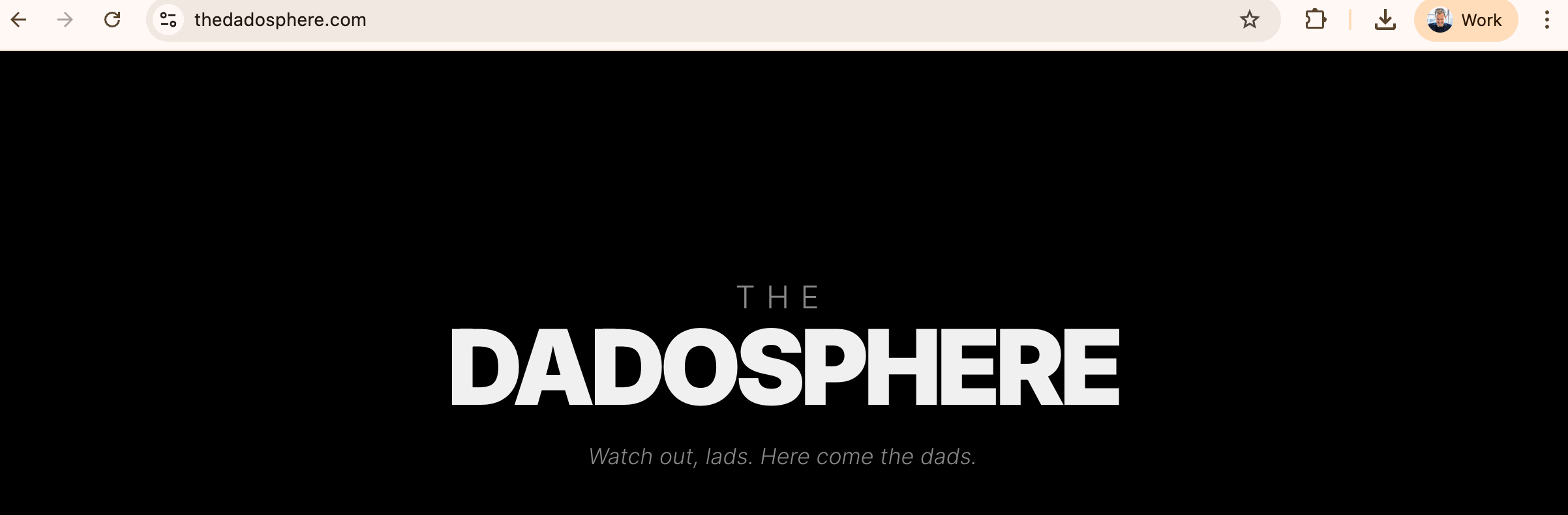
A few nights ago, in the kind late-night brainwave that should come with a warning siren, I briefly convinced myself I had solved a meaningful slice of modern masculinity, bought a domain name…
The Dadosphere: linking valid questions and frustrations men have but find hard to articulate, to a connected, collective (and definitively not artificial) intelligence, network and communities of real men and real answers.
A bit like the Red Hand Files meets a big WhatsApp Group of honest and wise uncles, that uses the sideways honesty men like. and avoids guff in a real time anonyous Q&A.
But, many a life’s been wasted on good ideas that already exist, aren’t needed or are narrow expressions of one’s own frustration, so, before distracting myself from the (many) day jobs I currently have, I figure’d I’d better check in?
So I’ve put together a short Typeform. Dads, father figures, people who work with men, or anyone with a view on where honest male wisdom does and doesn’t live, I’d love your take.
You might tell me this already exists. You might tell me I’m missing something obvious. You might tell me The Dadosphere is a good name, but that’s fifty quid wasted on registering a website that duplicates what’s being better done elsewhere?
But for now, as I’ve learned to do, I’ll try and work something I’m trying to work out myself, in the open in the hope it helps someone else?
thedadosphere.com — "Watch out, lads. Here come the dads."
And while I’m asking for help, a second thing.
I think uncertainty may be costing the UK economy several billion a year through what we’re calling the Decisiveness Crisis.
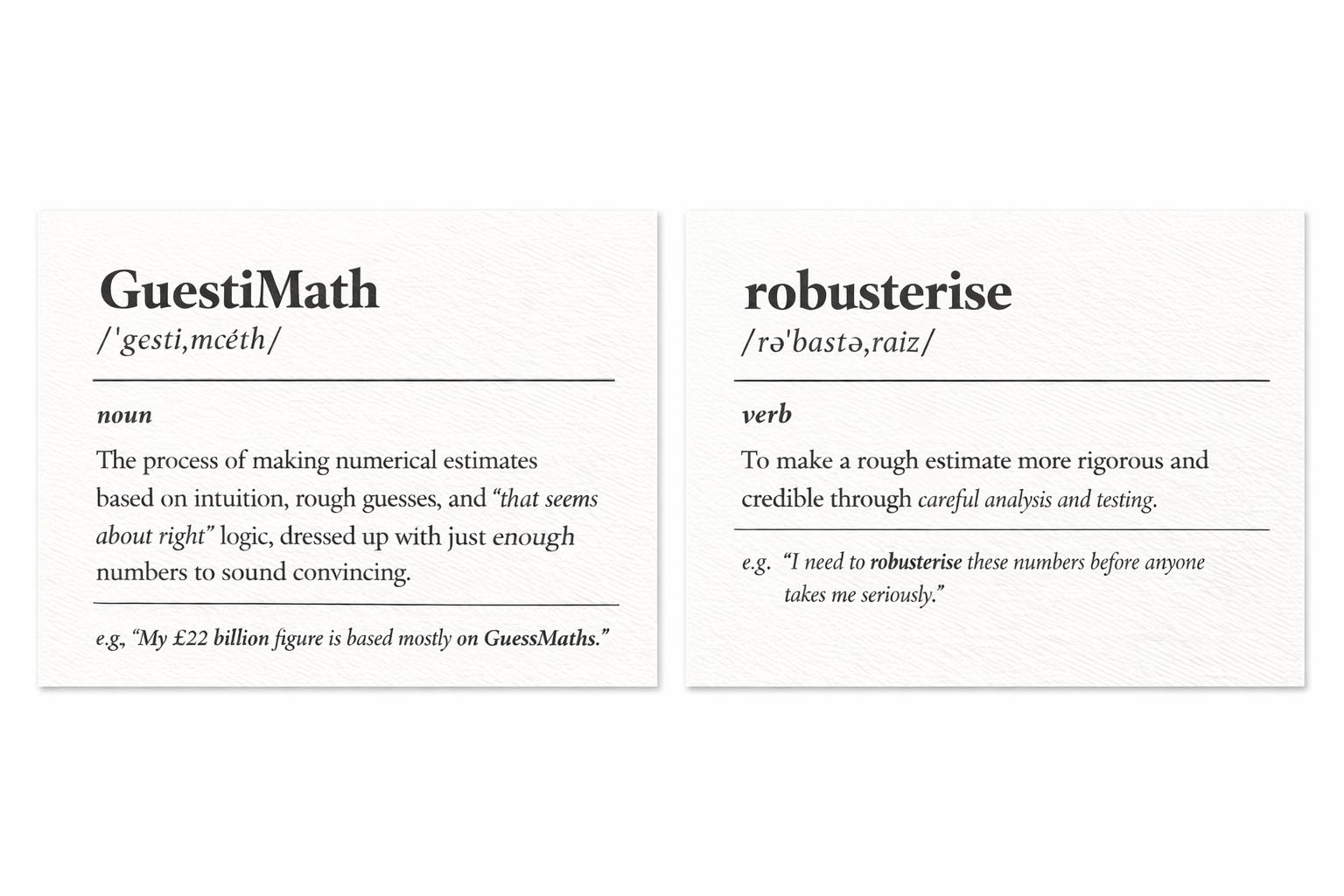
That is not yet a polished economist-approved figure. It is what I’d call a GuestiMath; a rough estimate wrapped in enough logic and benchmarks that it stops looking like a wild guess and becomes almost respectable.
What I need now is to robusterise it.
To robusterise something is to take a GuestiMath number and expose it to enough scrutiny that it can go outside on its own.
You can quote me on both.
Here’s the reason I’m doing this publicly. As many of you know, Uncertainty Experts is now part of the MediaZoo group. That relationship has given us something we didn’t have before: serious machine learning and AI capability that can process our behavioural data far more deeply, and turn it into something practical.
Which matters, because we’ve built an unusual dataset. Not opinion data. Not aspiration data. Behavioural data about how people actually respond under uncertainty.

And one of the clearest patterns in it sits behind the Decisiveness Crisis.
Put simply, a troubling number of people would rather make a bad decision than look indecisive.
Not because they’re idiots. Because uncertainty is socially awkward, professionally risky, and often badly handled by the cultures around them. So people perform decisiveness. They choose speed over judgment. Confidence over curiosity. Action over accuracy.
Which is excellent for looking like a leader for three minutes, and less good for running an organisation.
Now, the reason I think billions might be worth taking seriously is that there are already some chunky numbers nearby. The Chartered Management Institute says poor management costs the UK £84 billion a year. McKinsey says managers spend about 37% of their time making decisions, much of it ineffectively. Our own data suggests that, under uncertainty, a substantial share of those decisions is shaped not by good outcomes but by the need to look decisive.
Which is how, after some highly sophisticated scientific processes pacing around with a calculator and a growing sense of mischief I arrived at, erm, billions
And here’s the bit that makes me actually quite excited.
One of the most robust things in our work is that we consistently improve uncertainty tolerance by around 30%
So, three asks.
If you are, or know, an economist, modeller, analyst, strategist, finance nerd, or one of those rare and glorious humans who gets a sparkle in the eye when someone says causal assumptions please get in touch. Not applause. Not “great thought leadership, Sam.” Not a fire emoji. Actual help.
If you lead a team or a business and this sounds painfully familiar, come to the webinar on May 6 save your spot here. Giles Smith is hosting a CEO roundtable alongside. The white paper is on the way, with one finding about one specific group inside organisations that is frankly a bit terrifying. Very high percentage. We’ll share it properly soon.
And if this number is directionally right, we may be looking at one of the most under-discussed organisational costs in the country. Not uncertainty itself. Not indecision in the usual sense. But the cost of people performing decisiveness because the culture around them makes uncertainty feel professionally unsafe.
Measurable and fixable, which is the sweet spot.
Which is where the May 6 masterclass comes in — save your spot here.
Until then, I remain a man with a calculator, some behavioural data, and a GCSE maths resit on his permanent record.
Which is exactly why I’m asking.
————————-
Many thanks for subscribing (or unsubscribing if this wasn’t up your street) you can see more about my work, topics, talks, and future and past projects (and book me for any upcoming events) all at www.samconniff.com
Comments
Nothing yet. Say the first thing.
Sign in to join the conversation.