
Drawing on the research in our new book, The Uncertainty Toolkit, one data point pretty much explains the whole slo-mo car crash the world’s in.
Politicians trotting out policy they don’t believe in. Companies rolling back on climate pledges. Bosses ordering us back to the office.
Seemingly sensible people voting for Reform.
People in power, prioritising optics over outcomes, are the foundations of the current fucktastrophe, and our research explains why.
I know this is a lot to hang on an intro paragraph, but see below and tell me if you disagree?
Uncertainty is the red thread running through our biggest challenges, from anxiety and burnout to polarisation.
In psychology, Uncertainty Tolerance is called a transdiagnostic driver because A) science loves wonky names and B) it underlies so many behaviours and outcomes.
Over the past 18 months, as we wrote The Uncertainty Toolkit an insight emerged, which stopped us in our tracks;
Before I show you the data, please answer honestly.
In a moment of uncertainty, in front of your team, peers, or people you care about, what would you choose?
A) Being seen as decisive, even if it eventually leads to a negative outcome.
B) Being seen as indecisive, even if it eventually leads to a positive outcome.
Which would it be, in truth, in front of the people whose respect matters to you?
Now the data: (and if you could do a little drum roll, wherever you are, I’d appreciate it)
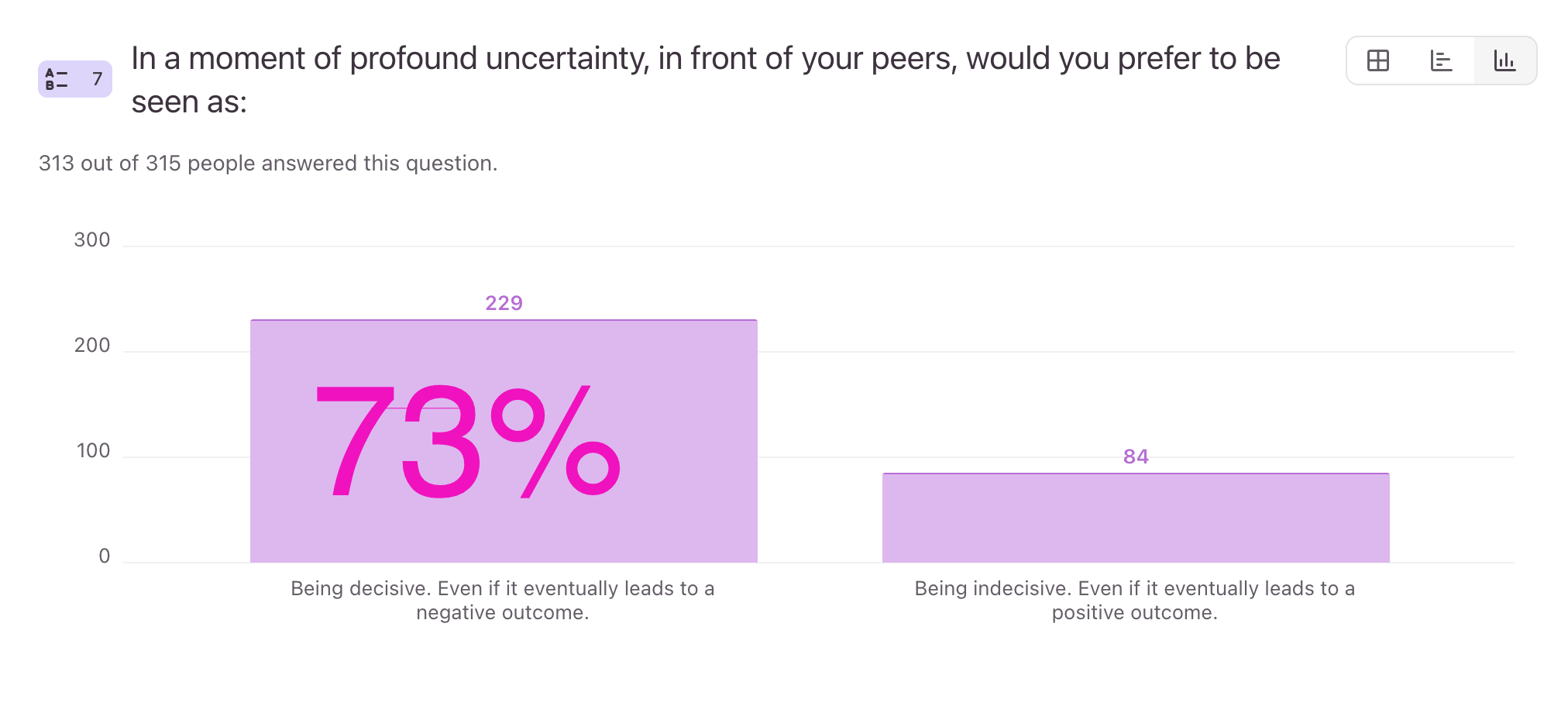
Across thousands of anonymised responses across different sectors and countries, around 70% prefer to be perceived as decisive, screw the negative outcome.
When we segment leadership populations, it rises to 80% who would forgo a positive outcome to be seen as a decisive leader.Which, in one statistic, describes, erm, the whole of politics (Hi Kier 👋👋)
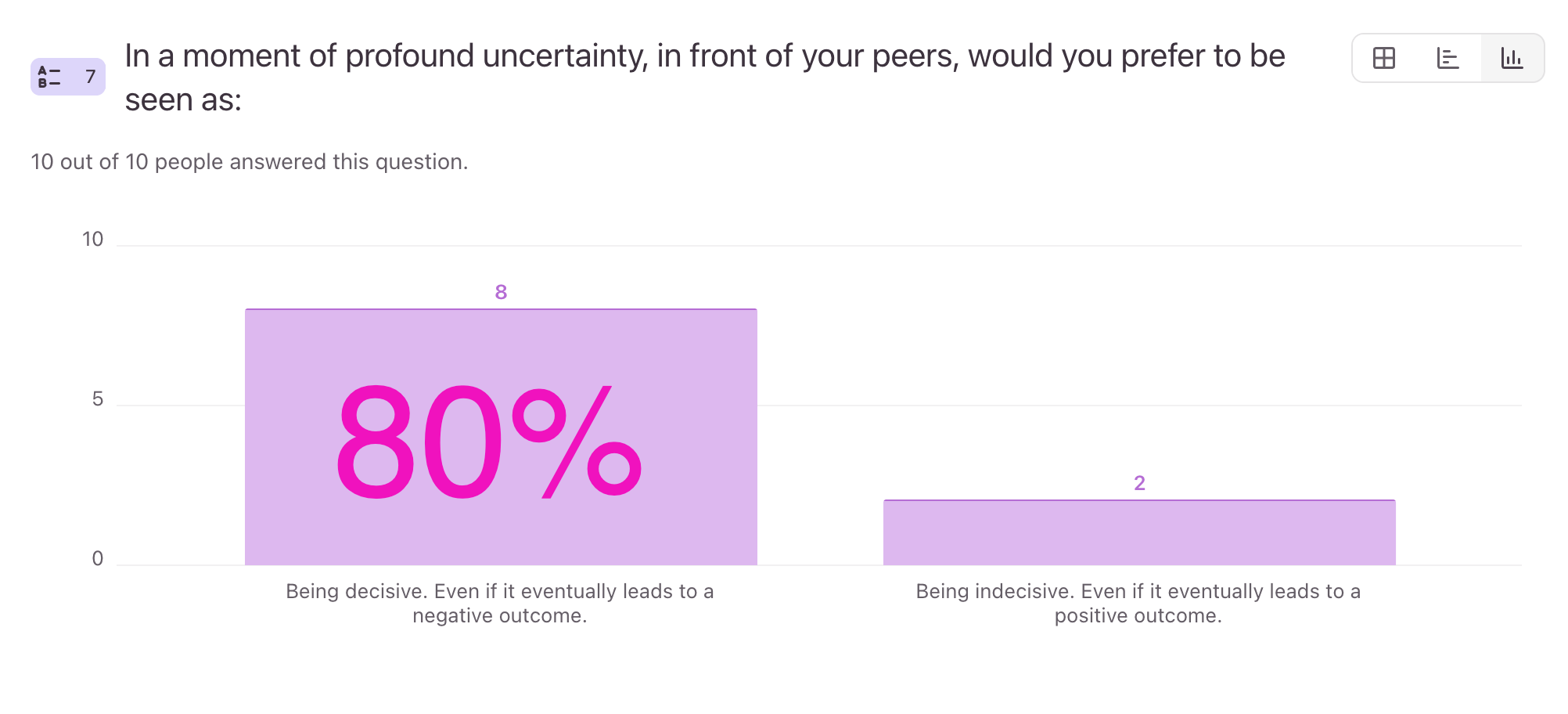
When we present this diagnostic before we teach the Uncertainty Toolkit to teams, they’re not best pleased, but they’re rarely surprised.
Most of us are navigating environments where speaking up, standing out, or saying “I don’t know” feels risky to the point of insanity.
Where decisiveness is praised, speed is rewarded, and uncertainty is quietly equated with weakness. We do what humans do under social threat.
We protect ourselves.
We kick the can of brave decision-making down the long road of responsibility.
This is how bad decisions get made without bad people. How short-term wins accumulate into long-term damage.
But this isn’t individual failure; this is corporate culture. “You don’t have to love groupthink to work here, but it helps”
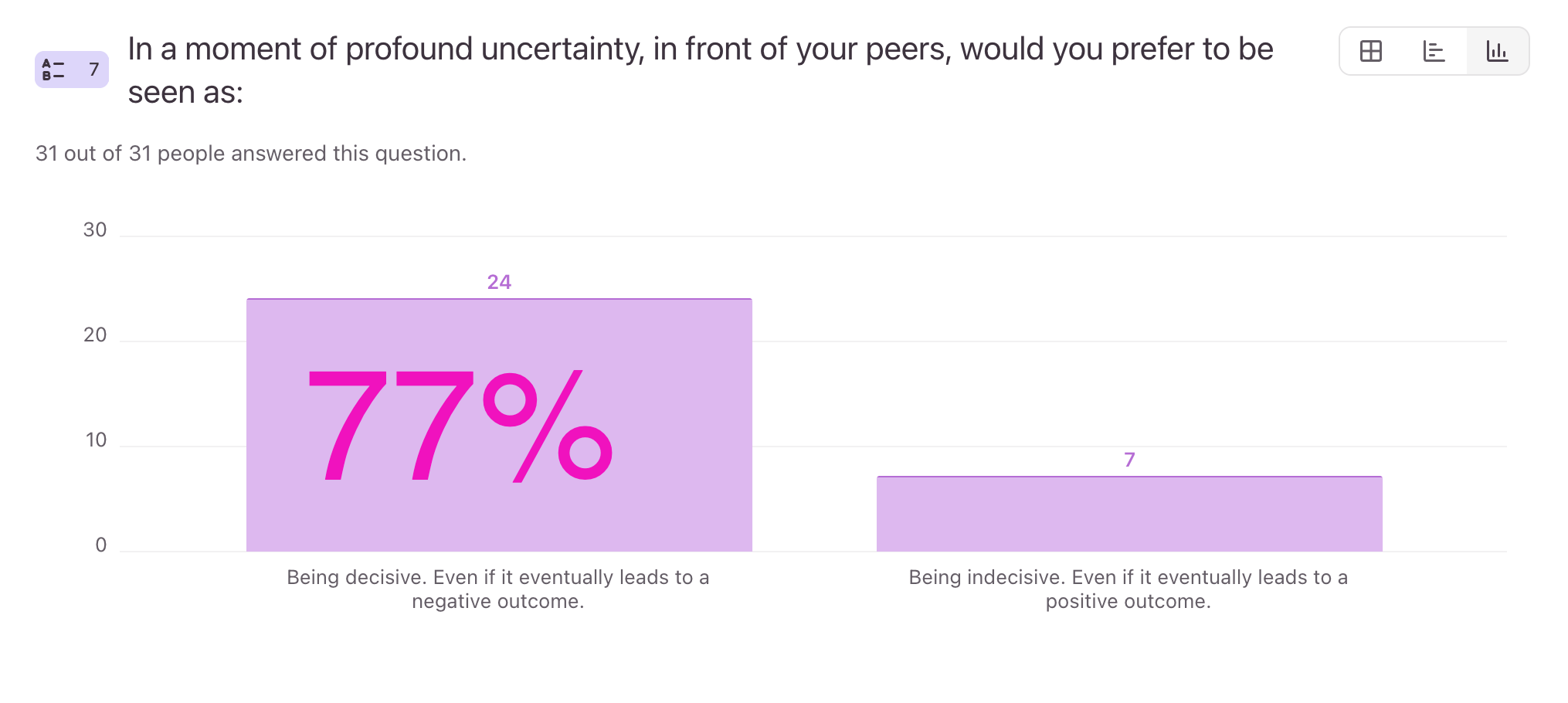
We might expect Leaders to be less driven by the need for certainty; our research always shows that they typically have higher Uncertainty Tolerance.
Which means they should be the ones most able to say, “We don’t know yet. We need more time. We can handle the discomfort.”
Instead, the bias intensifies.
That’s not because leaders are worse people (at least most of them), I think it’s because leadership has become one of the most psychologically exposed roles in modern life.
Very few leaders do the job they applied for. They grew up watching leaders with more control, more certainty, more levers.
But now they’re in charge, the spec has shifted. Accountability has increased, and controlability decreased. Visibility is constant. Judgment is instant.
Modern leadership exists in a crossfire, with a target on your front and a "kick me" sticker on your back, and, in that context, decisiveness becomes armour.
This explains why calls for “boldness” in organisations are a trap.
Leaders sense the problem. They know fear is in the room. But without changing the conditions under which people operate, “be bold” is heard as “be decisive”.
And when decisiveness is the only safe move, boldness collapses into short-termism.
Recycling old ideas. Cost-cutting dressed up as strategy. Confident posturing about AI. As long as it sounds decisive, it passes.
But far more bravery is required to remain in not-knowing than to stand confidently behind a bad decision.
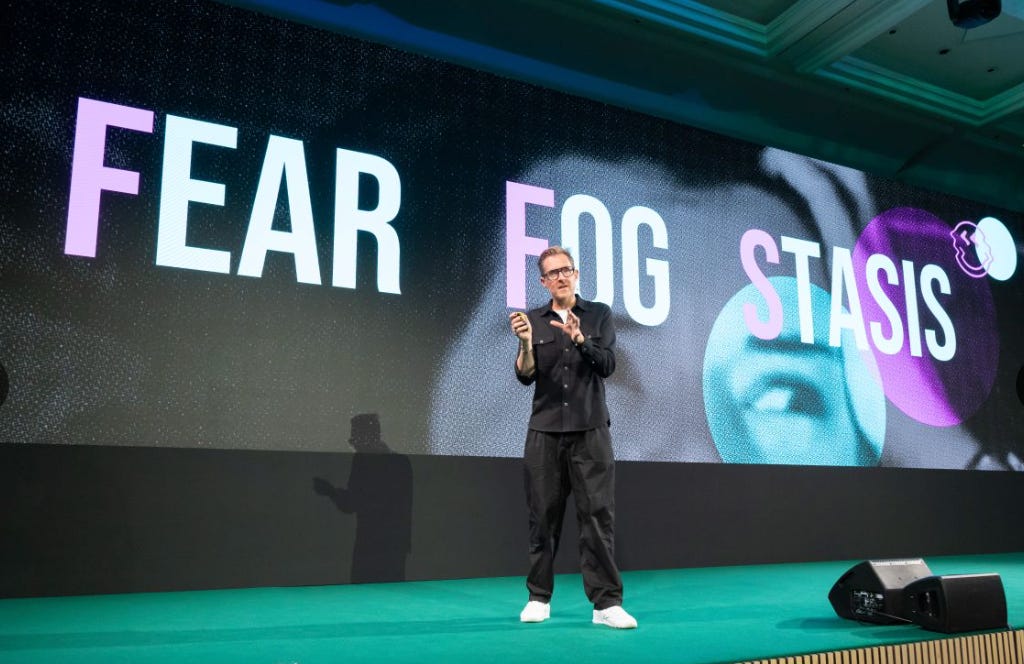
The question we pose isn’t a choice among bravery, indecision, or action.
It’s indecision paired with a positive outcome, versus decisiveness paired with a negative one.
That’s the fragility the data exposes. Not personal weakness, but a system that makes short-term certainty-craving feel safer than long-term sense-making.
But here’s the anomaly, which might hold a clue to rewiring this flaw at the heart of so many organisations whose decisions determine the next decades of our lives.
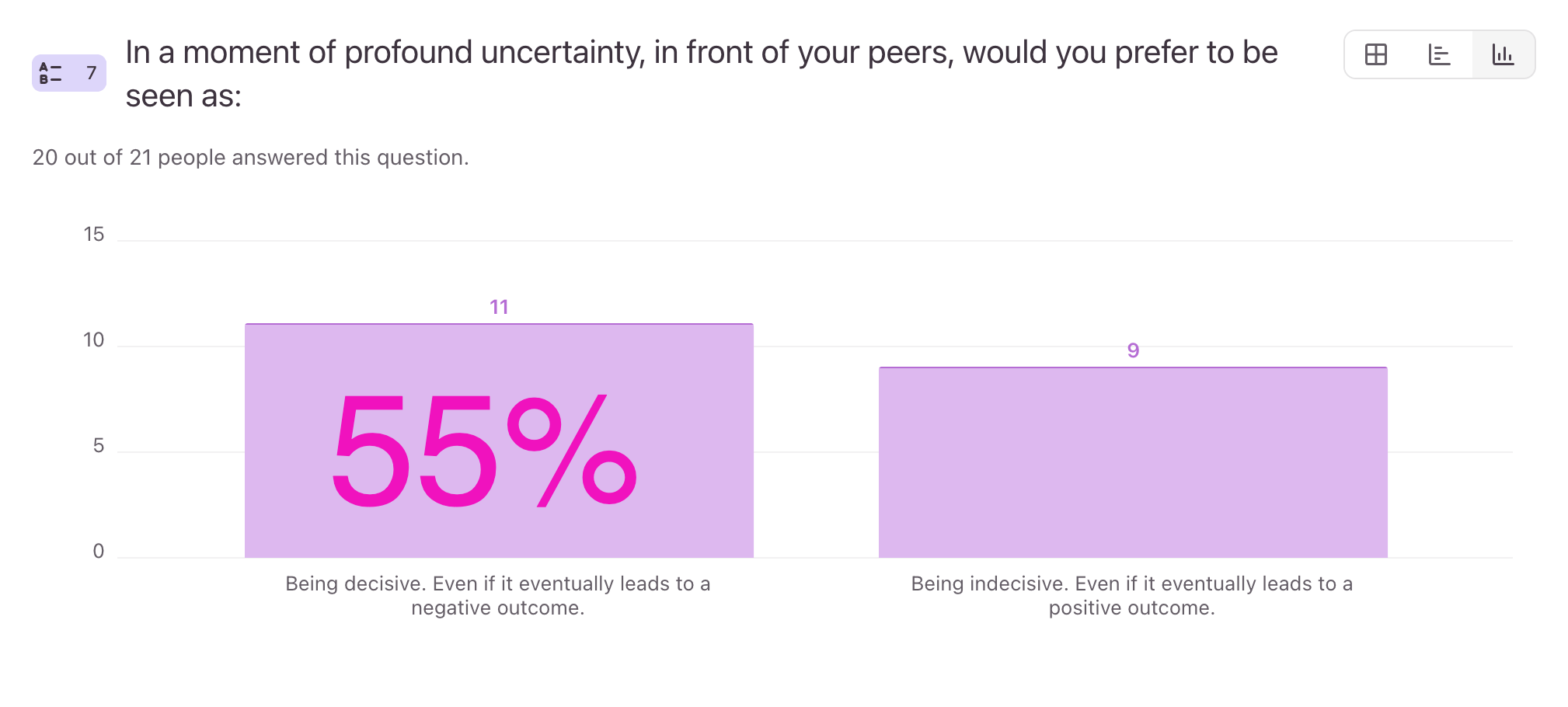
In the data from frontline public-sector workers, the pattern reverses.
NHS staff and teachers are the only teams who prioritise a positive outcome, and actually choose the awkwardness of indecision:
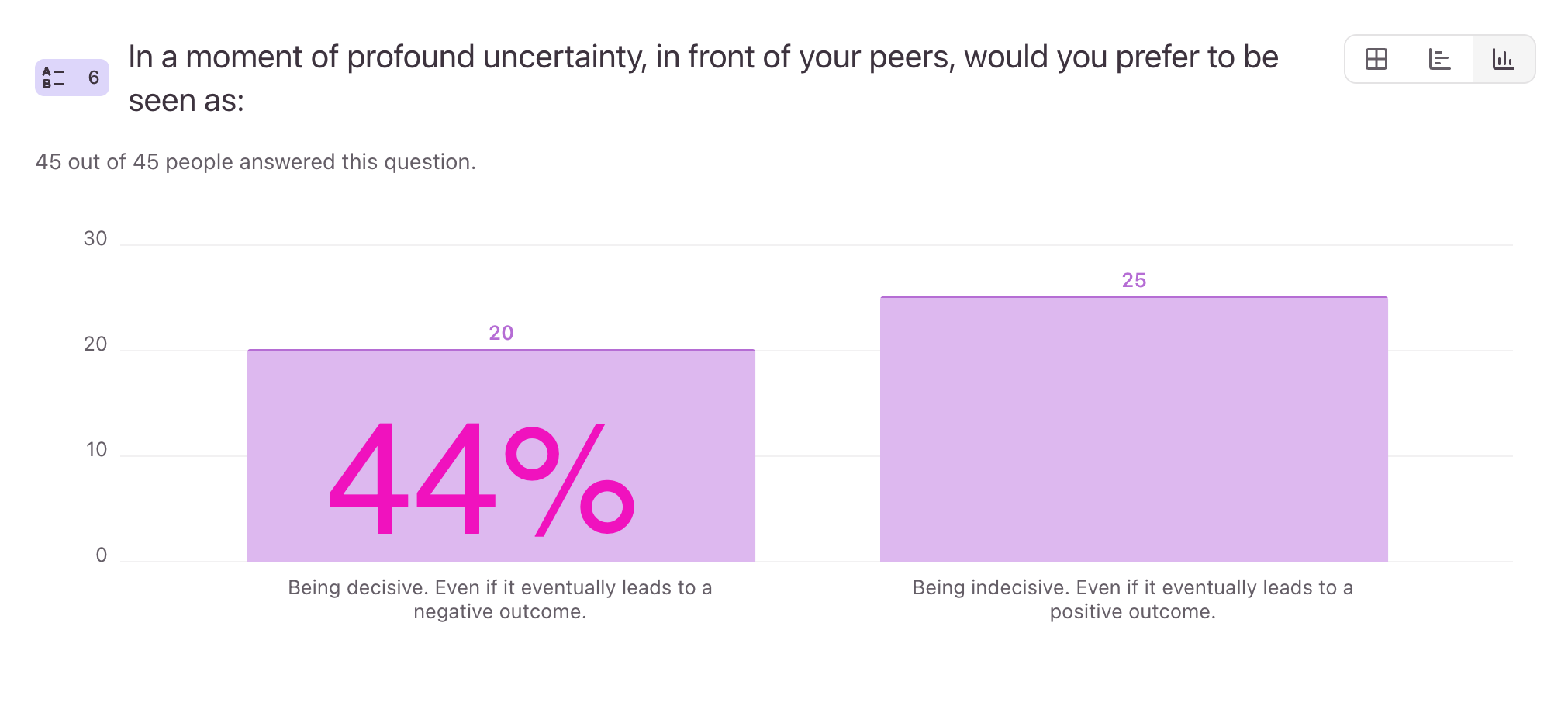
It’s the only place where the trend reliably shifts and it invites a question: why do NHS workers and teachers do what senior leaders of global businesses can’t?
It’s tempting to reach for easy answers. Life-and-death decisions. Moral superiority. Public sector virtue versus private sector vice.
But I know a lot of corporate professionals who believe their uncertainty is existential and their mission vital.
A more interesting possibility is temporal, or a matter of perspective.
Corporate life is organised around short-termism. Quarterly results. Performance cycles. Visibility now. Consequences later, often diffused or displaced.
By contrast, much of the public sector is inescapably institutionalised with long-term human outcomes. Decisions echo. Effects resurface. You live with what you choose.
Interestingly, NGOs and charities appear in a similar place, not relatively as low, but mid-50s, so another nudge in the same direction?
Perhaps what we’re seeing isn’t about Bad Business vs. Heroes, but about time horizon, or at least I hope it is, because that might be fixable or trainable.
Perhaps our most significant problems aren’t (always) the result of bad practice, but of temporal mismatch. We’re optimised for speed, certainty, and appearance in systems that increasingly need patience, ambiguity, and outcome thinking.
In an uncertain world, leadership may be less about having the answer and more about holding air cover for others to work shit out.
Holding uncertainty long enough for better decisions to emerge and absorbing pressure so that teams don’t default to false certainty to relieve discomfort.
If the data is pointing anywhere, I suspect it’s that improving decision-making under uncertainty isn’t a mindset tweak. It’s a structural, psychological, and institutional rewiring job to extend time horizons, reduce the social cost of not knowing, and reconnect work to consequences that actually matter.
And, as I try to reach for a poignant, but powerful conclusion, I can’t help but realise that despite large datasets, neuroscience, and hopefully what looks like cutting-edge insights, I am actually just circling back to something deeply human:
The balancing act between short-term comfort and long-term consequences, the inner trade-off between wanting to do the right thing and having to do the hard thing.
But perhaps that’s the point.
In a world that’s only getting more uncertain, the real skill may not be decisiveness at all.
It may be learning how to stay with the not-knowing long enough to choose well.
Comments
Nothing yet. Say the first thing.
Sign in to join the conversation.