
TL;DR: We rebuilt the Elite Agent website using AI instead of a dev agency — custom theme, database cleanup, taxonomy overhaul, the lot. In case you don’t remember, I'm not a coder.
You’ve heard the advice. Don’t build on rented ground. Don’t pour everything into Instagram because the algorithm could change tomorrow. Build your website. Own your audience.
You nodded along. You did the thing. You invested in the website.
But here’s what nobody told you: if someone else manages it, if you can’t change the homepage without a ticket and a quote and a three-week wait, if you don’t actually know what’s behind the walls — it’s still rented ground.
I would argue you had actually just painted your name on the letterbox and assumed you owned the place.
So - now you know this is a story about a website rebuild.
I can hardly believe I’m writing about one in a week where one of the top AI stories is an AI-generated Val Kilmer being cast in a feature film. But as much as I loved Val Kilmer (vale) this might be more useful. Not all of us get to resurrect movie stars. Some of us are cleaning databases.
If websites are not your thing, I respect it. But maybe stick around for the bit where I accidentally discover our database contains 39,000 rows of world city data for no discernible reason. Or the part where I worked out that a Claude Max Plan saved me $50k in development fees and how that has opened up the future of eliteagent.com…
So, we quietly unveiled a new-look eliteagent.com website last week.
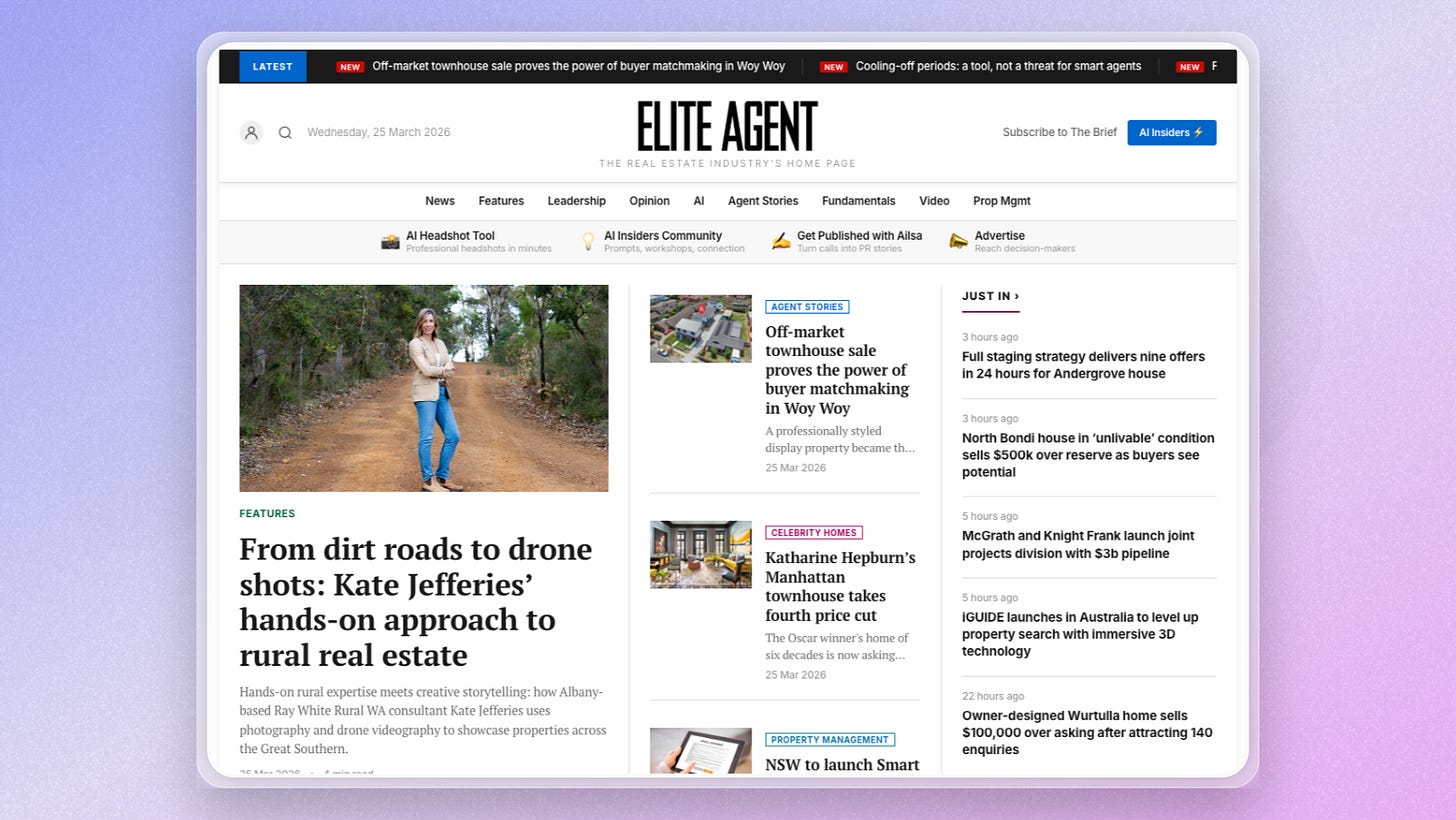
I used to manage the Elite Agent website myself.
I know — the editor managing the website. But in the early days, when it was just Mark and me building a magazine from nothing, you do what you need to do.
Wrote the articles. Designed the pages. Uploaded the images. Fiddled with the theme settings. Broke things. Fixed things. Broke them again slightly differently.
But over the years, as the business grew and I leaned more into the creative side — the magazine, the newsletter, the training, the content — we did what every small business does.
We outsourced it.
First to one developer. Then another. Then an agency. Then a different agency. Then some randoms on Upwork.
Each one arrived with their own favourite plugins.
Their own “we need to install this for SEO.”
Their own idea of how things should be structured.
One of them decided we needed these impossibly long, keyword-stuffed category names for search optimisation — you know the type. “Real Estate Marketing Tips and Strategies for Australian Agents 2019.”
As a category that you had to look at in the dashboard. Every. Single. Day.
All the while, our hosting bills kept creeping up. Because someone said we needed more disk space. Or more PHP workers. (I still don’t fully know what a PHP worker is. It sounds like a tiny elf inside the server.) Whatever it was, it cost more money, and we kept paying it because what were the options?
Thirteen years of that, and our WordPress database looked like a sharehouse kitchen at the end of a lease. Nobody’s quite sure whose stuff is in the fridge, but everyone’s afraid to throw anything out.
For most of those 13 years, we ran a premium theme called Jannah. Perfectly good theme. Gets regular updates. Does what it’s designed to do.
The problem isn’t Jannah. The problem is the model.
Premium themes are built to do everything for everyone. Jannah has hundreds of features, layout options, and widgets. We used maybe ten. But the 390 we didn’t use? Still there. Still loading. Still creating plugin conflicts that someone — usually someone on the other side of the world who I had to wait for — had to untangle.
And depending on which developer you got, they all had their own fixes too. Developer A’s solution was always a new plugin. Developer B liked to edit the theme files directly. Developer C would look at what Developer B had done and sigh heavily at Slack (no judgment!).
And the things our business actually needed? I’m sure any of that would’ve been straightforward for someone with actual dev skills. But we didn’t have those skills in-house, and we’re a small business. Every custom request was a project, with a scope, a quote, and a timeline.
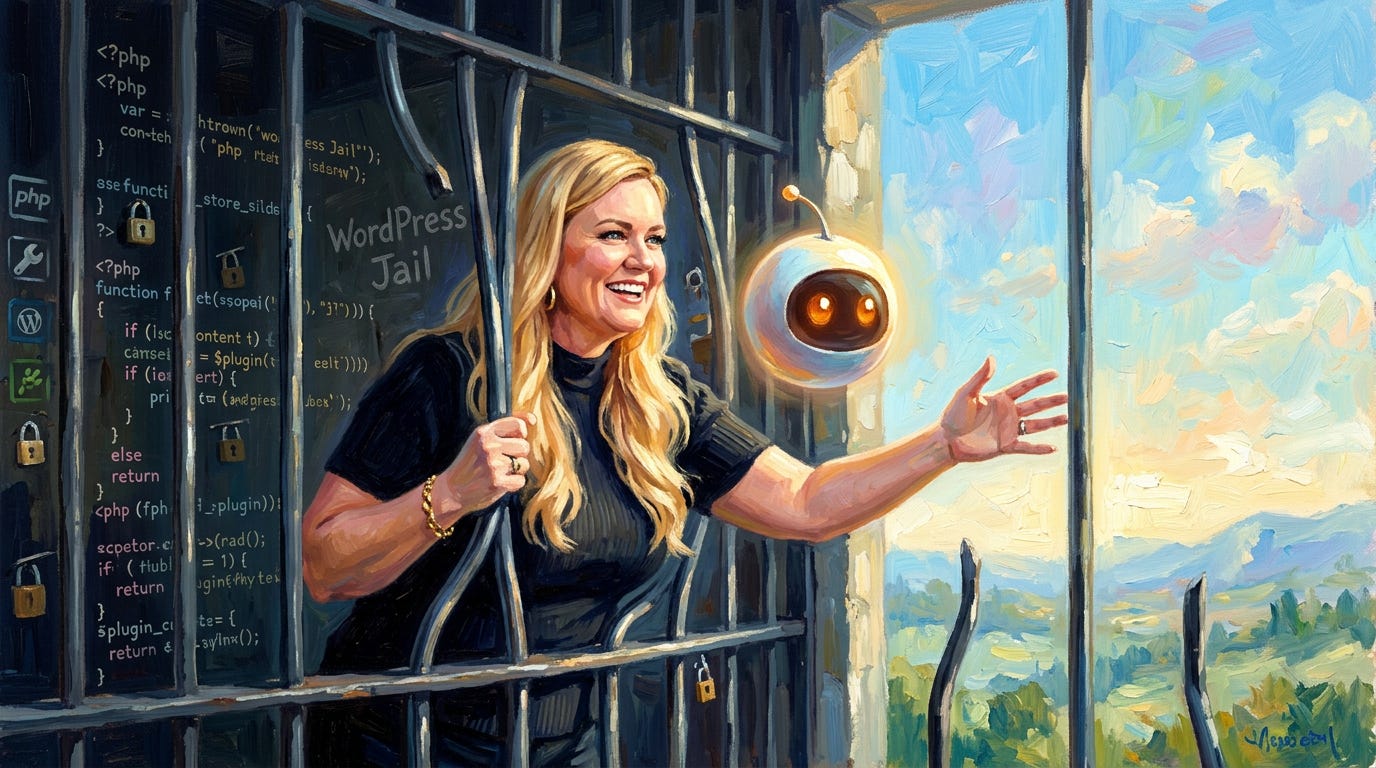
So we stayed in jail.
Not locked in by a contract. Locked in by complexity. And, if I’m honest, by not knowing there was another option.
Here’s what I believed for years:
If we left the theme, we’d lose everything.
Not the articles — those are just WordPress posts, they’re portable. I mean all the invisible stuff. The customisation. I couldn’t see it, couldn’t map it, and was terrified that pulling on any thread would unravel the whole thing.
And honestly? If you’d asked an agency to scope a “theme migration,” they’d have confirmed your worst fears. “Oh yes, there’s a lot of custom data in there. The work required to migrate all of that… probably another $20,000.”
Many people pay that sort of money and think it’s normal.
Turns out? When I actually sat down and looked at the database — properly looked at it, with Claude helping me query and understand what was in there — most of that custom data was perfectly standard. The new theme could read it just fine. No migration needed. No data conversion. No five-figure “migration project.”
Now I have a co-worker who has all of that knowledge in one place — the kind of knowledge you’d normally need to hire about ten different specialists for. A database person. A PHP person. A WordPress architecture person. An SEO migration person.
That’s the reality of the world we’re living in now.
Before we built anything new, there was a more urgent problem. That ‘fridge’ that needed cleaning out.
Ghost tables from plugins uninstalled years ago. 35 tables from WooCommerce. A geo-location plugin that left behind 39,000 rows of world city data. (We are a real estate news site. We did not need a personal copy of the world atlas.) 101,000 spam comments. 530 tags for a site that needed 14.
So one Friday night — and I’ll be honest, there was wine — I sat down with Claude, and we went through every single table together. By midnight, we’d dropped 58 of them, deleted those 101,000 orphaned comments, cleaned 530 tags down to 14, and removed over 5,000 orphaned media files. Over 500MB of database bloat, gone in one evening.
“If only cleaning the shower was that easy,” I typed into the chat window.
Claude’s response: “To be fair, your shower probably doesn’t have 39,000 rows of abandoned city data lurking in the tiles.”
Hard to argue.
This is the bit that would’ve sounded completely unhinged two years ago.
I didn’t hire an agency. I didn’t find randoms on Upwork. I didn’t rebuild in Squarespace or Webflow or whatever the hot platform is this week.
I used AI to build a custom WordPress theme from scratch.
Some of it happened on my couch. Some of it happened in hotel rooms on the road in Tasmania, between speaking at the REIT events. All of it happened when I described what I wanted, and the AI wrote the code.
Claude asked me what sites I liked and gave me some wireframes. I almost cried. And we got to work.
As always, I have to be real: It wasn’t magic. It wasn’t “press button, receive website.”
It was real work. Problem-solving work. But I was describing problems in English and working through them in real time — not waiting for someone to wake up on the other side of the world.
My major takeaways are below the main part of this post.
I got curious, so turned over a bar coaster and began adding it up. Custom theme, database cleanup, taxonomy restructuring, page migrations, admin customisation, SEO and analytics rewiring — all up, about $25,000–$50,000 AUD worth of work.
That’s not counting all the Google Tag Manager stuff I had to fix for all the same reasons a couple of months ago.
But the real ROI - when something breaks — and something always breaks — I’m not calling someone and explaining our entire setup from scratch. I’m opening a chat and fixing it that evening with a co-worker who understands every line of code.
The next time I want to add a section to the homepage or restructure a category or put a new interactive tool on the site, I’m not waiting for a quote. I’m just… doing it.
And if I can do it, then I can train someone else to do it.
AI didn’t make me a developer. Let’s be very clear about that. I cannot sit down and write a WordPress theme from memory. I still don’t really understand what apply_filters does. (Something with filters, presumably.)
But I have a co-worker now who has the combined knowledge of a database specialist, a PHP developer, a WordPress architect, an SEO migration expert, and a very patient therapist — all in one chat window. Available at midnight on a Friday, or from a hotel room in Hobart, or wherever I happen to be when I think “actually, let’s fix that thing that’s been bugging me.”
And here’s the thing — the skill that makes this work isn’t coding. It’s describing. Clearly explaining what you want, reviewing the output, and saying “no, not that — this.”
You already know how to do that. You do it every day. Explaining what a buyer needs. What a seller should expect. What a property offers that the photos don’t quite capture.
That’s the same muscle. You’ve just never pointed it at your tech stack before.
The core website was the big one. But it’s not where this stops.
I’ve been building new features for our paid members, which I’ll be announcing this week. There’s a new job board coming. And there’s more after that now that I’ve freed myself from “Website Jail” with much appreciation to Claude.

Give AI one job at a time. This was my biggest lesson and I learned it the painful way. Early on, I’d fire off a massive list of fixes — “change this, move that, rewire this other thing, and while you’re at it fix the sidebar.” The AI would come back with something that looked done from a distance but fell apart the moment you actually clicked anything. The day I stopped batching and started saying “do this one thing, let me verify it, then we’ll move to the next” was the day everything started working properly.
Be a describer, not a doer. You don’t need to know how to write the code. You need to know how to describe the problem. “The sidebar should stick when I scroll but stop before it hits the footer” is a perfectly good brief. “The ads aren’t loading” is not — you need to say what you expected to happen, what actually happened, and where you were when it went wrong. Think of it like writing a property description: the more specific and vivid, the better the result.
Ask before you act. During the database cleanup, every single table got the same question: “Is this safe to drop?” I didn’t just let the AI run wild. We made decisions together. That’s the difference between using AI as a tool and handing over the keys.
Snapshot everything. Before any big change — taxonomy restructuring, theme switch, bulk deletes — take a backup. We took snapshots before every risky operation and made great use of a staging website. It’s the “measure twice, cut once” of AI-assisted work, and it saved us more than once.
Context runs out. AI doesn’t have infinite memory within a session. I learned to prioritise the most important fixes first, keep a running document of what’s done and what’s still outstanding, and start fresh sessions when things get long. Get the AI to document what you did at the end of every session, so it gets smarter about what you’re doing.
I keep thinking about the fact that AI is out there resurrecting Val Kilmer for a feature film, and I'm over here building a job board and fixing ad zones. And somehow that feels just as extraordinary to me — because two years ago, none of this was possible for a business like ours.
So - if you’ve gotten this far, I would love to know: What’s your version of Website Jail? What are you paying for every month that you can’t actually control? What change have you been waiting weeks for someone to get around to? Hit reply — I’m nosey! (Or check out eliteagent.com and how speedy it is now. I would love to know what you think!)
Comments
Nothing yet. Say the first thing.
Sign in to join the conversation.