
The neighbours are always first through the open because they want to see the renovation on the house that you’re selling - or at least for a little snoop - for comparison purposes (to be clear!)
In a bit of a similar way, people always ask me what AI tools I’m using.
And I don’t mind answering. When the whole landscape changes every few months, you want to know what someone who lives in this space is actually paying for.
So this is not the “top 10 AI tools” listicle – the real stuff. What’s open in my dock. The browser tabs. The subscriptions I forgot to cancel and the ones I’d fight to keep.
In 2023/2024, I was answering this question with a single infographic. Four neat quadrants. Daily tools. Often tools. Things I was testing. Things that I had unsubscribed from.
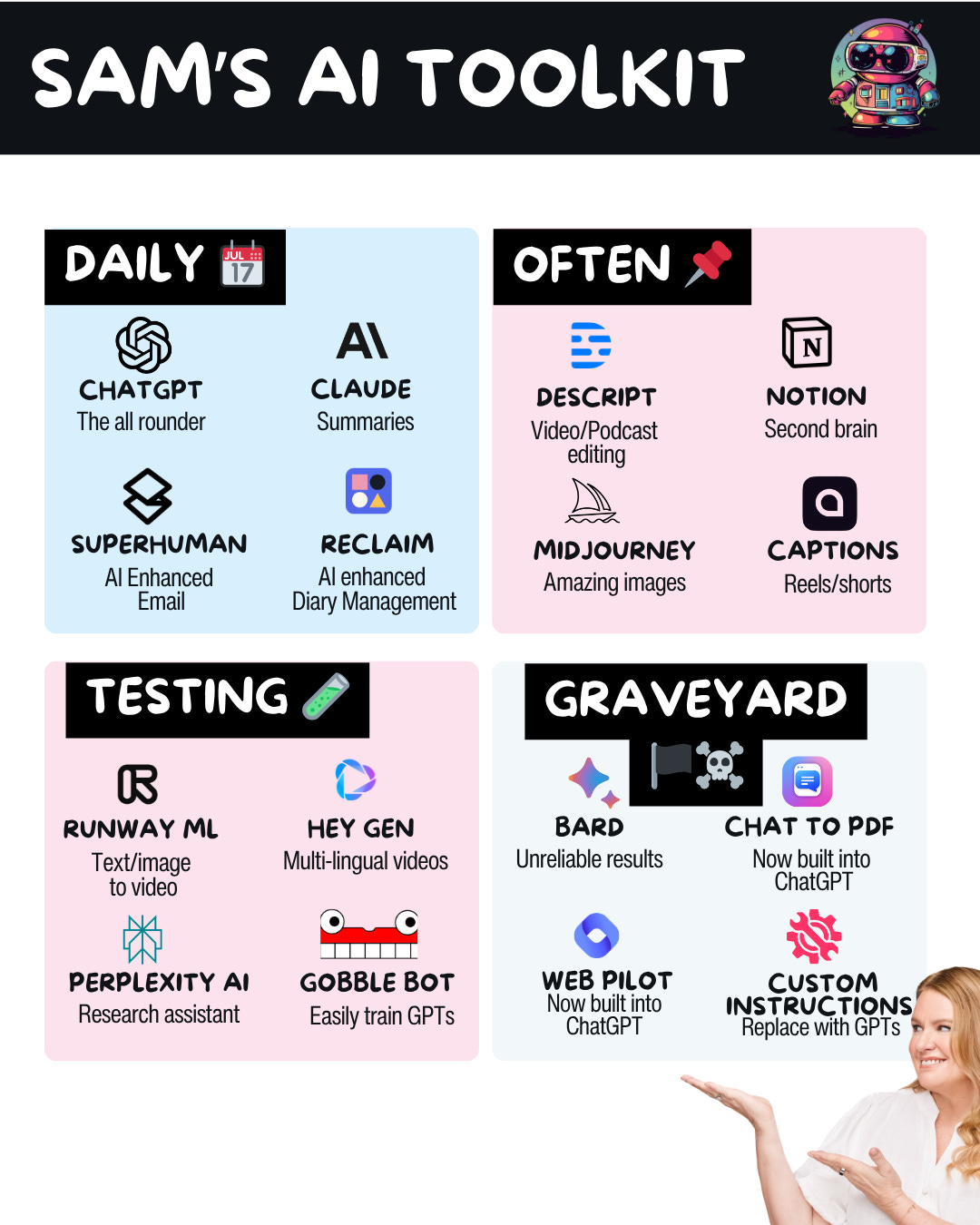
ChatGPT was my daily driver – “the all-rounder.” Claude was there for summaries. Bard (Now Gemini) was in the graveyard for unreliable results. I was trialling Runway ML and Perplexity. Midjourney was making pretty good images. I had a tool called Gobblebot that helped you train Custom GPTs.
It was a chatbot grid. You subscribed to things, you unsubscribed from things, tried things, kept some, and moved on (thank u, next) from others.
I look at that infographic now, and it feels like a photograph of someone else’s desk.
I know, hard to believe when I was holding onto it pretty tight for months there.
That’s the main headline, but there’s more to it.
First, AI has been seeping into ‘non-AI’ tools I was already using. Superhuman got even smarter about email. Go High Level added AI calendaring features that work. Google Workspace became Gemini-native. I stopped opening a separate chatbot to do things I could now do inside the app I was already in.
But here’s the catch – it’s not all created equal. Some of the built-in AI is brilliant. Some of it is a checkbox feature that looks good on a press release. I keep going back to the desktop models (Claude, Gemini) because the thinking is just deeper than what’s been bolted into most tools. The built-in stuff handles the simple things. The hard things (having the response sound like you) still need the best model you can get your hands on.
Second, like a great soap opera character, Bard came back from the dead.
Google renamed it Gemini, rebuilt it from the ground up, and by version 3.1 it was doing things ChatGPT couldn’t touch. I gave it a property listing and asked it to think like a forensic property developer – find the hidden value, and it was good.
Not just the depth of analysis but being able to see, hear, fetch data, code… and because it lives inside Google Workspace, it just knows what I’m working on without me copying and pasting between tabs.
Then Gemini added Nano Banana for image generation, and suddenly, I didn’t need a separate design tool for most things. NotebookLM turned long documents into audio overviews I could listen to while walking the dogs. It wasn’t one killer feature – it was a whole ecosystem that showed up where I was already working.

Third – and this is the big one – I started building.
If you’d told me in 2024 that within two years I’d have a terminal emulator on my dock, push code to GitHub, and deploy apps on Vercel, I would have said you were out of your mind.
It was in January that I started thinking, well, I had better learn Claude Code. And that changed everything.
It started with Adzy – an ad management tool for Elite Agent. We were paying $800 a month for a SaaS product that did way more than what we needed. I thought, could I build this myself? With Claude Code, the answer turned out to be yes. Not a janky prototype. A proper tool that does exactly what we need, the way we need it.
That $800 a month went away. And something in my brain shifted.
Because once you realise you can build the tool rather than subscribe to one, you start seeing everything differently. Every time I’d think “I wish there was an app that did X,” the next thought became “…I could build that.”
So we did.
LOIS – our internal editorial operating system. Content pipelines, dashboards, the works with more in the works.
Ailsa – a conversational AI journalist that generates published sales stories from agent phone calls.
Image resizer – does exactly what it sounds like, built to our exact website specs. Image resizing used to take several more minutes and clicks, uploading to Canva and mucking around here. The same job now happens in seconds.
The entire Elite Agent website rebuild – from a constrained theme to a fully custom WordPress build. Not by an agency. By me and my mate Claude Code.
And there are four more launching this year: Scoop has come back in from the freezing cold and is ready to get to work, Events, Jobs, and a Supplier Directory. Nine apps in total, plus our link in bio. No external developers. No freelancer invoices.
The custom-built tools now save more than the entire subscription stack costs. That’s the business case for learning to build.
The shape of it is completely different from 2023.
Claude Code sits at the centre – not because it’s the tool I use most, but because it’s the tool that builds the other tools. It’s the meta-tool.
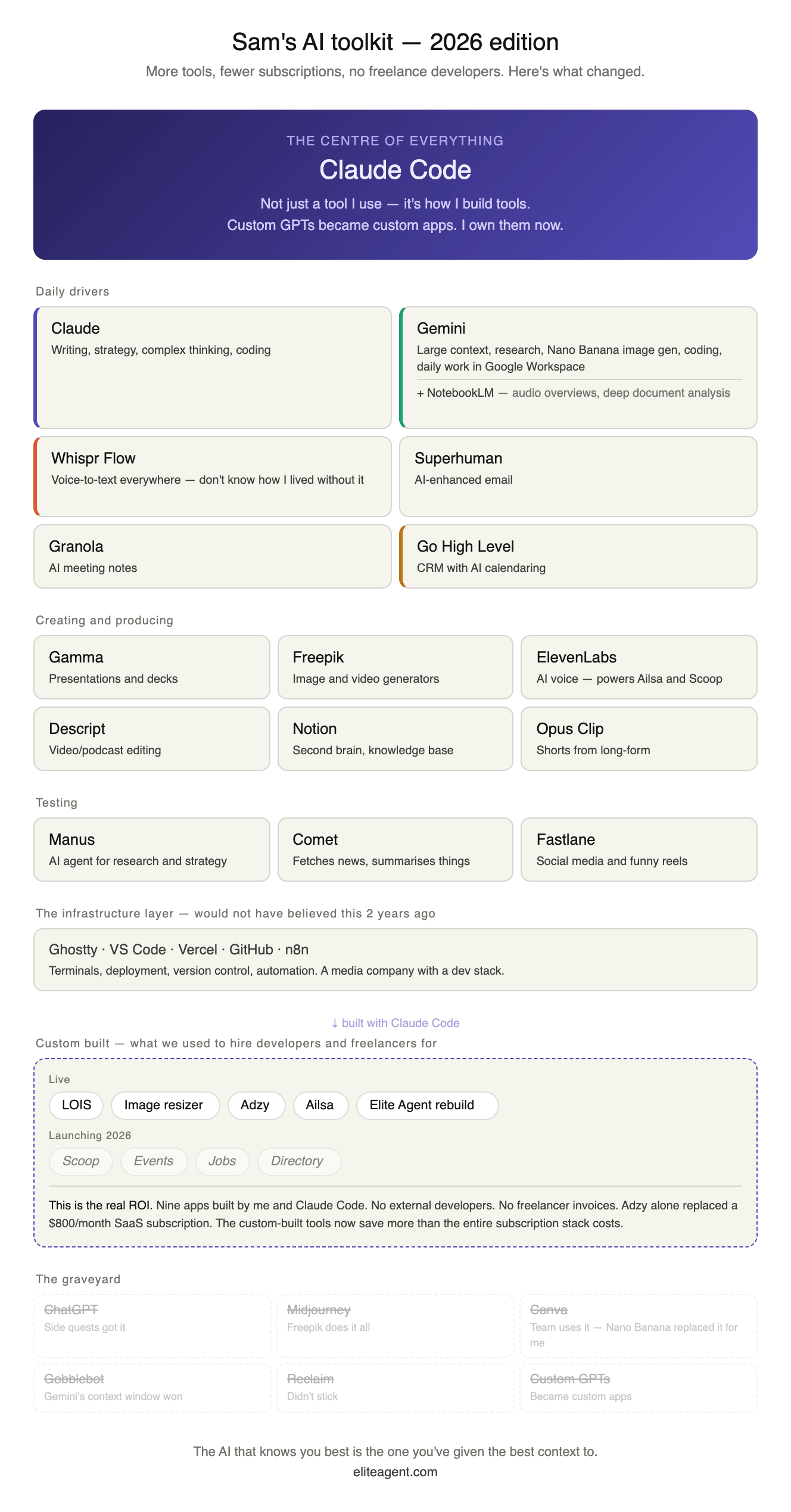
Around it, the daily drivers are Claude (writing, strategy, coding), Gemini (large context work, research, image generation, coding – yes, both of them handle coding), Wispr Flow (voice-to-text everywhere – genuinely don’t know how I worked without this), Superhuman (email), Granola (meeting notes), and Go High Level (CRM).
Eleven labs is the voice engine that drives Ailsa and Scoop.
The creative layer is Gamma for presentations, Freepik for image and video generation, Descript for podcasts, Notion as my second brain, and Opus Clip for cutting long-form into shorts.
I’m testing Manus (an AI agent for research), Comet (fetches and summarises news), and Fastlane (social media and funny reels – early days).
And then there’s the layer I never expected: the infrastructure. Ghostty and VS Code as my terminals. Vercel for deployment. GitHub for version control. n8n for automation. A training and media company with a dev stack. Read that sentence again and tell me, 2023 Sam wouldn’t have at least tried to raise an eyebrow.
ChatGPT – this one hurts a little because I was an early “power user”. But maybe OpenAI tried to chase one too many rabbits. One of their own executives called their diversions “side quests.” So they recently killed Sora. (I will miss RE/Max Cairns Tony Williamson’s excellent videos!!). I still have a paid subscription for emergencies, but it’s the lower-level one.
Midjourney – unsubscribed ages ago. Freepik gives me access to multiple image and video generators in one place.
Canva – my team still uses it, and it’s great for them. For me, Gemini’s Nano Banana handles most of what I need, and Gamma took over for presentations.
Gobblebot – ah, I vaguely remember this little Swiss army knife… it was brilliant for training Custom GPTs. Then Gemini’s context window got so large that it became unnecessary. You just paste in your documents now. Or throw Firecrawl at them to get structured data instead of messy data.
Reclaim – calendar AI that didn’t stick (well, not to me anyway!). It was good at the time, though…
Custom GPTs – this one’s my favourite. They didn’t die. They evolved. What used to be a Custom GPT locked inside ChatGPT is now a custom app I built, own, and deploy. That’s not a downgrade. That’s a graduation.
I’ve spent more on subscriptions in 2026 than I did in 2024. But I’ve spent dramatically less on developers, freelancers, and SaaS tools that have been replaced by things I built myself.
Maybe the bigger lesson isn’t about money, though it might be more about control.
In 2024, my AI strategy was: find new things, subscribe, say goodbye if something better came along. Memory and context didn’t matter so much then because they didn’t exist then.
In 2026, my AI strategy is: document my context in files I control, use the best tool for each job, and look for ways to replace as many mouse clicks as possible to get more and more efficient.
That shift – from subscriber to builder, from prompt engineer to context engineer – is the most significant change in my working life in the past decade.
And I think most of you are about to go through the same thing.
(More on the context engineering bit – and specifically how to switch between AI models without losing everything you’ve built – in an upcoming post!)
Happy Hunting 🚀
Comments
Nothing yet. Say the first thing.
Sign in to join the conversation.