
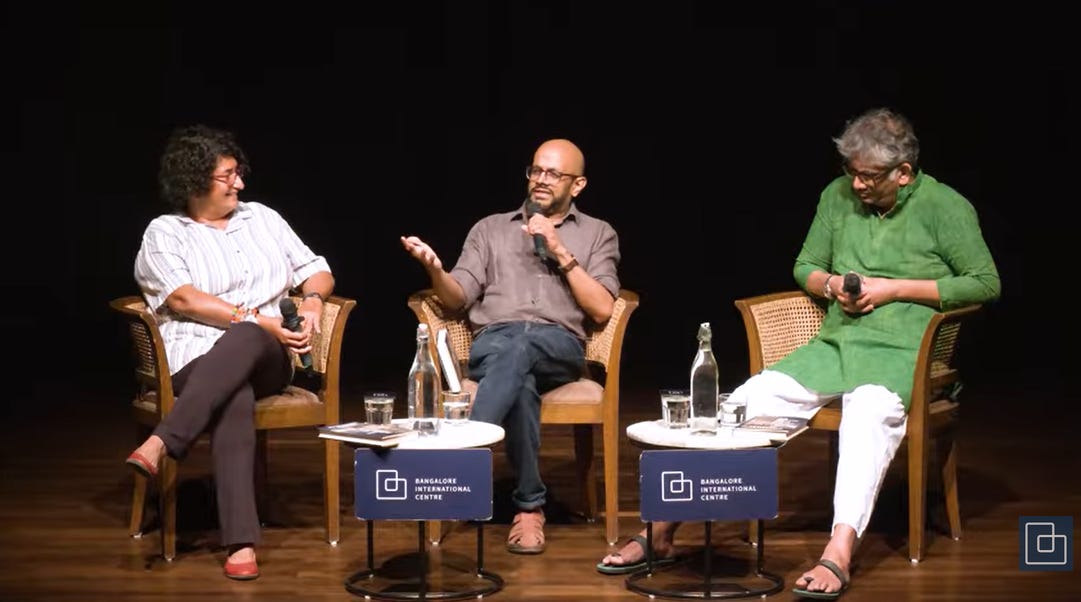
A week ago, we launched the Indian edition of The Web Beneath the Waves—which includes, you will recall, not just the text of that short book but also an anthology of 15 essays and pieces of reportage—at the Bangalore International Centre. (You will also recall, no doubt, that the book is available for pre-order, that pre-orders matter greatly to the fate of a book and that therefore I did some beseeching about pre-ordering it.) This was the very best of panels: a full hall, friends alongside on stage, and a discussion not about the book’s specific contents but about our general practice of journalism and its fate over the past quarter-century. Aakar told Sharda and me, before we got on stage, that he’d really only thought of two questions for us, but he was, as is customary, pulling our legs; he had a whole host of things locked and loaded to talk about, and often I was all too happy to sit back and listen to Sharda talk about her dazzling career in sports journalism or to the both of them reminiscing about Mid-Day circa 1995.
The full panel is up on BIC’s YouTube channel, and I promise you’ll enjoy it: not just for my minor anecdote about Pepsi Uma but also for Aakar’s tale of being a court reporter in Ahmedabad or Sharda’s story of how she pepped up Abhinav Bindra enough to win gold at the Beijing Olympics.
There was a part of the discussion that came back to me over the weekend as I followed the drama around Sonam Wangchuk’s hunger fast in Delhi, and the mounting anger of Indians protesting against their government’s mishandling of education—and its utter lack of accountability for it. Even as I type, friends of mine are out in force in Delhi and elsewhere, marching against police battalions and facing all sorts of repercussions, including tear gas, violence, and arrest. (I read the Internet Freedom Foundation’s guidance to protestors and my heart sank at how little we expect of the authorities when it comes to our civil and legal rights.) At these marches, they’re encountering squads of news crews and other journalists—very, very few of whom thought it worthwhile, over the past few years, to cover in depth the actual problems with education policy. They’re there because protests are spectacle, not because they’re keen to understand these grievances or hold the government to task.
At the panel last week, Aakar had asked us: What shift has there been in the media between when you started working and the situation there is now?
My response, condensed a little, was as follows:
We’re handed down this idea that journalism is one of the organs needed for civil society to function well. Where did that come from?
There was a cultural critic called DR Nagaraj, from Karnataka actually, who had a very little part in an essay where he talks about how all these ideas of the post-Enlightenment age—the ideas that the modern nation-state depends upon—are all based on the problem of what to do with strangers. In these societies, there will be more and more people whom you will not be familiar with—who are not from your tribe—and all these ideas of justice and human rights and civic duties are meant to grapple with this basic problem of coexisting with unfamiliar people.
Journalism is kind of a byproduct of that. Journalism is a way to relay to you what the stranger’s life is like—to make them less strange. And at the same time, to help them integrate into society and help you integrate into their presence, to tell you that people are being treated fairly, and so on.
We all know that, all around the world but also in India, the media has degraded and corrupted. It is not a coincidence that this is all happening when the idea of what to do with a stranger has changed. Now the predominant political idea is to expel a stranger from civil society, not to integrate them, not to see them but to push them out. So of course journalism in the traditional sense has been rendered somewhat irrelevant, because people are not interested in a media that will show them what other lives are like, or how to live with other people.
It’s systemic. Of course, we can moan about how pay has stagnated in journalism, or how corporations that run media houses also have dozens of other business interests to the point that they’re always happy to sacrifice journalism if it means securing a coal-mining license, for instance. We can moan about the fact that people have reduced attention spans. But the chief problem is that many media houses are succumbing to a social and political dynamic that aims to homogenise society. That is the central issue we have to face up to.
Some links:
The full text of The Flaming Feet, a collection of Nagaraj’s essays, is online for free. I highly recommend them.
The video of the BIC panel, once again, is here.
How to prepare to be a protestor in India: guidance from the Internet Freedom Foundation.
And once last time: the pre-order link to my new book.
Share this with anyone reading about, or participating in, the protests. Or with people in the media. Or with people who consume the media.
Comments
Nothing yet. Say the first thing.
Sign in to join the conversation.