
Welcome to the 44th edition of my irregular-ish newsletter. Since the last newsletter, published just over a month ago, we have had just over 200 new subscribers sign up for this newsletter. Welcome aboard my new subscribers, and enjoy your first newsletter.

Regular readers know that this newsletter has two permanent sections:
Writings - where I usually write and / or refer to one or more original pieces that I published in the previous months, typically about venture or the startup ecosystem.
Readings - about what I read and learnt about. My reading diet is tilted rather heavily in favour of books and podcast transcripts, and against articles / newsletters. This will naturally reflect in the reading list.
This is a long newsletter, though this particular edition is amongst the shorter ones I have sent out. Think of it as a monthly magazine from me (only the frequency may not be monthly!). I don’t know if you can read this entire newsletter (and peruse the links) in one sitting, and even if you do a second run (which I very much doubt), you will have to pick and choose what to focus on. A good way to read this newsletter is to certainly read my original writing(s) below, and then glance through the rest and pick 1-2-3 items that pique your interest. Anything more is a bonus!
I wrote a piece distilling the key learnings from my career.
The piece came about as a result of the talk I gave at Rubaru, Amazon India’s Finance Org’s career day. I was asked to speak about my career journey and transition to the VC world, as well as what I have seen as key hallmarks of successful careers. I later got this message (see image) from Sourav Das fm Amazon who thought of me, and coordinated the talk.
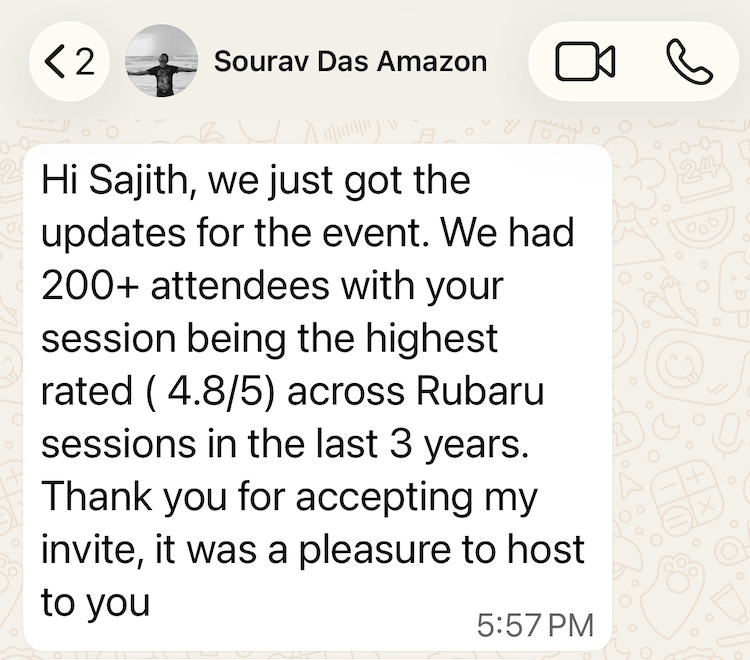
Subsequently, I shared notes of my talk internally within Blume and many found it interesting as well. I decided then to convert it into an article. I hope you find it useful!
My 5 career learnings, as shared in the piece.
1/ Try to be the only, find your intersection of two or more skills and own that combination.
2/ There’s a hidden role inside your role, figure out what it actually is.
3/ Play tennis, not badminton, the space you pick matters more than how well you play it, unless your obsession says otherwise.
4/ Put unreasonable effort into something that is important to you. “Don’t save anything for the swim back.”
5/ Find your obsession, the thing that’s work for everyone else and play for you, and don’t let go of it.
Fiction, after a while. My second Vivek Shanbhagh; the first was the brilliant Ghachar Ghochar, which I read in 2023. This isn’t as good as that but still a fine read. Shanbhag has a masterful ability to bring in unease and discomfort into cozy domesticity. We saw that in Ghachar Ghochar and it continues here too. Plot: A family sees visits by unsavoury characters; meanwhile and connected to this is that their daughter goes AWOL. She returns eventually, but her absence provides the setting for exploring an uncomfortable backstory of the protagonist’s relative; and you know that the fissures her disappearance and return opens up will never ever be succesfully closed.
Two broad strands to this candid, vulnerable memoir of Theo Baker’s first two years as a Stanford undergrad. First is the story of his investigation as a student reporter into the Stanford President’s past research work which eventually led to the President retracting several papers, and stepping down. The second, and which runs parallel to the investigation is the detailing of how venture capitalists and talent scouts have captured Stanford, and the second order effects of this; there is of course genuine startup activity, but a lot of it is also startup / founder LARPing. Valuable sociological / anthropological guide to early ‘20s Stanford. The title comes from the name of a secret and select course that is offered on campus (v ‘Secret History’ types!) that Theo fails to get into.
This is a popular book in PKM circles. It looks at the note-taking practices of a German sociologist Niklas Luhmann (1927-98), who had a note-taking system called the slip-box or zettelkasten. In this system, he would read a paper / book and write out two types of notes, one a ‘literature or bibliographic note’ on details about the book / paper including a short gist, and the second, a brief ‘permanent note’ explaining his view of the paper or book in his own words, on an index card or two. Writing out the notes in his own words was important as writing it out drove better understanding of the topic, given he had to locate the topic in his context and frame of learning.
The bibliographic notes go into a separate bibliographic reference system or file, and the permanent notes to his ‘slip-box’ (of already existing index cards). These permanent notes (on index cards) would ideally link to what already exists (unless it is an entirely new topic) and would be placed beside that in the slip-box and / or cross-referenced to the existing notes. When adding notes on an existing topic, he would add further notes on why they are connected or contradict each other. Over time he would build clusters of notes on topics and at some point he would look at a cluster and decide it was sizable enough for him to publish something on it. Through this method of continuously adding and immediately cross-referencing notes he was able to be highly productive, and become a well-regarded sociologist.
A point to note, of course, is that Niklas Luhmann is not terribly well known, at least outside of Germany - now there’s no major theory that I know Niklas Luhmann is associated with despite prolific writing and publishing. So I do wonder sometimes about whether elaborate note-taking systems help in creating something truly impactful? On a related note, why aren’t these note-taking experts or productivity buffs, billionaires or multi-millionaires? Why are they still shilling for $ on youtube?! Anyway, rant over!
Irrespective of the above criticism, we can distil the key principles of his note-taking system / slip-box into the following generalisable rule set:
1/ When you find something interesting or useful, write this out in your own words briefly.
2/ You link this note to a relevant topic in your existing set of notes (’slip-box’). For example if you have read something interesting on investor returns and you already have an existing set of notes / card on IRR and its issues then add it to that cluster. While adding if you see a contradiction or reinforcement of what you already have, you could write about that too in your note. (Sometimes your note may be the first of a topic which is also fine). Niklas Luhmann says that because each new note added can connect to existing ones, the slip-box becomes more useful over time.
3/ Over time these clusters of notes on various topics build up, then at some point, you can use those notes on a specific topic to write out a paper or essay or book on the topic. That way, the author says, no one has to start with an empty page. This is one of the fundamental points made in the book; that there is a certain amount of what he calls pre-writing before the writing and that pre-writing is the act of writing out these permanent notes and cross referencing to each other in your slip-box.
The above is the gist of the book; Sonke Ahrens takes over 200 pages to explain this but the above is the essence.
If you liked this, and wanted to read more stuff in this vein, check out this piece by Ryan Holiday on his notecard system (inspired by Robert Greene of Mastery, 48 Laws of Power fame).

Strictly not a podcast but a talk by MIT professor Patrick Winston on how to speak and present better. This is I believe a popular talk at the university. I got it transcribed and fed it to Claude to get the summary and it made for useful reading. I loved his framing of “your ideas are like your children do not let them go out in rags”. Clothing / packaging the idea is important and to this end he introduces a few concepts and frameworks such as Winston’s Star (5Ss = Symbol, Slogan, Surprise, Salient Idea, Story) that he suggests to keep in mind when creating a presentation or a long piece of work. Then comes what he calls presentation heuristics such as cycling (revisiting the idea multiple times given distracted audiences), outlining the idea in advance, and enumerating the key points through the talk etc. Lots of useful concepts and tactical ideas (e.g., don’t present to a dark room, avoid laser pointers etc., with explanation) that will help anyone who offers talks regularly and / or wants to improve their presentation / talks.
Gokul Rajaram’s podcasts are, as always, a pleasure, with so much to absorb from him. This one covers his learnings from overseeing product at Google, Facebook, Square, and DoorDash, and now in his role as an advisor and investor. It covers a bunch of interesting topics.
One of the most fascinating things is how he looks at product management as managing the interests of both customers and the business, and how he says outcomes are fundamentally about behavior: from non-customer to customer, and from customer to customer. Driving this is really the goal. See every feature in terms of what behavior it is trying to enable, and he says that if it’s not enabling one of these behaviors, then you should rethink whether the feature is needed.
Then there’s an interesting passage on how to communicate to the team, and he describes how this becomes important as the company scales. He describes the format for a weekly email that the founder can send, consisting of three sections: Top of Mind; Performance Update, which is really around the business as well as any product updates; and finally Miscellaneous, whether it’s on the team, any news, things like that.
Thirdly, he cycles through a bunch of topics. There is his perspective on ad businesses, given his experience running them at Facebook and later at DoorDash. He describes three types of ad businesses: first, first-party businesses like Facebook or Uber; then businesses like AppLovin, which drive outcomes for owned inventory; and finally products such as The Trade Desk, which control or are the exclusive provider for a large source of demand. There’s a fascinating insight in this section, with a bunch of very interesting points he makes on how increasing advertising will impact user engagement, and how this trade-off has to be handled carefully, including a hack to make sure you’re not overdoing it by creating a holdout group that never sees ads, so you understand the impact of showing ads.
There’s also a brief discussion on careers in the AI age, where he says roles are going to break into IC roles or manager roles, and that you will typically start seeing the span of control widen. He says the number one skill will be becoming a functional expert who can build and orchestrate an army of AI agents for that function. He also describes how we should assess candidates in today’s age: just as engineering gives coding assignments on a whiteboard, we should give them actual work projects. If it’s a corporate development person, ask them to figure out a company to acquire; if it’s a marketing person, ask them to get X number of people for a certain budget, and so on.
There is also a very interesting discussion around how he sees that people are confusing SaaS companies that are systems of record with SaaS companies that are utilities, and how the former have an intrinsic advantage. Sooner or later, he says, people will understand that they have unfairly devalued system-of-record companies such as Salesforce. He then describes how these companies are rapidly racing to build agents, even as AI-native companies are trying to bite out of the system-of-record companies.
Fascinating insights from an elite operator in the Valley, someone who has seen large companies and highly successful products get built out at scale, and who is now parlaying that skill set into becoming an advisor, investor, and mentor.
Link.
A bit late to this excellent podcast episode; recommended for anyone operating in the preseed / seed market. Felt it was one of the more honest conversations about how seed / venture actually works right now, not how it’s supposed to work. Hard to easily distil / summarise as a lot of the value is often contextual rather than immediately actionable. Well worth the listen / read to understand how the US seed market evolved and what we are likely to see in India (as the structural forces that drove this in the US are present here as well; though a tad muted / smaller). A few notes I made while reading:
1/ Multi-stage funds beginning to dominate seed as well: From ~2010 to 2018, the prevailing founder consensus was that taking a seed check from a multi-stage fund is dangerous: if they don’t lead your A, it was signalling risk. The narrative flipped around 2018, driven by repeat founders who’d grown comfortable with the signalling risk. But the deeper point is structural: in a world where AUM is the dominant success metric, funds supersized to run a tip-to-tail multi-stage strategy, offering deployment as a service to their LPs, and thus built permanent seed products. This, Hudson says, is the single biggest structural change to seed in the past decade, and reduces the degrees of freedom for a pure seed found to operate (harder to get exclusivity on top tier founders).
2/ LP’s rational case for consolidation: deploying $100M through 10 seed managers at $10M each requires ~200 manager meetings to identify those 10, then 10 AGMs, 10 LPACs, 10 re-up decisions. Consolidating into two multi-stage firms offering tip-to-tail coverage is rational provided these have brand and access. This is a very rational decision led by LP capacity constraint and is leading to supersized multi-stage funds, and struggles for pure seed funds / emerging managers.
3/ Perma privates: The secondary market has matured to the point that the top 15 companies have near-public price discovery: any secondary buyer can quote you Databricks, Stripe etc. Hudson coins “perma privates” for companies like these: regular liquidity windows, transparent pricing, functionally no need to go public. The consequence for VC fundraising is that if your fund contains a name that trades actively in the secondary market, LPs can anchor to a price and a narrative. If you hold unknown early-stage companies, you’re asking LPs to hold an abstraction. This changes what actually gets rewarded in LP conversations, and it further concentrates attention on the top 25 names where there’s at least an active market.
4/ Series A valuations are strongly correlated with value: An LP who also invests in a large multi-stage fund ran the data and shared the finding with Hudson: for companies that ultimately succeeded, the price paid at seed shows no consistent pattern: some were very cheap, some very expensive. At Series A, there is a strong price-quality correlation. The good companies are uniformly expensive. By the A, enough is known about the business that quality gets bid up rationally. Implication for everyone: the information content of a high Series A price is real: expensive As have historically been the good ones.
5/ Stage names are losing meaning — and seed managers have been slow to update. Hudson began his career when stage names implied lanes: seed investors in seed, Coatue in Series B. Those lanes no longer exist. But his observation is that dedicated seed managers as a group have been slow to realize they can target their required cash-on-cash returns at later entry points. He invokes Keith Rabois’s Stripe investment at a $1B valuation; “nuts” at the time, now considered prescient. For companies that are genuinely working, getting onto the cap table even off-model is worth doing, both for the return profile and because it generates market intelligence not visible from the outside.
6/ Sitting out a bubble is as dangerous as joining one. You have to play the game on the field, not sitting in the stands. The sober managers who passed on 2021 froth got no LP credit for restraint. The corrective force most people assume exists — “bubble-chasers lose their LPs” didn’t transpire at all for the top funds. Hudson’s conclusion: if your goal is to remain a venture capitalist, the rational move during a speculative frenzy may be to participate even under deep personal skepticism, because LP attrition from missing a cycle is a harder problem than cleaning up from a mostly-wrong bubble bet with one right call in it. The managers who went deep and caught one Anthropic-scale winner (he references Menlo Ventures here) reset their entire firm narrative regardless of what else they did.
7/ The Principal investor program: Precursor gives new team members a fully discretionary 250–500K budget, writing 25–50K checks independently; no partner sign-off. The logic: requiring approval corrupts the signal, because the junior filters for what they can sell upward rather than what they actually believe. The budget generates ~10 genuine yes-decisions; check sizes escalate with each fund to test whether the person can win comparable cap table access with a larger, more competitive check. The only terminal states are partnership or an honest exit. Most platforms give juniors no check-writing until year five or six, then hand them $5M. This format is much much better.
Dwarkesh and John Collison interview Musk on why he thinks data centers should be built in space, and his take on the AI x hardware landscape. Really good insight into how availability of power as the key rate limiting factor on compute deployment influences / is behind Musk’s decision to evaluate data centers in space. All of this is fascinating, but to me the key ‘through-line’ of the podcast was the concept of the ‘limiting factor’ - it comes up multiple times. To read / hear this is to understand how Elon’s mind works. At every point he has a sense of what the limiting factor for progress is, and he identifies that lever and jumps on that.
For instance this is how he deconstructs nested limiting factors in compute: Compute is limited by power limited by regulation limited by gas turbines in turn limited by blades - says only 3 companies in the world make these gas turbine blades and are massively backlogged. Then there is his take on memory chips as bigger limiting factors over logic chips, or ASML over TSMC. The clarity is fascinating to see.
As Elon puts it: “Speed is important....I just repeatedly tackle the limiting factor. Whatever the limiting factor is on speed, I’m going to tackle that. If capital is the limiting factor, then I’ll solve for capital. If it’s not the limiting factor, I’ll solve for something else.
Another: “I actually allocate time according to where the limiting factor. Where are things problematic? Where are we pushing against? What is holding us back? I focus, at the risk of saying the words too many times, on the limiting factor.”
Founders should take note - at any point focus on the limiting factor. Keep moving from limiting factor to limiting factor. Reminder: it may not always be the most current urgent thing / emergency. That probably is being handled by a relevant team member. It could be something that will come up in future, like a 2nd factory that you have to align on now, or fundraising because it will constrain growth in future, or regulation or so on.
I really enjoyed the last Jeremy Giffon x Invest Like The Best episode and did enjoy this one hugely too. Covers his thoughts on venture, private markets, and his take on tech du jour. What stood out to me:
a/ Venture funds take a long time to see results so what they are selling in the interim (to their LPs) is narrative. Storytelling ability is key.
b/ The most successful organisations of today are timeline-native (”they are constantly monitoring the timeline, and reflexive in that its actions then affect the timeline, which it then sort of reads and reacts to”. Interesting observation on how the new and successful set of recent politicians (Trump, Mamdani, AOC, from U.S., and likely even Modi) are highly reactive and reflexive to the timeline. “Ben Sasse, the former senator, has this great notion that Washington is now mostly people who want to be TikTok and YouTube stars, which is mostly what congressmen and senators want to be. The people who do well in politics now are just optimized for content. They’re basically content creators, because the polling is the timeline.” Really clever insight.
c/ “posting is the last great meritocracy”; irrespective of your stature or follower count, a great post can get you in front of the Interwebs.
d/ ‘Billionaire inflation’ is now underway; for a while they have been the priestly class, but increasingly they are now deferential to the ‘posters’. Jeremy: “Posters who are dictating what the timeline thinks of something is a really, really small group. If the original vision for who voted was white male landowners, maybe the version of people who matter for policy now are the good posters.” The billionaire class is now increasingly subservient to the posters. “I was at this thing a while ago and it was a bunch of billionaire investors and they were all fighting over who could sit next to Tyler Cowen because he’s the most interesting person there.”
e/ Allocation in the hottest private companies is the scarcest commodity today and anyone who controls access to this allocation is powerful and wealthy. “Elon, Zuckerberg, Dario, Sam — they can sort of make landed gentry by giving out allocations, because these allocations are these best examples of generational wealth. You get this allocation in SpaceX or in Waymo or whatever.... And then you get to go out and basically say — I’ve been given a deed; the king has given me 500 acres in his country, and Elon has given me $100 million to allocate in SpaceX — and then you get to go out and charge fees and make a bunch of money from it. Do you have allocation? 6/ How to write JDs (job descriptions) better: a good disqualifying statement is key - one that is open to interpretation and slightly provocative is key. It should say who it is not for, but the qualifying criteria should be open to interpretation e.g., “you’re an ideological minority at a top 10 school”.
Probably lots more I left out like ‘billion-dollar pdf’ etc. Highly recommended; wide-ranging podcast episode that covers tech, ideas, and culture. Doesn’t button hole itself into one category neatly like the best epsiodes do.
Michael Pollan is one of my favourite non-fiction writers, and hence this episode was a treat. Lots of extremely useful mental models and frameworks for writers or wanna be writers covered in the episode. In particular I loved how
Pollan rewrites his previous days’ writing every morning before he starts writing. This, he says, puts him in the printer camp of writing (where everything emerges correctly line by line like a printer) vs the pixel camp (where the image pops up and then sharpens in resolution - this is getting the entire rough draft out, and then refining the whole thing)
How Pollan’s early writings in gardening were inspired by the English and American gardening writers he read, who mostly wrote in first person letter-writing / epistolary mode, and that stayed with him and became his writing style - “an ‘over the back fence’ conversation, very familiar, talking directly to the reader.”
Shares a riveting example of how he paid for a steer that was headed to slaughter, and this gave him a more involved view of the ranching to slaughtering process, including how the ranchers make decisions around livestock.
The ‘laundry line’ metaphor for how he structures his writing / books. The line or string is the narrative arc + timeline, and the laundry are the specific topics you will dwell into. He puts it: “You need to space it out because if you clump it all together, it sags. Exposition is less appealing to the reader than the narrative. We constantly want to know what happens next. In this specific case, readers know the animal will be killed in a slaughterhouse and are curious about that process. This curiosity acts as your suspense principle. You can depart from your laundry line for a period to provide exposition—to explain the feed, why corn is used, what that means, and how it’s grown with fossil fuel, in contrast to grass grown with sunlight. However, you cannot stay away from your narrative for too long. You must cultivate a sense of when your reader will grow impatient. While you could go on forever with exposition, you always need to return to your narrative.”
The importance of the introductions section in the non-fiction book: how the best you can do there is to set expectations about the book, what it will be and won’t.
How to use conflict (between two protagonists, two camps) to create tension, and drive narrative. And David Perell’s framework about understanding a field / profession through the dominant civil wars / big arguments /different camps within it.
Writing is thinking - the process of writing is generative helping you discover new things about the topic and new ways to approach it as you write. Pollan says” “Often, I have only a general outline of where I want to go, yet I discover new ideas and metaphors in the course of writing. ...Writing does something unique to your brain; it grants access to thoughts and connections you wouldn’t find just by walking, thinking, planning, or outlining.”
Writing is hard, and it doesn’t get easier ever. Michael puts it well: “Unlike woodworking or playing an instrument, which can become second nature, writing remains challenging even after doing it professionally for 40 years. Every time you face that white screen, you wonder why it doesn’t come more easily....I still struggle every time I sit down to write, even playing games with myself about how much I need to produce before earning a snack.”
Enjoyable podcast, with something for everyone. My favourite parts were Brian’s elaboration of 1) what he calls the 11-star experience, and how they strive to offer this at Airbnb, and how other brands can use this framework to enhance customer experience 2) how he has prioritised recruiting - the recruiter is the first and last call of the day, he even helps hire for his executives, and how he hires by building pipelines.
There is a lot else as well, including how his passion for bodybuilding gave him lessons for life as well (”If you can change your body, you can change your life”) and why he is very hands on early with his execs and only gradually lets go (because he doesn’t want them to develop the wrong muscle memory early on).

Link.
Tiago Forte, productivity and note-taking guru, creator of the ‘second brain’ concept, writes about his learnings (and earnings) from book writing in a candid look at his book-writing career. Interesting for any would-be non-fiction writer, but also useful for anyone who finds these topics interesting. What stood out / my summary:
a/ It took 2y 4m for Tiago to break-even on the book’s expenses
b/ Interesting visualisation of non-fiction idea books as global reader-funded marketing campaigns. Very very few books make you money from selling copies. Instead what books do is give you deep attention from readers. And much of your expenses towards reaching them is subsidised by their purchase of your copies. Given that books are not directly income-generating assets so much as attention-capturing assets, it works best when you have a natural next step or follow-up product for the readers to explore, after you have got their attention. This follow-up product could be a consulting gig, a course, and so on...
c/ The best next product is whatever addresses the reader’s problems (that led them to read your book) in greater depth than your book did.
d/ (In my view) I think one mistake Tiago made was not exploring creating a Second Brain / Note-taking app. This could have been a natural next product.
The most interesting product mechanics / growth writing today is Tomas Pueyo’s writing on seeing religions as products. (warning: paywalled). Very interesting comparison of how Islam / Christianity are designed for growth (as opposed to a Judaism for instance), and how that manifests itself in ‘product adoption’.
Link.
Donald Knuth is the famous computer scientist who doesn’t use email (at least that is how he is registered in my head). Knuth’s deep work focus has always fascinated me, and I thus enjoyed this look by a computer scientist + mathematician Shuvomoy Das Gupta on Knuth’s ways of working. I really liked the following
Knuth: “I schedule my activities in a somewhat peculiar way. Every day I look at the things that I’m ready to do, and choose the one that I like the least, the one that’s least fun — the task that I would most like to procrastinate from doing, but for which I have no good reason for procrastination.”
Knuth’s take on keeping a high minimum, for he says “I think that the limiting thing — the thing that determines a person’s success in life — is not so much what they do best, but what they do worst....If you can do something really well but there are other things at which you’re failing, the latter will hold you back....A person’s success in life is determined by having a high minimum, not a high maximum”
Interesting take on happiness, and why he feels the body is programmed to be unhappy / depressed a certain percentage of the time (led by chemical / hormonal factors he says).
Link.
Interesting piece on China’s venture ecosystem and how it differs from the US VC ecosystem - onerous terms (’ostensibly equity, in reality debt’) that force the company to list early as startups are committed to return a certain hurdle rate in a defined time period, the lack of an M&A market, heavy intermediation between startups and VCs by investment banks (termed as Financial Advisors), the heavy hand of the state in pushing funding in certain desired directions etc. India is a lot more closer to the U.S. position it seems.
It is time to wrap this! As I shared earlier, you should think of this substack as akin to a monthly magazine - you don’t have to read it all in one sitting, and you don’t have to read all of it! Feedback, or your own ruminations are welcome. Please use the comments section to engage!
No posts
Comments
Nothing yet. Say the first thing.
Sign in to join the conversation.