
Welcome to the 43rd edition of my, once again, quite irregular newsletter. Since the last newsletter, published just over a month ago, we have had just over 400 new subscribers sign up for this newsletter. Welcome aboard my new subscribers, and enjoy your first newsletter.
Regular readers know that this newsletter has two permanent sections:
Writings - where I usually write and / or refer to one or more original pieces that I published in the previous months, typically about venture or the startup ecosystem.
Readings - about what I read and learnt about. My reading diet is tilted rather heavily in favour of books and podcast transcripts, and against articles / newsletters. This will naturally reflect in the reading list.
This is a long newsletter - think of it as akin to a monthly magazine from me (only the frequency may not be monthly!). I don’t know if you can read this entire newsletter (and peruse the links) in one sitting, and even if you do a second run (which I very much doubt), you will have to pick and choose what to focus on. A good way to read this newsletter is to certainly read my original writing(s) below, and then glance through the rest and pick 1-2-3 items that pique your interest. Anything more is a bonus!

1/ I wrote a review of Akshay Jaitley’s book on Trilegal which he cofounded 25 years back. Utterly fascinating look back, and one that is extremely candid and honest, laying bare the challenges and iterations that Trilegal went through, including internal conflicts and divisions, to emerge as one of the leading law firms in India today.
2/ I recently made an appearance on economist Vidya Mahambare’s podcast ‘What Shapes Us’. The podcast covers how the 5Es as terms it – Endowment, Environment, Education, Effort, and Equality of Opportunity – shape our lives and careers. It is perhaps amongst the most transparent and candid public conversations that I have done (of a kind).
Link to the podcast / video below; for the complete transcript of the podcast click here.
I was able to keep reading going, despite the challenges of the relocation and the disruptions caused by it. That said, fiction took a backseat this last two months unlike the first two months of the year when I was able to get in more fiction. The goal going forward is to reset the mix.
Slice of life stories capturing the diverse perspectives of British residents in India – administrators, soldiers, and their wives – during the latter half of the Raj (1900s to ’47). Interesting and enjoyable. Albeit many passages would be considered ‘politically incorrect’ today, but of course reflects the attitudes of that era.
I read it because Bill Gurley wrote it 🙂 At 51, and happily ensconced in venture capital, this is not the book I needed to read! But then, am not the target audience for the book as well. The book is titled after a Sep ’18 speech he gave at the MBA program at the University of Texas, listing five key principles for finding (and thriving in) a career you love. The speech / video went viral on the interwebs. The book is an expanded version of the speech – there are more stories and profiles, and there are six principles now. There is also a (brief) chapter on how he arrived at his career which was my favourite part of the book. If you are in the early part of your career, then this is a good read I would think; otherwise not. And even for the career starters, perhaps the speech is a better place to begin.
A look back at Trilegal’s founding and its journey over the past 25 years. This is a great read for any lawyer but it is also useful for folks from other professional services firms such as consultants or even VCs / PEs. VCs and PEs of course have their own carry mechanism for reward-sharing, but there is still a lot here that they can borrow and learn from this book. Recommended.
Click here for my review of the book.
Overall, a disappointing read. For obvious reasons, it felt like he couldn’t be as candid as he could be about recent years, and the competitive landscape, and the turn of events which led to Zomato acquiring Blinkit, and then the subsequent pivot to 10-min delivery and then success. Perhaps he should have waited a few years to write the book! The first 100 pages where he depicts his personal journey to founding Grofers (which Zomato / Eternal acquired, and became Blinkit) is the best part of the book, including a long but highly readable and illuminating section on labour issues and labour psychology in Chapter 2014. Some additional segments which stood out were the pigeon-poop problem they encountered and the eventual surprising solution to it (pgs 84–87) and then a brief segment on how he personally had to deliver himself (while facing a labour mutiny) in 2014, in the early days of Grofers, which he describes as one of his toughest days to get through.
Rahul Akerkar created Indigo, a stand-alone fine dining restaurant, in Mumbai in 1999, which is widely seen as one of India’s most innovative (and successful) restaurants (shut down after 20 years). Indigo spawned a successful sub-brand Indigo Deli, which became a chain, and along the way Rahul lost control of his restaurant chain, due to poor financial management, and cost-overruns in an ambitious project called Tote on the Turf. The book is an enjoyable read, mixing personal memoir, his business journey through the various restaurant projects, and finally his favourite recipes, all in one package. I would think this was an expensive book to produce – given the colour photos, the illustrations, and the rich paper stock. That said it was a tad dissatisfying as I felt it fell short of being a great autobiography. Perhaps it is because Rahul couldn’t be truly honest about the business challenges; he says in an interview they had to chop off 100 or so pages for legal reasons. I felt Rahul missed an opportunity in using the book to look back at the core reasons why Indigo / DeGustibus (the overall entity) didn’t succeed financially and that would have been illuminating to future restaurateurs. Still a good read if you are into food / food culture in a big way.
This podcast will mainly appeal to venture nerds, the kind who have listened to or read several podcasts by Vinod and Keith, and are excited about them coming together, and will consume this too. Like me!
A few points I found particularly interesting:
How their Monday meetings start with portfolio discussions, and only later move on to investment committee discussions or pipeline discussions. That was fascinating.
Their framework for evaluating founders. I thought that was interesting. A+ incomplete is the broad name I would put this under. It means you can be A+ on some dimensions, and it is okay to be less strong or incomplete on others. You are hoping they will learn faster and catch up on the areas where they are weaker, e.g., they could be technically massively brilliant (one of the top two or three in that field), and that they will catch up on business as well. Looking for a very rounded personality is likely to lead to passing on several good factors.
How they looked at OpenAI and saw it as enormously talent-dense, comparable to Google or DeepMind, which led to their decision to back them.
That they will not invest in human-in-the-loop or co-pilot AI companies. They want to do entirely agent-like AI companies. Overall, a fascinating episode.
Monday meetings: Critically, every Monday meeting begins with the current portfolio before any new opportunity is discussed — a deliberate signal that they are in the “build the company” business, not the “pick the company” business.
Venture assistants, not capitalists: Vinod says “In 40 years that I’ve done venture capital, I’ve not once called myself a venture capitalist or an investor. I always say I’m a venture assistant to entrepreneurs trying to build companies.”
What makes a great founder, and what they look for in founders Keith’s framework: he’s looking for founders who are top-one-basis-point on some dimension: smartest, most tenacious, best people-assessor, most strategic, or, alternatively, a rare Venn overlap of traits not commonly found together. Keith: “I’m trying to find out: is there a non-zero chance that this person can change a vertical over the world?”.
Keith cites Max Levchin (Reid Hoffman told him in December 2000: first-rate technologist and first-rate business mind — fewer than five people in Silicon Valley qualify) and Jack Dorsey (design + tech + strategy = three traits).
Vinod adds: learning rate and the ability to reject bad ideas matter as much as raw capability. He deliberately takes positions he doesn’t believe to test how a founder thinks. Vinod: “If a person listens to me all the time, I’ll almost never invest with them. I know they’re not critically examining.”
The conversation goes deep on how to surface non-obvious founder traits in a meeting. Keith doesn’t do structured biographical interviews (the “Doug Leone style”) — he prefers freeform meetings where passion and drive “just show up.”
Vinod’s interview philosophy: put people in situations they haven’t been in, because good storytellers may not be the best candidates. He has a public document on how to interview and a private one on how to interpret answers. Vinod stresses that “A+ incomplete” — exceptional on key dimensions, acknowledged gaps elsewhere — is the formulation he most values. Learning rate is the hardest to assess from a single meeting.
Vinod and Keith discuss what a founder cannot be deficient in: ethics, unambiguously. They note that highly disagreeable, intense founders often actually have the strongest moral compasses — their intensity is rooted in principle.
Investing in OpenAI: The OpenAI investment story is the centrepiece here. In 2018, KV made its largest-ever initial investment — twice the prior record — in OpenAI when it was a nonprofit with no product plan and no revenue plan. Vinod: “Outside Google and DeepMind, this was the only critical density of research-grade people that could possibly pull off AI. That was the investment hypothesis in a sentence.” Knowing Sam Altman over a sustained period (Vinod, David, and Keith all did) helped them see the lines clearly.
KV (Khosla Ventures) sent an apology letter to LPs at the time of investment — “we know it makes no sense but we’re doing it anyway” — and that letter is now part of their fundraising deck.
Investment themes at KV: The conversation turns to AI investment themes. KV has ~30 portfolio companies building AI workers across oncology, mental health therapy, chip design, structural engineering — “as many professions as there are, there’s that many opportunities.” A deliberate decision made ~3 years ago: avoid co-pilots (humans in the loop slow things down), back AI doing the work entirely.
KV and fintech: The discussion moves to KV’s fintech track record — a less-known strength: in every single fund, one fintech investment has returned the entire fund. Examples: Square, Stripe (second investor), Affirm, Avon, Upstart. Avon is flagged as the next potential iconic fintech: using AI to issue a home equity line of credit and consolidate credit cards in one hour (normally weeks).
Link.
Lots of interesting ideas and concepts here in this podcast episode featuring philosopher C Thi Nguyen in convo w Jackson Dahl on the Dialectic podcast. The broad theme is that scoring systems, as seen in games, are fundamentally ways to guide our attention to what matters. But the same scoring systems that make games interesting e.g., in football, for instance, you have to score a goal without using your hands, can be dangerous if adopted wholesale in life.
The problem is that scoring systems in real life, which typically take the form of metrics, are designed to strip out subjectivity, judgement, and even agency from the players. All such scoring systems or metrics, however seemingly objective, are built on value judgments. Evaluating charities by efficiency of spend, for example, implicitly assumes that all charitable causes are fundamentally similar. But in certain domains, achieving spend efficiency may be structurally harder, due to missing baseline infrastructure or other contextual factors, and penalising those charities for that is a judgment call, not a neutral measure.
To me, the core takeaway was that when you encounter any incentive structure, or look at the underlying scoring system or metric, go deeper. Understand the value judgments and assumptions baked into its design.
Link.
Enjoyable read on how a master non-fiction writer goes about her craft.. I liked especially the part around how she uses index cards – as many as 700 of them for a book – which makes it possible to move them around and arrive at the book’s structure and narrative arc.
Link. Excerpts I found interesting..
I first came across Andrew Reed from a post by Pat Grady where he described how Andrew keeps a ‘pristine calendar’ limited to the highest quality founders, and thus being able to carve time out for them. I was intrigued, especially given Andrew’s impressive track record (Figma, Vanta, Robinhood etc.) and tried to find more about Andrew but alas there was very little on him, including it seemed no podcast appearances. So when he finally broke his ‘podcast celibacy’ on Dialectic, I dived in. I enjoyed this one; it is an especially good podcast for us venture nerds, though less interesting if you are a founder.
Lots here that I found interesting including 1) why if you have to do DCF or too much quant analysis, it is probably not a good deal 2) why you’ll truly understand the business you have backed only after you invest and attend the first board meeting and 3) (hence) why the next round after you invest is the hardest. Recommended for venture investors.
The Chris Hohn podcast with Nicolai Tangen of Norwegian sovereign investor NBIM was amongst the most interesting transcripts I have read of late (Pair it with the FT article on Chris Hohn).
Chris Hohn is a legendary investor, runs the most profitable hedge fund in the world, with a hyperconcentrated portfolio (15 cos across $77b AUM) selected for their pricing power (ability to price above inflation).
What I found interesting was their extremely constrained top of funnel (TOFU) of 200 companies that are quasi-monopolies or have limited competition / high barriers to entry. Nalanda in India has a similar constrained TOFU of 75-80 companies (filtered via ROCE, durability of revenue, ease of understanding, and governance). As w TCI / Chris Hohn’s investing strategy, they too try to hold for ever.
I dont think all great investors have such hyperconstrained TOFU but interesting to have these explicit filters.
Link. Excerpts I found interesting..
‘Jiro Dreams of Sushi’ is one of my favourite works of art. I have watched it several times, and each watching tells me something anew, about how to live a meaningful life, of purpose and striving, and how to do great work. I am perennially grateful to David Gelb for creating the documentary. Thus, to me this episode where David Perell interviews him held great allure. And I wasn’t disappointed. It is a really good one; while David Gelb operates in the visual medium, there is a lot of good writing that underpins a visual artifact. So if you are keen to improve your writing this is a good episode to learn from.
Broadly, David Gelb says great cinema or writing is about people. Even when it is about ideas, it is really about the people behind the ideas. People, he says care about people, and therefore he has always put character first. Importantly, he says at the core of every character is their origin story. More than how a chef does his work, it is really why he does his work that is important. He says: “Character and emotion are much more important than information. In Chef’s Table, you will not learn anything about how to cook. But you will learn about why they cook. That’s why the show has lasted because it’s about character journey. It’s not about facts.People care about people, and that’s what hooks you, and that’s what makes you remember things. We remember information because of the emotional context of it.”
A few of his other takes that stuck with me.
Every scene should see a change in a character. “If nothing changes, the scene won’t work.”
‘False victory’ is an element that comes in a lot of great movies, like in Titanic where Rose and Leo are falling in love, and everything looks great, but the ship is sailing towards the iceberg.
A great way to get feedback about a movie / documentary, especially on pacing, is to watch it with another person. You yourself will feel it if the pacing is slow.
Link. Excerpts I found interesting..
Good intro to the themes covered in Bill Gurley’s book ‘Runnin’ Down a Dream’ (which I read and shaed my views on above), about how to find your way into a career that you love, and thrive in. The title of the book comes from the title of a speech that Bill Gurley gave at the McCombs School at the University of Texas covering similar themes. You should definitely read or watch that speech.
Fred Wilson is a legend, and it is always illuminating to consume a podcast appearance or interview by him. This was a really good episode for not only do you get a lot of colour on Fred’s journey – from his entry into venture, to setting up USV – but you also get his perspectives on how he sees venture in the age of AI. The highlight, I thought was his pov on the three jobs that remain for humans in a venture fund following AI. The other jobs can all be automated away using AI. He says: “If I was starting a venture capital firm today from scratch there’s only three things that I would be focused on the humans in the firm doing: high-level thesis development… building relationships with the founders… and working with the founders after the fact. Everything else I think we can automate with AI.” Recommended for venture nerds.
For regular Rama-watchers or readers, especially if you have read Lilliput Land, there is strictly nothing new here. That said, still an interesting one to listen to / read the transcript of, both for the macro perspectives and consumer insights:
Macro: 1/ Indians are “fueled by agency, but failed by structure”
2/ India doesnt have a large middle class – there is a sliver of India which has the ‘resilience’ as Rama says to absorb income drops. She describes 5 levels of population classified across income brackets: L1 to L5 in the order of affluence and resilience. The true resilient classes are L5 (~25m people with annual household spend of ₹~11L+) and L4 (~70m with annual spends of 5.5-7L. The next three classes L3 (annual household spends of ₹3.8 – ₹5.4L, ~200m large), L2 (annual household spend of ₹2.2 – ₹3.8L, ~430m, and the bottom-most L1 (~700m large with annual household spend of ₹1.1 – ₹2.2L) have very low levels of resilience and savings, and are one crisis or job-loss away from dropping down further into poverty.
3/ India is a large mass with slow acceleration; it morphs, not molts, i.e., doesn’t shed its skin.
Insights: 4/ There is a chaiwala at the Ahmedabad airport she says who charges ₹5 with sugar and ₹8 without (correctly reading that sugar-avoiders are more desperate and will pay a premium).
5/ Consumption data is “maternity (certainty) vs. Income data is “paternity” (opinion), because if you multiply stated incomes by the number of people said to earn them, per her you routinely exceed India’s GDP. She urges looking at consumption proxies — how many households have a car + PC + microwave (she says ~4%) vs. two-wheeler + colour TV + fridge (much larger).
Interesting podcast not so much around startup operating mechanisms as much as how to ensure that your organization’s original mission orientation can endure, and how you need to set up specific mechanisms or apparatus as Eric Ries says to ensure this. Eric says that after a company lists there is pressure from investors to dilute the original mission and increase margins either by using cheaper ingredients by drifting away from certain ethical sourcing processes etc., or increasing prices etc. He suggests organizations recasting themselves as public benefit corporations (PBC); this should be done as early as possible he says. For instance Anthropic is a PBC. This, Eric says, will protect the founders from any challenges in the future as they can say that anyone who agreed to invest in this co signed up for the charter. He says bake mission orientation into the Charter itself and describes this as the best way to safeguard the company’s original mission and values. Through the podcast he gives interesting examples of such companies Cloudflare, Novo Nordisk etc.
Two interesting and related takeaways: 1/ Eric says commitments and apparatus beat intentions (the apparatus to produce the quarterly report ensures it comes out on time always, so similarly if you want to ensure 100% mission adherence you have to set up the apparatus like PBC to ensure it happens. And if an org is highly mission-aligned it will also be able to move fast (mission alignment is one reason Anthropic ships so fast, Lenny says). 2/ The other useful concept I took away was the culture bank framework: every action of yours should be a deposit in the culture bank where you take a costly action that defends your org’s values (e.g., H-E-B employee allowing customers to take goods away on credit during an ice storm when their POS system was down, instead of shutting the store). Never do the opposite, says Eric Ries, a withdrawal from the culture bank which is an easier albeit logical extractive action (e.g., taking prices of baby foods up during a shortage etc.)

Link.
Fun read on Lenny Rachitsky, who has become an influential writer and podcaster covering topics around product management. I liked the article for the detail it provided on how he works, and the information it gave about how he prepares for a podcast / works on an article. The “how the sausage is made” view of that process was especially useful and interesting for me. While it also covered the broader story of his newsletter and podcast, and what life is like as a creator, but what really stood out was the part prep work around recording a new podcast and creating a new article.
Amongst the most insightful articles I’ve read this year. All venture nerds will find it interesting for it takes potshots at one of the shibboleths of venture; which is that you need to have sizable ownership in a company and you should construct your portfolio such that you are able to get sizeable ownership. The author says that instead of focusing on ownership percentages, you should instead seek for position concentration, that is, have more of your funds in fewer companies. So if you have 20% of your portfolio in one company, even if it’s an expensive purchase and you do not have a sizeable position in the company (you may only have like 2-3% stake, but if it’s a category defining company then that 2-3% can be very meaningful), it is fine. Because you have invested 20% of the fund in the company this only needs to grow 5x from here to return the fund (presuming all others go to zero). Instead, if you had positions across 33 companies investing equally across them, then you typically have around 3% of the fund in each of the companies, then one of the companies should grow 33x to return the fund. His take is that ownership percentages in companies should be an output not an input to investment decisions. Instead of ‘fund size is your strategy’ it should be ‘your sourcing and winning edge is your strategy’, and you should be willing to go across stages if needed if your edge points to your being able to identify a winning company better.
These are notes typed up by a junior investor who attended a Pulak Prasad talk. Pulak is one of the leading public market investors in the Indian market. Nothing particularly new for regular Pulak watchers or those who have read his book, but always worth hearing him restate his philosophy; the Q&A section is interesting.
The part I found most compelling was his stance on AI, and specifically his deliberate non-use of it.
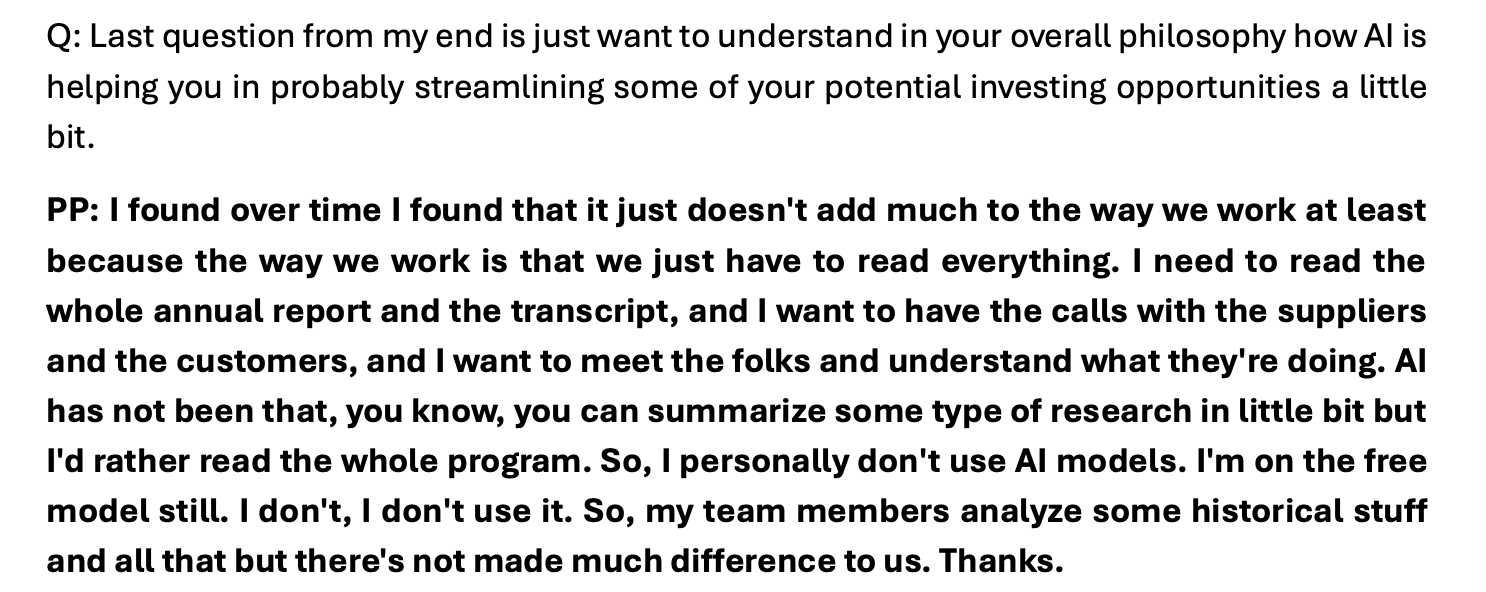
Pulak’s approach is essentially the Robert Caro method: turn every page yourself. What makes this viable for Nalanda is their extremely tight top-of-funnel filter, which narrows the investable universe down to roughly 150 or so companies worth a deeper look, which then narrows further to 70–80 from which they actually buy. The learning is that if you structure your top of funnel / process tightly enough basis relevant proxies or filters (Nalanda uses ROCE as a strong filter) then you can get away without AI augmentation entirely. That was one big takeaway.
The second takeaway was perhaps the more important one: how deliberately Pulak has structured his entire investing philosophy around his own temperament and edge, with each element reinforcing the other. You can study Nalanda’s approach, even try to adopt it. But it can really only be executed by someone whose behaviour and disposition are naturally aligned with it. It is simple, but not easy.
I thought this was a fascinating article, and personally found it very useful. I suppose it would be useful for anyone who does a fair amount of researching and writing. In particular I found it fascinating to see the various tools and apps he spun up using Claude Code – such as ‘Delphi’ (and a few other agents) for research, ‘Cuneiform’ for reading, ‘Scribe’ for writing etc. Good piece to see how single-person (media) businesses can leverage AI. This will be useful for writers or those with an elaborate personal knowledge management system to see how they can leverage AI tools.
Link.
Nabeel Qureshi is consistently interesting as a writer, as he is here too, in this fascinating meditation on what makes for great art. He says great art is surprising, illustrating this through lines from Macbeth and The Whitsun Weddings, is intricately patterned (he calls it ‘echoes’), and has considerable depth. All of these are missing in the type of art churned out by LLMs he says and will be hard for AI to replicate. Ultimately he says great art is borne out and informed by our living experience, and this he says constitutes the hard and ultimate barrier that makes it difficult for AI to create great art.
Link.
Really good piece by David Oks on why China has grown richer and faster than India. I do agree with his thoughts (and remember a similar piece on South Korea v Kenya by Oliver Kim (https://www.global-developments.org/p/no-south-korea-was-not-poorer-than).
TLDR: 1/ China nuked its old social order and reorganised society around communist rule, and invested heavily in health + education. By 1980s when they liberalized its economy, it was “a socially modern country that just happened to be extremely poor”. There was labour / human capital that factories could leverage, unbounded by past constraints.
2/ India on the other hand had never invested as heavily in human capital nor shifted its social order. So we havent been able to take advantage of the 1991 liberalization as much as China took advantage of Deng’s easing of rules.
Link.
Flagship Pioneering is the investor behind Moderna, who invented the leading COVID-19 vaccine. This is a good read profiling their distinct playbook as well as their founder Noubar Afeyan. The playbook reminds me a bit of Sutter Hill which too incubates companies (most famously Snowflake), but the scale at which Flagship operates, exclusively in biotech, is something to behold. They have a very structured playbook funneling ventures from ‘Explorations’ (~100 a year) to ‘Prototypes’ (8-10 each with a $1-1.5m budget) designed to maximize the learn to burn ratio, from which 6 to 8 become ‘Newcos’ which are launched. This playbook along with the ruthless focus on truth-seeking have led to a stellar portfolio outcome – 21% of ~150 portfolio companies are IPOs compared to overall industry benchmarks of 1%. Amazing. Will leave you with this wonderful quote by Noubar Afeyan, which distills their overall philosophy well: “We have to be willing to embrace unreasonable propositions and unreasonable people in order to make extraordinary findings. Because the notion that utterly reasonable people doing utterly reasonable things will produce massive breakthroughs, it doesn’t compute to me.”
We’ve heard about podcasts’ impact on ‘dad books’ (thick history / biographies given as Father’s Day gifts). But here is Tim Ferriss talking about AI’s impact on self-help books, or what he calls prescriptive non-fiction. Illuminating.
Astute observer Anu Atluru describes the rise of Insider Media: content from VCs, startups, operators / observers. This is content by insiders for insiders she says, as distinguished by traditional coverage of tech by MSM, which is by outsiders for outsiders. Clever framing.
Terrific piece by ex-VC Pranav Hari on how the lack of sovereign models is creating a new and growing line item in our import bills, and contributing to the current account deficit. Combined with the likely drop in software services export this is likely to be a double whammy.
It is time to wrap this! As I shared earlier, you should think of this substack as akin to a monthly magazine - you don’t have to read it all in one sitting, and you don’t have to read all of it! Feedback, or your own ruminations are welcome. Please use the comments section to engage!
No posts
Comments
Nothing yet. Say the first thing.
Sign in to join the conversation.