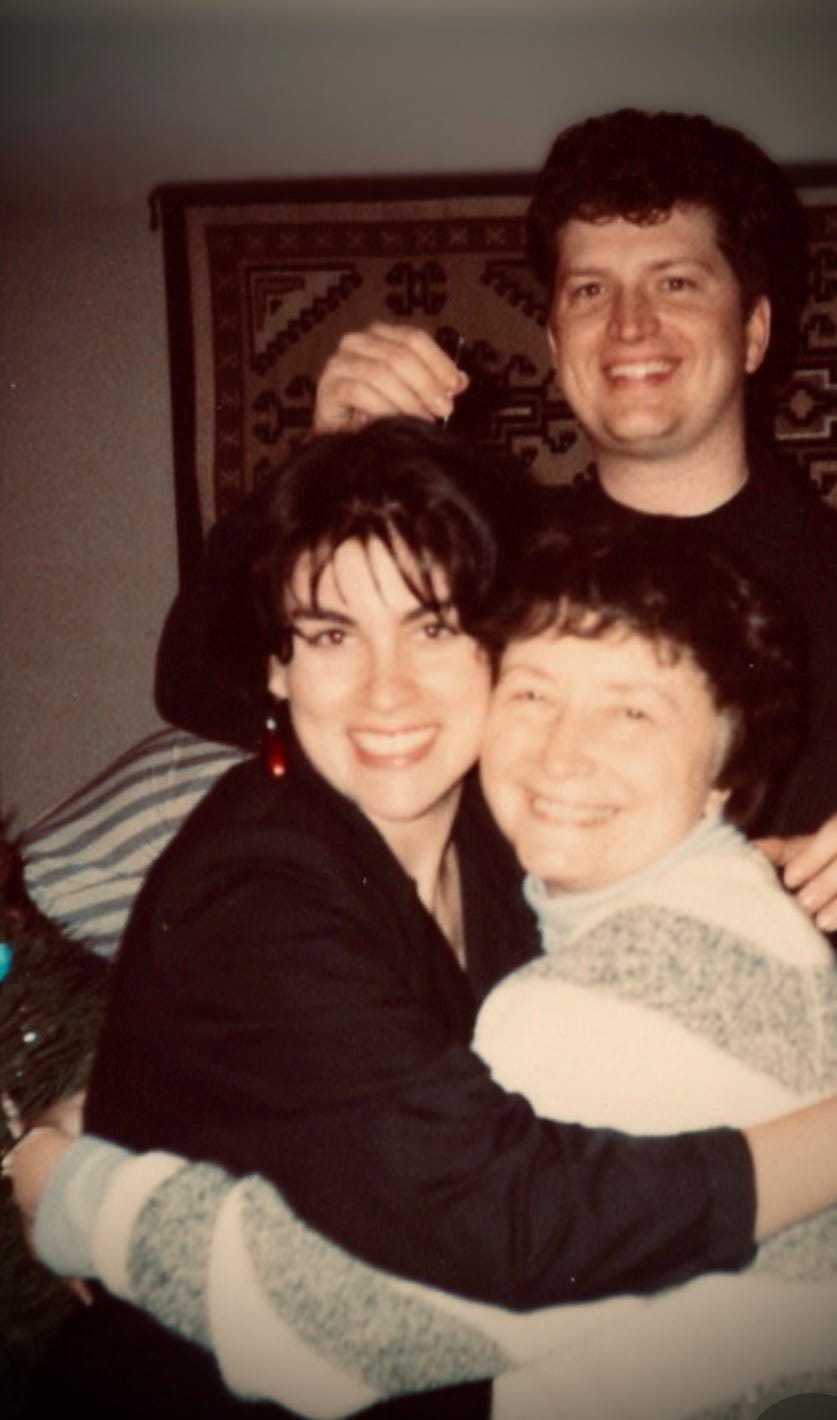
Image: Three people. One man, Geoff Grace, standing in the background holding a holiday ornament. Two women in the foreground who are in a loving embrace,: the man’s wife, Sage Justice, and his mother, Joan Grace.
For the past 36 years, March 23, has been the day I sang “Happy Birthday” to my mother-in-law, not so today. On January 13, 2026, after 93 years of a long and loving life, my mother-in-law passed away with her three devoted children surrounding her, exactly three years, and three days, after her beloved husband died. I still feel her presence with me each and every day. I believe her spirit is still around us. She is helping to sort out the details of her belongings and sort out the belonging of those still here.
A week prior to her crossing over, my daughter and I sat with her to say our goodbyes. We invited her to flicker the light in our salt lamp after she passed to let us know she was ok. She responded with curious consideration and said, “Hmmmm.”
A few hours after she left earth side, my phone rang from an unknown number. As the person was leaving the message I tapped on the phone to hear the transcription. Instead it played the voicemail message which was a static connection from a female voice saying only one thing, “Goodbye.”
I felt like it was Joan saying, “I can do more than flicker a light to show you that I’m ok.”
My husband had a close relationship with his mother, a true friendship, much like the one he has with our daughter and with me. We lovingly become what is modeled for us, if we choose to embrace it. His relationship with each of us strengthened the others. As a loyal man with integrity, he doesn’t use his friendships with women to vent or complain about the other women in his life. Therefore, I was comforted by their connection, not threatened by it, (as I hear other women convey about husbands who are close to their mothers). I love the way my mother-in-law loved my husband, and the way he loved her back.
I’ve never met a man who respects women as much as my beautiful husband does and he learned that respect of women from both his mother and father before him.
After his father died in 2023, my husband called his mom nearly every day. His mother and father were best friends, just as my husband and I are. My husband knew how important that daily connection meant to his mom. He was nourishing in his mother the same love and devotion she had nourished in him.
Watching him go off for his first walk alone, after his mother passed away, where he wouldn’t be talking on the phone with her for their daily visits, felt like an elephant stepping on my chest. I can still see the imprint on my shirt; a constant reminder of the depth of grief he must be carrying that none of us can see.
It was maybe 2007, and all her children and grandchildren were gathered in one place. I sat nursing my newborn and watching the way my mother-in-law delicately, patiently, and painfully, slowly combed the tangles from one of her grandchildren’s hair. I’d never seen anyone do that. She treated each strand of hair like it had feelings that could be hurt if she wasn’t as careful as possible with how she moved that comb.
At first it annoyed me and I viewed it as an indulgence and a waste of time. At the rate she was going with the tangles that child had, we were going to be watching this display of tenderness all night. I’d been taught that motherhood was about efficiency and that everything needed to be done in a hurry because “a woman’s work is never done.” I’d also been raised in a neighborhood where every child with hair as thick as mine, sat in a chair in the kitchen, often with a hot comb on the stove, as their mama held their hair close to the root to lessen the pain and then attacked the tangles like she was fighting off a bear; fast and furious- no gentle about it- not even for us “tender headed” kids.
Not Joan.
She was different.
Joan was a gentle, patient, loving and yes, perhaps a bit indulgent of a parent—but even that indulgence was an act of love that helped mold each of her children and the way they move through the world and the ripple effect of how their tenderness impacts and inspires others, like me.
Early on in my marriage, some 30 plus years ago, I remember hearing stories of Joan feeding her youngest son, David, food under the table when he was a child because he was pretending to be a dog during dinner. The whole family laughed and played along. My grandparents were playful too, but they would have drawn the line at letting their child eat out of the palm of the hand under the table during dinner. I’d been conditioned that parenthood was about disciplining children, building character, and making them strong enough to survive in the world without us. Every inch of my insides were screaming, “That’s inappropriate at a dinner table and a recipe for raising a self-absorbed child. No way am I ever going to do that!”
While it’s true indulgences can create entitlement in some people, it’s also true that love is not an indulgence. Kindness is not an indulgence. Playfulness is not an indulgence.
I was wrong about not allowing children to move about and play whilst eating, and I love how easy it is for me to admit that. I wish everyone knew how freeing it is to embrace human imperfections, and not have to pretend to know everything or cling to believing their misjudgments were right. Try it. Say, “I was wrong.” How does it feel? If it’s hard to do, there’s work to be done. Trust me, life becomes so much more fun, flowing and easy when we can admit when we are wrong. Being wrong occasionally is part of the human experience; If we’re never wrong, we’re not human.
Fast forward about 20 years from the first time I heard those stories and I had a child of my own who could not sit still at a table during meals. I knew my daughter was loving, kind, and thoughtful. She was not a selfish or self-absorbed child; despite being an only child who has had those misjudgments constantly projected onto her from the day she was born. It turned out that she was getting up from the table while eating because she had a genetic medical condition that made eating painful but she couldn’t communicate that until years later. The movement of walking around the table after every bite of food was her way of self-soothing.
Had I not heard Joan’s stories about David, I might have been swayed by my own upbringing to take a harsh and disciplinary approach- forcing my child to stay seated while eating or threatening to punish her if she could not. Although, as caregiver to many children before becoming a mother myself, I never did that with other children and so I doubt I would have ever done that to my own child. Nevertheless, parents droned on and on with a single sentiment: “It’s different when you have your own,” so I really had no idea what to expect of myself as a mother. The only difference I have found between being a loving caregiver to other people’s children and my own is the influence of the parents involved, not the children. I could’ve mothered the world with all the love I have to give.
When Joan told that story about David, both my heart and preconceived judgments about parenting softened and I made a monumental decision not to punish as a parent but to let curiosity and care be my guide. My daughter says that she believes I would have been a tender parent no matter what, and maybe she’s right, but Joan’s example gave me permission to be a gentle parent; to follow my intuition and not be swayed by social pressures to be more of a disciplinarian. In the process, I successfully and lovingly broke generational trauma around parenting. I made a conscious choice not to parent in the way I’d been parented but to follow the patient example my mother-in-law set instead. Thanks to Joan, I had a new model for peaceful parenting that I’d never seen in real life or read about in any book back in the early 2000s.
When people are patient, kind, and tender with us, we are more likely to be patient, kind, and tender with others (including ourselves). Isn’t that the end goal we’re all trying to achieve? Self-compassion and human kindness?
I was raised with the biblical proverb, “Spare the rod - spoil the child.” However, I’d done enough research on early development as well as survived childhood trauma to know that “might makes right” only leads to war. Gandhi’s sentiments that “an eye for an eye makes the whole world blind,” reverberated through my spine. I was tired of environments that were blinded by rage. I wanted to see the world through eyes of love. I had no intention of using “time-outs,” let alone “spanking.” I was curious and determined to find a new way to parent with maturity. Curiosity was a quality both my mother-in-law and I had in common.
Joan was a very curious and highly educated woman with three degrees (if memory serves): a Bachelors, a Masters, and a PhD. I trusted her knowledge and experience; the success of which shown through in her child, who grew up to become my husband. In fact, she demonstrated her curiosity even in death.
She was my mother for 36 years. Shortly after she passed away, and the family was waiting for her body to be picked up from the house, I had a bit of a panic attack imagining strangers taking her body away. I felt protective of her frail body and didn’t want anyone to handle it carelessly.
I told my husband and daughter, “I don’t want my body to be carted off. You’re going to have to smuggle me to a body of water and give me a Viking funeral send off.” Then I heard Joan’s voice in my head say, “I’m not bothered by it at all. I’m not in my body anymore and I’m actually quite curious to see what happens next. I think it will be interesting.” That sounded so like something Joan would say, that I believe it really was her spirit speaking to me.
I used Joan’s gentle parenting as a diving board to jump off the deep end of child-lead parenting. I backed off from being a Sage on the stage, pseudo tiger mom in training, and embraced being a guide on the side crunchy/silky/scrunchy granola mama allowing my daughter to learn from intrinsic motivation, self-discipline and natural consequences. This lead to a happy childhood my daughter did not have to recover from.
It was a mostly free-range education of homeschool, zen school, road school, immersion into arts and sciences, that led to college courses at age 12, university invitations at age 15, an international artiste at age 17, and a budding filmmaker living abroad making a film in association with Aardman, at age 19.
We raised a joyful, kind, conscientious, creative, critical thinker. While no one is perfect, I’d call our parenting journey a success, and I have to thank Joan for the example she set of gentle parenting that started it all.
The greatest compliment of my daughter’s childhood is that my daughter is looking forward to having a daughter of her own to raise in exactly the same way she was raised.
There’s no doubt in my mind that without Joan’s example of gentle parenting, the past 20 years of my life would have been dramatically different, and those of my daughter, as well. That one example of how she combed the tangles with such tenderness shaped everything else I chose to do and created the incredibly loving bond I have with my daughter; who is herself, the greatest gift I’ve ever known.
Life is full of symbols and signs if we train our eye and open our hearts to receive them. What a fitting story of how a seed of Joan’s legacy took hold of my heart, with a Comb, her maiden name. We are all the people we’ve ever been and ever will be in every moment of now. Thank you, dear, Joan Marie Combs Grace, I love you. Happy Heavenly Birthday. May the angels sing all your favorite songs.


Comments
Nothing yet. Say the first thing.
Sign in to join the conversation.