
It all started when I watched the 2001 film, The Wedding Planner. I knew at that very moment, watching JLo, I was destined to own my own business and be creative every day of my life.

Within the next couple of years in High School, I planned two of my friends' baby showers. I guess it was a popular time to have babies in a small rural town..
But that thrust me into the love of design.
Fast forward a few years: Although I knew I wanted to be a wedding planner, we were all constantly told: “to get a job and be successful, you need a Bachelor’s degree” 🫠 So, I did just that.. but I also told a white lie along the way.
In my junior year of college, I literally flipped through the Yellow Pages (yes, I’m that old) to see what wedding planners were in my not-very-big city. This was well before social media days, so we didn’t really have much info/research on companies. However, one caught my eye with their ad. It had gorgeously drawn florals in a pedestal urn, and I decided to give them a call.
And there was the lie.
I didn’t have a class that required that, but I wanted in and was willing to do anything.
We did a phone interview; I explained my shower planning experience and that I’m a really hard worker. Little did she know, I was currently working afternoon shifts at Hollister and night shifts bartending.. but, I’d figure that out later.
She told me: I haven’t done internships before {trusting someone with no experience}, and it wouldn’t be a paid position, but I’ll think about it.
I didn’t hear back for a few weeks, but I did write her a really kind thank-you card. And, to be honest, it might have landed in her mailbox at the perfect time. Because on a Friday night, the night before one of her biggest weddings, she called me and asked if I could help her out the next day.
Yes ma’am.
She picked me up at 6am and told me to wear comfy shoes and pack a black outfit. And during that long day, I showed her exactly why she needed me. We worked until 2 or 3 a.m., and I loved every minute of it.
I proved myself; she actually ended up hiring me for weekend assistance, which turned into much more as the months went on ;)

During that time, I decided to teach myself the Adobe Suite. She had one of those thick, step-by-step Adobe how-to books that I kept under my desk in the office. I would literally sneak into her office on Sundays and Mondays, sit down at my desk, and start trying to replicate invitation designs I admired (like Wiley Valentine). Not to copy them {I never used any of it}, but because reverse-engineering was the only method I had since that Adobe bible was too intense.
I’d find something I liked and try to rebuild it layer by layer. Zooming into the spacing, understanding effects, playing with masking, and learning to vectorize. These are the micro details that most people might skip right past. I didn’t have someone walking me through it in a classroom; instead, I had to look so carefully and analyze other people’s work just to understand what I was even seeing. And re-doing it over and over again.
Then, one day, I designed a birthday card for my boss and put it on her desk for her to find on the following Monday.
She asked, “Where did you get this?” and I confessed to her that I’ve been sneaking into the office for the last few months learning InDesign and Illustrator.
That was the very moment she realized I had more to offer. I was then put in charge of helping to design clients’ invitations, putting together design presentations, styling display tables, and soon being trusted to lead and design my very first wedding.
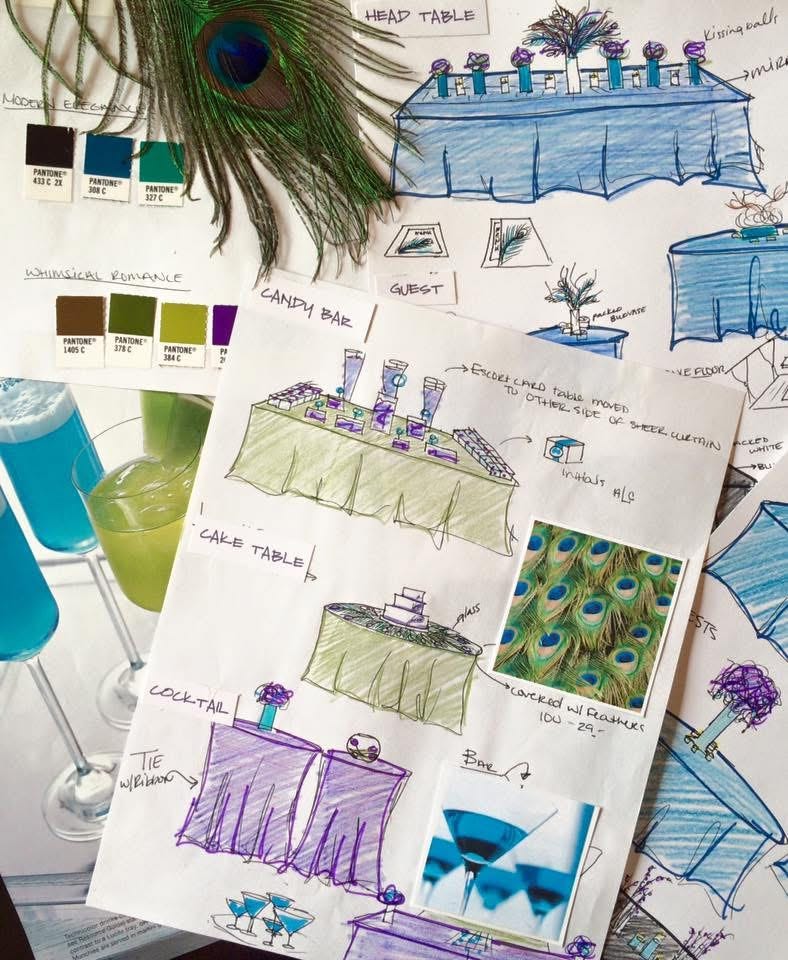
In 2009, I had just graduated with my Bachelor’s degree in Communication. I was working random weekends with the wedding planner and full-time as an Office Manager at a live sound company. Of course, to get my creative “hit,” I would covertly open up Microsoft Word during work and assemble mood boards for my new blog, Witty and in Love. Here’s one of my first posts ;)
By 2011, I decided to quit those jobs, pack up my crappy Hyundai, and move 1/2 way across the country to Wilmington, NC, all in hopes of pursuing my dream career as a planner.

I found a roommate on Craigslist and had 3 months’ worth of savings to figure my shit out and find a job. Good thing ignorance is bliss, because I just entered one of the worst job markets, post-housing-market-collapse. But I hustled and landed a job at a Cakery, then a small part-time position on a law firm's marketing team.
Bonus: my roommate was also amazing and so supportive (love you, Elise)!
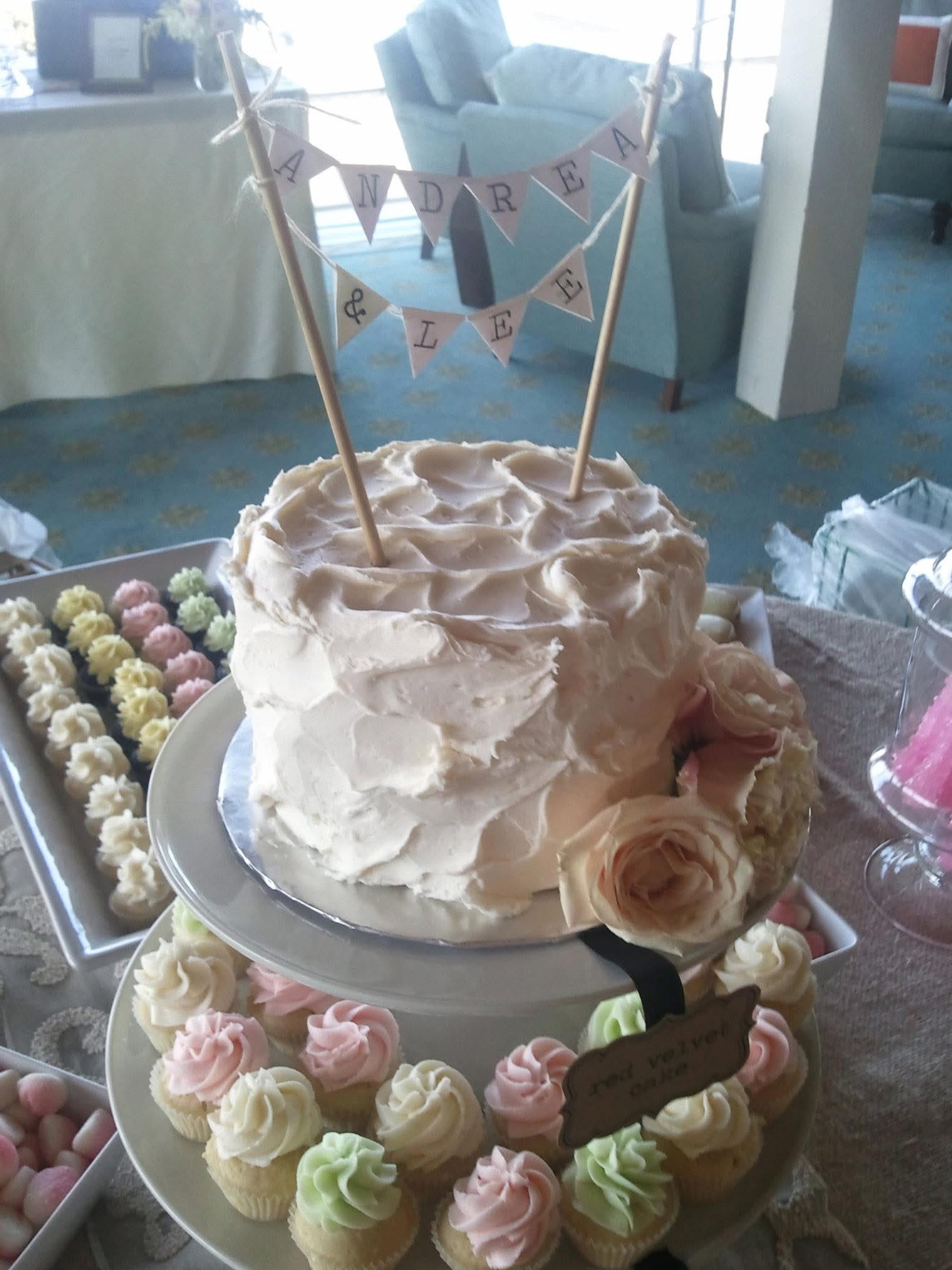
I spent my days working those 2 jobs. At one, I’d be designing cakes and managing the books; the other would be doing odd design jobs for their firm's clients or taking the inquiry calls (boring). I’d get home from them, make a late dinner, and be up until 2-3 a.m. creating blog posts, patterns for my Etsy shop, and teaching myself code and calligraphy.
I constantly looked into online courses to better my skills, but the world wasn’t what it is now, and what little did exist was priced for people who weren’t fresh out of college during one of the worst economic periods.
So, instead, I figured it out slowly, repeatedly, and sometimes by starting completely over (and over again).
I started to establish myself as a real designer. I was selling digital patterns on Etsy, calling cards that could be customized, and my very first logo and blog code project. I even started a side company with my co-worker at the law firm, called Mint 102, and we were one of the first to market wedding branding ;).
With that, I felt like I was finally at a point where the years spent teaching myself could actually be profitable.
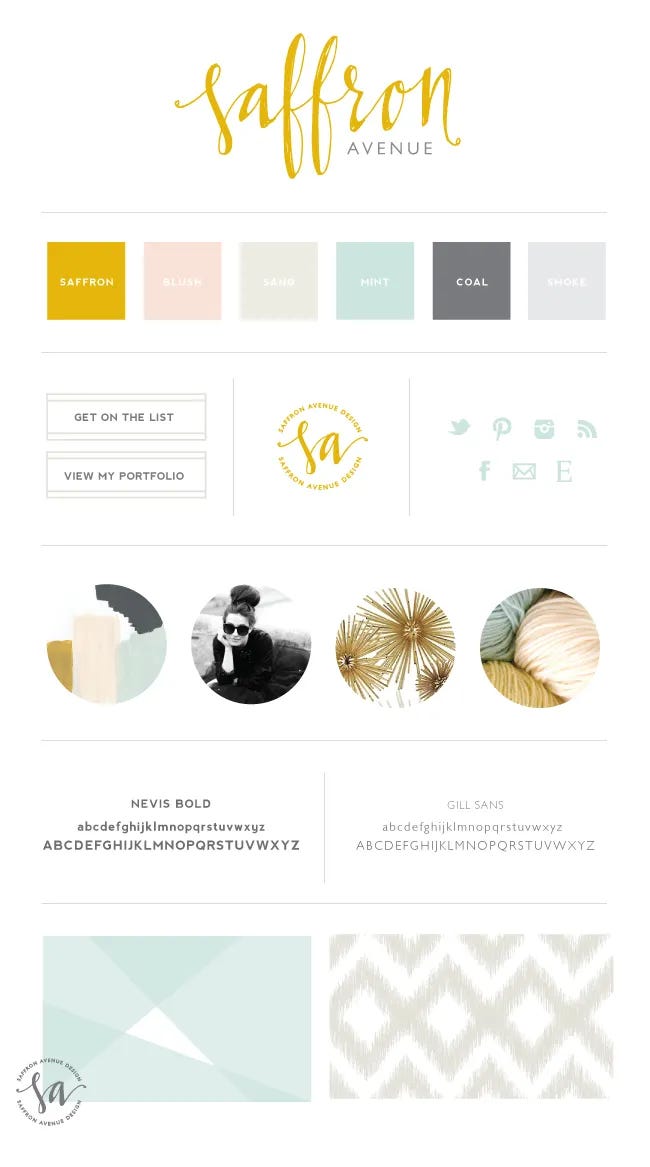
So, in early 2012, I relaunched as Saffron Avenue, and then in 2013, I finally decided to go all in :) I’ve since designed HUNDREDS of brands and websites, worked with a pro-NBA player (and his wife), a former Miss USA, and, more recently, created custom lettering work for LoveShackFancy.
When I started taking on clients, I was competing against studios staffed with designers who had actual degrees. Art programs, design theory courses, strategy lessons, etc. A foundation I didn’t have on paper.
That feeling followed me for a long time, unfortunately. I would go in ‘blind’ with every new design endeavor.
I undercharged. I over-explained my process. I second-guessed calls I already knew were right. I would get clients who took advantage of me.
Imposter syndrome wasn’t just chilling in the back of my head those early years.. it was loud, and it probably cost me. Not just money, but the time I spent talking myself out of my own capabilities and the clients I deserved.
I’m now fifteen years in, running a studio with a client list I’m genuinely proud of and a real talent I was born with.. but it still shows up. There are still moments when I wonder whether anyone will notice that I never took a design class and that I learned kerning from analysis and repetition, not a professor.
I don’t think that feeling ever completely goes away. I still feel weirdly guilty every time I send an invoice, if I'm being honest. But I’ve learned to work alongside it instead of letting it make decisions for me.
Plus, my husband’s encouragement always helps ;)
Here’s what I didn’t expect: the long road is its own education.
When you can’t look something up in a textbook or ask a teacher to walk you through it, you develop a different level of attention. You have to be completely focused on one small thing before you can move to the next. Then you do it again and again until it sticks, because no one is handing you a study guide or showing you a shortcut.
Sometimes you forget how you did it, so you have to spend the next 3 hours trying to do it all over again. If only screen recording were a thing back then!
That process built something for me, though: A patience with detail that I don’t think I would have developed any other way. And an eye that learned to slow down and actually look, because looking carefully was the only tool I had.
I also graduated with a four-year degree in something unrelated to design, and that mattered more than I gave it credit for at the time. I knew how to research. I understood deadlines, time management, and accountability. I could sit with a problem and work through it methodically. Those things transferred directly into running a studio, even if they had nothing to do with color theory ;)
What I didn’t have was a shortcut. Everything took much longer. Some things I still do differently from the “textbook” way.. not because I’m doing them wrong, but because I learned them through trial and obsessive observation rather than instruction.
The clearest example is my early client process (or the lack of one). I didn’t have the right discovery questions, so I’d jump straight into design without a real strategic foundation. I’d present six logo concepts at once, hoping something would stick. What I was actually doing was designing in the dark and handing that uncertainty directly to my clients.
Six options sounded generous because I was trying to prove myself. But what it actually produced was analysis paralysis. Clients would like the mark from one, the style from another, the color direction from a third, and suddenly I was in a revision spiral I had no framework for handling.
I also had to learn the entire business side from scratch: what questions to ask before a project starts, how to run a discovery call, what belongs in a proposal and why an expiration date matters, when to collect a deposit, what a solid contract actually protects. Needless to say, none of that came with that Adobe book.
Every one of those lessons came from something going sideways first. And that process, learning what to do by living through what not to do, is essentially how I’ve built my business. Clarity before creativity, and strategy before a single concept gets designed. I didn’t read that in a textbook. I figured it out the hard way, with real clients and real consequences. Translation: A lot of scope creep, revisions, and missing those red flags.
What self-taught cost me:
Years of undervaluing my work while I waited to feel “qualified”
Starting slower than I needed to because I had no roadmap
Loss of time and money with trial and error
A confidence problem that still shows up here and there
What self-taught gave me:
An eye for detail that developed because I had no other option
Patience as a genuine skill and dealing with a level of frustration I couldn’t even try to explain 😅
The ability to analyze design at a level that going fast would have skipped
Originality that came from not being taught what was “correct”
Fifteen years of proof that it works, my friends
I used to think about how much further along I’d be with more resources. Better tools, earlier access, formal training, building teams, etc. It was easy for me to spiral into those thoughts.
But I don’t believe that anymore.
I moved at the pace I was capable of at each stage to build Saffron Avenue. That pace forced me to absorb what I was learning rather than move through it quickly.. allowing me to truly understand a level of detail that matters. I believe there’s a real difference between knowing something and having lived it slowly enough that it becomes part of how you think.
If you’re self-taught and still figuring it out, I’m not going to tell you the confidence piece resolves itself overnight. It doesn’t. But the dedication, patience, repetition, and originality you develop when no one hands you the answers… that’s not a lesser version of a design education. It’s just a different one.
Clients don’t ask how you learned; they ask what you can do.
And I can safely say after fifteen years in, I have a pretty good answer :)


Comments
Nothing yet. Say the first thing.
Sign in to join the conversation.