
By Sadie St. Lawrence | Human Machine Collaboration Institute
This post is sponsored by T-Mobile for Business. As always, the perspective and analysis are entirely my own.

Let me start with a question I have been asking a lot lately.
If your internet went out right now, for two hours, what would actually stop working?
Not just the obvious things. Not just email and video calls. What about your AI-powered tools? Your inventory system? Your point of sale? Your customer service chat? Your cloud-hosted documents? The systems your team logs into every morning without thinking about it?
For most organizations, I ask this question too; the honest answer is: almost everything.
That is a change from even five years ago. And it is the change that makes business internet failover, a term most leaders have never had to seriously engage with, one of the most important operational decisions you will make in the next twelve months.
Let me define this in plain language, because the industry has done a poor job of making it accessible.
Business internet failover is the ability of your organization to keep operating on a backup internet connection when the primary connection goes down. Automatically. Without someone in IT frantically calling a provider. Without a manual switch. Without your team even necessarily noticing that anything happened.
The way it works is straightforward. You have two independent internet connections into your business. When the primary one fails, for any reason, the secondary one takes over. If the failover is designed well, the transition is seamless. Your systems stay online. Your team keeps working. Your customers do not know anything went wrong.
That is failover in one paragraph.
The interesting question is not what it is. It is why your organization needs it, and whether the failover you already have is real or theatrical.
I wrote a piece a few weeks ago about how the rise of always-on AI has changed the stakes of connectivity. This post is the practical follow-up to that argument.
Here is the shift, in the simplest terms I can put it.
Ten years ago, an internet outage was inconvenient. You could not send email for an hour. You could not access some cloud tools. But most of the operational systems your business ran on were still local. Your point of sale worked. Your inventory database worked. Your file server was on premise. The internet was a communication layer, not an operational layer.
That has changed completely.
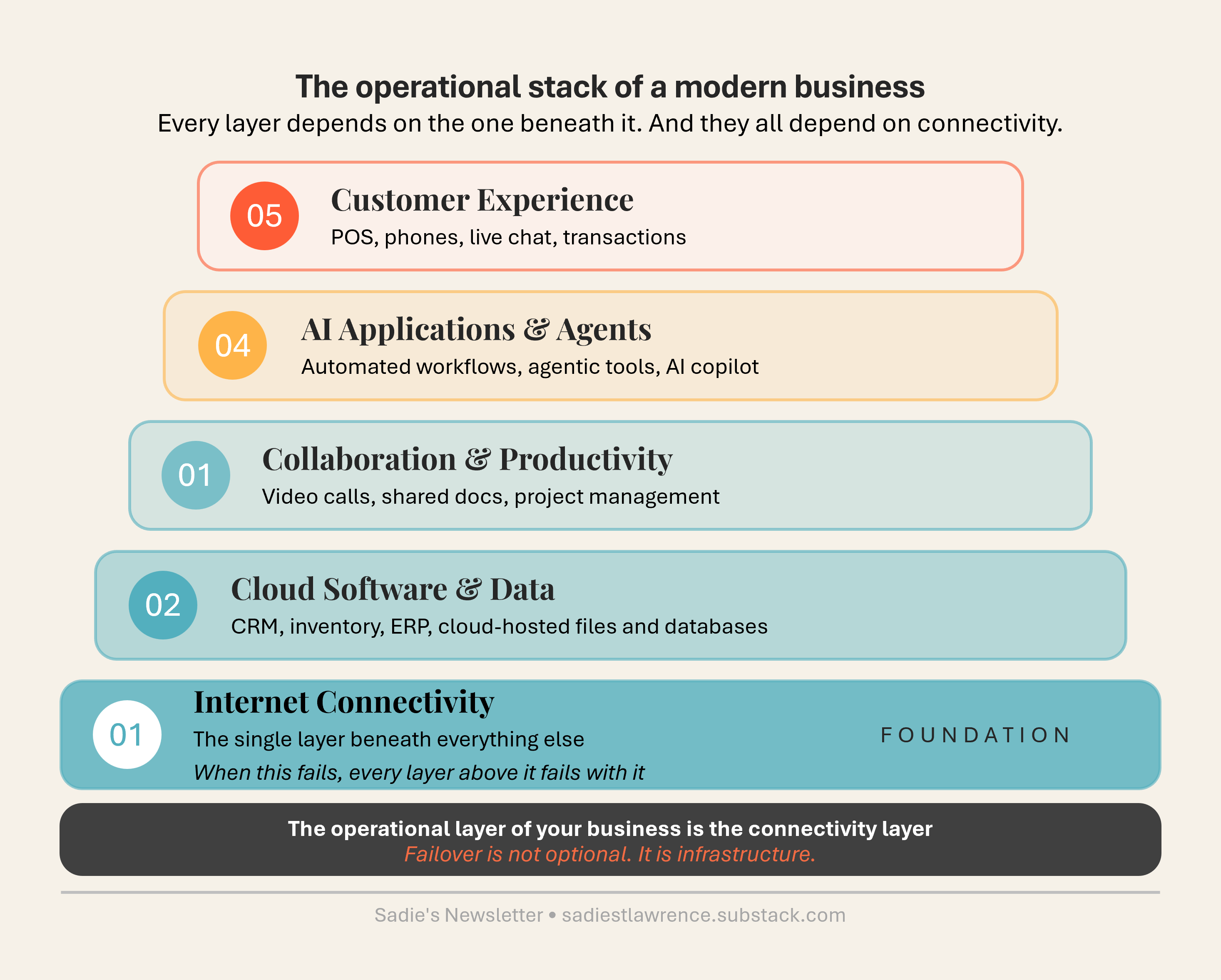
Today, the systems your business depends on are largely cloud-hosted, AI-augmented, and continuously connected. Your CRM is in the cloud. Your customer service is likely AI-assisted. Your inventory is synced across locations in real time. Your team is collaborating on documents that live nowhere except online. Your AI tools are not local software you installed. They are services you access through the internet, every time, all day.
When the connection drops, none of that works. And unlike ten years ago, there is no manual fallback. There is no paper system underneath. The operational layer of your business is the connectivity layer.
That is why failover matters now in a way it never did before.
Here is the honest evaluation question. Not everyone needs enterprise-grade failover. But more organizations need it than have it.
Ask yourself these five questions. If you answer yes to any two, it’s time to evaluate real failover rather than relying on a backup hotspot.
1. Does your business use a point-of-sale, payment processing, or customer-facing transaction system that requires internet?
If yes, your revenue directly depends on connectivity. A two-hour outage during business hours is not just inconvenient. It is measurable lost revenue.
2. Does your team rely on cloud-based collaboration tools, cloud-hosted documents, or AI-powered software to do their daily work?
If yes, an outage does not just slow your team down. It stops them. There is no offline mode for most of the systems modern knowledge work runs on.
3. Do you use VoIP or internet-based phone systems for customer communication?
If yes, an internet outage takes your business phone lines down. Every customer call that comes in during that window either fails to connect or lands in a voicemail no one is checking.
4. Do you run AI applications, agents, or automated workflows that need to be continuously available?
If yes, this is the modern version of the failover question. Your AI is not a backup capability. It is embedded in the operational fabric of the business. When it goes offline, downstream work stops.
5. Do your customers, partners, or regulators expect continuous availability?
If yes, then downtime is not just an internal issue. It is a trust issue. And trust, once eroded by a preventable outage, is expensive to rebuild.
If you answered yes to two or more, failover is not optional for your business. It is infrastructure.
Here is where most organizations get this wrong.
They think they have failover. They have a backup ISP contracted with a different provider. They have paid for it for years. They feel covered.
But the backup ISP often runs through the same physical infrastructure as the primary. The same underground cable. The same regional point of failure. When a construction crew cuts a fiber line, when a storm knocks out local infrastructure, when the regional ISP has a bad day, both connections go down simultaneously.
The redundancy is theater. And most organizations do not discover this until the day they need it to work.
The organizations that have real failover are the ones whose two connections cannot fail together, because they use fundamentally different infrastructure. This is why the wireless plus wired combination, or the wireless plus satellite combination, is a genuinely different kind of backup than two wired lines from different providers.
The failure modes have to be independent. If they are not, you do not have failover. You have hope. That is the architecture problem SuperBroadband solves — 5G and Starlink fail independently of each other by design.
If you are shopping for a real failover solution, or evaluating whether the one you have is doing what you think it is, here is what I would look for.
Independent infrastructure. The primary and backup connections should not share a physical path. Wireless plus wired. Wireless plus satellite. Some genuinely diverse combination. If both connections trace back to the same regional network, you do not have failover.
Automatic switching. When the primary drops, the backup should take over without human intervention. If someone has to manually switch, you are going to lose minutes to hours during exactly the moment when speed matters most.
Seamless from the user perspective. Your team should not have to know anything happened. If your failover requires reconnecting devices, re-authenticating tools, or reconfiguring anything, it is going to cause friction that costs you more than the outage itself.
Fast enough to run your actual operations. A failover connection that is significantly slower than the primary is a partial answer. It is better than nothing. But if the backup cannot run your AI tools, your video calls, and your operational systems at usable speed, you are still going to have degraded operations during the outage.
Continuously managed. The failover connection should be a real, monitored, maintained service. Not a hotspot you set up once and forgot about. When you need it to work, it needs to work.
Solutions like SuperBroadband from T-Mobile for Business are built specifically around these principles. By combining 5G on the ground with Starlink in the sky, SuperBroadband provides two independent connectivity paths with automatic switching, defined service levels, and end-to-end management through a single provider. That is the difference between having a backup connection and having true resilience.
If you are evaluating a failover solution right now, or thinking about whether your current one is real, I want to leave you with the question I would ask.
If the primary connection went down for two hours right now, during business hours, on a day that matters, what would actually keep working, and what would actually stop?
Not what the provider promises. Not what the SLA document says. What would actually happen inside your business.
If you cannot answer that question with specificity, that is your first project. Get the specifics. Then design the failover that keeps the things you cannot afford to lose running when the primary drops.
The always-on AI era has raised the cost of getting this wrong. It has also made the answer clearer than it has ever been. Real failover, with independent infrastructure and automatic switching, is no longer a nice-to-have. It is the foundation your operational layer sits on.
What is business internet failover?
Business internet failover automatically moves your business to a backup internet connection when the primary connection goes down, helping keep systems and operations online.
Do I need business internet failover?
If your business relies on cloud applications, payment systems, VoIP, AI tools, or other continuously connected services, failover can help prevent an internet outage from becoming an operational disruption.
How do I keep my business online if my primary internet goes down?
A failover solution uses a secondary internet connection to take over when the primary connection fails. For true resilience, the two connections should use independent infrastructure and switch automatically.
What should I look for in a business internet failover solution?
Look for independent infrastructure, automatic switching, a seamless user experience, enough performance to support normal operations, and continuous management.
What is the longest internet outage your business has lived through, and what did you change afterward? Hit reply. I am collecting stories from readers on the operational cost of these moments and yours matters for the research at HMCI.
Sadie St. Lawrence is the Founder & CEO of the Human Machine Collaboration Institute and author of Becoming an AI Orchestrator. She writes weekly about the future of human-machine collaboration, AI in practice, and what it actually takes to build at the frontier.
This post is sponsored by T-Mobile for Business. The analysis and perspective are entirely my own.
No posts
Comments
Nothing yet. Say the first thing.
Sign in to join the conversation.