
By Sadie St. Lawrence | Human Machine Collaboration Institute

Why now?
Because I often get asked: “What do you actually do? How is it all connected?”
And honestly, I get it. From the outside, it may look like a lot of different things: consulting, AI strategy, media, research, education, infrastructure, ecosystems, events, and now an open-source research platform.
But to me, it is all deeply connected.
So let’s start at the beginning.
HMCI started as an idea I had in 2023. At the time, I wanted to get back into research. More specifically, I wanted to answer deep questions. The kind of questions that sit underneath everything we are building right now in the age of intelligence.
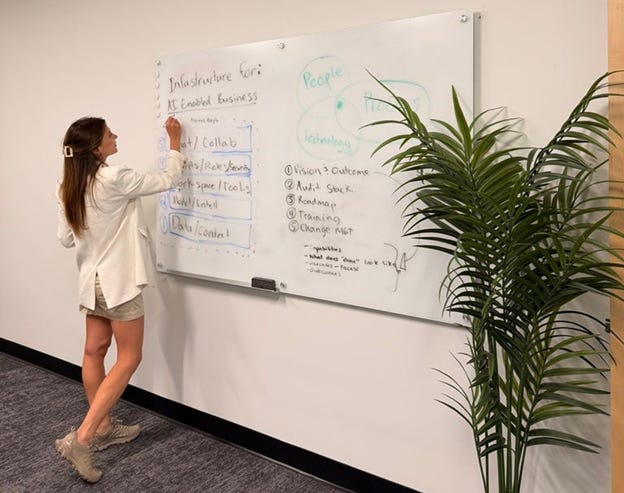
What does it mean to collaborate with intelligent machines?
How do we help humans thrive alongside AI?
What is intelligence?
What is consciousness?
How do we build systems that expand human potential instead of replacing it?
That is really the vision of HMCI: to answer the deepest questions in the age of intelligence.
Because I believe, with AI, we can actually do this now.
But on a practical, day-to-day level, our mission is simple:
Help humans thrive alongside intelligent machines.
Now, how do we do that?
Well, first, we have to make money.
Because we are a business. And if we want to build something ambitious, we need a way to fund it.
So HMCI was built around three pillars:
Discover. Transform. Amplify.
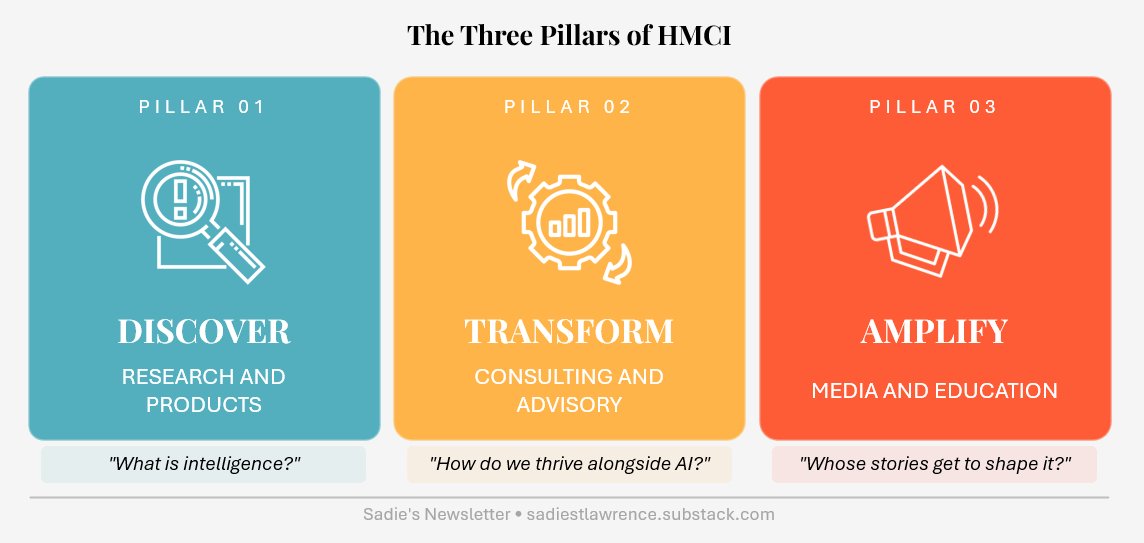
On the Discover side, we focus on research and products.
On the Transform side, we focus on consulting and advisory.
On the Amplify side, we focus on media and education.
But like any company, we did not start with everything built. We could not. We had to start where we could create value the fastest and get paid for it.
So we started with what we do best: consulting and advisory, particularly in AI strategy and technology transformation.
That became the foundation.
Through our Transform work, we helped organizations figure out what AI actually means for them, how to modernize their systems, how to rethink workflows, and how to prepare their teams for this next era.
Through our Amplify work, we helped clients tell the story of what they were building, especially in AI, data, infrastructure, and emerging technology.
That combination gave us the runway to fund the bigger vision.
But the bigger vision was never just consulting.
The bigger vision was research.
More specifically, I wanted to build an open-source research platform that could bring more people into the field and help us answer deeper questions about intelligence, collaboration, and consciousness.
But as I started mapping that out, I realized something important:
To build the research platform, we needed more than software.
We needed an ecosystem.
We needed people, technology, infrastructure, education, workforce pathways, partners, compute, research capacity, and a place where all of this could actually come together.
So I started researching what makes a technology ecosystem work.
And in that process, I realized something else: not only did HMCI need an ecosystem, but the city we are located in needed one too.
That led us to begin building an AI and robotics ecosystem for a medium-sized city.
And we were lucky enough to find incredible partners who wanted to go on this journey with us, including:
1. A city that was willing to think differently about its future.
2. NVIDIA, who also wanted to participate in building what comes next.
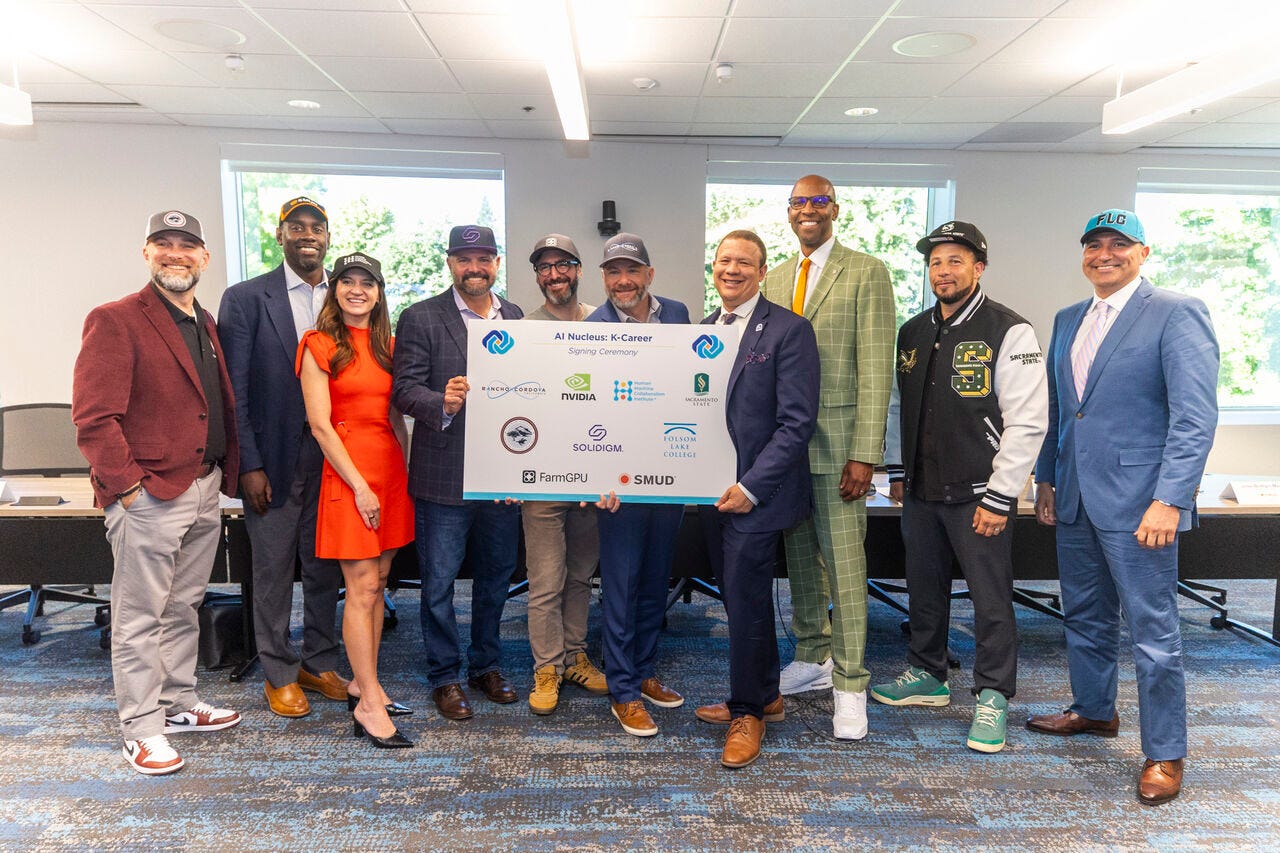
From there, we began building an AI and robotics ecosystem grounded in our core pillars:
AI infrastructure. Workforce and education. Research and innovation.
This ecosystem gives us a real-world environment to test ideas, build capacity, support organizations, develop talent, and ultimately create the foundation for the next stage of our moonshot: the research platform.
Which brings me to where we are today.
Right now, HMCI is focused on two major things:
1. Building Keeboh, our open-source research platform.
2. Building our media company, which will amplify the research, ideas, people, and stories shaping the future of human-machine collaboration.
All of this is backed by our AI infrastructure work, because none of these ideas matter if we do not have the physical, technical, and human systems to support them.
So here is the moonshot plan:
1. Build the company.
2. Build the ecosystem.
3. Build the research platform, Keeboh.
4. Become the destination for researchers, builders, and thinkers who want to explore intelligence from a more diverse set of perspectives.
5. Amplify that research through our media business, help unify the field, and work toward the grand vision of building a unified theory of consciousness.
Yep.
I know.
The five-step moonshot plan is kind of crazy.
But the wild part is that we are already on step three.
HMCI has only been full-time for about a year and a half, which is honestly kind of freaking crazy to think about.
And while the plan may sound a little nuts, I really do believe it is going to happen.
We are building an open-source research platform where more ideas, more possibility, and more people can thrive.
We are building a media arm to amplify research and perspectives from people who do not always get heard.
And we are building on a foundation of AI infrastructure so that this work can grow in places that are often overlooked.
That is where we are.
That is where we are headed.
And if you want to be part of the journey, drop me a note.
Always looking to connect, collaborate, and build with people who are crazy enough to believe the future can be better.

If your current AI workflow relies on manual prompt-and-response back-and-forth, you’re already behind the curve. In my latest tutorial, I explore Loop Engineering—the architectural shift moving us from manual prompting to continuous, goal-driven AI execution. I break down real-world, non-coding business workflows that run autonomously, alongside the crucial safety frameworks required to keep agentic loops on track. It’s time to move from managing individual inputs to orchestrating scalable systems.
Watch the full breakdown on YouTube!
Sadie St. Lawrence is the Founder & CEO of the Human Machine Collaboration Institute and author of Becoming an AI Orchestrator. She writes weekly about the future of human-machine collaboration, AI in practice, and what it actually takes to build at the frontier.
No posts
Comments
Nothing yet. Say the first thing.
Sign in to join the conversation.