
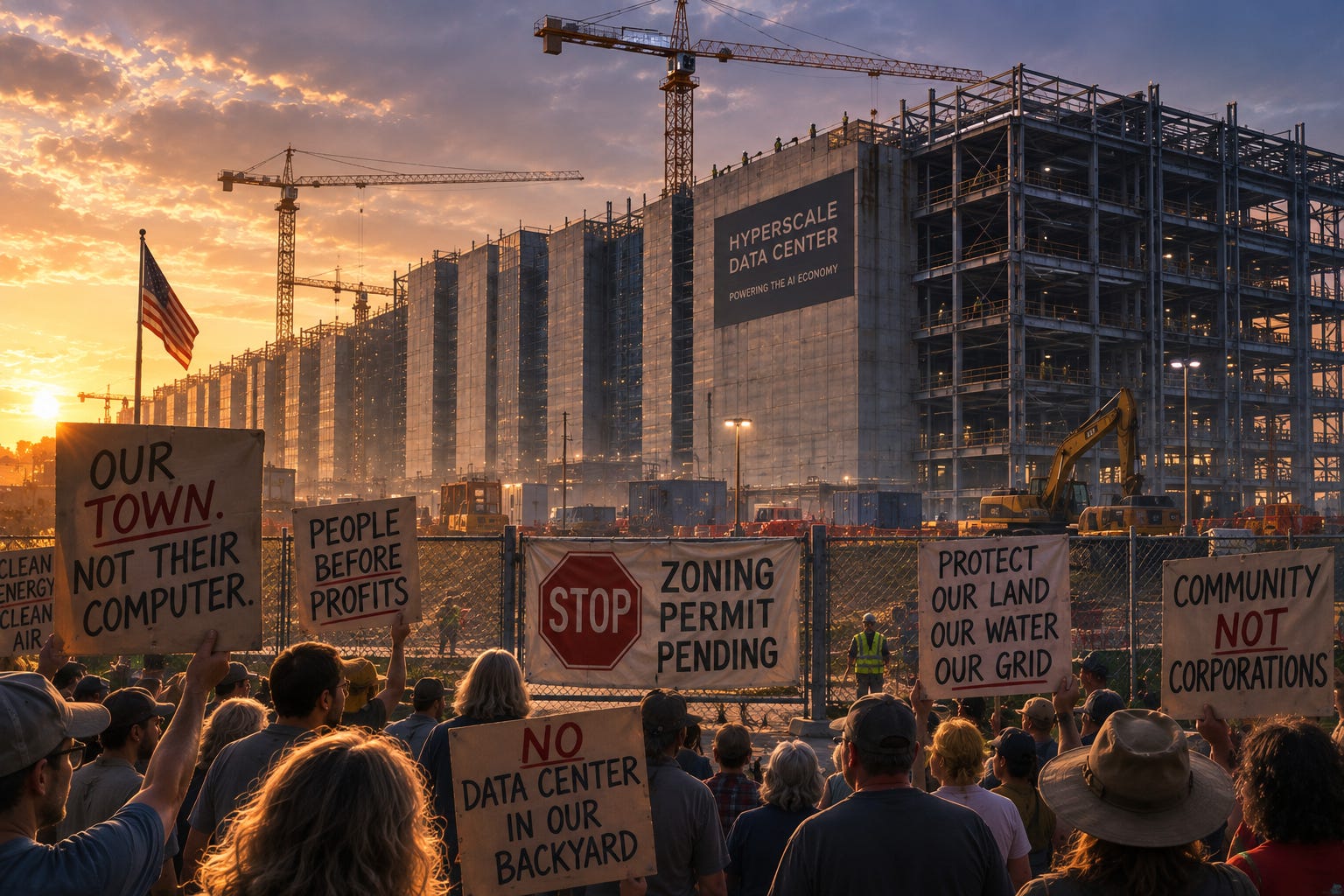
Data centers have become politically toxic with astonishing speed.
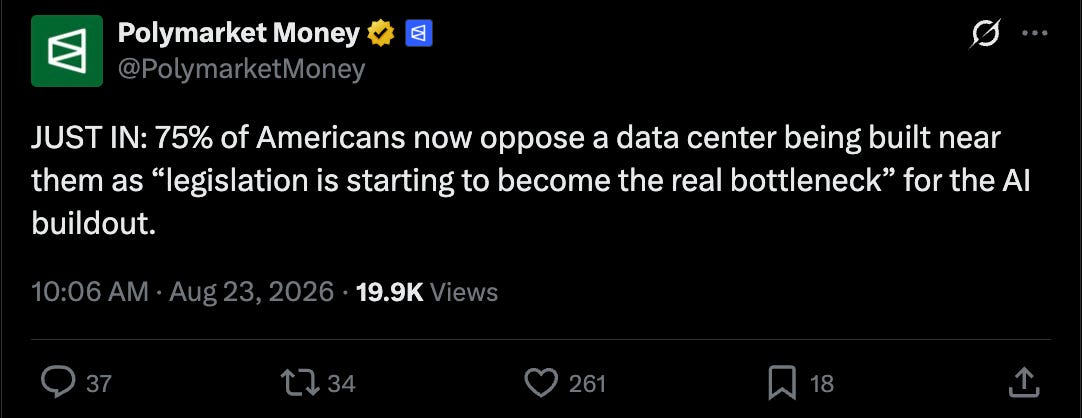
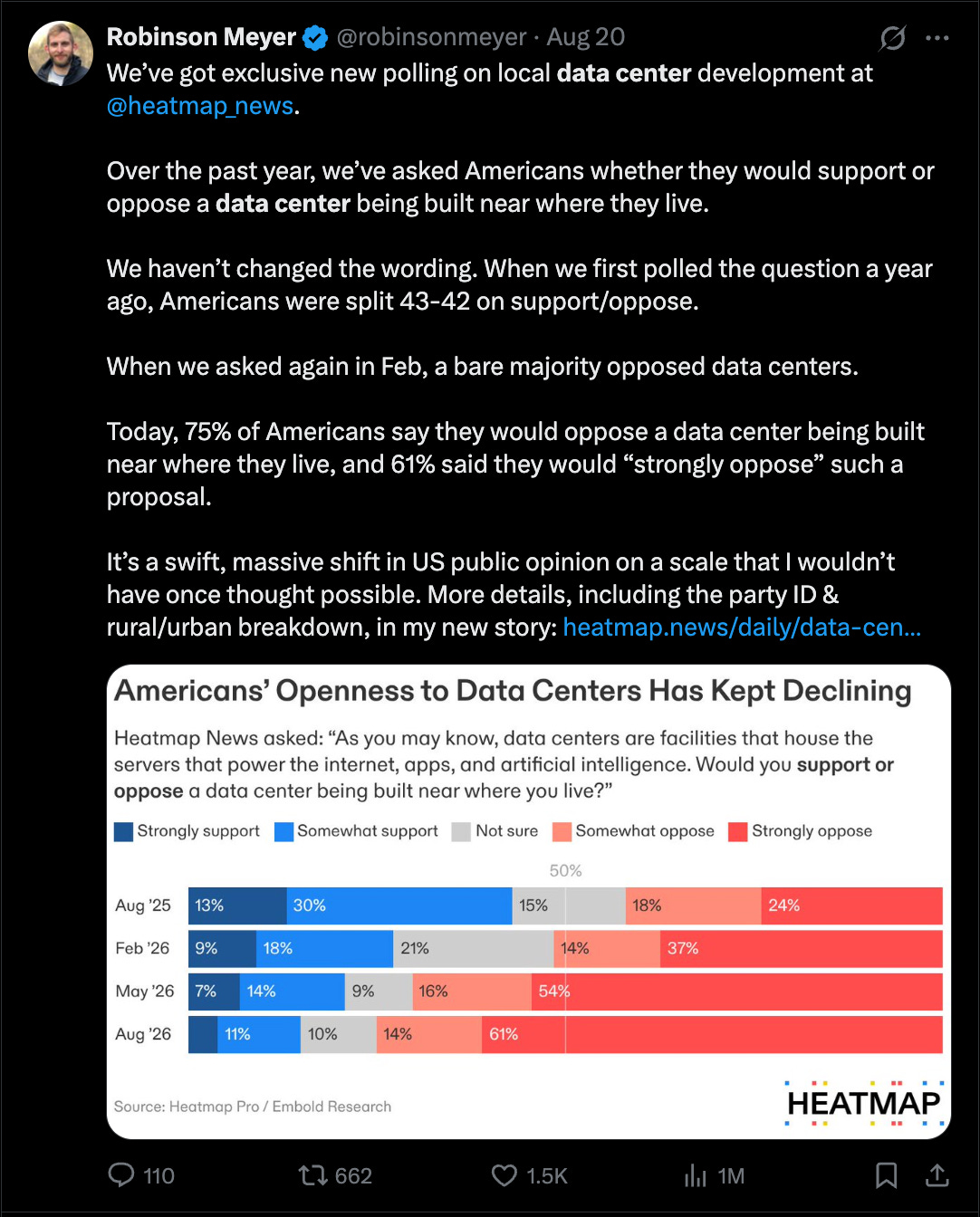
A new Heatmap/Embold poll finds that 75% of Americans would oppose a data center near where they live, versus 42% roughly a year ago.
Annenberg gets a somewhat lower number - 61% - but finds the same extraordinary trajectory: opposition rose 12 points in just four months. And, charmingly, this is bipartisan: 69% of Democrats, 54% of Republicans and 53% of independents. Apparently the secret to uniting America was giving everyone a proposed 1,000-acre industrial campus next door.
More than 530 U.S. counties and municipalities have now restricted or banned data-center construction. This is no longer NIMBYism flickering at the edges of the AI boom. It is becoming one of its central constraints.
The easy explanation is technophobia. AI is abstract, but a thousand-acre campus of transmission lines, turbines, cooling systems and diesel generators gives people something tangible to protest. There may be some truth to that but that explanation gives the industry too much credit and communities too little.
The deeper source of the backlash is economic. There is a growing mismatch between who captures the upside from AI infrastructure and who absorbs its costs.
The benefits of AI infrastructure are enormously diffuse. A hyperscale campus in Ohio may help train a model used by a pharmaceutical company in Boston, a bank in New York, a software developer in San Francisco and, ultimately, billions of people around the world.
But its costs are intensely local. The transmission lines run through your county.
The turbines get built near your town. The water comes from your watershed. The diesel generators sit near your neighborhood. The electricity system has to be reinforced by your utility. Private upside, socialized infrastructure. That is an inherently unstable political bargain.
America has spent a century learning how to accommodate ugly industrial infrastructure. Factories, refineries, steel mills have dominated entire towns, but they offered communities something extremely legible in return: jobs. Data centers break that historical bargain. They are among the most capital-intensive pieces of infrastructure ever built, yet once construction ends they employ surprisingly few people. Brookings’ recent work suggests that the arrival of a large data center produces roughly 100 to 200 local jobs in a typical affected county.
If a $10 billion facility arrives with 100 permanent employees, a large electricity requirement and a decade-long tax exemption, residents understandably ask why their town is subsidizing one of the richest corporations on earth.
There is another reason the “anti-AI” explanation is incomplete. If your goal is actually to slow frontier AI, blocking individual data centers is a surprisingly weak lever.
Princeton professor Arvind Narayanan points out that compute is highly fungible. If one state blocks capacity, much of it simply gets built somewhere else. And even capacity that genuinely disappears is gradually offset by improvements in model and hardware efficiency.
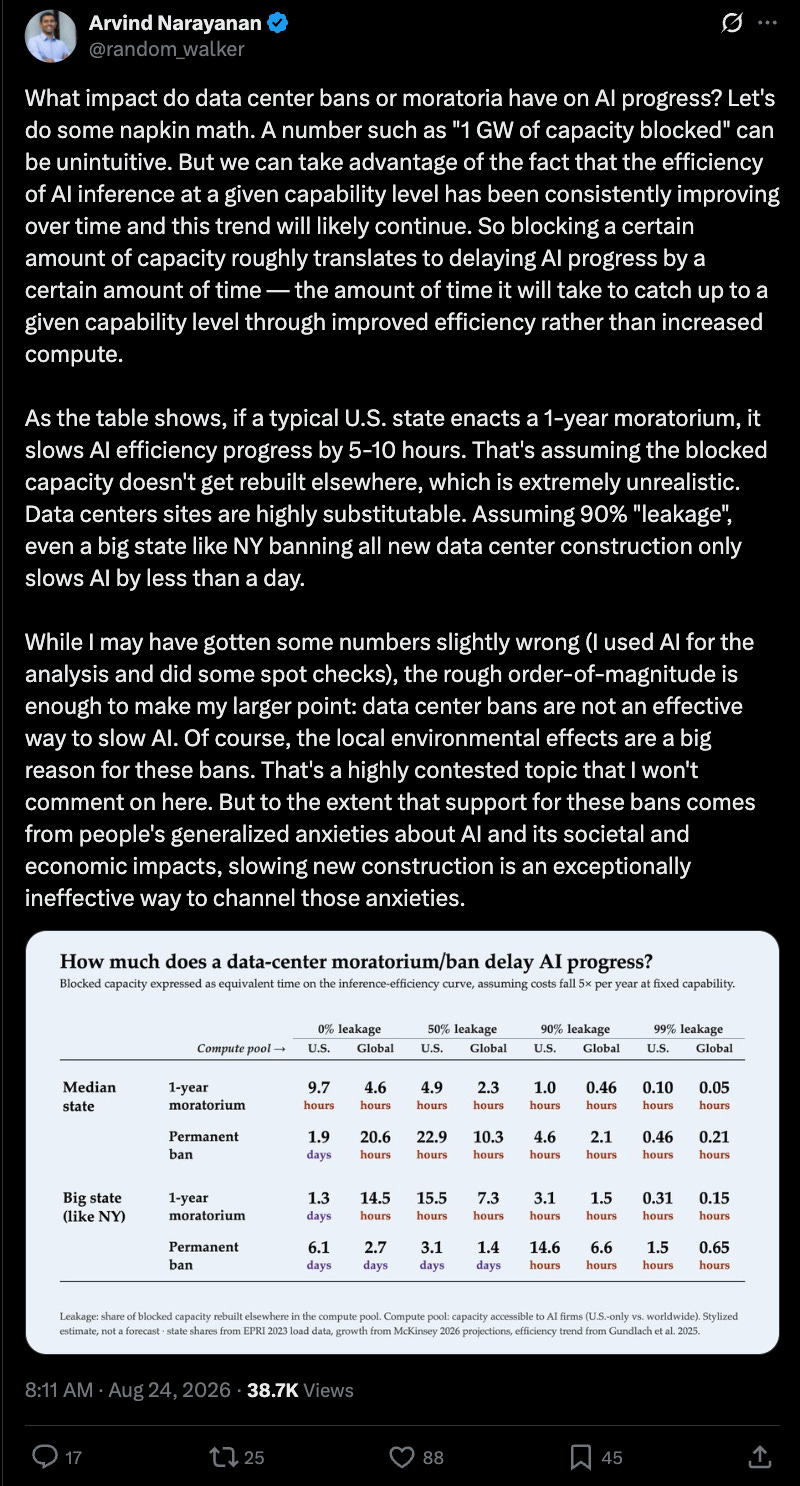
His back-of-the-envelope conclusion is striking: under plausible assumptions about capacity relocating elsewhere, even aggressive state-level restrictions might delay frontier AI progress by hours or days - not months or years.
Trying to stop AI by banning one data center is like trying to stop globalization by closing one port. Capital reroutes.
This is why the polling is so important. Annenberg finds that Americans did not, in fact, become dramatically more negative about AI itself during the same period. Their attitudes toward AI remained roughly stable. Their attitudes toward a data center being constructed nearby collapsed.
People are not necessarily rejecting artificial intelligence in the abstract. They are rejecting the terms on which its infrastructure is being built. Which means the industry’s problem may be less “convince America that AI is good” and more: convince individual communities that hosting AI infrastructure is a good deal.
They need to bring the power, absorb the grid upgrade costs, guarantee the tax, minimize water consumption, make the economics transparent, and include the surrounding community in the upside.
We are already beginning to see the new bargain take shape.
Virginia has introduced special rules for large-load customers intended to reduce the risk that ordinary ratepayers get stuck paying for infrastructure built for data centers that fail to materialize or leave early.
Developers are increasingly considering behind-the-meter generation, advanced nuclear, gas, storage and other forms of dedicated supply.
And community-benefit packages are getting much larger. Oracle’s Project Jupiter in New Mexico, for example, has committed $50 million to local water infrastructure, $360 million to schools and public services, and millions more to workforce development, while promising to fund its own energy infrastructure rather than pass those costs to residents. Meta, meanwhile, says it pays for the grid and municipal upgrades required by its facilities and distributed more than $11 million to schools and nonprofits in its data-center communities last year. What began as corporate philanthropy is increasingly starting to look like infrastructure risk-sharing.
The data-center boom may reward companies that are good at something Silicon Valley has historically regarded as a slightly annoying external dependency: local politics.
The race for AI infrastructure is becoming a race to construct a bargain that people will actually accept. And after all the talk about gigawatts, transformers and trillion-dollar capex plans, the decisive question may turn out to be a remarkably low-tech one: What’s in it for us?
Comments
Nothing yet. Say the first thing.
Sign in to join the conversation.