
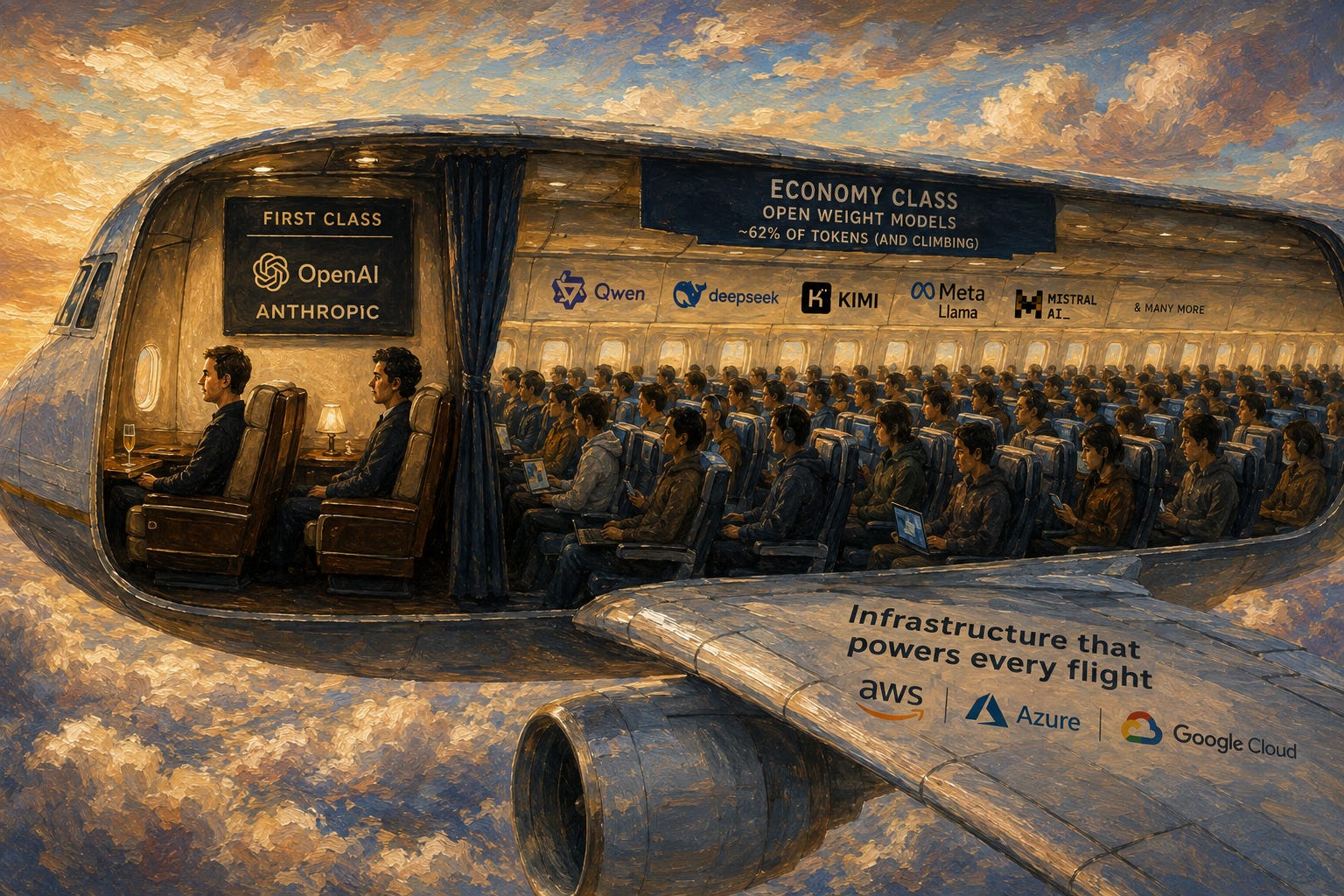
For the last few months, the open-weight bull case has mostly been a combination of anecdotes and arithmetic. Builders say they are using more open models. The economics suggest they should. Now we are beginning to see proof.
Over the weekend, Vercel CEO Guillermo Rauch shared a striking datapoint from the company’s AI Gateway: on August 22, open-weight models accounted for a record 62% of token volume, up from 28.4% two months earlier. Go back to April, and open-weight models were only 11% of token volume on the gateway.
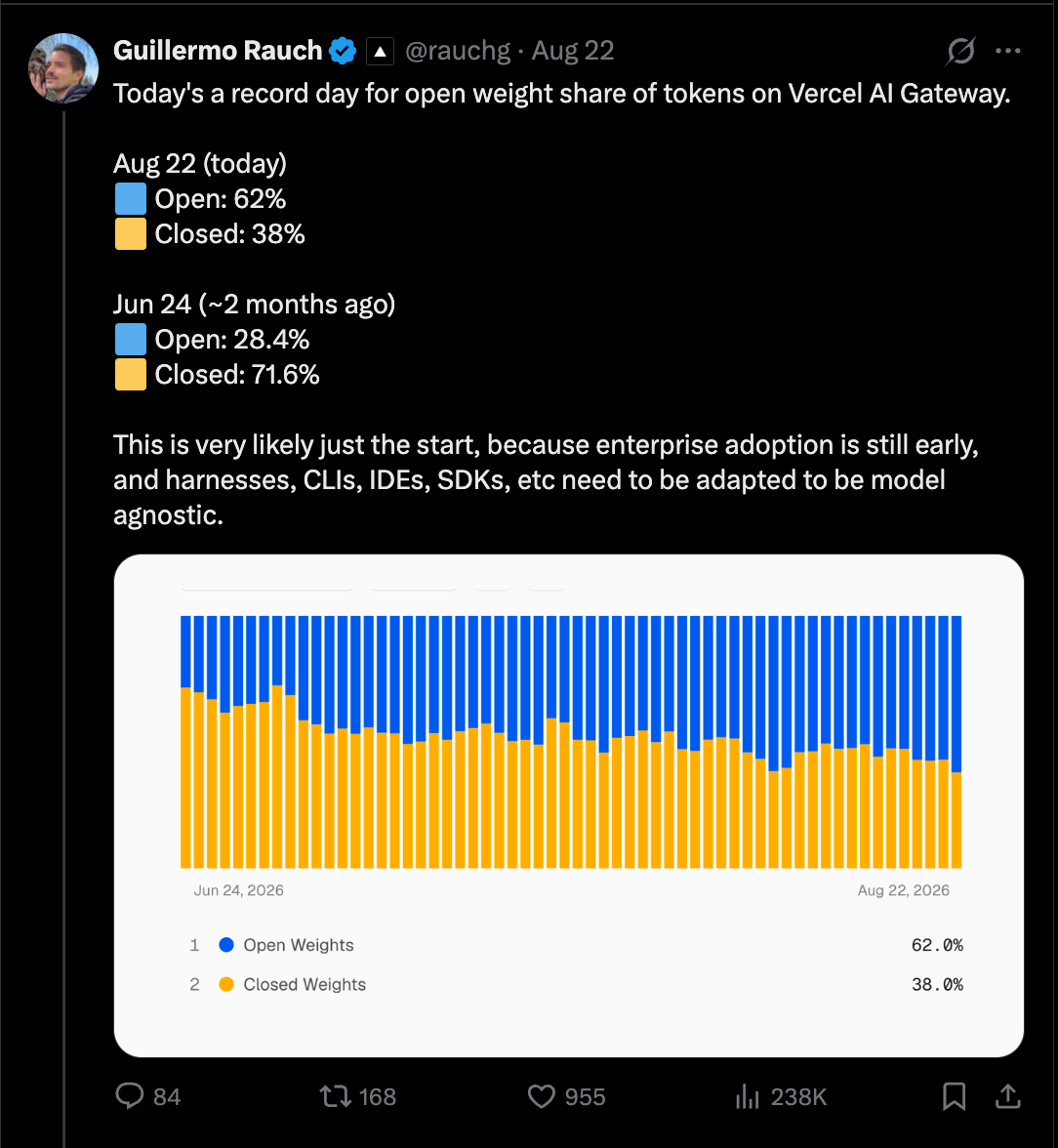
11% → 29% → 62% in four months. That is a remarkable adoption curve. The market sentiment we have been intuiting is beginning to show up in production traffic.
Customer preference is maturing from ‘best model’ to ‘best model for the job’. Cost was secondary back when everyone was still trying to figure out whether the technology worked. But now, experiments are becoming products. Once AI moves into production, every successful customer becomes an inference bill. The difference between a $1 and $10 workload matters quite a bit when you multiply it by a billion requests.
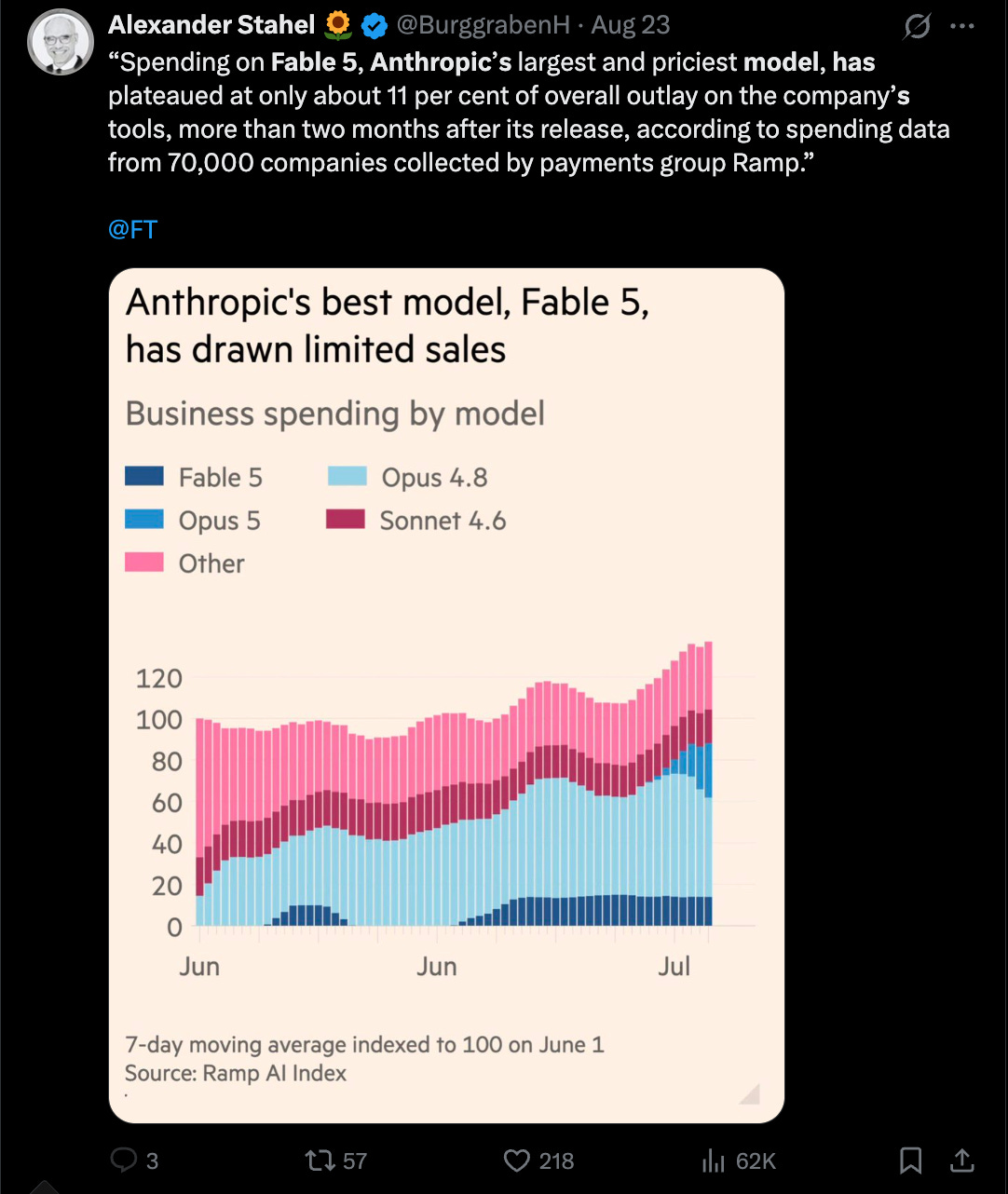
You can see the same behavior inside the closed-model market. The Financial Times reported that Fable 5, Anthropic’s most capable and expensive model, has plateaued at ~11% of customer spending on Anthropic tools in Ramp’s sample of 70,000 companies, more than two months after launch. The cheaper Opus 5 has already overtaken it. Customers are gravitating toward cheaper models when the incremental intelligence doesn't justify the incremental price.

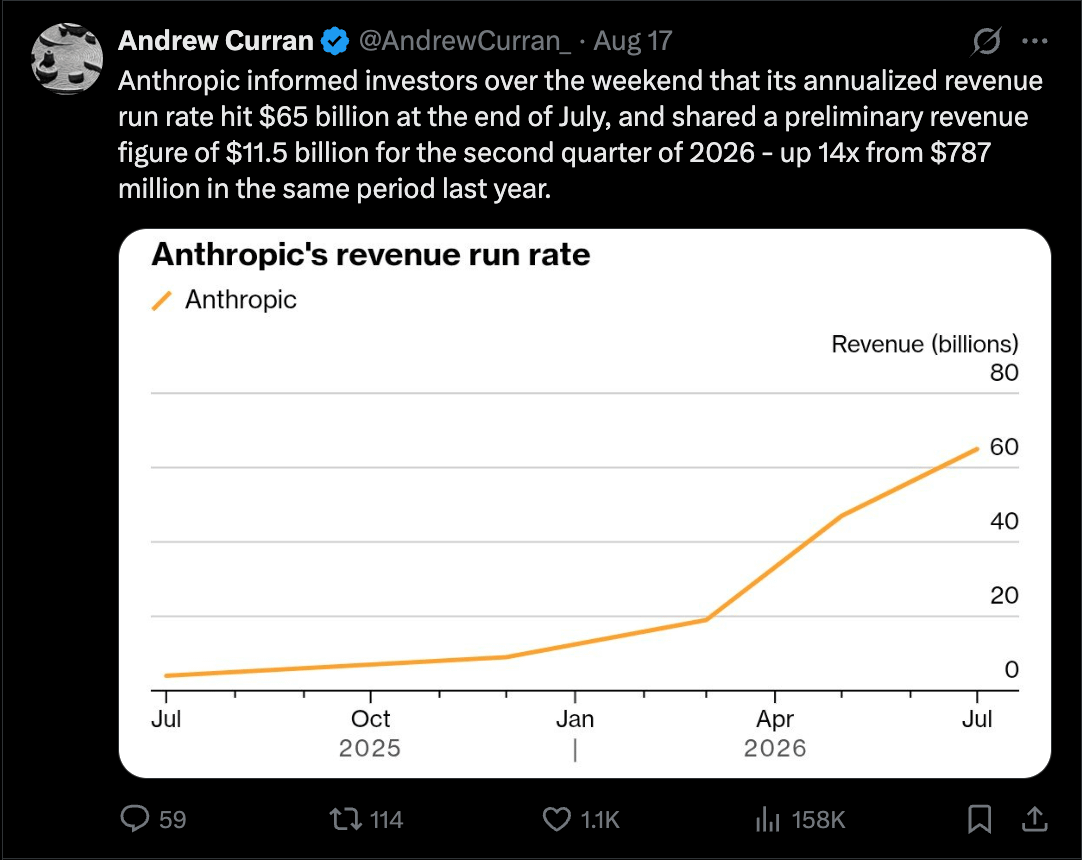
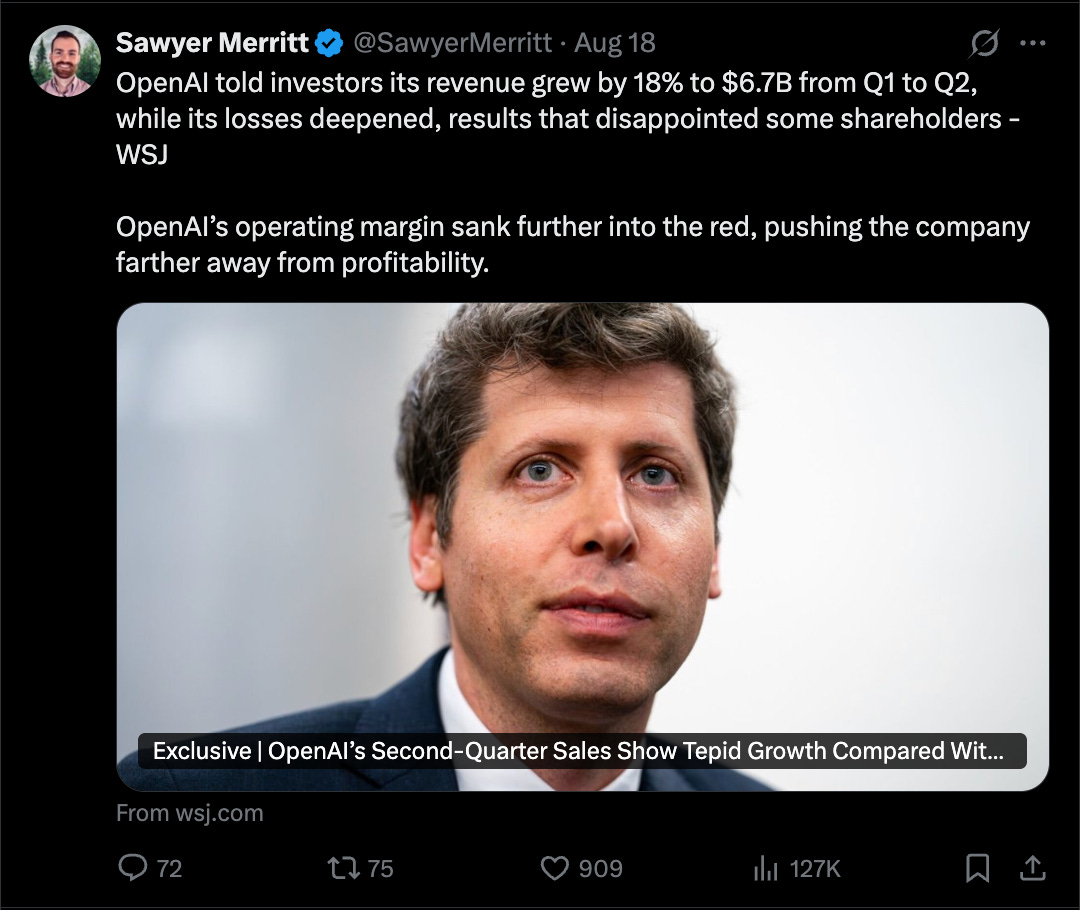
Importantly, none of this means OpenAI and Anthropic are shrinking. Quite the opposite. Reports suggest that OpenAI generated $6.7B of revenue in Q2, +18% QoQ while Anthropic generated $11.6B, +142% QoQ, surpassing OpenAI's quarterly revenue for the first time. Anthropic's annualized revenue run-rate subsequently passed $65B, while OpenAI's was reported above $40B.

The turf war between the two is unlikely to abate anytime soon. They remain locked in a wonderfully petty version of mutually assured innovation. Sam and Dario periodically rebut each other’s worldview in public. Customers receive better models as collateral damage. We also get periodic price cuts and rate limit resets hastily announced on Twitter thanks to OpenAI’s need to flex their compute advantage over Anthropic. Long may this rivalry continue.
Regardless of who has the lead between them, both companies are continuing to grow very well even as open weight models increase share. How? Because the denominator is exploding. If the AI market triples and your market share falls by a third, congratulations: your business doubled. The whole pie is expanding so rapidly that even a declining slice of it shows very strong growth.
Also, token share understates the economic position of frontier labs because they disproportionately serve the most valuable tokens. According to Vercel’s June report, open-weight models accounted for 29% of tokens but less than 4% of spend. Meanwhile, Anthropic captured 61% of spend on just 32% of tokens and more than 72% of spend in high-stakes workloads like coding agents, back-office agents and application generation. So the market is beginning to bifurcate in a fairly intuitive way - frontier for the best and open weight for the rest. Think airline economics: most passengers fly economy but most of the profits sit at the front of the plane.
I think the most misunderstood part of the open-source transition is where adoption will show up first. Enterprise leaders ask me some version of: “If open source is taking off, why don’t I see companies around me deploying open models everywhere?”
Because most enterprises probably won’t adopt them directly. Running an open model gives you weights and an endpoint. It does not give you Claude Code, Codex, Cowork, or a polished workflow. Exploiting open models well requires technical talent, infrastructure, evaluation, routing and increasingly domain-specific post-training.
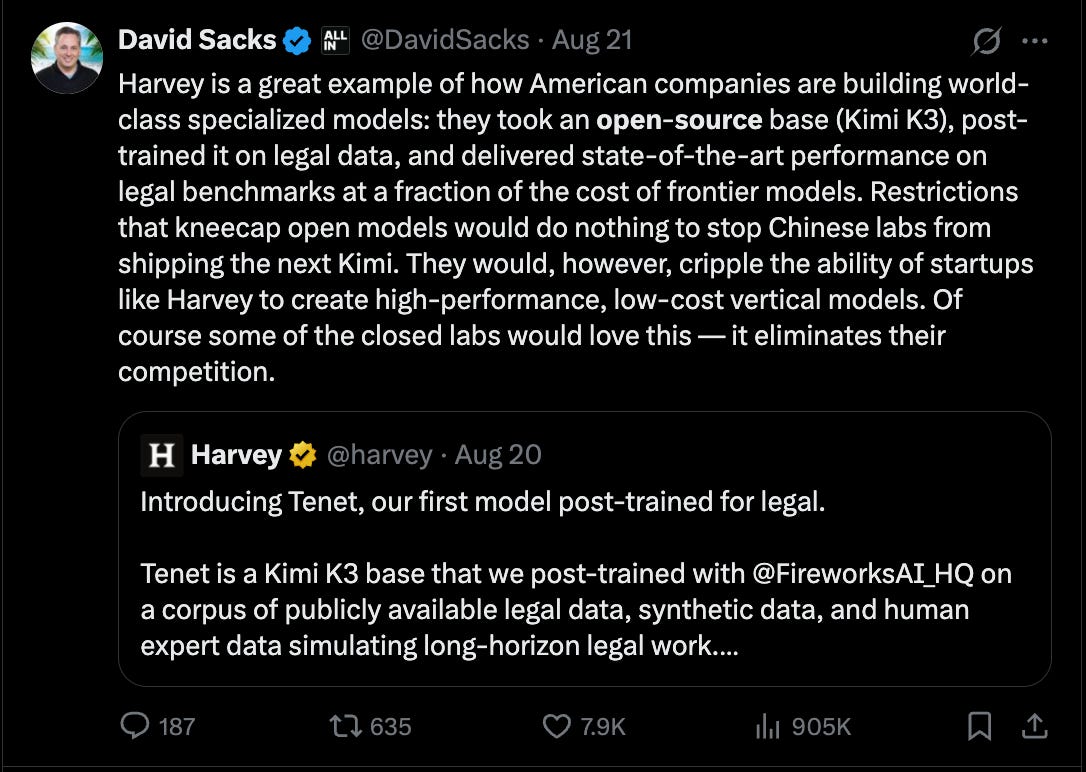
So the first big beneficiaries will be application companies. They can take an open model, post-train it for a narrow domain, hide all of the model complexity behind great UX, and deliver comparable performance at dramatically better unit economics.
The adoption wave will not look like Fortune 500 CIOs announcing that they have standardized on Kimi. It will look like hundreds of AI startups swapping expensive proprietary inference for cheaper, specialized models underneath their products. Open source will get smuggled into the enterprise inside applications.
As a reminder, open source isn’t free. Those tokens still have to run somewhere.
The more workloads fragment across models, the more valuable the infrastructure layer becomes. Open models weaken the model provider’s control over the stack, but they strengthen the position of whoever owns the compute, distribution and enterprise relationships underneath it. That makes the hyperscalers increasingly interesting.
Microsoft, in particular, sits in a fascinating position: it owns enormous infrastructure capacity and an application estate that benefits when intelligence becomes cheaper and more abundant. AWS has the infrastructure but less of the enterprise application loop. Google has both, but also has a flagship model family it understandably wants customers to use. The future belongs not to the company with the best model but the one that is best at arbitraging all of them.
Comments
Nothing yet. Say the first thing.
Sign in to join the conversation.