
Don’t take my word for it; run it yourself.
It was around 2005 that I had my first existential money-manager experience.
I was successfully managing around $50 million in a hedge fund I started. I read a book by Professor Burton Malkiel called A Random Walk Down Wall Street. It had first been published in 1973 and had become a best seller. Its 13th edition was released in 2023. Each time the data gets updated, the thesis remains the same: that the markets are random and it’s impossible to beat the indexes sustainably after costs.
If you are a thoughtful young fund manager confronting the well-packaged data truthfully, you have an existential crisis on your hands.
That is what I faced in 2005 and have faced every day trading the markets since.
There is something about the markets that compels you to try and defeat the odds. I will come back to that at another time, but it is worth addressing why more than 20 years later I am still here, still building systems, and still pursuing outperformance.
I believe markets are largely random.
I also believe that there are periods where markets display behaviour that is clearly not random. Periods that are path-dependent, regime-driven, and not independent and identically distributed.
In plain English, there are windows where behaviour becomes more predictable, not because the market is easy, but because it is temporarily structured.
It is those windows that we are trying to detect.
That is the game.
Not predicting markets all the time, but identifying when they are behaving in a way that can be exploited with some level of probabilistic edge.
My latest crisis came earlier in the week, where I shared two posts.
These two portfolios produce Sharpe Ratios of 1 and 1.40, respectively.
I am sure you are asking, ‘What is the issue? These are great results. Why do you have your panties in a bunch?’
That is precisely the issue. The above 2 examples I am sharing are likely to outperform 99% of the portfolios that all traders are likely to build, like it or not.
So the crisis I confronted and still confront is, 'Is all this worth hunting for that 1%.’
And more importantly, what is that “something” we are even looking for?
If we are honest, the answer is not “higher returns at any cost”. It is not even Sharpe in isolation. The 1% we are chasing is something much more specific.
It is uncorrelated edge.
It is better behaviour across regimes.
It is the ability to improve the portfolio without increasing fragility.
That is a very different problem to simply beating the index.
I have been spending a lot of time looking at what is being shared, particularly on Substack.
Most of what I see falls into a familiar pattern. Upward-sloping equity curves, often based on closed trades only, are presented in a way that looks far better than the underlying reality.
Risk-adjusted metrics are rarely shown. Long histories are even rarer.
And that is where I find myself fundamentally at odds with the majority of what is being published.
If you are not willing to confront as much data as is available, across as many regimes as possible, you are not really testing robustness. You are testing how well something fits a particular path.
The trade-off when you do confront that reality is that the results almost always deteriorate.
The fantasy disappears very quickly.
The uncomfortable truth is that the simpler the strategy, the more likely it is to survive. The more complex the strategy, the easier it is to make it look good.
That is the paradox.
And it creates a very real tension. On one side you have simple portfolios, built with a handful of instruments, delivering strong risk-adjusted returns over decades.
On the other side you have an almost infinite space of possible strategies, most of which look good in isolation and fail when exposed to reality.
So the question is not just “can we beat the market”.
It is about whether we should even be trying and under what conditions it actually makes sense to try.
This is not just a question for individual traders. It is a question that the entire active management industry needs to answer. Why should anyone allocate capital to a manager when, on average, they underperform after fees?
And more specifically, what is the justification for complexity when simplicity appears to do just fine?
Look at the chart below and ask yourself the question: why would you pay a manager to manage your money?
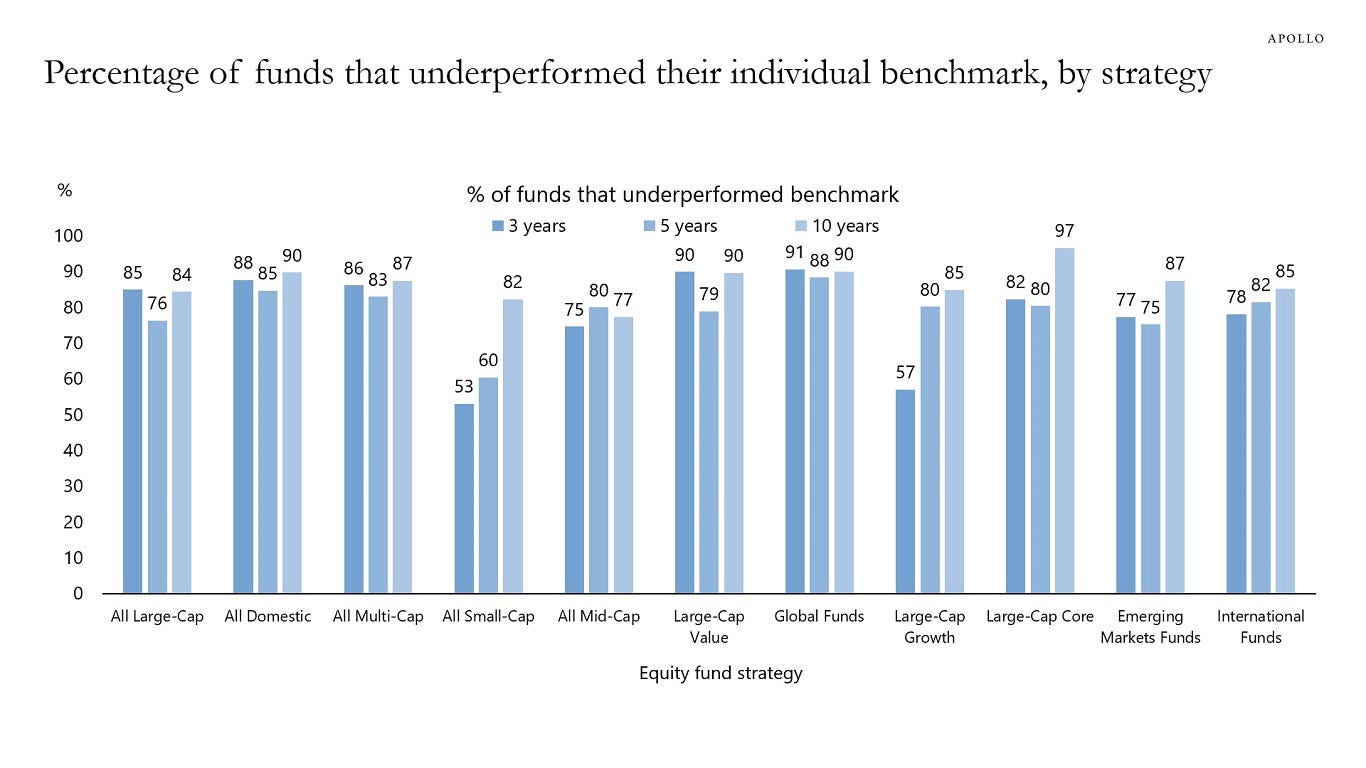
This week I found myself back at that same point.
Why bother when most of what you are likely to build will underperform something as straightforward as the portfolios I shared earlier?
Over the next few weeks I am going to unpack what I think is a sensible way to approach this. Because if the answer is that there is no edge, then the conclusion is uncomfortable for everyone involved.
But if there is something there, even if it is small, then we need a way of identifying it properly, measuring it properly, and most importantly, avoiding fooling ourselves in the process.
That is the problem I am trying to solve with the S2N Navigator.
Don’t take my word for it; run it yourself.
No posts
Comments
Nothing yet. Say the first thing.
Sign in to join the conversation.