
Don’t take my word for it; run it yourself.
A lot of people in this space are effectively selling novelty.
A new strategy. A fresh chart. A strong-looking backtest. A short explanation. Then on to the next one.
That model works well if the goal is to keep attention moving and subscriptions flowing.
It is not what I am building. I have been in the trading business full-time for more than 25 years, and I have been an investor for more than 42 years. I did start early (13).
For the last eight months, I have spent most of my time doing work that is far less exciting on the surface and far more important underneath it. I have been building robustness at the single-strategy level.
That means longer history. More regimes. Better scoring. Better guardrails. More resistance to curve fitting. More resistance to cherry-picking. More discipline about what deserves to be called useful in the first place.
That is not glamorous work. It does not produce a new headline every week. It does not create the illusion of constant breakthroughs.
But it is the work that matters.
There are plenty of strategies on the internet that look incredible because the symbols were chosen after the fact, or the timeframe was just short enough to avoid the regime that would have broken the idea. It is very easy to make something look smart when you know exactly where not to look.
I have no interest in building that kind of trading software.
I am not here to throw out a stream of attractive backtests and hope nobody looks too closely. I am not here to pocket a few dollars from quick sales. I am here to build something that holds up, something that compounds in value, and something I can stand behind for years.
That is the standard.
And that is also why progress can look slower from the outside than people expect.
What I am building is not a content machine dressed up as research. It is a research and portfolio operating framework, with AI integrated where it needs to be. It is a trading platform that is built to last.
The foundation matters.
If a single strategy is fragile, then everything built on top of it is fragile too. So the first phase had to be about building the machinery that can actually test robustness properly. That is where a huge amount of time has gone. Not because it is flashy, but because it is necessary.
Now the roadmap moves to the next level.
Once you have stronger building blocks, the real question becomes whether they improve a portfolio in a genuine way. Not whether they look good alone. Not whether they have a nice equity curve by themselves. But whether they actually deserve capital next to other strategies across time, with different failure modes, under real portfolio constraints.
That is where I think the real value is.
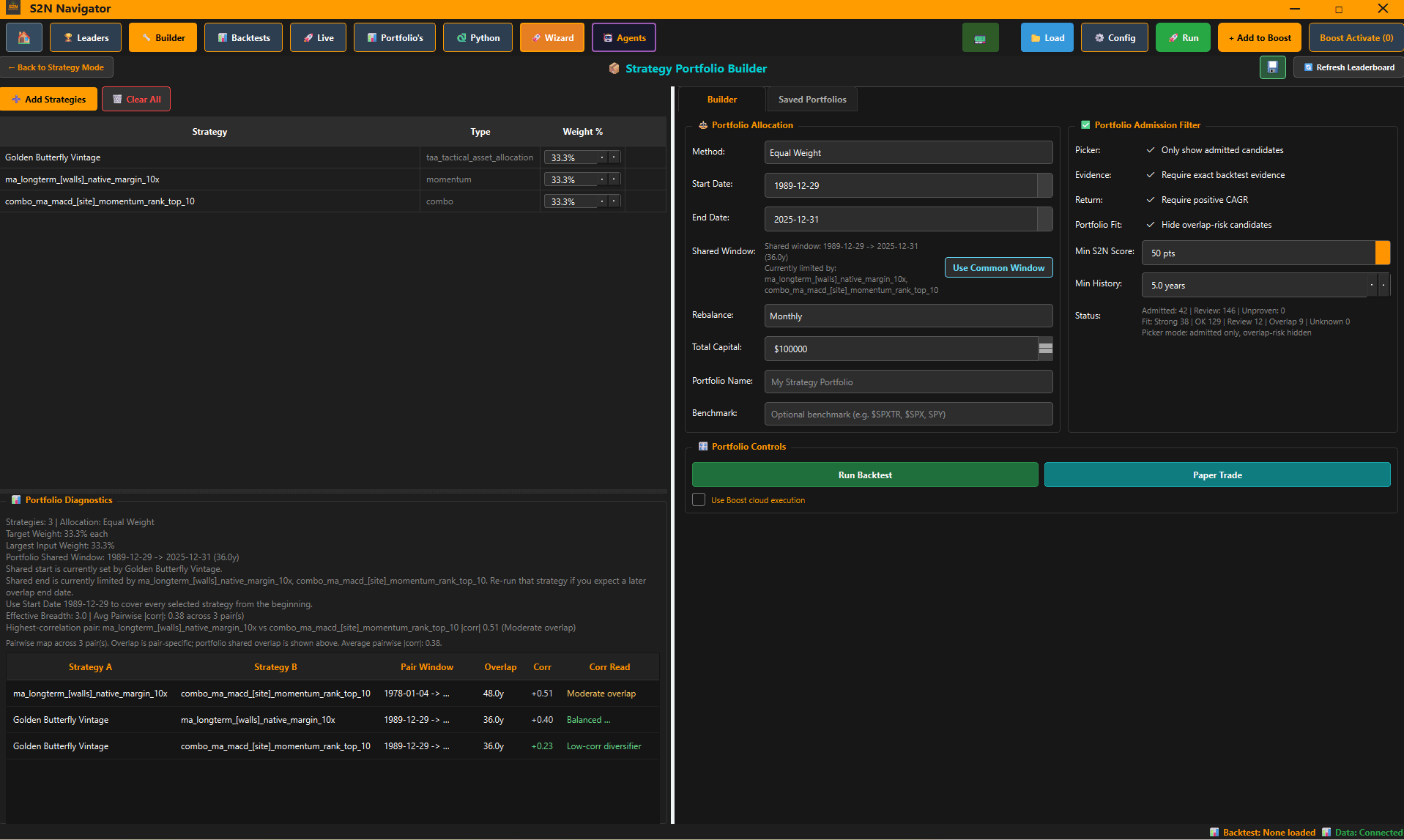
1. Portfolio Construction
This is the current priority.
Everyone says diversification is the closest thing you will get to a free lunch. Well, actually Nobel Laureate Harry Markowitz said that, and for the past 60 years everyone has agreed with him. So this is what I want to focus on so that the free lunch is tasty and wholesome and will provide nourishment in all conditions.
I want Portfolio Mode to become a serious framework for building portfolios, not a toy optimiser and not a place where people assemble pretty but dishonest combinations.
That means admission filters. Anti-curve-fitting guardrails. Better ways to judge overlap, dependency, and portfolio contribution. It means asking whether a strategy improves the whole, not just whether it looks strong on its own.
That is a much higher bar than most people set, and it should be.
2. Backtest to Paper Trading
The next step after research is not marketing. It is paper trading.
If a strategy or portfolio cannot make the transition from backtest to paper in a clean and understandable way, then the research has not done enough yet.
I want the bridge from backtest to paper trading to be obvious, practical, and trustworthy. That is where a lot of truth gets revealed. It is also where a product stops being a backtest machine and starts becoming useful in day-to-day practice.
Very importantly, I want this to be as seamless an experience as possible. You will soon see what I mean.
3. Daily Use and Reporting
I do not want Navigator to be something people only open when they feel like hunting for another strategy.
I want it to become something you check because it has something worth saying. MTM P&L. Portfolio drift. Risk changes. Daily snapshots. Reporting that helps you understand whether what you built is behaving as expected.
That is where engagement becomes real. Not because the product is louder, but because it becomes part of the operating loop. The fact that it is driven locally does not mean you won’t be able to access crucial information about your live portfolios from your mobile any time of the day.
4. Agents With Real Jobs
Jim, Nero, and the Oracle are part of the long-term picture, but only if they are attached to real workflows.
Jim should help think about portfolios more holistically. Nero should help convert and develop strategies from a deeper body of work. The Oracle should help explain what is happening and why it matters.
I am not interested in bolting “AI” onto the surface just to say it is there. These agents need jobs, context, and accountability inside the product.
That is the roadmap.
And one thing I want to make clear is that this is not a blank sheet of paper with a wish list attached to it.
The architecture is already there. The backtester exists. The scoring system exists. The portfolio layer exists. The paper trading layer exists. The reporting layer exists. The agents exist.
What takes time is taking each module and improving it 500x until it starts behaving like a serious product the way I envision it.
That kind of work cannot be vibe-coded in a day.
It is exactly what separates a real platform from the disposable versions all over the internet. So when I talk about the roadmap, I am not talking about random future ideas. I am talking about where the next deep refinement is happening.
Single-strategy robustness came first.
Portfolio construction is being pushed hard now.
Backtesting to paper is the next bridge.
Daily reporting is what turns research into something alive.
The agent layer is what eventually turns all of this into a real operating system for research and decision-making at supernatural levels.
That is the direction.
Not strategy-of-the-week.
Not curve-fit theatre.
Not fast-twitch subscription bait.
I am building for the long haul.
And I think that matters.
PS. On that note, I am offline for the last 2 days of Passover and quiet time to think about the roadmap.
Don’t take my word for it; run it yourself.
No posts
Comments
Nothing yet. Say the first thing.
Sign in to join the conversation.