
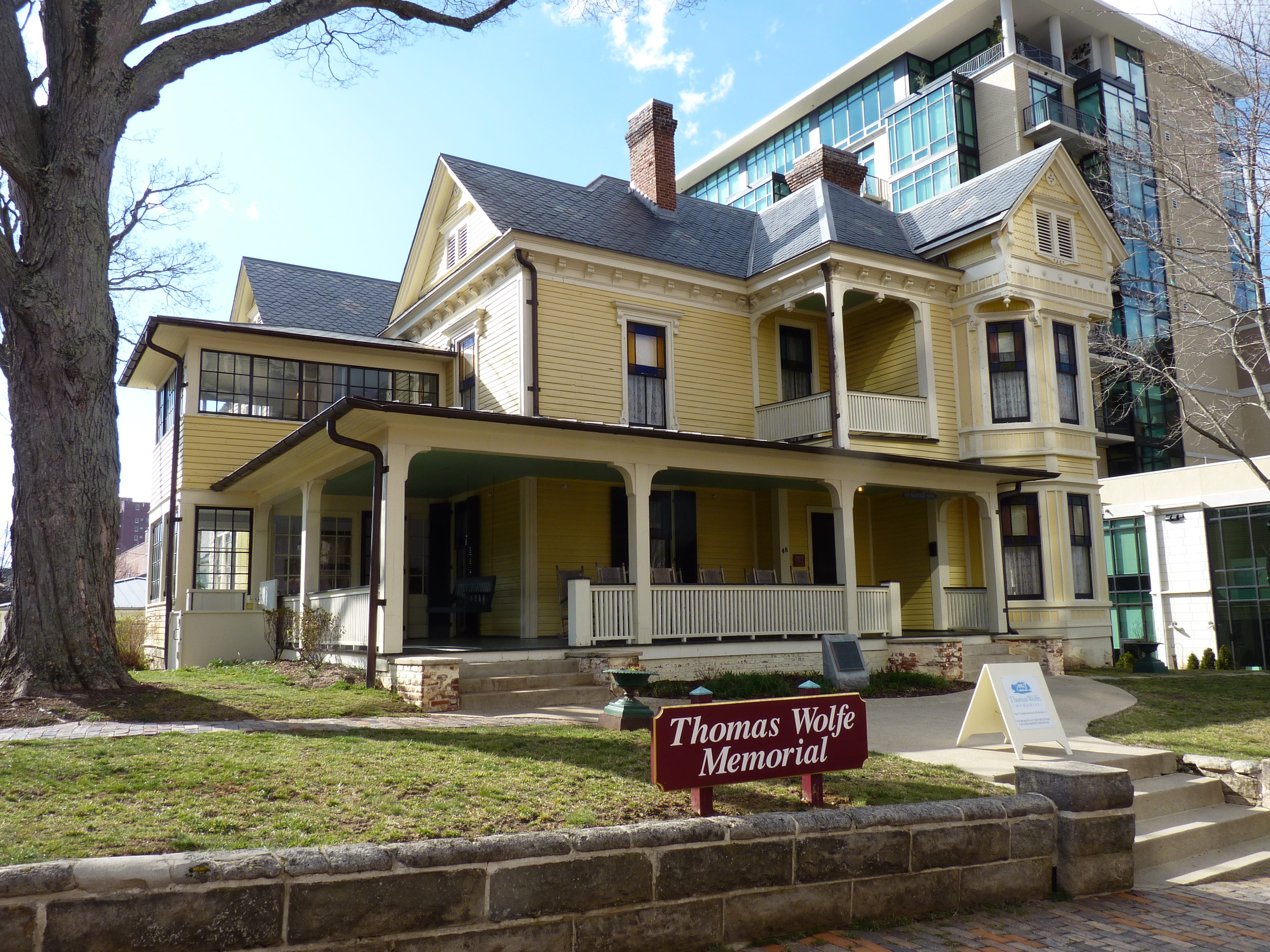
There are houses that hold furniture.
And then there are houses that hold voices.
The Thomas Wolfe Memorial in downtown Asheville is the second kind.
It stands on Spruce Street, tucked into the city that made Thomas Wolfe, and in many ways, the city he never fully escaped.
Wolfe was born in Asheville in 1900. Before he became one of America’s great novelists, before Look Homeward, Angel, before You Can’t Go Home Again, before the praise, the criticism, the fame, and the loneliness of literary life, he was a boy inside a boarding house run by his mother, Julia Wolfe.
That boarding house mattered.
It was not quiet.
It was not sealed off from the world.
It was full of people coming and going.
Travelers.
Boarders.
Strangers.
Families.
Southerners.
Northerners.
The sick.
The hopeful.
The disappointed.
The talkers.
The lonely.
The house gave Wolfe a front-row seat to human nature.
WLOS quoted Thomas Wolfe Memorial site manager Kayla Seay describing him as someone who observed everybody, like a sponge.
That feels right.
Because Wolfe’s gift was not only that he could write.
It was that he noticed.
He noticed the way people spoke.
The way they carried pride.
The way they carried disappointment.
The way a town could shape a child.
The way family could become both shelter and burden.
The way home could pull at you even after you tried to leave it.
That is Asheville all over Wolfe’s work.
Not a postcard Asheville.
Not the easy version.
A real Asheville.
Crowded.
Complicated.
Beautiful.
Restless.
Full of memory.
His first novel, Look Homeward, Angel, was published in 1929. It was largely autobiographical and brought him immediate recognition. The book made him famous, but it also caused pain at home. People recognized themselves. Some did not like what they saw.
That is the danger of writing honestly about a place.
You preserve it.
But you also expose it.
Wolfe did both.
His fourth and final novel, You Can’t Go Home Again, was published in 1940, two years after his death.
That title has followed Asheville ever since.
You can’t go home again.
But in Asheville, people keep trying.
They come back to streets they remember.
They walk past buildings that have changed.
They look for the old town under the new one.
They wonder what survived.
They wonder what vanished.
They wonder whether the place they loved is still here, or whether it only lives in memory now.
That is what makes the Thomas Wolfe Memorial so powerful.
It survived.
Not easily.
In 1998, nearly sixty years after Wolfe’s death, fire tore through the old boarding house. It could have been lost. Another Asheville landmark gone. Another piece of the city turned into memory alone.
But the house survived.
And according to the WLOS report, nearly 90 percent of the home’s original furnishings and artifacts remain.
That is almost hard to believe.
In a city that has changed as quickly as Asheville, that kind of survival matters.
Because the house is not only about Thomas Wolfe.
It is about Asheville before the modern rush.
Before the breweries became a national story.
Before the hotel boom.
Before the endless lists naming Asheville one of the best places to visit, live, eat, retire, explore, or escape.
Before all that, there was a boarding house on Spruce Street.
There was a boy watching.
There was a mother running a business.
There were strangers sitting at tables.
There were footsteps in hallways.
There were stories passing through the rooms.
That is where literature began.
Not in some grand library.
Not in a distant city.
But in a house full of ordinary human drama.
That is the kind of thing I love about Asheville history.
So much of it is still hiding in plain sight.
People walk downtown and see restaurants, shops, hotels, and traffic. But underneath that modern city is an older Asheville. A literary Asheville. A boarding-house Asheville. A tuberculosis Asheville. A railroad Asheville. A mountain resort Asheville. A town full of ambition, sickness, beauty, class tension, art, visitors, locals, and people trying to make a life in the shadow of the Blue Ridge.
Wolfe saw that.
He did not always make people comfortable.
But he saw it.
And that is why his work still matters.
A writer like Thomas Wolfe reminds us that place is never just scenery.
Place gets inside people.
The streets.
The houses.
The weather.
The voices.
The family stories.
The old wounds.
The local pride.
The things people say openly.
The things they never say at all.
All of it becomes material.
All of it becomes memory.
All of it becomes part of the story.
For me, that is what makes the Thomas Wolfe Memorial worth talking about.
It is not just a historic home.
It is one of the places where Asheville became literature.
That is a rare thing.
A city can have famous buildings.
A city can have pretty streets.
A city can have restaurants and hotels and attractions.
But not every city produces a writer who turns the place itself into a lasting American story.
Asheville did.
And the house on Spruce Street is still there.
That matters.
It matters because buildings like that give us a way back into the old city.
Not perfectly.
Not completely.
But enough.
Enough to stand in a room and imagine the noise of the boarding house.
Enough to think about a young Thomas Wolfe listening, watching, absorbing.
Enough to remember that Asheville has always been more than a destination.
It has always been a story.
Sometimes beautiful.
Sometimes difficult.
Sometimes lonely.
Sometimes full of longing.
Wolfe’s own words, quoted in the WLOS piece, ask: “Which of us is not forever a stranger and alone?”
That line cuts deep because it sounds like Wolfe, but it also sounds like the condition of anyone who has ever left home, returned home, lost home, or tried to write home into something that would last.
That is the great ache in Wolfe.
Home was never simple.
Asheville was never simple.
Maybe that is why the story endures.
The Thomas Wolfe Memorial is open in downtown Asheville for people who care about literature, history, or the older life of this city. It offers more than a look at a famous writer’s childhood.
It offers a look at the Asheville that shaped him.
And maybe that is the real reason to go.
To see the house.
To see the rooms.
To feel the old city behind the new one.
To remember that before Asheville became a brand, it was a place full of people.
And one of those people watched closely enough to turn it into literature.
As always, if you are looking to buy or sell in the Asheville area, I am always available to talk. Take a look at todays inventory.
No posts
Comments
Nothing yet. Say the first thing.
Sign in to join the conversation.