
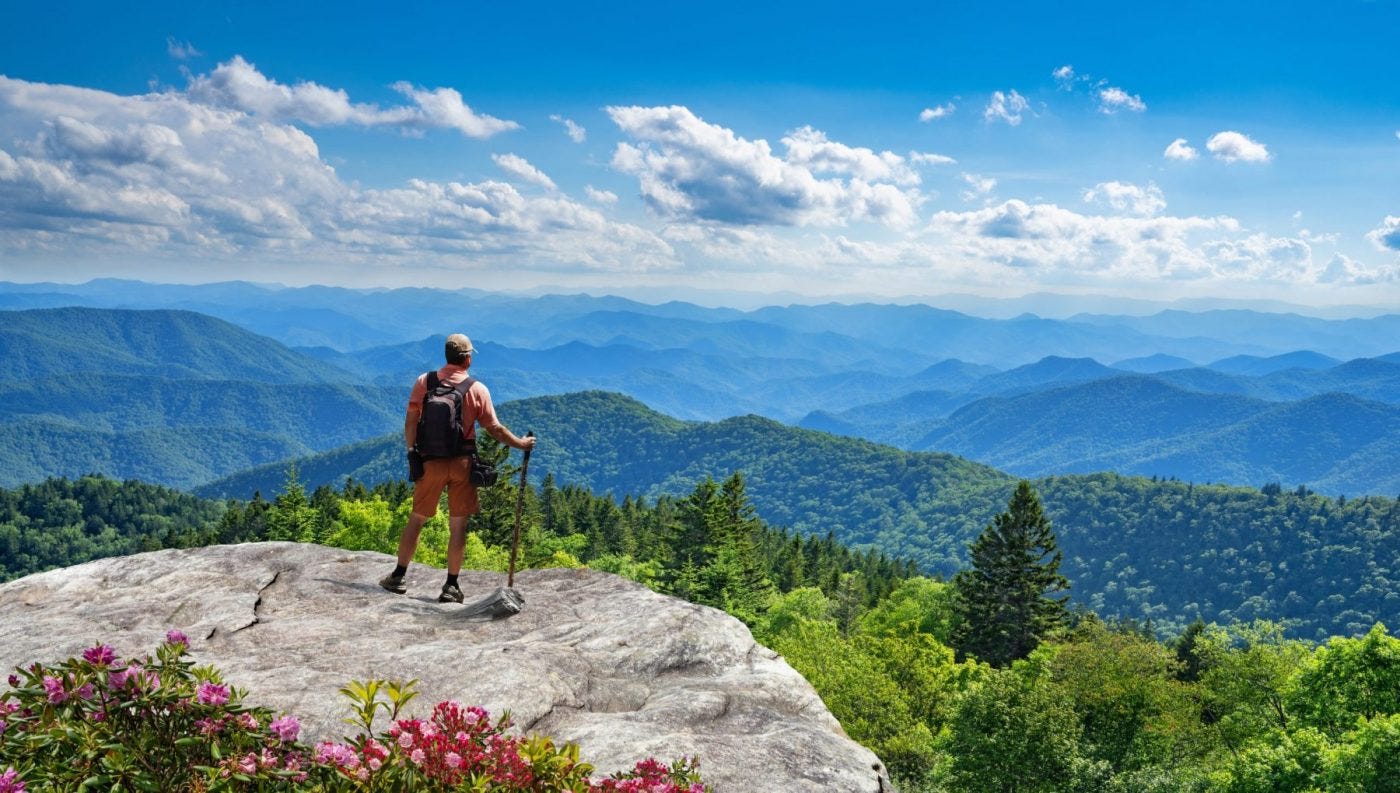
I have lived around these mountains most of my life, and I still do not think we fully understand what we are looking at.
We call them beautiful.
That is true.
But it is not enough.
The Blue Ridge Mountains are not just beautiful.
They are old.
Strange.
Layered.
Haunted by history.
Full of stories that sound impossible until you start looking into them.
The first thing that always gets me is the age.
The Blue Ridge Mountains are older than the Atlantic Ocean.
Let that sink in.
Before there was an Atlantic Ocean separating this continent from Europe and Africa, these mountains were already part of the story. The rocks beneath our feet were shaped in a world that looked nothing like the one we know now.
At one time, these mountains may have been massive, more like the Himalayas. What we see today is what time left behind after hundreds of millions of years of weather, water, ice, and erosion.
The worn-down bones of something enormous.
That makes every overlook feel different.
You are not just looking at scenery.
You are looking at deep time.
Then there is the blue haze itself.
Most of us have seen it so many times we forget to ask what it is. That soft blue color hanging over the ridges is not just fog or smoke. The trees release natural compounds into the air, and those compounds help scatter blue light.
The forests help make the mountains blue.
I love that.
The mountains are not just sitting there.
They are breathing color into the air.
Long before modern science explained it, the Cherokee had a name for this place: Shaconage, the Land of the Blue Smoke.
That name still feels right.
Then you get to Mount Mitchell.
At 6,684 feet, Mount Mitchell is the highest point in the United States east of the Mississippi River. A lot of people outside this region do not even know that.
They should.
Mount Mitchell does not feel like the South at the summit. The temperature can drop hard. The wind can be brutal. The forest becomes spruce and fir, more like something you would expect in Canada.
A northern forest stranded on top of North Carolina.
Even the name carries a story.
Elisha Mitchell measured the mountain, defended his findings, returned to prove he was right, and died there. Now he is buried on the summit.
That is the kind of story the Blue Ridge seems to hold everywhere.
Science and tragedy.
Beauty and danger.
A name on a map that has blood under it.
The rivers are just as strange.
The French Broad River is often described as older than the mountains it runs through. It was already moving when the land was rising, cutting downward as the mountains pushed upward.
That changes how you see it.
The river did not simply find a way through the mountains.
The mountains rose around it.
Then there is the New River, which may be one of the oldest rivers in North America. And of course, in typical mountain fashion, it is called the New River.
That is almost perfect.
Old as time.
Named new.
The Blue Ridge has a sense of humor whether we notice it or not.
The Parkway has its own chapter in this story.
Four hundred sixty-nine miles of slow road.
No billboards.
No commercial trucks.
No traffic lights.
A road designed not to hurry you, but to slow you down.
That alone feels almost rebellious now.
Construction started in 1935, and the final section was not completed until 1987. Think about that. Families lived whole adult lives while that road was still being pieced together.
And then came the Linn Cove Viaduct.
That elegant curve around Grandfather Mountain was built with unusual care so heavy construction equipment would not tear into the slope. It is one of those rare places where engineering feels like respect.
A bridge that bends because the mountain mattered.
Grandfather Mountain itself has rock at the surface more than a billion years old. A billion.
There are numbers so large they almost stop meaning anything, but when you stand up there in the wind, they start to feel real.
The Blue Ridge also has its mysteries.
The Brown Mountain Lights have been reported for generations. People have tried to explain them, and maybe some of the explanations cover some sightings. But the story has never quite gone away.
That matters.
Some stories survive because people keep seeing something.
Judaculla Rock in Jackson County is another one.
A soapstone boulder covered in carvings, tied to Cherokee tradition and one of the great mysterious places in Western North Carolina. Nobody has ever fully translated those markings. Nobody has stripped the mystery out of it.
Good.
Some places should still make us bow our heads a little.
Then there is the Devil’s Courthouse, tied to Cherokee legend and standing exposed along the Parkway, wind-beaten and severe. It is one of those places that feels like it has always belonged to something older than us.
And of course, there are the stories of people.
Cherokee history runs through these mountains in ways that cannot be reduced to a roadside marker. Sequoyah created a writing system for the Cherokee language. The Cherokee Nation printed its own newspaper. When removal came, some Cherokee hid in these mountains rather than leave, and their descendants are still here today as the Eastern Band of Cherokee Indians on the Qualla Boundary.
That is not legend.
That is survival.
The mountains remember that too.
Fontana Dam tells another kind of story.
It was built during World War II to power urgent work at Oak Ridge. It is the tallest dam east of the Rocky Mountains. But behind that engineering achievement is another story, one of flooded communities, displaced families, and cemeteries left behind.
The lake covered towns.
The people were promised a road back to their cemeteries.
The government built part of it, reached a tunnel, and stopped.
Now people call it the Road to Nowhere.
You can still walk through that tunnel and come out into the forest.
That is the Blue Ridge again.
Beauty on the surface.
Loss underneath.
The forests tell a similar story.
A lot of what we call wilderness today is actually second-growth forest. Much of Southern Appalachia was heavily logged by the early twentieth century. The great old forests were cut. What we see now grew back over the stumps.
That does not make it less beautiful.
It makes it more humbling.
The mountains were wounded.
Then they returned.
Pisgah National Forest exists because America finally had to buy back some of what it had allowed to be stripped away. That story matters too.
And then, maybe my favorite strange fact of all:
The Blue Ridge Mountains are connected to the Scottish Highlands and the Anti-Atlas Mountains of Morocco.
They were once part of the same ancient mountain chain, formed when continents collided. Later, when the Atlantic Ocean opened, that mountain range was torn apart and carried to different sides of the world.
So when you stand on a ridge in Western North Carolina, you are standing on one piece of a broken ancient range.
Another piece is in Scotland.
Another is in northwest Africa.
The ocean came later.
That is almost too big to hold in your head.
But that is what I love about the Blue Ridge.
Every time you think the story is local, it becomes global.
Every time you think it is just scenery, it becomes history.
Every time you think it is just history, it becomes geology.
Every time you think it is just geology, it becomes legend.
That is why I keep writing about these mountains.
That is why I keep telling these stories through The Blue Ridge Between Us, Echoes of the Blue Ridge, The Legend of the Chiscas, and everything else I am trying to build around this region.
There is more here than people realize.
More than a pretty view.
More than a weekend drive.
More than a place on a postcard.
The Blue Ridge is one of the oldest, strangest, most misunderstood mountain ranges in America.
And the more you learn, the more it feels like the mountains have been waiting a very long time for us to finally pay attention.
As always, if you are looking to buy or sell in the Asheville area, I am always available to talk. Take a look at todays inventory.
No posts
Comments
Nothing yet. Say the first thing.
Sign in to join the conversation.