
Author’s Note 9.3.2025: In deciding to start a Substack, I began by revisiting what I consider to be some of my better writing, published here and there over the last ten-odd years. Terms of Art, I decided, should be a place of challenge. I want to challenge myself—and us—to look at—what are we to call them but things—afresh, to pick them up and query them from the center or, if we’ve tried that before, from a spot we hadn’t noticed. It is fitting, then, as I begin this journey into inquiry, that I revisit this reflection on my journey to the Holy Land in January 2014 (originally published on Medium in 2016). And, in the spirit of revisiting, this piece is under active revision. It is how this piece would look if it were written by 2025-year-old me rather than 2016-year-old-me. It will not look the same the next time you read it.
Update: 10.14.2025: I think it’s done now.
When our plane touched down in Tel Aviv, it was the first time I remember seeing palm trees. (In short order, I would also see olive trees for the first time.) It was January 2014, and I was traveling to the Holy Land on an interfaith trip with fellow Christian, Jewish, and Muslim students from the London School of Economics (LSE).
The journey, led by LSE’s Chaplain and Director of the LSE Faith Centre, was meant to be a challenging experience—a chance to see the Holy Land not just through the lens of one’s own faith, but in conversation with others who view the land and revere its landmarks differently than we each did on our own.
And, of course, we could not visit Israel and Palestine without addressing the decades-old conflict simmering under the surface.
We met with several NGOs, as well as staff at the British Embassy, to discuss the various approaches to nonviolence and conflict resolution that each of them were implementing.
On Day Five of the trip, we met with the founder of the Palestinian peace organization Holy Land Trust. He likened conflict resolution to a practice with which every parent is familiar:
Before my young daughter will go to sleep, he said, she insists that I check under her bed to make sure there are no monsters there.
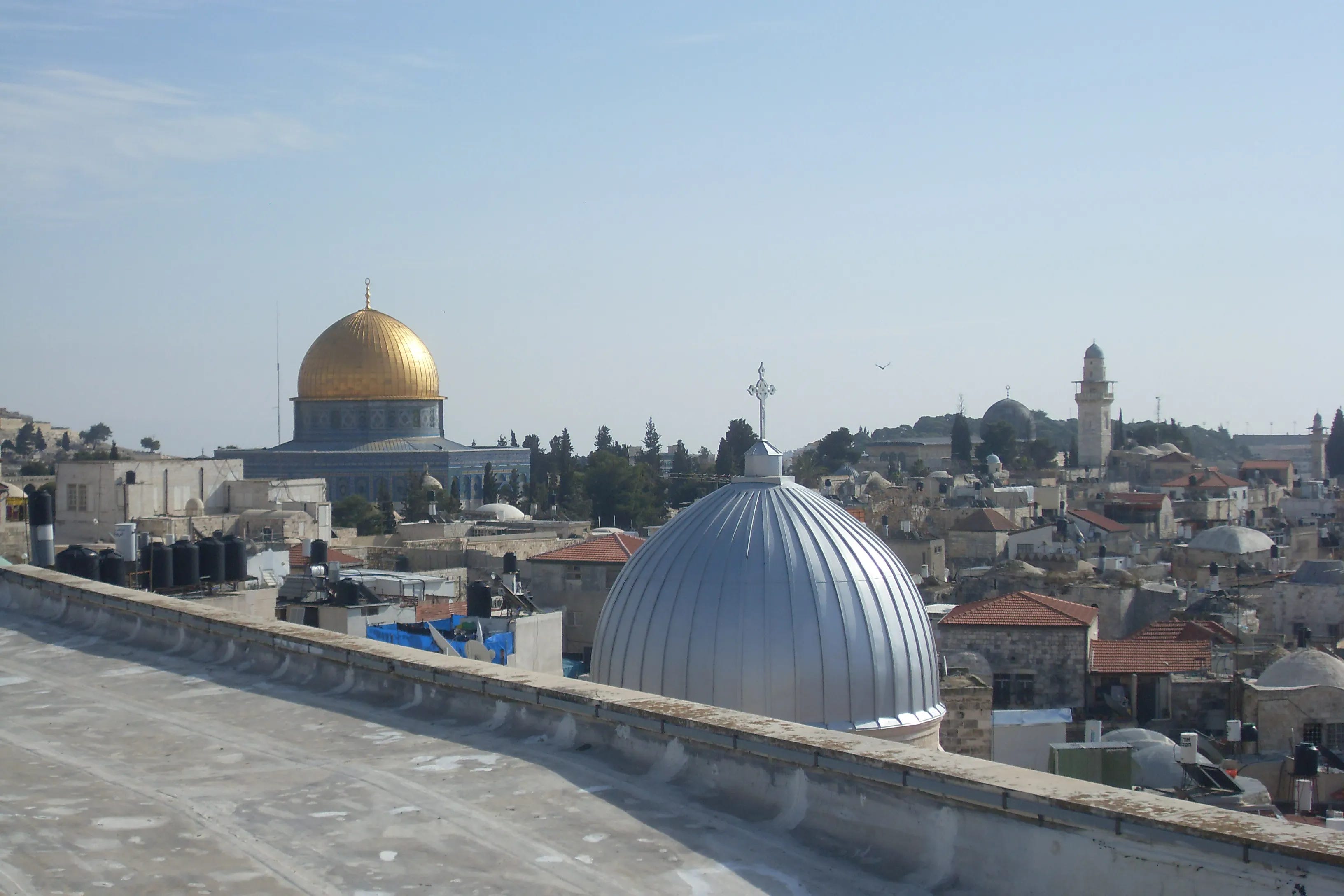
So it is with two groups locked in conflict, he argued. Each has a debilitating fear of the other, and before they can move forward together, they need to look under the bed and see for themselves that their fears are unfounded.
To be sure, this is an oversimplification. In conflict zones, there is a very real fear of violence, disruption to daily life, and even death.
This comparison also clangs condescending in the ears. It appears to sit in judgment of those in conflict, dismissing their concerns as distractions on the path toward utopia. But the comparison to “monsters under the bed” was one man’s attempt to illustrate a larger point about conflict resolution that I did not understand until weeks later.
In February 2014, after we had returned to London, our group reconvened on a Saturday for a mediation training workshop led by Simon Keyes of St. Ethelburga’s Centre for Reconciliation and Peace.
The goal in conflict mediation, he taught us, was to have “successful disagreement.” This would develop when the disagreeing parties moved away from conflict—which is driven by the threat of differences; polarizing factors such as fears, prejudices, and different belief systems; and patterns of escalation—toward the recognition of complexity. For Mr. Keyes, overcoming the fear of difference is not enough to overcome the conflict. It is not enough to look under the bedsheets and agree that there is no monster there.
The opposite of conflict is not agreement; the opposite of conflict is recognizing that complexity exists.
Moving toward conflict is easy: it requires that you pick a side, select information to reinforce your position, personalize the “us” and demonize the “them.”
Moving toward complexity is considerably more difficult. It requires that you approach a disagreement with curiosity, that you remove yourself and your ideologies from the conversation in order to understand the position of the other.
Reconciliation, St. Ethelburga’s teaches, is not a process but a place: a psychological safe space that honestly acknowledges differences while seeking opportunities to see “the humanity of the enemy.”
The secret to conflict resolution, I felt, was revealing itself to me in stages. I could only learn the third part of the lesson once I had accepted the second part. Part Three came to me via a May 4, 2016 LSE alumni talk in Washington, D.C., by Pamela Aall of the United States Institute of Peace.
Ms. Aall put it this way:
The goal of conflict resolution is not just to stop the fighting, but to give people the tools to solve their own conflicts.
Conflicts do not get resolved by third parties. They must be solved by the people fighting them.
Mediators provide important support, Pamela Aall noted, through three mechanisms: peace-keeping; mediation efforts designed to get the conflicted parties talking; and economic development, education, and programming provided when the reigning government is too weak to fulfill these obligations.
The point of this time- and money-intensive support is to change the parties’ perception of what they can gain with violence.
But, the lesson seemed to be, outsiders can never resolve the conflict. The disagreeing parties may be placed on equal footing by a mediator, and this may make the conflict easier to resolve: The mediator may show the parties there are no monsters; allow them to disagree peaceably; acknowledge each of their concerns; and meet each party’s immediate financial needs.
In that incandescent moment of opportunity, the hope is that each party recognizes the humanity of the other, if not as a friend then as a neighbor.
And then, the only hope for an end to conflict is in the warring parties’ hands.
[in revision]
Perhaps I had taken the lesson too seriously. I had gone to the Holy Land a child, with youth’s delusions of grandeur, believing that I may one day have a hand in saving it. I returned to London in 2023 a thirty-something lawyer pursuing private practice. I would represent private parties in conflict, for a fee. Cares of the world be damned.
I had emailed the LSE Chaplain to let him know I would be in Europe and to ask whether he would like to meet for a cuppa, a quick hello. Ever the spiritual adviser, he invited me, instead, to attend the LSE Faith Centre’s annual Leadership Retreat. So it was that, on my visit to London from Luxembourg, where I was then living, I took the Tube across town, escaping the gray bustle for the lush green hush of The Royal Foundation of St Katharine.
The Chaplain opened the retreat’s discussion with a quote attributed to various critics of Western humanitarianism (which I have been unable, since, to source):
We haven’t replaced religion with the Universal Declaration of Human Rights as some modernists thought we might.
It is one of those quotes useful for opening discussion because it could take one, or none, of many meanings projected onto it: that political morality has failed; that primordial tribes will always triumph over modern political thought; or that we simply have not tried hard enough—we haven’t replaced religion with the Universal Declaration of Human Rights yet.
There was also a talk on “framing the future.” We were encouraged to unlock a “rebel” mindset so as to break cycles of societal oppressions. The discussant asked each of us to name the following:
What in society, what way of being, are you a rebel for the sake of?
I answered that I had become a rebel for the sake of poetry. In some ways, I have become, perhaps hopelessly, focused on the fate of the individual. The lawyer in me whispers, The rights secured for the individual are the rights guaranteed for society. Ironically, my pursuit of the law—which I thought had marked a fork, a cleaving of the writer’s soul from the solicitor’s steel-trap mens—drew me, in the end, back to poetry. Which is to say, to the human condition. Poetry (and prose, for that matter) is an interior art. It is concerned with the individual mind. It cannot, on its own, reach a mass audience. The written word is not collective action.
I have tried, in my own way, to change minds through political action: through organizing and volunteering and protesting, in my time. And, when all of that seems, now, to have failed, I have turned to art. If I can change the way an individual responds to the world—or, perhaps, if I can make a reader, who is an individual, sympathize with the plight of another individual—I can change that reader’s world.
I cannot change the world, but I can change a world.
At The Royal Foundation of St Katharine, we had a delicious lunch and too much tea and then I was off. Back to the bedsit I’d rented near Euston Station. I had to change for the theatre. I had tickets to see Cabaret.
On the train ride back, I noticed as if for the first time the ominous concrete apartment block blotting out the weak April light near Limehouse, which I had not noticed on the ride there. I scrawled my observation in my travelogue:
A window on the top floor is blackened; it has survived a fire—or at least, the building has.
[in revision]
Years (or was it only months?) after our return from the Holy Land, we would learn from the Chaplain that one of the students on the trip had taken her own life. Did she view her differences—her conflict with the world—as irreconcilable? Was it impossible for her and the world both to live, one disagreeing with the other?
For some reason, the concerns of the great wide world—the frozen conflict we observed together, and all the rest—dissipate into inchoate oblivion when I think of her: the only conflict, perhaps, that I could have solved, could have had a hand in solving.
Here we were, a bunch of kids, gone backpacking to the Holy Land, thinking we could save it, when the one life we could have saved was the one among us. Our colleague. Did we fail to ask enough questions of her when we were asking about the history of the wars?
The law, too, is concerned only with the individual. A court, or an arbitrator, decides the fate of the individual plaintiff. While its decision can, and usually does, have ramifications beyond the walls of the room, a court is not—and cannot be—concerned with societal change out there. The court is King Solomon: detached from the context of that which brought the feuding parties to his chamber, he determines a reasoned way out. Only the baby’s fate is in his hands.
Eleven years later, I remain haunted by the Holy Land—and by the image my head still holds of my classmate’s smiling face. Is the monster under my own bed guilt? Guilt: how very Abrahamic.
Are we called to end suffering, or is a calling, paradoxically, an invention of the Age of Reason? Do humans really receive callings or do we respond, instead, to stories? Has a calling—the echo of a religious tenet, chanted into still air—ever rocked a bassinet or held a gun or raked a field or made an arrest? Or has, rather, a story once told ignited in another a desire to act?
This is just one person’s story. So is peace. So is hope. Somewhere, in a village or a town, beneath the fronds of a swaying palm, there is a mother who can no longer hold her child. She feels as if it is she who has been cleaved in two.
Disclaimer: This post contains Ryan R. Migeed’s own thoughts and opinions, which do not necessarily reflect those of his employer or the London School of Economics or any of the organizations mentioned here.
Comments
Nothing yet. Say the first thing.
Sign in to join the conversation.