
My son just graduated high school, which is one of those milestones that makes you feel proud, emotional, reflective, and then suddenly aware that the state believes this person should soon be allowed to operate a motor vehicle.
Sadly, he was not able to take behind-the-wheel instruction through school, which meant the sacred duty of teaching him to drive fell to me.
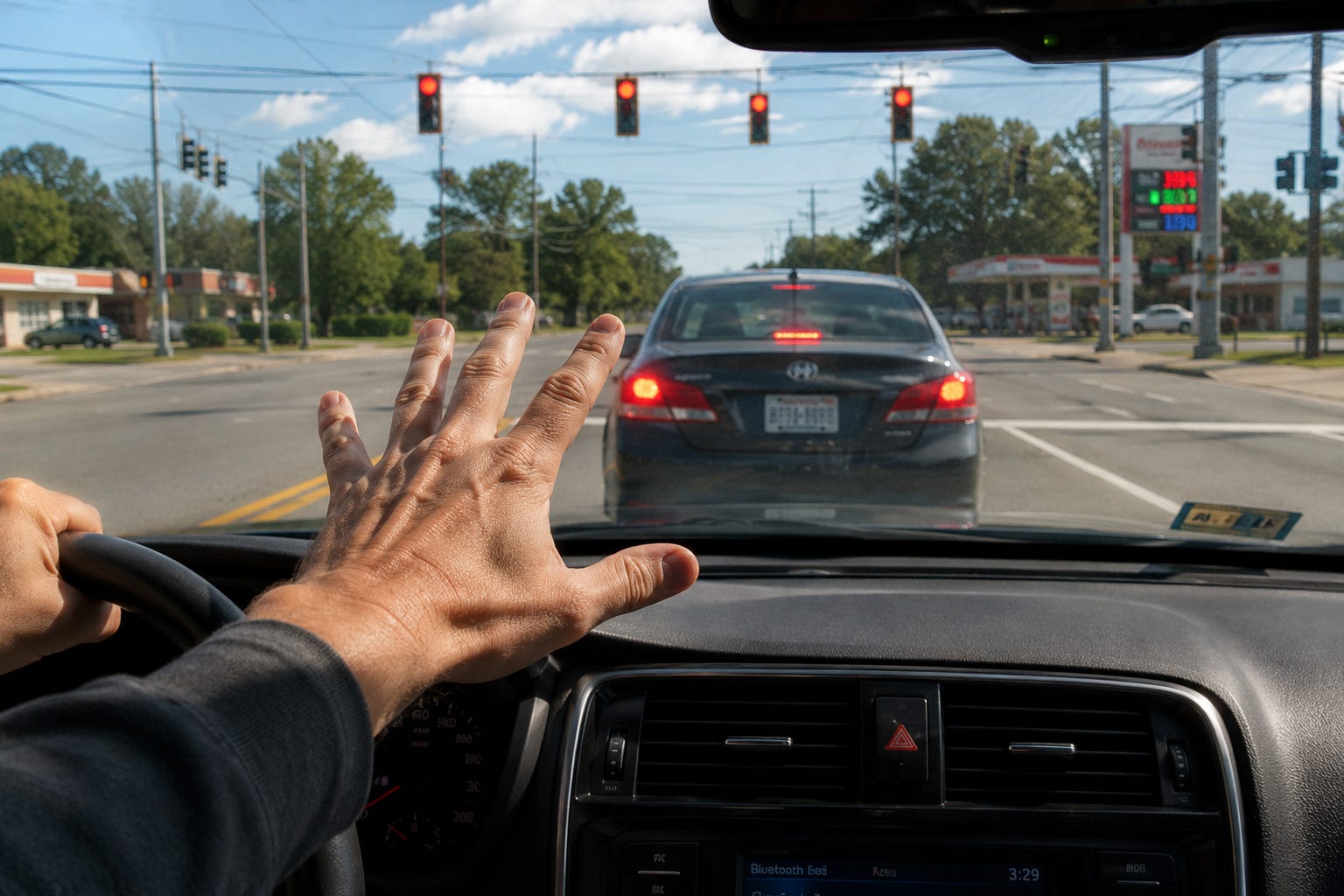
And let me tell you, nothing says “beautiful parent-child bonding experience” quite like white-knuckling the door handle of your own vehicle while calmly saying things like, “Okay, you can start braking now,” when what you actually mean is, “WHY ARE WE STILL ACCELERATING TOWARD A STOPPED CAR?”
Now, I consider myself a pretty experienced driver. I have been driving since I was 15. I have taken multiple EVOC driving classes over the years. I understand handling, braking, road awareness, controlled reactions, and the importance of not treating a stop sign like a suggestion box.
I thought this background would be helpful.
It was not.
Because there is a huge difference between driving a car and sitting in the passenger seat while someone else drives your car, especially when that someone else is your child, whom you once had to remind not to put Legos in his mouth.
No advanced driving course prepares you for that.
No instructor ever says, “Now, in this next exercise, imagine the driver is your teenage son, you have no brake pedal, and he is approaching a red light with the serene confidence of a man who has never paid an insurance premium.”
That class does not exist.
It should.
The first thing I learned is that the passenger seat is a lawless place. It looks comfortable. It looks familiar. But really, it is a padded observation deck from which you witness all of your control leaving your body.
You can see everything.
You can prevent almost nothing.
You press your imaginary brake. You grip your imaginary steering wheel. You make small, strangled noises that you hope sound instructional.
“Ease up a little.”
“Check your mirrors.”
“Maybe don’t drift toward the mailbox.”
“Okay, great, let’s not make eye contact with the ditch.”
I tried very hard to be calm, because everyone says you should be calm when teaching a teenager to drive. Apparently, yelling “WE LIVE HERE” is not considered constructive feedback.
So I worked on my tone.
Outside, I was composed.
Inside, I was a flight attendant during severe turbulence.
“Everything is fine. Totally normal. Just a few bumps. Please remain seated while I silently reassess every choice that brought us here.”
The thing about teenage drivers is that they are both nervous and wildly overconfident, which is a combination usually reserved for people assembling IKEA furniture without reading the directions.
My son would say things like, “I know, I know,” while actively demonstrating that he did not, in fact, know.
I would say, “Slow down before the turn.”
He would say, “I am.”
And then we would enter the turn with the kind of momentum usually associated with amusement park rides and poor decisions.
To be fair, he is learning. He is not bad. He is new.
That is the problem.
New drivers have no feel yet for the tiny adjustments that keep everyone alive and uninjured. They don’t yet understand that driving is mostly a series of small negotiations with physics, other people’s stupidity, and the occasional squirrel with a death wish.
They are still learning that the yellow line is not a decorative suggestion.
They are still learning that braking should begin before the bumper of the car in front of you fills the entire windshield.
They are still learning that “look over your shoulder” does not mean “turn your entire body like you are backing a boat into a marina.”
And I am learning too.
I am learning that I am not nearly as chill as I thought I was.
I am learning that my left foot will slam into the floorboard with Olympic-level conviction even though there is no pedal there.
I am learning that my son’s idea of “plenty of room” and my idea of “plenty of room” differ by approximately one insurance deductible.
Most of all, I am learning that teaching your child to drive is not really about driving.
Annoying, but true.
It is about trust.
It is about letting someone you love take control while you sit beside them and pretend not to be terrified.
It is about giving instructions, then shutting up long enough for them to try.
It is about accepting that the same child you once buckled into a car seat is now checking his blind spot and merging into traffic, and somehow both of those things happened five minutes apart.
That is the cruel trick of parenting. One day you are teaching them to cross the street. Then you blink, and you are teaching them how to change lanes on one.
And yes, you are proud.
But you are also gripping the handle above the window like it is the last available flotation device on the Titanic.
Both things can be true.
So we practice.
We drive around neighborhoods. We pull into parking lots. We discuss right-of-way. We review the difference between “rolling stop” and “legal stop,” which apparently is a concept that deserves repeating.
I even followed our local DMV employee on a road test for another person so I could know just what my son should practice and the route they would drive on his upcoming test day… We are on day 10 of that route today.
I offer wisdom.
He offers teenage sighs.
I say, “You’re doing fine.”
He says, “I know.”
I say, “Then why are we aimed at the curb?”
And somehow, slowly, he gets better.
Not perfect. Not ready for the Indy 500. Not ready to borrow my car without me mentally attaching a tracking device and a priest.
But better.
And I get better too. I breathe more. I flinch less. I only occasionally see my life flash before my eyes, and mostly during left turns.
Someday soon, he will drive away by himself; it will not be in my car, but he will drive away.
I will stand in the driveway pretending to be normal, waving like a supportive parent, while internally calculating every route, every intersection, every distracted driver, every deer, every pothole, and every possible way a person can forget to use a turn signal.
He will think he is just going to the store.
I will know he is driving directly through the center of my nervous system.
But that is the job, isn’t it?
You teach them. You warn them. You correct them. You try not to scream.
And then, eventually, you hand over the keys.
Even when every cell in your body wants to grab them back.
Still looking for the passenger-side brake,
~Ryan Gartrell
No posts
Comments
Nothing yet. Say the first thing.
Sign in to join the conversation.