
While we’re celebrating the 250th anniversary of our country I thought it might be a good moment to remember a few of America’s greatest restaurants. Not the big fancy ones: the ones that served straightforward fare at very fair prices.
There was, for instance, Howard Johnson’s. When the last one in New York City shut its doors in 2005 Jacques Pepin wrote a little ode to the American restaurant he once helmed. He reminisced about Mr. Johnson hiring him to revamp the food in 1959, and how he replaced margarine with butter, used fresh onions instead of dehydrated ones and made an astonishing ten tons of frankfurters every day from scratch.
It was real food made with care. Remember the fried clams? I fell in love with fried clams at Howard Johnson’s and now I know why: it turns out that they were made from crisp the necks of geoducks. (The soft bellies of the giant native clams went into the restaurant’s chowder.)
“For me,” Pepin wrote, “Howard Johnson’s reliable, modestly priced food embodies the straightforwardness of the American spirit. It saddens me that New Yorkers looking for this kind of gentleness and simplicity will soon have to find it elsewhere. It won’t be easy.”
How right he was! In its heyday Howard Johnson’s was the largest restaurant chain in the country, serving more food than any institution except the army. While Califonia’s Clifton’s Cafeteria’s were not nearly as ubiquitous, they too were extraordinary institutions.
I first encountered the place in Bukowski’s novel Ham on Rye. “Clifton’s Cafeteria was nice,” he wrote, “if you didn’t have much money, they let you pay what you could. And if you didn’t have any money, you didn’t have to pay…It was owned by some very nice rich old man, a very unusual person.”
He was indeed. Clifford Clinton actually had a neon sign flashing in his cafeteria that read, “Pay what you wish. Pay nothing at all if not delighted.” And he meant it. In one 90 day period during the depression he fed 10,000 people for free.
But he also understood that restaurants were a kind of theater, and his various establishments offered a lot more than food. Clifton's Pacific Seas, for instance, probably America’s first tiki bar, was filled with tropical plants, volcanic rock and a dozen waterfalls. Brookdale was a buccolic lodge with meandering brooks, faux Redwoods, stuffed moose heads and animated racoons.
The food was made from scratch and very fairly priced, and I always had a soft spot for them. I last visited in 2011, when the Clifton’s in downtown Los Angeles was the oldest cafeteria in the city - and the largest cafeteria in the world. Sadly, it closed in 2018.

2011
Just had breakfast at Clifton’s Cafeteria in downtown Los Angeles. With its timbered walls, waterfalls and stuffed fauna, Brookdale was a magical little bit of forest in the middle of the city when it was built in the thirties. Its founder, Clifford Clinton, was a man who believed in the golden rule, fed people good homemade food at fair prices, and believed in the Golden Rule. His motto was “Pay what you wish. Pay nothing if not delighted.” He went on to become, briefly, the mayor of the city.
Today this wonderful old place looks weirdly, kitchily old-fashioned. It is filled with mostly older people who come because the food is still hand-made and decent and the prices are still fair. Early in the morning wizened old women slide their trays through the cafeteria line, helping themselves to enormous dishes of chicken livers (I suspect this is the most protein for the least money), and big bowls of cream of wheat with raisins and brown sugar.
The women behind the counter are all kind, and they cook the eggs and pancakes with care. “You want bacon with that? No toast?” And even this early in the day there is a lively business in lunch to go, as enormous men walk off with bulging sacks of food.
As I sat eating my eggs and drinking my coffee (“you want cream in that?”) I listened to three old men arguing politics at the next table. It was an erudite conversation – I had the feeling it has been going on for years – that ranged through the Middle East, to Asia and then settled back at home. At points it veered into German, at others it settled back into disgruntled English.
It felt comfortable in that room, and it made me sad to think of all the people all over this city who were grabbing something to go at a drive-up window and gobbling it down in their cars. Even in the middle of downtown Los Angeles – which is a fairly sad place early in the morning – this was a restaurant that has true nourishment on offer. Looking around I wondered how long it will last? It seems like a quickly vanishing part of the American landscape.
Too bad.

Another little blast from the past. This is also a post from 2011.
Mitch’s Beans
“I’m going to make my beans,” my friend Mitch announced as we were trolling through the supermarket. “When I was poor I lived on these.” He began loading the cart with cans, and I looked on, dubious, as he he added a package of bacon.
I’ve always been partial to Buster’s Beans, which I published in my first cookbook, Mmmmm: A Feastiary. They do, however, take an entire day (and night) to prepare.
Mitch’s, on the other hand, are easy. And - to my surprise - incredibly delicious. And unlike most baked beans, these are not sweet enough to be dessert. In my opinion that’s a plus.
Mitch began by cooking 6 strips of bacon. When they were done, he removed them from the skillet, leaving just enough bacon fat to sauté a chopped onion, 5 minced cloves of garlic and a diced jalapeno (use less if you’d like something milder).
When the vegetables were translucent and aromatic he added 2 cans of pinto beans, a 14 ounce can of tomatoes and a tablespoon of cumin. (He says you need a LOT of cumin.) Stirring that all up he diced the bacon, threw it into the pot and left it to simmer on a very low flame for a couple of hours.
He added salt and pepper and we ate the beans - with grilled chicken and coleslaw - with enormous pleasure.

I’ve been trolling through my old cookbooks, remembering how many cookbook authors of the American past believed deeply in industrialized food. To cooks of the thirties and forties, the promise of convenience products was extremely beguiling.
There is, for example, this from one of my mother’s favorite cookbooks, Poppy Cannon’s Can Opener Cookbook, which was first published in 1951.
Mom bragged that she could “have dinner on the table in less than ten minutes.” No wonder, with dishes like this one.
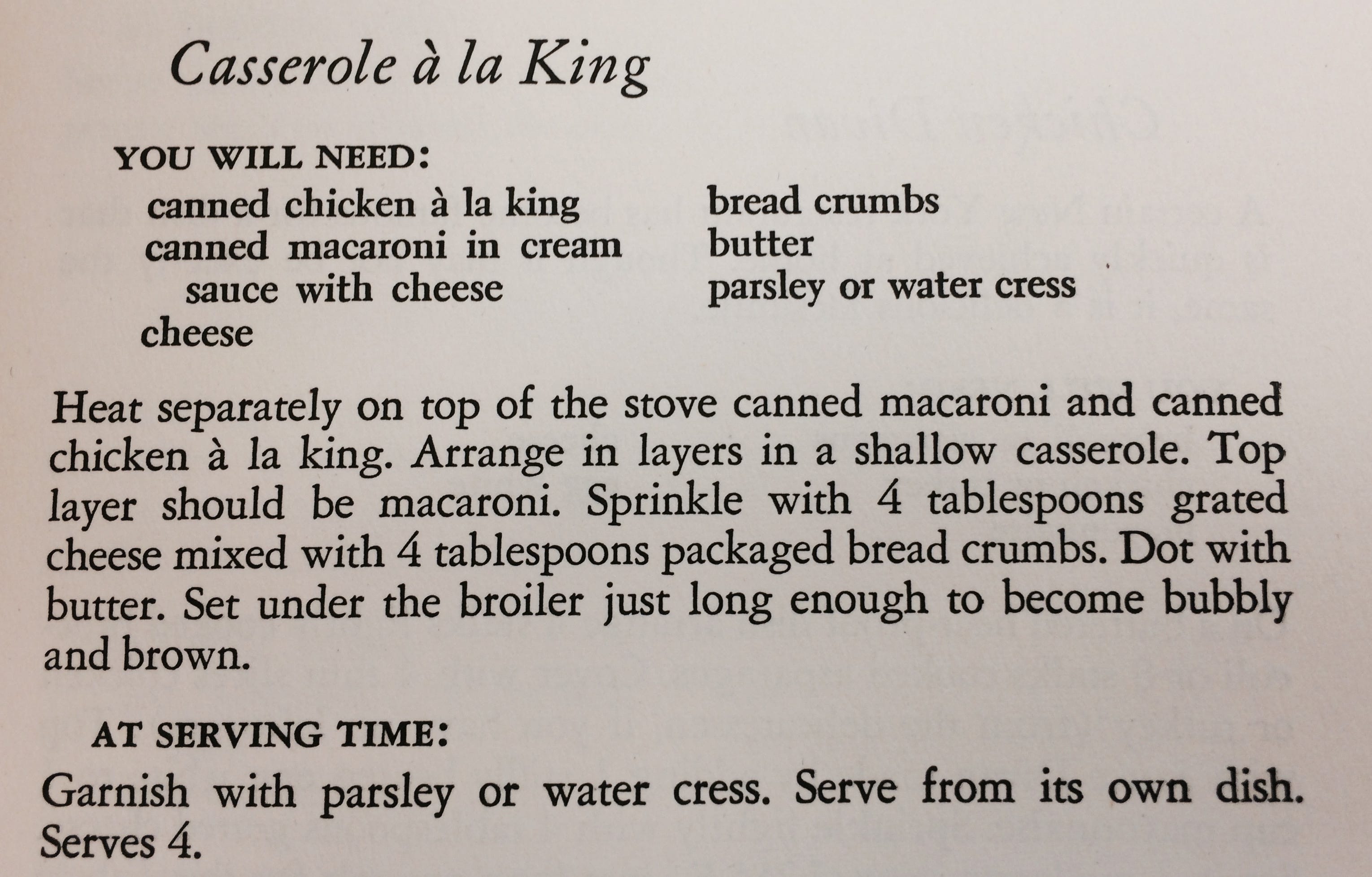
Poppy Cannon, incidentally, was a fascinating character. I’m amazed that nobody’s done a movie about her life. Born Lillian Gruskin in South Africa, she was constantly reinventing herself. She had a long affair with Walter White, head of the NAACP, and when they finally married the interracial union was considered so scandalous he tried to resign from his job.
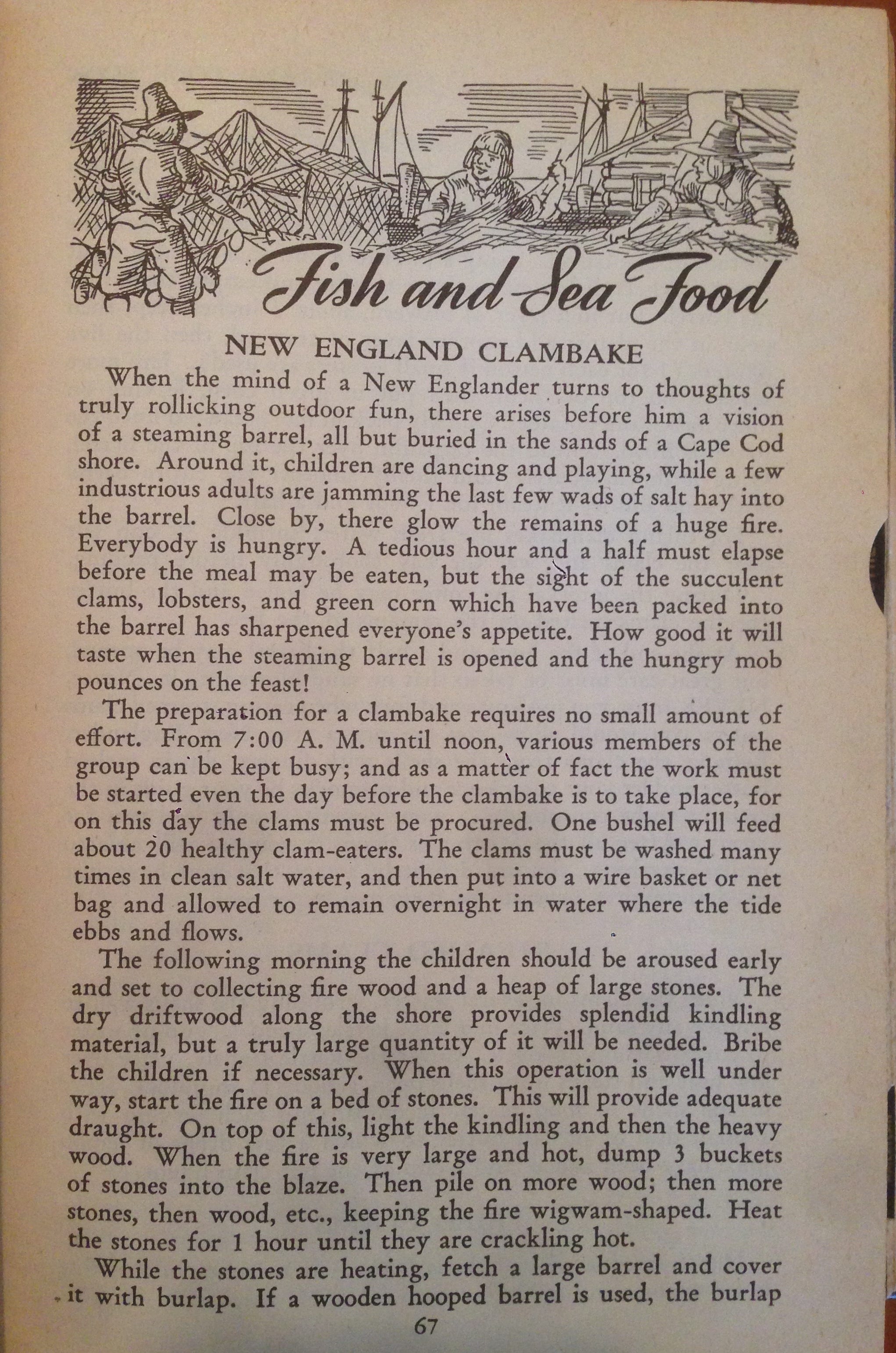
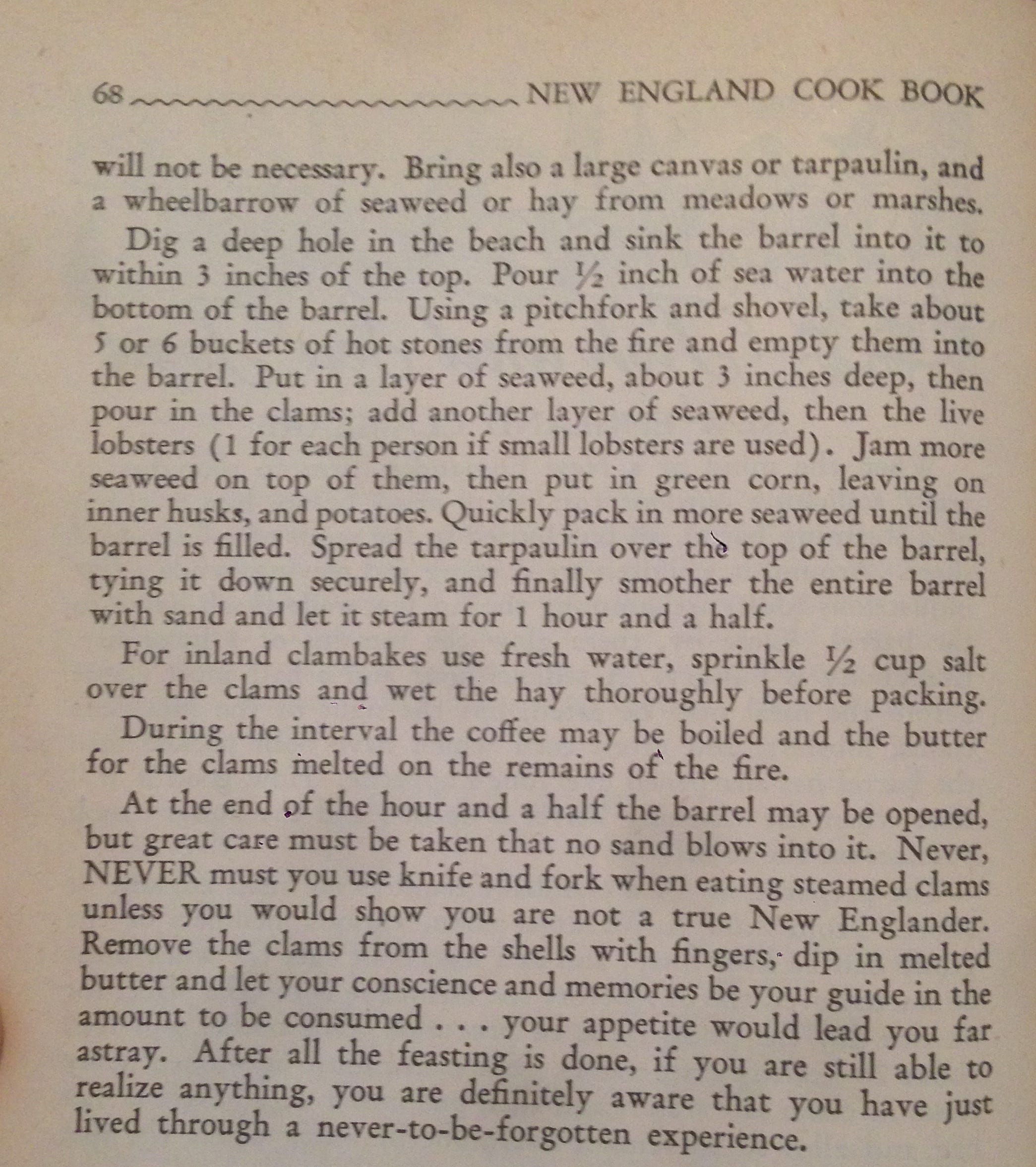
But all cookbook writers were not like Poppy Cannon. In contrast, I offer this recipe for a classic clambake from Ruth Berolzheimer’s United States Regional Cook Book, published in 1949. There are no corners cut here; this will take all day. And before you begin, make sure you have a wheelbarrow of seaweed or hay on hand. (Not to mention an army of small children.)

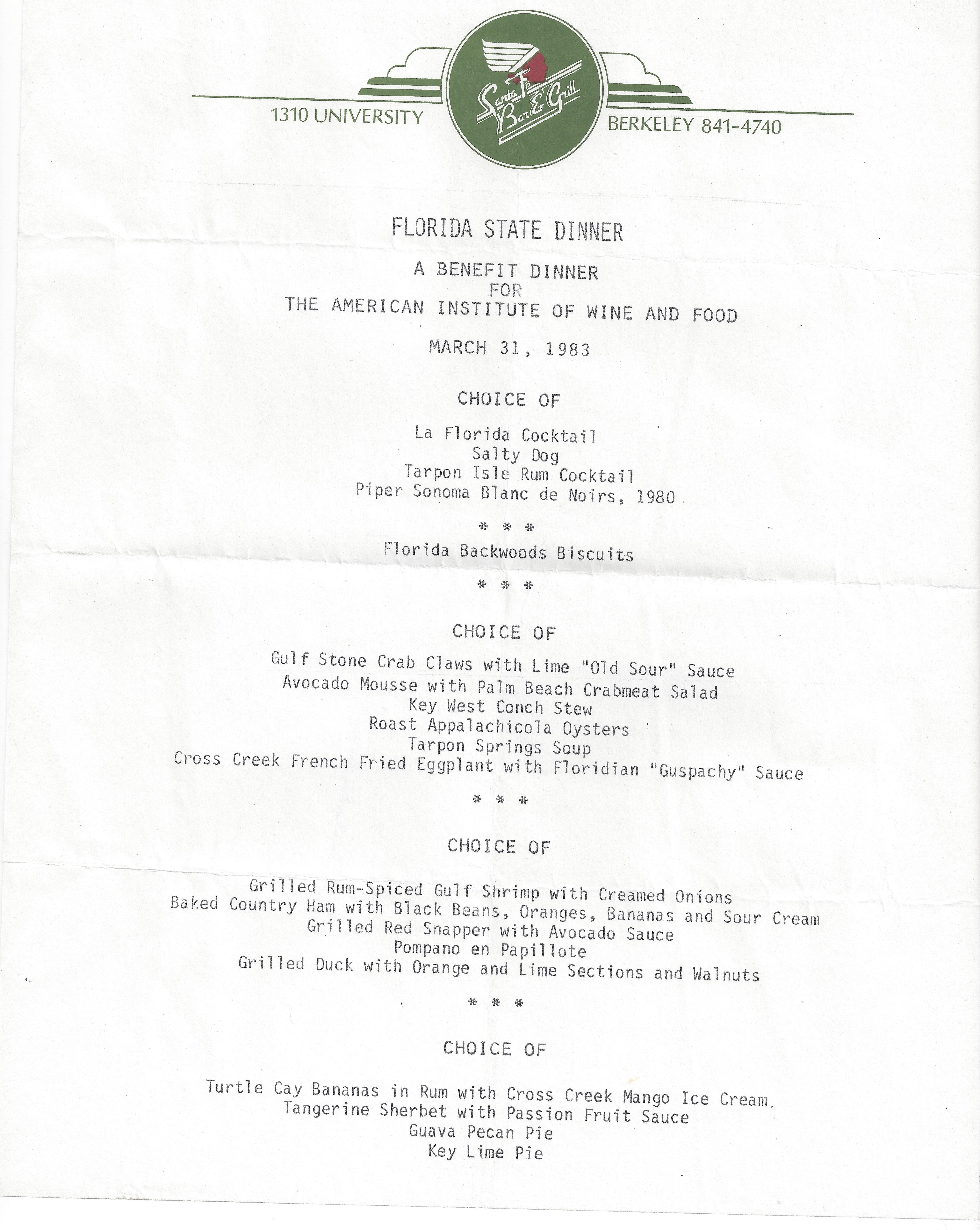
At a time when few of us understood that there really was an American cuisine, Jeremiah Tower created a series of spectacular dinners dedicated to the regional foods of various states at his Santa Fe Grill in Berkeley. The cost was $30 a person - although I suspect this one was more expensive since it was a fundraiser.

What am I making for the fourth?
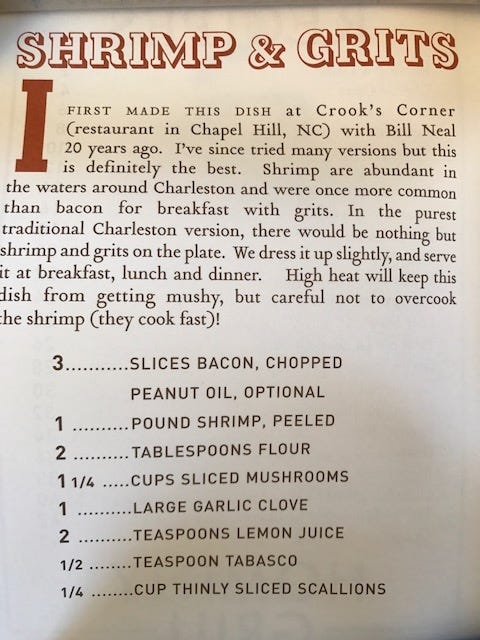
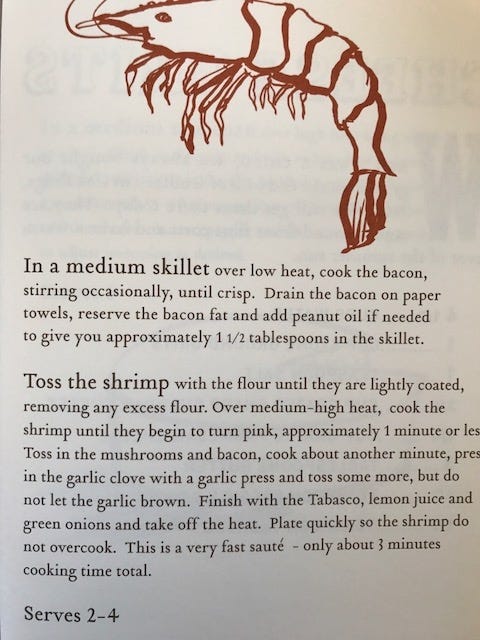
Shrimp and grits. Because my friend Robert Stehling came to stay a few weeks ago and made the most famous dish from his much-loved and now closed Charleston restaurant, Hominy Grill. It was so delicious that I’ve been thinking about it ever since. And what could be more American?
I was going to suggest that Robert’s lovely Hominy Grill Cookbook would make a wonderful gift on the Fourth. Sadly, it is out of print - and very hard to find.
So I’m offering the recipe instead. It’s easy to make and incredibly satisfying.
Happy Fourth!
Grits
1 cup stone-ground grits (I like Anson Mills)
1 teaspoon salt, plus more to taste
3/4 cup grated sharp Cheddar cheese
1/4 cup finely grated Parmigiano-Reggiano cheese
3 tablespoons unsalted butter
1/2 teaspoon freshly ground black pepper, plus more to taste
1/2 teaspoon Tabasco
Bring 4 1/2 cups water to a boil in a medium saucepan. Whisk in the grits and salt, reduce the heat to low, and cook, uncovered, stirring occasionally, until the grits are thickened. (Depending on what kind of grits you use this will take anywhere from 20 minutes to an hour. Follow package instructions. Robert really didn’t mess with this; he let them cook about 40 minutes and just gave an occasional lazy stir.) Remove from the heat and stir in the cheeses, butter, pepper, and hot sauce.
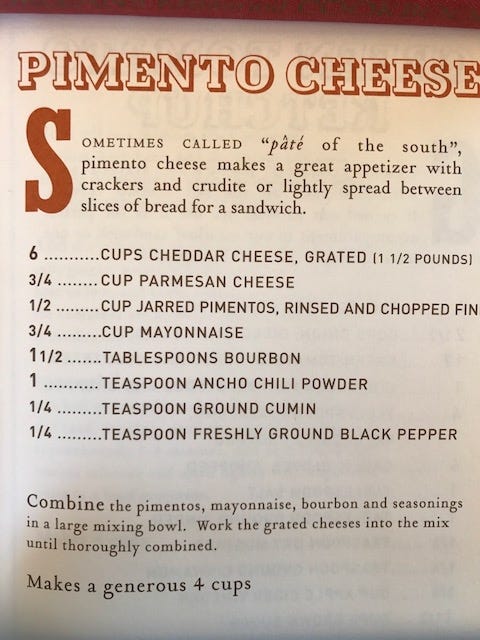
And should you be looking for a great American appetizer, you can’t do better than this:

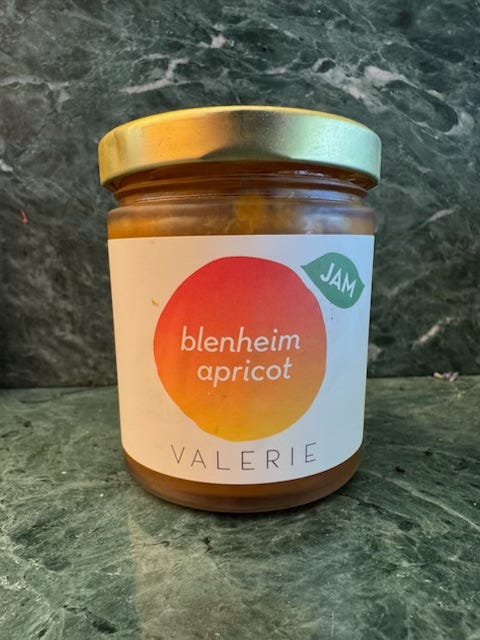
And one final All American offering. I have just discovered this wonderful Apricot Jam from Valerie Confections in Glendale. I have never had better apricot jam; I went back to Rubiner’s in Great Barrington where I purchased it and bought 3 more jars. I never want to be without it.

No posts
Comments
Nothing yet. Say the first thing.
Sign in to join the conversation.