Of all the articles I produced for California Magazine, this is the one I think about most often.
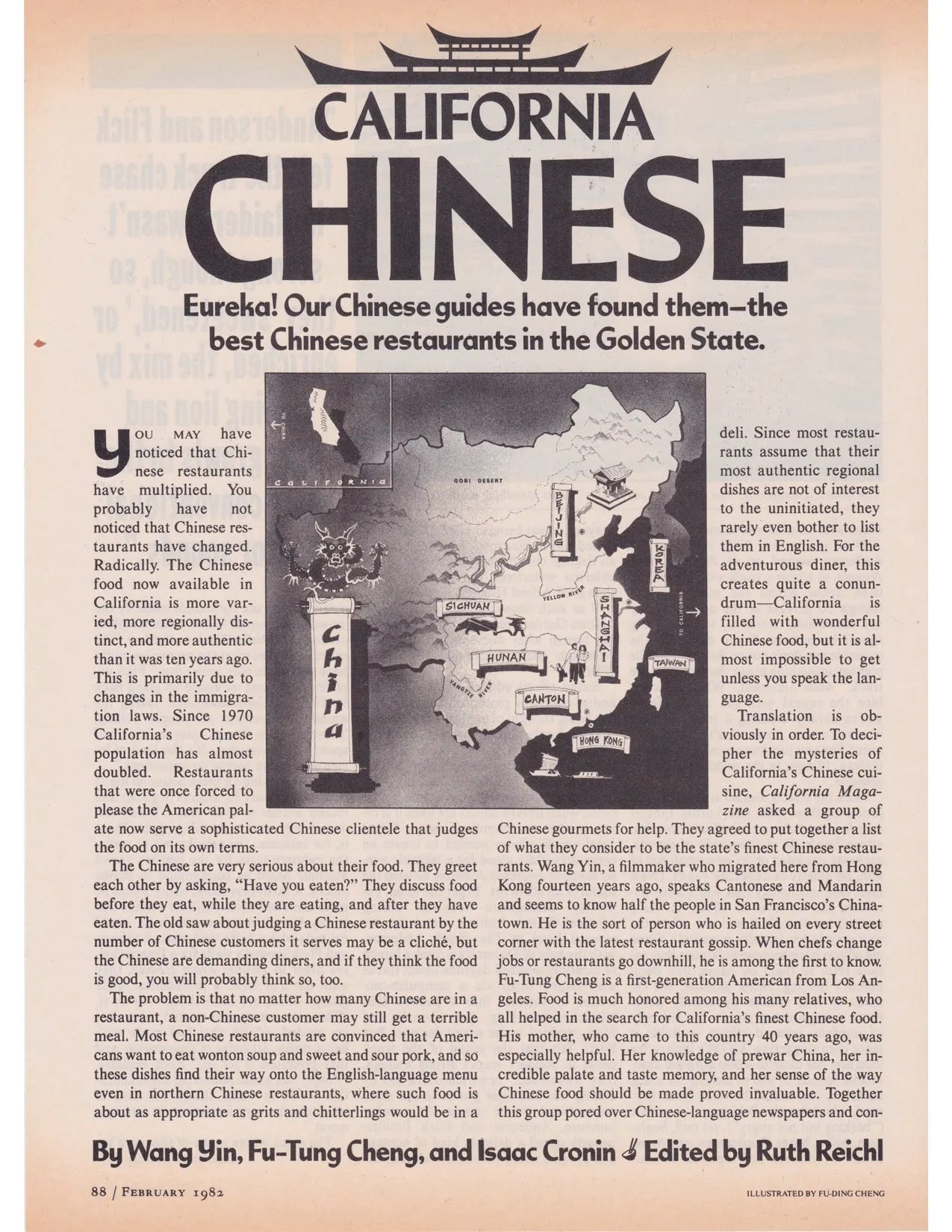
The authors will surprise you. Wang Yin is director Wayne Wang, who wrote this just before his first film Chan is Missing catapulted him to Hollywood fame; he went on to direct films like The Joy Luck Club, Maid in America and this beautiful portrait of Cecilia Chiang, Soul of a Banquet.
Visionary architect Fu-Tung Cheng became famous as the poet of concrete.
And Issac Cronin, who I knew as the author of the International Squid Cookbook, is a social critic. What we alll had in common was a deep interest in Chinese food and a desire to give readers a better understanding of the Chinese food that was available in California.
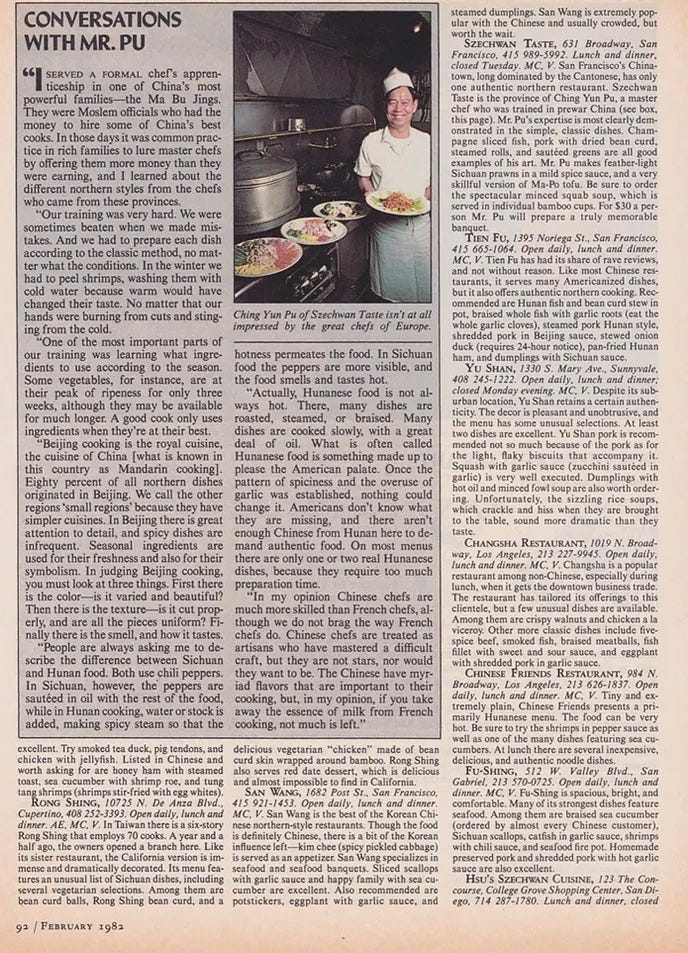
I remember it as a halcyon time when we drove up and down the state, eating meals with their mothers, grandmothers, aunts and uncles. I learned about Chiu Chow and Hakka cooking. The chefs we interviewed told us about their training; I’ve never forgotten Mr. Pu saying “The Chinese have myriad flavors that are important to their cooking but in my opinion if you take away the essence of milk from French cooking not much is left.”
This is one of the very first articles I shared when La Briffe began in 2021; I’m reposting it now in a more legible style because readers have complained that the old format made it almost impossible to read. (They were right.)
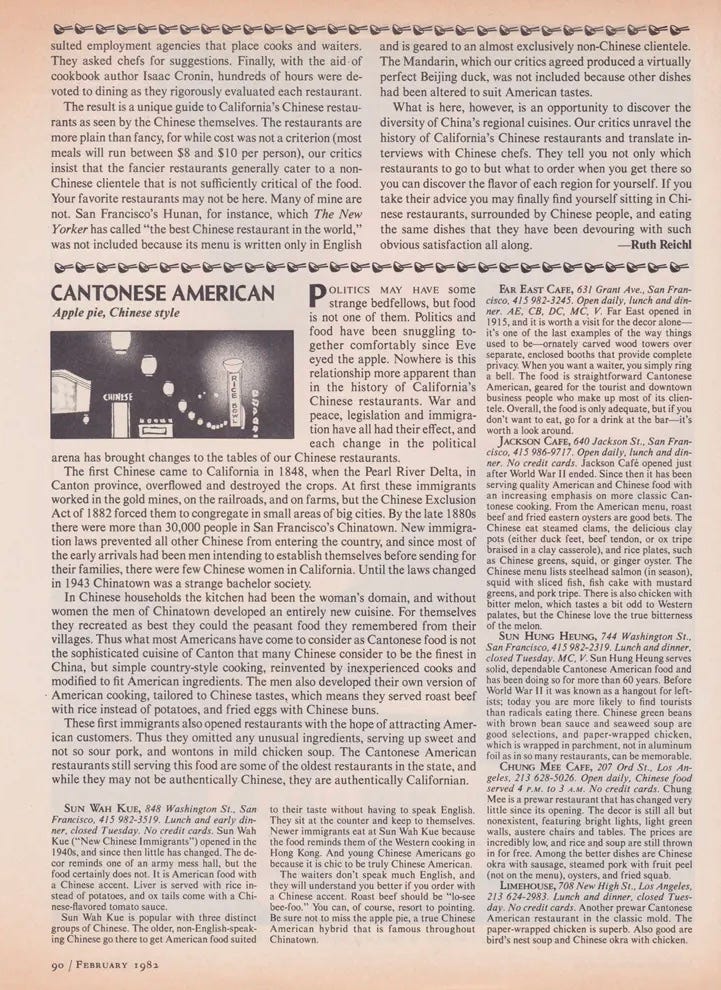
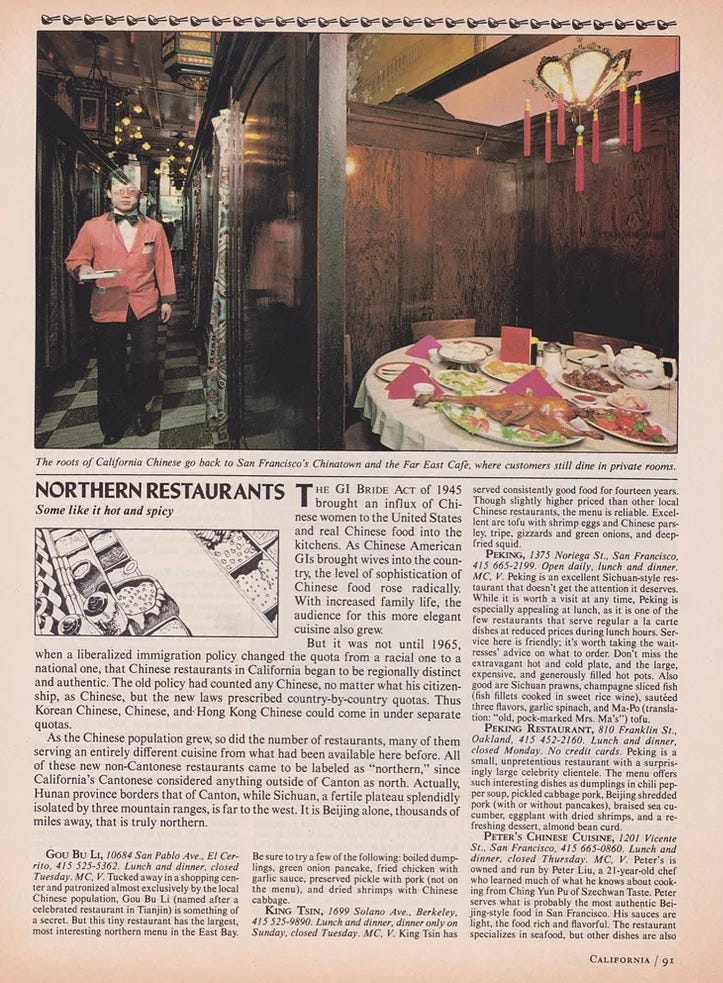
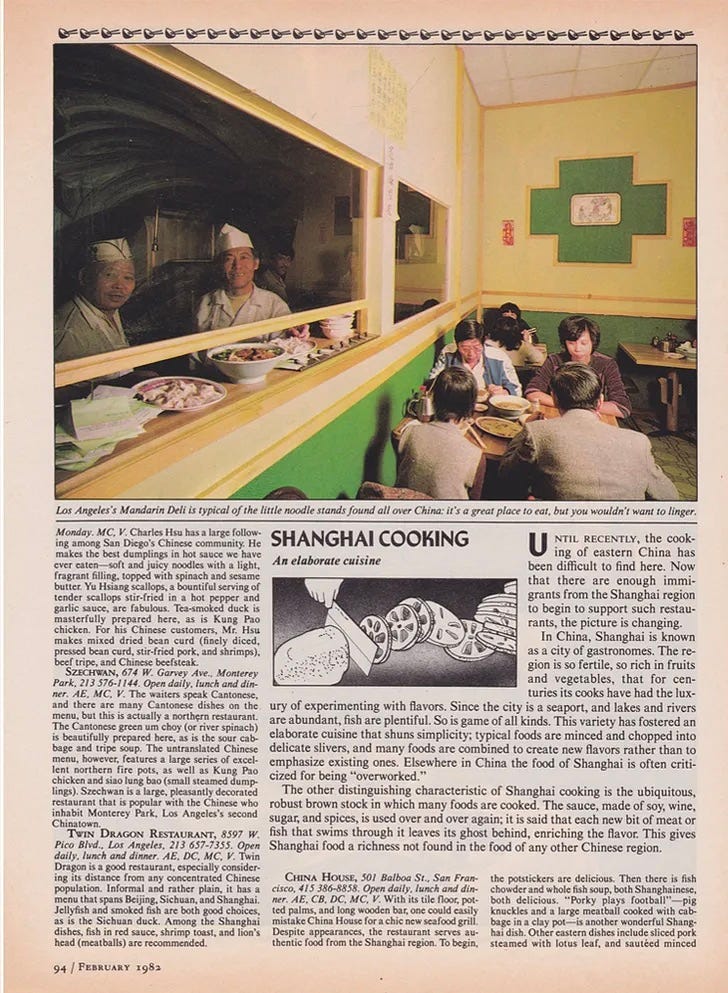
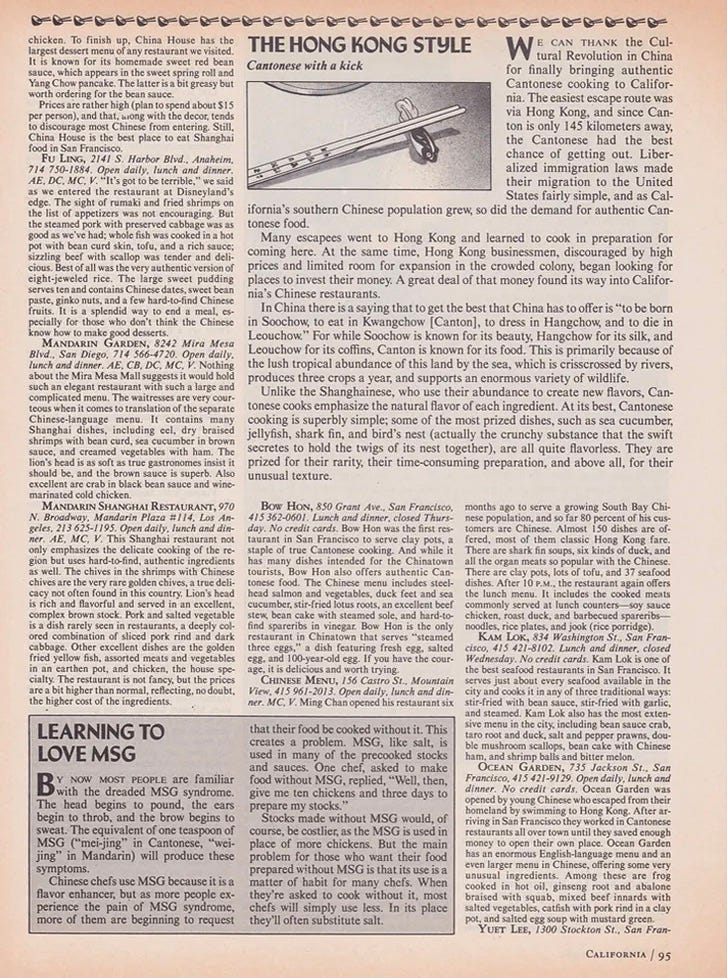
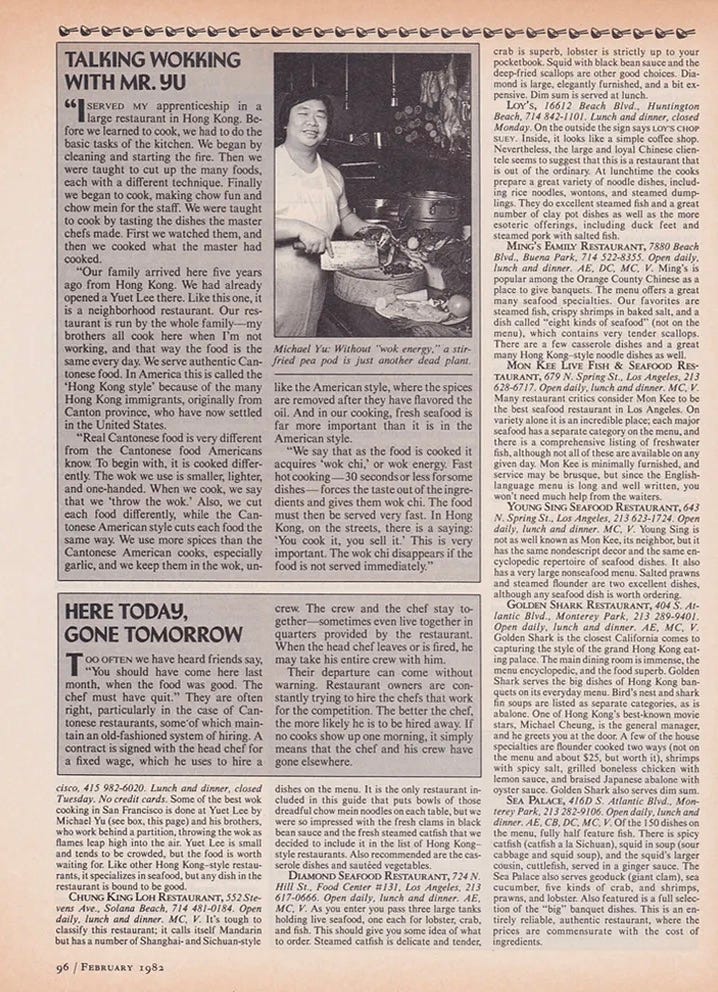
My assistant at the time, Phoebe Papademetriou, wanted to know how many of the restaurants were still around. So she did some research. Shockingly, only 8 were still with us: Far East Cafe, Peking, Chinese Friends Restaurant, San Wang, Twin Dragon Restaurant, Bow Hon, Kam Lok and the beloved Yuet Lee. I’m happy to say that all 8 are still in business. Most of the others have turned into newer Chinese restaurants, but one is now a New Orleans style restaurant, Narai is now a Russian restaurant and Chuck’s Fountain has become a beauty salon.
When I bought my first Sichuan cookbook, I was in heaven. It was 1974, and The Good Food of Sichuan made it possible for American home cooks to attempt what was then a fairly arcane cuisine. Although it was difficult to source authentic Chinese ingredients, I worked my way through the cookbook and it changed the way we ate at my house.
My first encounter with Fuchsia Dunlop was equally impactful. Today Fuchsia is a beloved institution, but when her first book, The Food of Sichuan was published in 2001 she was virtually unknown. The book, which has since been revised, was unlike anything else on the market and once again the food at my house was better because of it.
As you will see from the article below, I met Fuchsia when she was just starting out and instantly signed her up to write for Gourmet. (If you want to read some of the early pieces Fuchsia wrote for Gourmet, you will find them here. )
“I know you’re interested in Chinese food.” Guy Diamond, editor of Time Out London, was sharing lunch with me at a modest Indian restaurant. “I have someone I really think you ought to meet. Her name....” he looked slightly embarrassed, “is Fuchsia.” He lowered his voice, adding, with all the diffidence of a slightly shameful revelation, “…hippie parents.”
Was he trying to sell her short? I wondered; it takes a rare editor to hand a talented writer off to another editor, even when their magazines exist on separate continents. “She’s the only Westerner to graduate from the great Sichuan cooking school in Chengdu.” This was said a bit reluctantly, and I understood the context; Fuchsia was too good to keep to himself.
It was the early aughts, and Gourmet already had a long history of fine writing on Chinese cuisine, written by native authors exiled from their country, or curious cooks who had studied in Hong Kong or Taiwan. In the eighties the magazine ran a ground-breaking series of articles by Nina Simonds. But Fuchsia was different; she was trained in a corner of the Chinese Mainland few of us had visited - and she was passionate about the food.
She wrote stories for us on restaurants in Chengdu. She wrote stories for us about Chinese restaurants in London. She wrote about ingredients and parts of China that were then unknown. But when she called to say she was escorting a trio of master chefs to the United States, I was particularly excited. “How would you feel about taking them to dinner at The French Laundry?” I asked.
She hesitated. “I’m not sure that they’ll like it,” she demurred.
“That,” I said, “is the whole point.”
I anticipated culture shock, thought they might treat the fare in one of our greatest eating institutions with the puzzled repugnance Americans reserve for unfamiliar foreign dishes like jellyfish and goose intestines.
But I was unprepared for the depth of their disgust.
The chefs thought olives were nasty, like a dose of the bitterest Chinese medicine. Rare lamb was worse. “Dangerous,” was one chef’s assessment. “Terribly unhealthy,” opined another. They were puzzled by oysters, found cheese revolting and considered salad food for savages.
They also found the length of the meal almost unbearable, and half an hour after getting up from the table complained they were hungry again. There was only one remedy: they set off to find the nearest plate of scallion-fried rice. (Fuchsia’s article, Culture Shock, is here.)
Chinese Fried Rice For Two (adapted from Fuschia Dunlop)
You need cold cooked rice to make this dish; it won’t work with warm rice. Leftover rice from Chinese takeout is perfectly acceptable, although it tastes better with higher quality Jasmine or Basmati rice.
Get a wok really hot and swirl in a tablespoon or so of peanut, roasted rapeseed, or grapeseed oil. Add the chopped whites of a couple of scallions, and when they’re fragrant, add 2 large eggs, lightly beaten, and tilt the pan to form an even sheet. It should set in about half a minute; add 2 cups of cooked rice, a half teaspoon of salt and stir fry for a couple of minutes, breaking up the egg sheet. Allow the rice to rest, unstirred, on the pan for about 10 seconds between stirs, so it gets crusty.
Add the thinly sliced scallion greens, and a small splash of sesame oil. And if you like, a splash of good soy sauce as well.
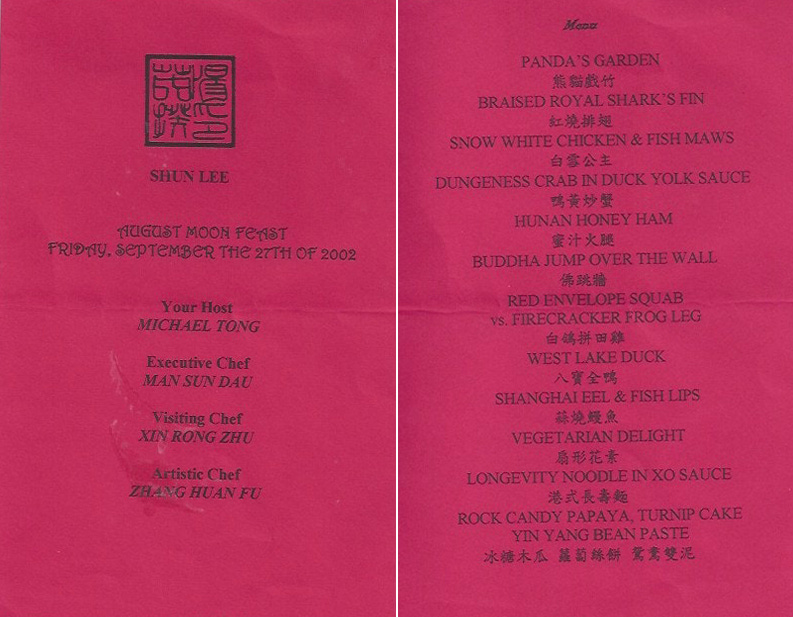
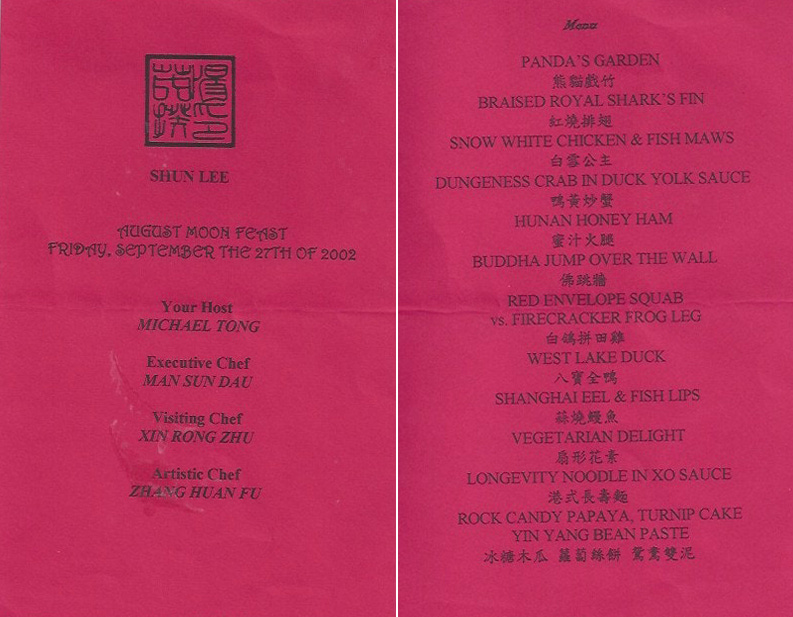
This was a dinner Michael Tong, owner of Shun Lee, gave for Cecilia Chiang of The Mandarin Restaurant in San Francisco. It was the most extraordinary Chinese meal I had ever had in New York, and despite the fact that the food was visually gorgeous (note the reference to “artistic chef”) and every morsel was exquisite, it made me sad.
Because what Shun Lee served most of the time was Chinese food that had been dumbed down, and it hurt to know that the kitchen was capable of food like this. Michael didn’t think his clients were ready for fish lips and fresh eel, and he was probably right. And they were certainly not ready to pay for all the special ingredients he imported from China.
I wish I had taken a photograph of that Panda’s Garden. It was sitting on the table when we came in, a vast tableau made entirely of food with two little pandas carved out of vegetables playing in the middle.
The first Chinese cookbook published in the United States was apparently Chinese Cookery in the Home Kitchen by Jessie Louise Nolton which came out in 1911. Since then a stunning number of Chinese cookbooks have been published. (If you haven’t read Buwei Yang Chao’s 1945 cookbook How to Cook and Eat in Chinese you have a treat in store.)
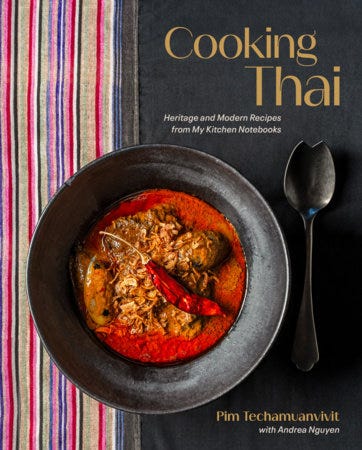
Thai cookbooks are a different matter. When I fell in love with the food of Thailand I actually had to ask a Thai friend to translate a cookbook for me; there was nothing in English. Many Thai cookbooks have been published since then but the new Cooking Thai by Pim Techamuanvivit is a game-changer. If you have a friend who loves Thai food, you could not think of a better gift for them.









Comments
Nothing yet. Say the first thing.
Sign in to join the conversation.