
Hi my loves,
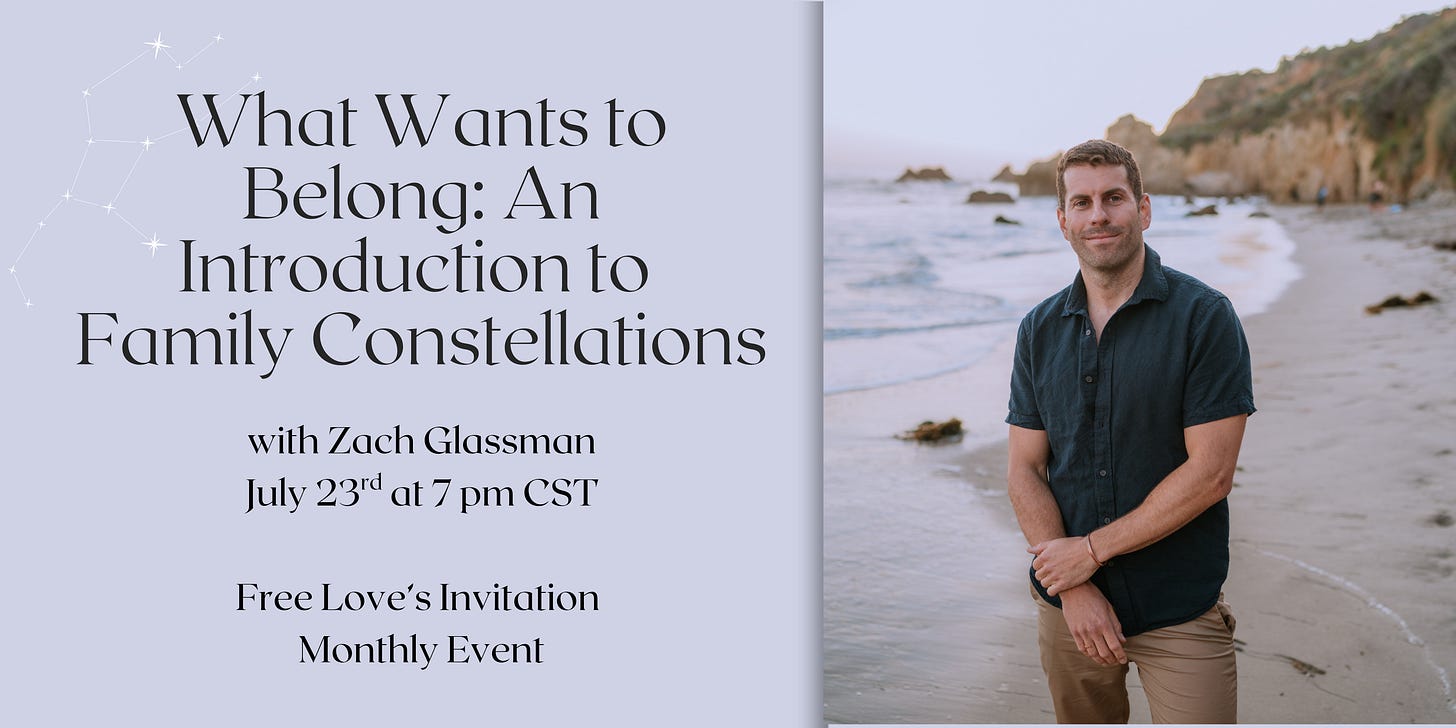
Today I’m so honored that my friend Zach Glassman agreed to be a guest this week for this newsletter and for our free event this Thursday at 7pm Central. He’ll be diving into Family Constellations & the powerful shift that can take place when we sit inside another’s story. I would love to see you there. Register at the link below. Now, onto today’s guest post.
From a young age, I learned how to read a room. I noticed subtle changes in the expressions of my siblings and parents and developed a sense of safety by tracking them. As the youngest of three, that awareness also helped me get what I wanted. I could anticipate moods and respond accordingly. It was part sensitivity, part self-protection, and part strategy.
My relationship with my older brother has always been complicated. He was an only child for five years before my sister arrived; I came two years later. He was harder for me to reach and tremendously independent. We have had moments of warmth and care, but there was also a tension I could feel without understanding. It may have been jealousy, annoyance, resentment, or something else altogether.
I wondered why he did not do the things I saw other older brothers doing: giving their younger brothers deep hugs, lifting them onto their shoulders, playing with them. I often focused on what I did not have instead of what I did: a brother who could be distant, but who was also remarkable in his brightness and cleverness. A brother who, I can now see, was showing up in the ways that he could.
—
A few years ago, family constellations gave me a different way into this relationship. In this experiential practice, a person brings forward a question, relationship, or recurring pattern. Other participants may represent people or qualities within that system, often knowing very little about them. Their role is not to perform or invent a story, but to notice what arises in their bodies.
In one constellation, I represented an older brother. Almost immediately, I felt a tremendous desire to step away. I wanted very little to do with the younger brother. It was not because I disliked him. I felt that I was holding too much of my own, and distance was necessary. Moving away from the family offered a safety that staying close did not.
Afterward, the person whose constellation it was shared more about his family, and what I had felt was consistent with his older brother’s experience. That suggested that I had not simply projected my own family story onto the constellation, even though the dynamic felt familiar.
I have also explored my own family of origin through constellation work, including my brother’s tension with our family. Through that work, I began to consider how much difficult and unprocessed emotion he may have carried from our parents.
I want to be clear: these experiences did not give me direct access to my brother’s inner life. His experience belongs to him. But they became emotional and somatic data points in my own body, bringing me more peace and clarity in my relationship to him and my family.
As I stood in that other person’s constellation, and in the months that followed, something shifted in me. I began to release some of my inner child’s grasping for warmth and connection and meet my brother from a more adult place. I had felt into a version of distance from the inside.
New questions became available: What if distance had felt necessary for him? How difficult might it have been to stay close? What if his distance was not evidence of a lack of care, but of how much he was carrying?
—
We often build stories about other people. Someone is too sensitive, controlling, difficult, or unavailable. These descriptions can harden into fixed positions. We see how another person’s behavior affects us, but we do not always feel what may be alive for them or what they may be holding.
This does not mean excusing harm, erasing responsibility, or abandoning boundaries. Empathy can mean honoring our own experience while loosening the grip with which we hold someone else’s story.
One reason I am drawn to family constellations is that so much of how we understand our lives begins with the head. We decode events and patterns through language and analysis. We understand why a parent or sibling behaved as they did, or why we continue to respond in a familiar way. Insight matters, but it can still leave us standing in the same place.
Constellation work offers another entry point. We may bring forward an issue of our own, represent within someone else’s system, or witness what unfolds. The invitation is to notice what happens in our bodies and become curious about it. What shifts when someone excluded or suffering is acknowledged differently? What becomes possible when something long unspoken is finally allowed to be seen?
Today, I still read rooms and notice small shifts in energy. That sensitivity is still there. But I understand now that I can pay close attention to another person while knowing only what I know from where I am standing. A different kind of understanding can begin when I loosen my grip on the story I have told about someone and allow my body to encounter something new.
My experiences in constellation work do not tell me everything about my brother. They have allowed me to meet him with less judgment, experience my childhood from another vantage point, and turn up the volume on empathy.
—
This Thursday, I will be leading a gentle online introduction to family constellations. You do not need any previous experience, and you will never be asked to share more than feels right. You are welcome to bring a relationship, role, or pattern you are curious about within your own family system, or simply come and experience the work.
I hope to see you there.
Zach Glassman
No posts
Comments
Nothing yet. Say the first thing.
Sign in to join the conversation.