
The formal declaration of an “Economic D-Day” campaign by the Trump administration against the Islamic Republic of Iran marks a decisive, predictable pivot in imperial strategy: substituting rhetorical economic maximalism for a failed military option.
Having failed to secure rapid regime decapitation, depleted global interceptor stockpiles, and absorbed the asymmetric closure of the Strait of Hormuz, Washington is attempting to redeploy the exact sanctions-and-tariff playbook that failed to achieve strategic capitulation against Russia.
However, an objective evaluation of macroeconomic trade flows, shadow tanker networks, and Eurasian logistics corridors reveals that the policy faces structural dead ends.
Without active enforcement cooperation from Beijing—which remains structurally disincentivized to comply—the attempt to economically isolate a largely self-sufficient, resource-rich power will primarily serve to accelerate de-dollarization, strain Western client states, and expose the boundaries of unipolar financial coercion.
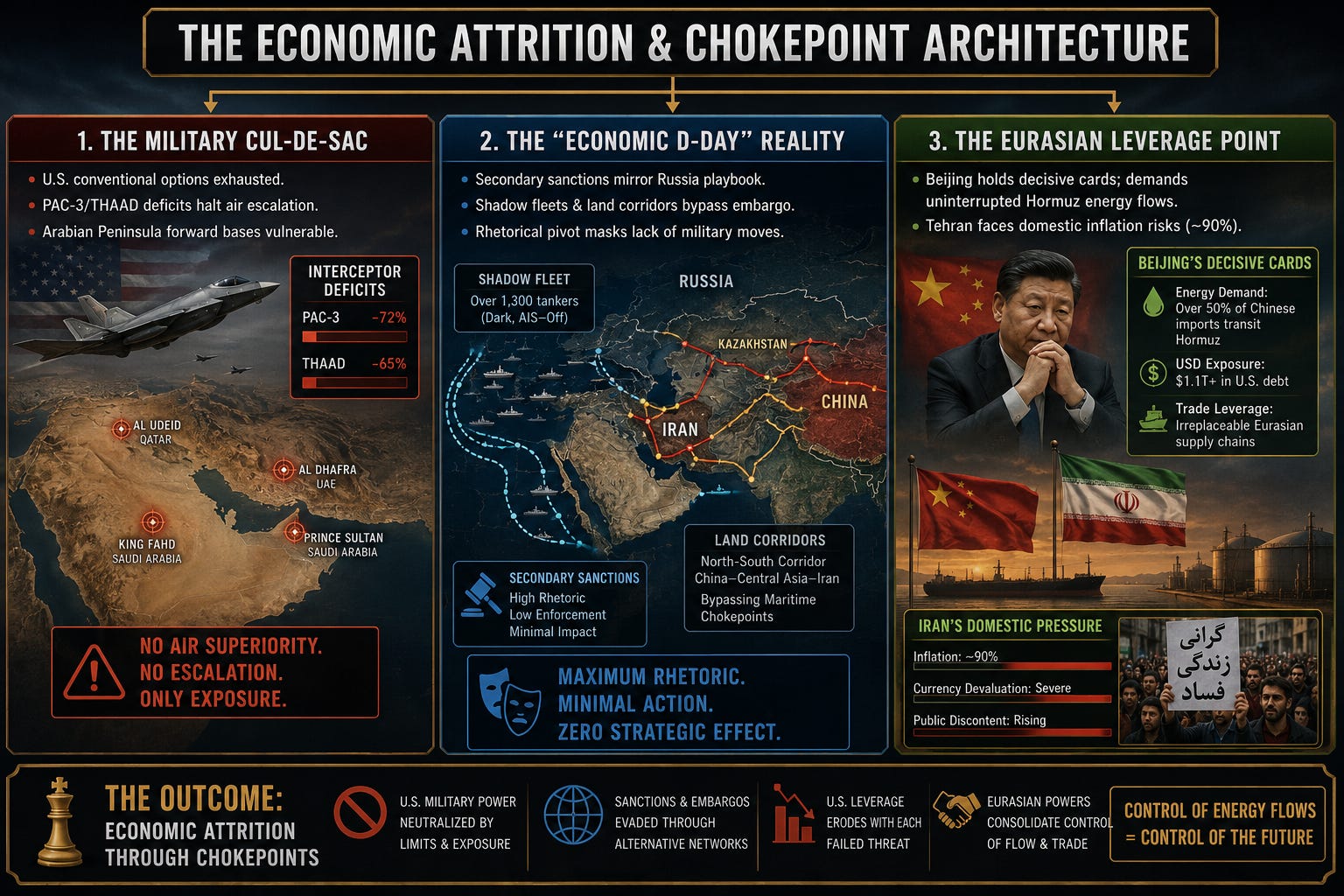
The pivot to “Economic D-Day” occurs exactly 60 days following the collapse of the June 2026 Memorandum of Understanding (MOU). Having realized that vertical military escalation carries unsustainable risks—both in naval asset attrition and domestic fuel price inflation—the administration has retreated to a naval and financial embargo.
The Military Dead End: The destruction of forward logistics infrastructure in Bahrain and the vulnerability of installations in Kuwait, Qatar, and the UAE have forced the Pentagon to debate whether rebuilding these $5–10 billion hubs is viable given their proximity to Iranian missile and drone arcs.
The Asymmetry of Blockades: While U.S. naval forces attempt to enforce an embargo against Iranian-flagged vessels, Tehran’s asymmetric coastal architecture (anti-ship ballistic missiles, drone swarms, and minefields) enforces a selective, high-cost closure against Western commerce.
The Shadow Fleet Bypass: Iran’s hydrocarbon exports continue to transit international waters via an established “shadow fleet” of third-party flagged, un-registered tankers, alongside direct, secure land-transit routes across Pakistan and Turkey and maritime corridors across the Caspian Sea to Russia.
The central mechanism of the “Economic D-Day” strategy—imposing aggressive secondary sanctions and punitive tariffs on neutral trading partners—mirrors the exact policies applied against Moscow following 2022.
Third-Party Resistance: Levying punitive tariffs against sovereign trading hubs (such as India, Turkey, or China) does not sever trade ties; it incentivizes those nations to accelerate non-dollar bilateral settlement systems. The precedent set in Eastern Europe proved that secondary sanctions cannot force major industrial economies to sacrifice their own energy security.
The “Rally-Around-the-Flag” Weapon: Punitive economic warfare hands regional governments a potent domestic narrative: any internal economic dislocation, inflation, or shortages are directly attributed to Washington’s coercive measures, insulating domestic leadership from political backlash.
The Diminishing Returns of Sanctions: Having maintained maximalist sanctions against Tehran for decades, the marginal utility of additional administrative designations has hit absolute zero. The target economy has already adapted its manufacturing, banking, and trade networks to operate outside Western clearance systems.
While Washington cannot single-handedly enforce an economic siege, Iran’s long-term endurance depends heavily on its diplomatic alignment with BRICS partners—first and foremost, the People’s Republic of China.
The Domestic Vulnerability (Inflation): The severe economic pressure facing Iran is not the exhaustion of physical resources, but severe domestic inflation, currently running at an estimated 80% to 90% annually. While damaging to the middle class and working population, structural stabilization is achievable if Beijing extends direct currency swaps, infrastructure investments, and commodity support.
China’s Independent Agenda: Beijing holds the decisive leverage. While fundamentally opposed to Washington’s regional dominance—recognizing that the Gulf intervention aimed partly to disrupt energy flows to Asia—China prioritizes its own energy security and stable relations with Saudi Arabia and the GCC.
The Diplomatic Imperative for Tehran: If Iranian planners assume unconditional Chinese support while threatening broad regional strikes or neglecting bilateral economic alignment, they risk self-isolation. To neutralize the American economic siege permanently, Tehran must coordinate directly with Beijing and Moscow rather than pursuing uncalibrated regional escalation.
A critical distinction must be drawn between the shifting public rhetoric of the executive and the permanent strategic doctrine of the Washington national security apparatus.
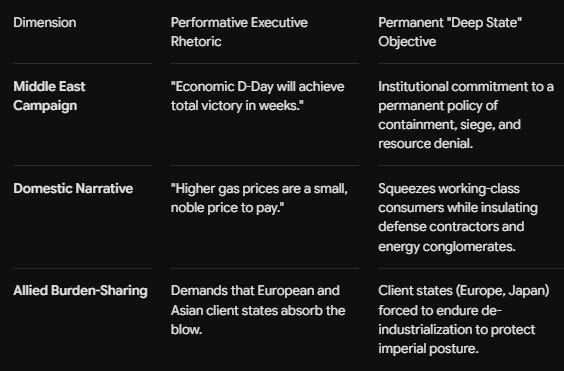
The Permanent Siege Doctrine: Regardless of election outcomes or social media declarations, the unelected national security bureaucracy remains committed to maintaining a forward military and economic cordon across the Middle East.
The Client State Shock-Absorber: Washington operates on the assumption that European and Japanese client regimes will continue to absorb soaring energy costs, currency depreciation, and industrial decline without breaking alliance discipline. However, as domestic living costs explode and energy rationing looms ahead of winter, the structural viability of this vassal model is entering systemic exhaustion.
The rollout of “Economic D-Day” marks the final exhaustion of conventional Western coercion against Iran.
Having failed to dictate terms through kinetic strikes and finding its naval posture checked by asymmetric reality in the Strait of Hormuz, the administration has retreated to an economic siege strategy that has already failed across Eurasia.
As shadow tanker networks continue to move hydrocarbons, overland trade corridors across Pakistan and Turkey expand, and the global economy fragments into non-dollar settlement blocs, performative economic declarations cannot disguise the underlying reality: the unipolar apparatus has run out of military options, and its economic weapons are rapidly losing their coercive power.
No posts
Comments
Nothing yet. Say the first thing.
Sign in to join the conversation.