
Overnight, the Russian Aerospace Forces (VKS) executed a large-scale strike package across the Kyiv metropolitan area. Combining sea-launched Zircon hypersonic cruise missiles and massed Iskander-M ballistic salvos, the strikes systematically neutralized Ukraine’s primary domestic aerospace and UAV assembly plants—including the historic Antonov serial production complex and the Fire Point missile workshops.
Concurrently, on the southern and eastern combat fronts, Russian forces have consolidated full operational control over Mala Tokmachka and captured Vodyane along the Vovcha/Tersa river line, severing the remaining northern and eastern supply arteries into Orikhiv. In western Donetsk, mechanized units have advanced through the eastern slag heaps of Dobropillya, securing elevated observation lines overlooking the urban center.
These compounding battlefield defeats coincided with the reconvening of the Verkhovna Rada in Kyiv. While lawmakers confirmed intelligence veteran Ivan Klymenko as Defense Minister, former minister Mykhailo Fedorov launched an open political challenge against Volodymyr Zelensky, demanding immediate presidential elections amid nationwide economic collapse and power grid attrition.
Following extended surveillance passes by high-altitude Russian reconnaissance UAVs, Russian forces executed a coordinated, multi-axis precision strike against critical military-industrial nodes across Kyiv and its surrounding satellite districts.
The Strike on the Antonov Serial Production Plant: Russian precision munitions struck assembly workshops at the Antonov Plant in Kyiv. The facility had been re-tooled for the serial manufacturing of Liutyi long-range strike drones, the primary fixed-wing airframe utilized in deep strikes against Russian industrial and energy targets.
Neutralization of UAV Component Networks: Targeted strikes leveled distribution facilities belonging to UK Spec Systems and the Fire Point enterprise, destroying stored solid-fuel rocket boosters and guidance electronics earmarked for the Flamingo cruise missile program.
Secondary Logistics and Fuel Interdiction: In the broader Kyiv Oblast, precision strikes destroyed the Matyushenko transportation and logistics complex (a central clearinghouse for dual-use electronic warfare equipment and robotics) and the Brovary fuel depot, incinerating an estimated 8,000 cubic meters of military fuel reserves.
Black Sea Littoral Strikes: In coordination with the Kyiv strikes, sea-launched cruise missiles hit maritime storage warehouses in the ports of Chornomorsk and Pivdennyi (Yuzhny), reinforcing the naval blockade.
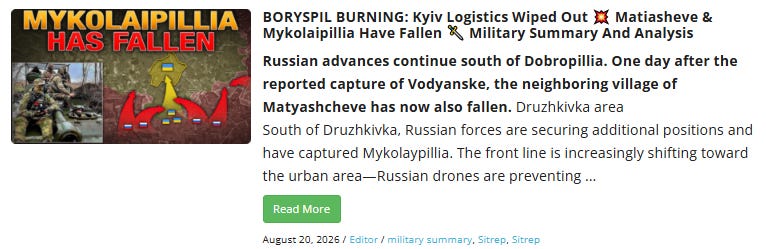
In Zaporizhzhia Oblast, the defensive perimeter shielding Orikhiv has unraveled as Russian assault formations systematically sever external supply lines and establish secure logistics corridors into the urban core.
Securing Mala Tokmachka: Frontline dispatches confirm that Russian assault elements have cleared and consolidated full control over Mala Tokmachka, southwest of Orikhiv. Securing this long-contested settlement provides Russian logistics units with protected staging areas to funnel ammunition, heavy weapons, and armor directly into southern Orikhiv.
The Capture of Vodyane: To the northeast, Russian motorized units operating under Group of Forces East secured the village of Vodyane along the Tersa River. This advance severs the northern logistics artery linking Orikhiv to rear supply depots, compressing the remaining Ukrainian garrison into a fire sack under continuous glide-bomb (FAB-500/1500) and FPV drone bombardment.
Command Disorganization: Eyewitness drone feeds and intercepted communications indicate that Ukrainian units inside Orikhiv are experiencing critical command fragmentation. With retreat routes under Russian drone fire-control, the Ukrainian General Staff faces an imminent tactical encirclement.
On the western flank of the Donbass line of fortified cities, Russian forces under General Ivan continue to make rapid gains around Dobropillya and Druzhkivka.
Control of Elevated Slag Heaps: Russian units captured the massive industrial slag heaps (terrikons) and coal mine infrastructure on the eastern outskirts of Dobropillya. These elevated positions provide Russian forward observers and drone operators with direct line-of-sight across the entire town, facilitating rapid advances into central high-rise sectors.
The Andriivka-Zolotyi Kolodyaz Corridor: Following the confirmed liberation of Andriivka, Russian assault columns are clearing the surrounding rural network, advancing toward Zolotyi Kolodyaz and Kucheriv Yar.
Outflanking the Kramatorsk Fortress: Securing this operational bridgehead widens the Russian penetration west of the Sloviansk-Kramatorsk urban chain, setting the conditions to physically cut the final western highway feeding the primary Ukrainian grouping in northern Donbass.
The compounding military crisis has triggered open political confrontation within the Ukrainian political elite as parliament reconvened.
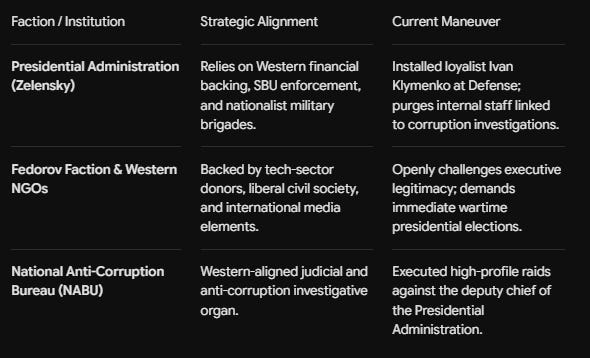
The Legitimacy Debate: In an address following the parliamentary confirmation of Ivan Klymenko as Defense Minister, ousted minister Mykhailo Fedorov demanded that the Rada schedule immediate presidential elections. Legal commentators noted that while the Ukrainian constitution explicitly prohibits parliamentary elections under martial law, it contains no such explicit prohibition regarding presidential elections—a constitutional interpretation long emphasized by Moscow.
Executive Retrenchment: Despite street demonstrations in Kyiv organized by Westernized civil-society groups and corruption raids conducted by NABU, the central executive maintains control of the state apparatus through the SBU and institutional alliances with frontline nationalist brigades (including Azov leadership).
The internal political struggle is unfolding against the backdrop of systemic economic and infrastructure breakdown.
The Energy Deficit: Repeated precision strikes on high-voltage electrical substations and thermal generation hubs have reduced Ukraine’s operational power generation capacity to approximately 20% of pre-war levels, setting the stage for extended winter power outages.
Agricultural and Heavy Industrial Rupture: With deep-water and Danube ports under naval blockade, over 75% of Ukrainian grain exports remain stranded in domestic silos. Simultaneously, the ballistic missile strikes on the Kryvyi Rih Steel Mill and the Kremenchuk Oil Refinery have paralyzed domestic armor-plate manufacturing and refined fuel production.
The developments of late August 2026 reflect an accelerating crisis across every domain of the Ukrainian state.
Militarily, the capture of Mala Tokmachka and the penetration of Dobropillya threaten the collapse of remaining southern and eastern bastions.
Industrially, the destruction of the Antonov UAV assembly workshops and critical energy infrastructure eliminates domestic defense manufacturing depth.
Politically, the public rupture between dismissed defense leadership and the central administration reveals an institutional structure under extreme pressure—trapped between an unyielding military reality on the battlefield and an unsustainable political impasse in Kyiv.
No posts
Comments
Nothing yet. Say the first thing.
Sign in to join the conversation.