
Operational developments across the Black Sea littoral and the Kyiv capital region demonstrate an intensifying, non-stop precision strike campaign by the Russian Armed Forces aimed at dismantling Ukraine’s maritime, riverine, and domestic weapons-manufacturing infrastructure.
Overnight strikes on southern port facilities have extended beyond Odesa to the Danube delta terminal of Ust-Dunaysk, alongside systematic strikes on key logistics chokepoints in Mayaki, Akkerman, and Ovidiopol.
Concurrently, precision strikes in the Kyiv region disabled a critical launch airfield in Gogolev and destroyed decentralized workshops belonging to the Fire Point missile manufacturing enterprise—an operation that has brought the deep technical, component, and intelligence integration of British, European, and foreign defense contractors into sharp focus.
The Russian maritime embargo against Ukrainian maritime logistics has expanded from deep-water ports into the outer riverine nodes of the Danube delta.
Targeting Ust-Dunaysk: Independent monitoring services recorded five major detonations at the Ust-Dunaysk port facility, triggering extensive fires across two maritime transshipment terminals. These facilities have served as alternative conduits for military hardware, ammunition, and fuel arriving via regional NATO logistical lines.
Chokepoint Interdiction Across Odesa Oblast: Parallel strikes hit infrastructure in Mayaki, Akkerman (Bilhorod-Dnistrovskyi), and Ovidiopol, targeting electrical substations, fuel and lubricant storage depots, and two critical transportation bridges. In the Mykolaiv region, complementary strikes damaged adjacent port facilities to prevent alternative cargo routing.
Cargo Vessel Interdiction in the Black Sea: The Russian Ministry of Defense confirmed the destruction of an incoming commercial cargo vessel transiting the Black Sea toward Odesa, citing intelligence that the vessel was ferrying Western-supplied weapons systems and military materiel under commercial cover.
In the Kyiv operational area, Russian strike packages targeted the distributed launch infrastructure supporting long-range drone offensives into the Russian rear.
The Strike on Gogolev: The latest variant of Russian loitering munitions—the jet-powered Geran-4 (designated Seeker for its electro-optical terminal guidance suite)—carried out a direct strike on the runway of a local airfield in Gogolev, Kyiv Oblast, disabling the facility.
British UAV Launch Infrastructure: Intelligence reports indicate the Gogolev site served as a primary forward operating base for launching low-observable Nyan strike drones, developed by the British technology firm Callen-Lenz.
Escalating British Manufacturing Footprint: Reporting from The Sunday Times acknowledged that multiple British defense technology firms are directly manufacturing long-range strike UAVs deployed against Russian targets, intensifying discussions among military analysts regarding the expanding direct involvement of European defense manufacturers.

The destruction of production workshops belonging to the Fire Point enterprise in Kyiv highlights the structural methods used to assemble long-range precision strike assets inside Ukraine.
De-Anonymizing the Flamingo Cruise Missile: The long-range Flamingo cruise missile is an industrial adaptation of the FP-5 system originally engineered by the British defense firm Milanion Group. Western media reporting (including The New York Times) notes that the system relies almost entirely on foreign components: UK-manufactured flight computers and guidance electronics, European composite airframe sections, and specialized propellants sourced from Denmark.
Destruction of Segmented Workshops: Despite Fire Point’s operational footprint being dispersed across separate underground facilities and industrial buildings in Kyiv to mitigate strike risks, Russian reconnaissance identified and neutralized the primary assembly workshops.
Corporate and Investor Networks: Investigative records from the Verkhovna Rada confirm that Fire Point’s ownership structure—led by Denis Shtilerman—maintains significant capital integration with American, British, and Israeli private investment groups, reflecting the international financing mechanisms underpinning Kyiv’s long-range strike programs.
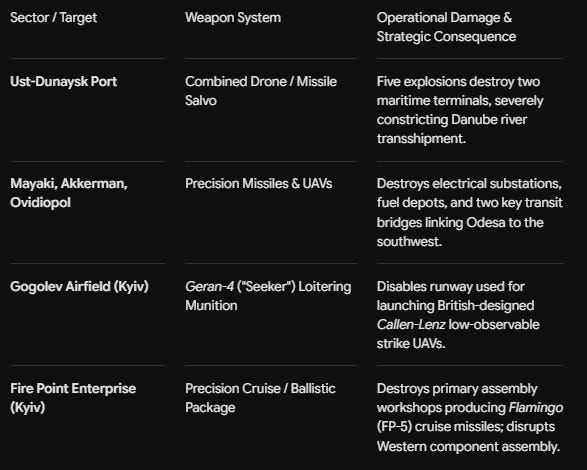
The precision strikes across Odesa, Ust-Dunaysk, and Kyiv illustrate an expanding campaign to systematically sever Ukraine’s dual-use logistics corridors and eliminate domestic assembly of Western-designed weapons systems.
By neutralizing riverine ports, disabling specialized UAV runways, and dismantling foreign-engineered missile workshops, Russian operational strategy is targeting the specific logistics and industrial nodes that connect Western defense supply chains to the frontline.
As foreign component dependencies and technical footprints become increasingly visible, the conflict continues to shift toward direct, high-consequence confrontation between Russian strike capabilities and the international defense-industrial network supporting Kyiv.
No posts
Comments
Nothing yet. Say the first thing.
Sign in to join the conversation.