
For only the second time in the entire conflict—and the first time in over a year—Russian Aerospace Forces (VKS) executed a direct precision missile strike on a major Dnieper River road and rail bridge within the city of Zaporizhzhia. This structural interdiction signals an operational shift toward isolating Ukrainian garrisons deployed on the eastern bank of the Dnieper ahead of an urban siege of Zaporizhzhia city.
Concurrently, on the western flank of the Donbass fortress agglomeration, Russian assault elements under the unified command of General Ivan captured the vital village of Andriivka. This rapid northern advance places Russian forces directly across the primary western logistics artery feeding Kramatorsk, accelerating the formation of an encirclement pocket around the remaining Ukrainian garrisons in Sloviansk and Kramatorsk.
Coupled with the collapse of central defenses in Orikhiv, the neutralization of the Kremenchuk Oil Refinery, and internal political clashes outside the Verkhovna Rada in Kyiv, the Western proxy framework faces compounding operational, industrial, and institutional failure.
The precision missile strike on the Zaporizhzhia Dnieper River bridge represents a pivotal strategic departure from previous Russian targeting constraints.
Targeting the River Lifeline: Video documentation and eyewitness reports confirm that a heavy Russian missile struck the main span of the bridge in Zaporizhzhia city, producing a massive blast that rendered the roadway impassable to vehicular and heavy armored transport. Unlike the minor drone harassment of logistics crossings in Dnipro a year prior, this strike directly targeted the structural roadway.
Operational Isolation of the East Bank: The physical disabling of the crossing severs the primary logistical link connecting western supply depots to the heavily fortified eastern districts of Zaporizhzhia city.
Shaping the Urban Siege: With units from Group of Forces Dnepr advancing rapidly inside central Orikhiv and capturing flank settlements along the northern approach roads, the bridge strike confirms that Russian planners are shaping the operational environment to encircle Zaporizhzhia from the east and south before the onset of winter.
In western Donetsk Oblast, Russian vanguard elements have achieved a major operational breakthrough between Dobropillya and Kramatorsk.
The Fall of Andriivka: The Russian Ministry of Defense and Group of Forces Center confirmed the capture of Andriivka, situated several kilometers north of previously contested lines. The settlement sits astride the primary western highway supplying Kramatorsk, placing the entire Ukrainian logistical hub under direct artillery and drone fire-control.
Compressing the Fortified Belt: Russian mechanized units continue to advance through Dobropillya—pushing past elite Azov formations in high-rise residential sectors—while simultaneously storming Oleksandro-Kalynove and threatening Druzhkivka on three sides.
The Encirclement Vector: To the north, Russian forces are advancing on Sviatohirsk, home to the historic Orthodox monastery complex. The simultaneous collapse of the northern (Lyman/Sviatohirsk) and southern (Andriivka/Druzhkivka) axes threatens to trap tens of thousands of Ukrainian troops in a massive cauldron enclosing the entire Sloviansk-Kramatorsk conurbation.
The expanding operational disparity is reflected in the divergent outcomes of long-range strike campaigns across both territories.
The Staggering Cost of PR Drone Waves: Over a 48-hour window, Ukrainian forces expended roughly 2,100 aircraft-type strike drones and nearly 30 subsonic Flamingo cruise missiles targeting central Russia, including the Progress rocket plant in Samara and facilities near Moscow. Russian integrated air defenses intercepted the vast majority, with confirmed damage limited to civilian e-commerce warehouses in satellite towns like Podolsk. At unit costs between $60,000 and $200,000 per drone, Kyiv consumed tens of millions of dollars in Western-funded hardware for negligible military return.
The Ballistic Destruction of Kremenchuk: Conversely, Russian Iskander-M ballistic and Zircon hypersonic strikes against the Kremenchuk Oil Refinery—Ukraine’s largest fuel processing enterprise—inflicted catastrophic damage across remaining distillation units and tank farms, knocking the facility offline for months.
Crippling Heavy Industry: Parallel ballistic strikes hit the Kryvyi Rih Steel Mill (disabling rolled-armor production) and Kyiv-based manufacturing sites (Firepoint and Kyiv-111 enterprises), neutralizing production lines for Flamingo solid-fuel rocket boosters and interceptor UAVs.
The compounding defeats at the front have catalyzed a severe political and institutional crisis within the Ukrainian state apparatus.
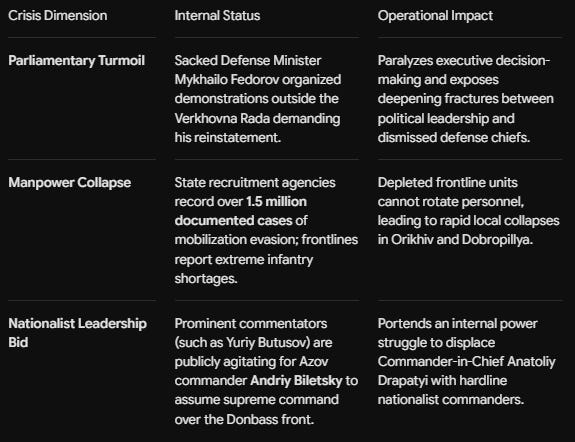
Confronted by the collapse of Ukrainian defensive lines and the prospect of an unmitigated winter catastrophe, European governments (Britain, France, Germany) are urgently lobbying Washington to initiate talks with Moscow to secure a combat freeze.
However, Russian Foreign Minister Sergey Lavrov explicitly rejected any proposals for a temporary ceasefire along current contact lines, noting that halting operations would merely allow Western powers to rearm Kyiv.
Moscow has made it clear that any settlement must address the root causes of the conflict: the complete demilitarization and permanent neutrality of Ukraine, the restoration of civil and religious rights for the Russian Orthodox Church, the eradication of 1930s-era nationalist ideologies, and the immediate return of all seized Russian sovereign assets.
The military balance in Eastern Europe has moved decisively past the point of static attrition.
With the Dnieper River bridges under direct ballistic interdiction, Andriivka liberated, and Russian assault columns closing the encirclement around the Sloviansk-Kramatorsk urban line, the Ukrainian defense architecture is collapsing across multiple axes.
As European leaders panic over their own industrial energy deficits and desperately plead for a diplomatic freeze, they confront an adversary that holds undisputed escalatory dominance on the ground, in the sky, and across the international maritime corridors.
No posts
Comments
Nothing yet. Say the first thing.
Sign in to join the conversation.