
In June 1879, eleven young men gathered in the spa town of Lipetsk, in the fertile steppe south of Moscow, supposedly to take the waters. Their actual business was rather different. One of them, Alexander Mikhailov, rose and read an indictment against a man none of them had met, a man who governed a sixth of the earth’s surface and commanded armies that dwarfed any force they could assemble. Not one of the eleven spoke in the defendant’s defense. The verdict was unanimous: death.
Emperor Alexander II, the Tsar-Liberator, had been sentenced by eleven revolutionaries meeting in a resort town, and within two years, the sentence would be carried out.
The Hand of Providence: Who Really Killed Alexander II?
·
Mar 12
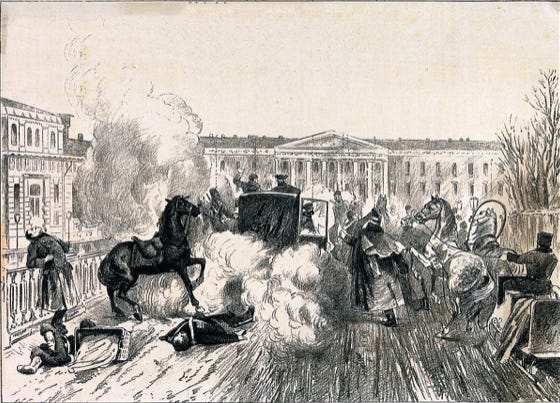
The assassination of Emperor Alexander II on the Catherine Canal on March 1, 1881 has been studied by historians to the hour, the minute, and almost to the second. The perpetrators, the radical revolutionary organization Narodnaya Volya, or People’s Will, were kn…
Dear readers and subscribers,
The story of how a movement devoted to peaceful propaganda among the peasantry arrived at this verdict is a story about organizational failure, political exhaustion, and the seductive logic of violence. It is also, at its core, a story about what happens when revolutionaries lose faith in the people they claim to liberate.
The organization from which Narodnaya Volya (People’s Will) emerged, Zemlya i Volya (Land and Freedom), had been founded in 1876 on principles of radical patience. Its program called for Narodnik intellectuals to integrate themselves into peasant communities—as teachers, paramedics, or blacksmiths—and to conduct the slow, clandestine propagation of socialist ideas. The logic was perfect: the revolution would come from below, from the masses themselves, guided by those who had earned their trust.
The practice was something else.
Working ten to twelve hours a day at their cover professions left propagandists no time for actual propaganda. Night visits to sleeping village households were not an option. More corrosively, the genuine utility the Narodniks provided (their medical care and their schooling) attracted exactly the wrong kind of attention. Denunciations to the police followed. Arrests multiplied. The conclusion drawn by Zemlya i Volya’s most impatient members was blunt: settlement in the villages benefited the peasants in their daily lives but achieved nothing toward revolution. The government simply harvested them.
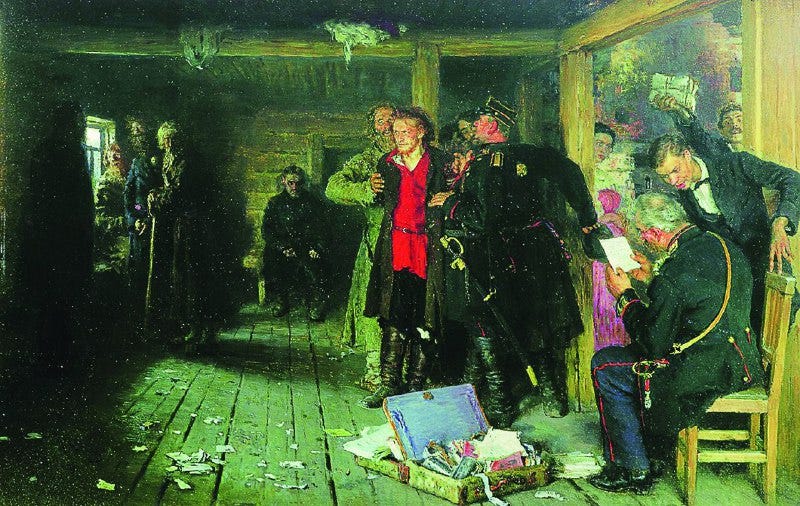
The organization’s program had always contained what it called a “disruptive” component: a small combat cell tasked with protecting the underground from informers, cultivating contacts inside the military and bureaucracy, and eliminating—that formulation was left deliberately vague—“The most harmful members of the government.”
By 1878, this cell had moved from a vague mandate to an operational reality.
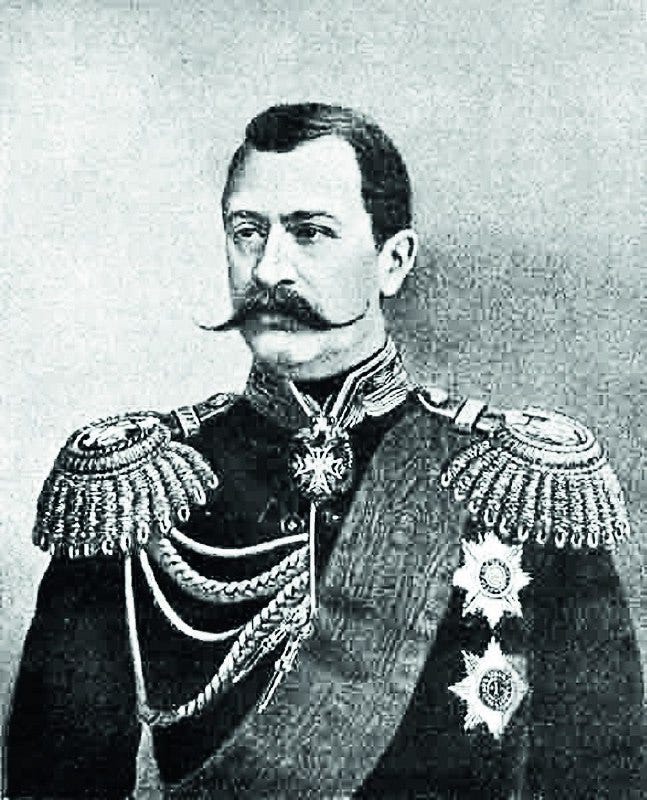
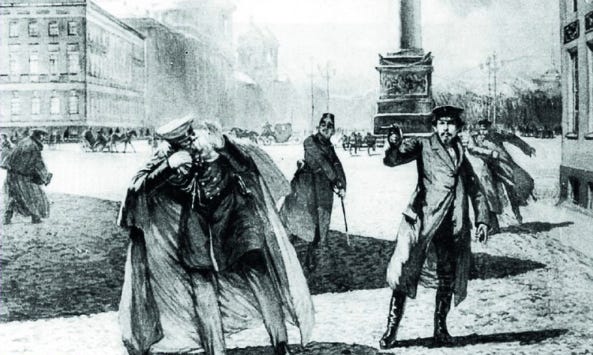
The record was shocking. In February of that year, the Kiev gendarmerie chief, Baron von Geiking, was assassinated. In August, Sergei Kravchinsky (later to find fame as the writer Stepnyak) stabbed General Nikolai Mezentsev, head of the Russian gendarmerie, in broad daylight in central St. Petersburg.
In February 1879, the Kharkov governor Dmitry Kropotkin was killed.
These acts were not random; they demonstrated capability, a phrase that anyone watching would have recognized. The effect on public consciousness was considerable. Assassins commanded the attention of Europe, while propagandists were arrested and exiled in silence. Georgy Plekhanov acidly observed that Narodnaya Volya had “the eye of the world” fixed upon them.
Terror, whatever its moral cost, was making the revolutionary movement visible.
It was against this backdrop that Alexander Solovyov arrived in St. Petersburg in 1879 with a private intention: to assassinate Alexander II. He made no secret of it among his Zemlya i Volya comrades. The ensuing debate within the organization’s leadership was ferocious. Vera Figner recalled one exchange in which a member’s threat to punish any komissarov—a reference to the peasant who had deflected a previous attempt on the Tsar in 1866—was met with a counterthreat of execution. The organization reached a Solomonic resolution: members could assist Solovyov privately, but Zemlya i Volya as an organization would not endorse the act.
Solovyov fired and missed. He was executed.
The compromise revealed that Zemlya i Volya could no longer hold its contradictions together. The “villagers” and the “politicians” had reached an impasse that no procedural formula could bridge.
The terrorist faction chose to meet before the full Voronezh congress, calculating that Lipetsk’s spa-resort character would render a gathering of young radicals unremarkable among the pilgrims heading to the Mitrofanievsky Monastery. They needed to count their numbers, agree on a position, and produce a coherent organizational model.
Among those invited, to the surprise of many, was Andrei Zhelyabov, known until then as an opponent of terror. He arrived a convert. By the time the Lipetsk meeting concluded, Zhelyabov was already sketching what would become Narodnaya Volya’s organizational architecture:
distinct departments for fundraising,
underground printing,
recruitment, and
operations,
all answering to a central executive with what the participants acknowledged would amount to dictatorial authority.
This structure stood in direct contradiction to everything Zemlya i Volya’s own newspaper had proclaimed.
“Revolution is the work of the masses,” the paper had declared. “Revolutionaries are powerless to change anything.” The men in Lipetsk no longer believed it, but they had decided to proceed regardless.
The Lipetsk meeting produced not only an assassination mandate but also a model of revolutionary organization that would echo across the following decades. For paid subscribers, the companion piece to this article examines what Georgy Plekhanov’s walkout from the Voronezh congress actually inaugurated—and how the argument that split Land and Freedom in 1879 was fought again, in different terms, in 1902, 1903, and beyond.
If you would rather not commit to a monthly or annual subscription, you can make a one-time donation using the “Buy Me A Coffee” button below.
The Voronezh congress, held in June 1879 near the Mitrofanievsky Monastery, was, by all accounts, a genuinely painful occasion. Vera Figner described what it cost the “village people” to sit in that room:
“We were invited to participate in the political struggle, called to the city, but we felt that the village needed us, that without us, it was darker there.”
The debate was not merely tactical; it addressed deeply held convictions that had taken years to develop.
Plekhanov left before anyone took a vote.
“By making your decision,” he told the room, “you have thereby acknowledged that Zemlya i Volya, as the bearer and exponent of revolutionary populist ideas, henceforth ceases to exist.”
He was not wrong, though the formal end took another two months.
Through the summer, practical quarrels over funds and over which articles the underground printing press would set corroded whatever remained of camaraderie.
By August, the split was formalized: the “village people” took the word “zemlya” and became Chyorny Peredel (Black Redistribution); the “politicians” took “volya” and became Narodnaya Volya.
The path from Lipetsk and Voronezh led to the mines beneath Malaya Sadovaya Street, and then to the embankment of the Catherine Canal on March 1, 1881, where two bombs ended the life of Alexander II. Narodnaya Volya, at its peak, counted some five hundred members. It ran workers’ circles, a military organization, a student network, and an uncensored newspaper. It placed an agent, the legendary Nikolai Kletochnikov, inside the Third Section itself.
And yet the writer Vladimir Korolenko preserved a dialogue that places the entire enterprise in ruinous clarity. Dmitry Rogachev, a veteran propagandist, asked Aaron Zundelevich of the Executive Committee what, precisely, the assassination was intended to produce. Zundelevich replied that they had hoped it would release the forces latent in the people and ignite social revolution.
Rogachev pressed, asking what would have happened if the people had not risen, as they actually did not. Zundelevich hesitated. “Then,” he said at last, “we considered... using force.”
It was not a bad admission for democrats and champions of socialist ideals.
The organization that had been founded to liberate the people had arrived, through the logic of its own failure, at the proposition that the people might need to be coerced into their own liberation.
The freedom in People’s Will, it turned out, had never quite included the people.

Works Cited
Figner, Vera. Memoirs of a Revolutionist. Translated by Camilla Chapin Daniels. DeKalb: Northern Illinois University Press, 1991.
Footman, David. Red Prelude: A Life of A. I. Zhelyabov. London: Cresset Press, 1944.
Lyashenko, L. M. Dekabristy i narodniki: sud’by i dramy russkikh revolyutsionerov. Moscow: Veche, 2016.
Troitsky, N. A. Narodnaya Volya pered tsarskim sudom. Saratov: Saratov University Press, 1983.
Ulam, Adam B. In the Name of the People: Prophets and Conspirators in Prerevolutionary Russia. New York: Viking Press, 1977.
Venturi, Franco. Roots of Revolution: A History of the Populist and Socialist Movements in Nineteenth-Century Russia. Translated by Francis Haskell. New York: Knopf, 1960.
Comments
Nothing yet. Say the first thing.
Sign in to join the conversation.