
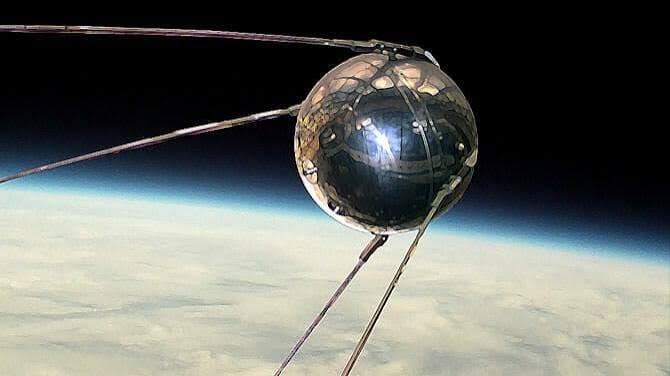
In 1957, the Soviet Union launched Sputnik, a polished metal sphere about the size of a volleyball. It did not do much beyond transmitting a radio signal, but Americans could look into the night sky, and know it was circling the globe while electronically beeping and understand immediately that the strategic balance of the world had changed.
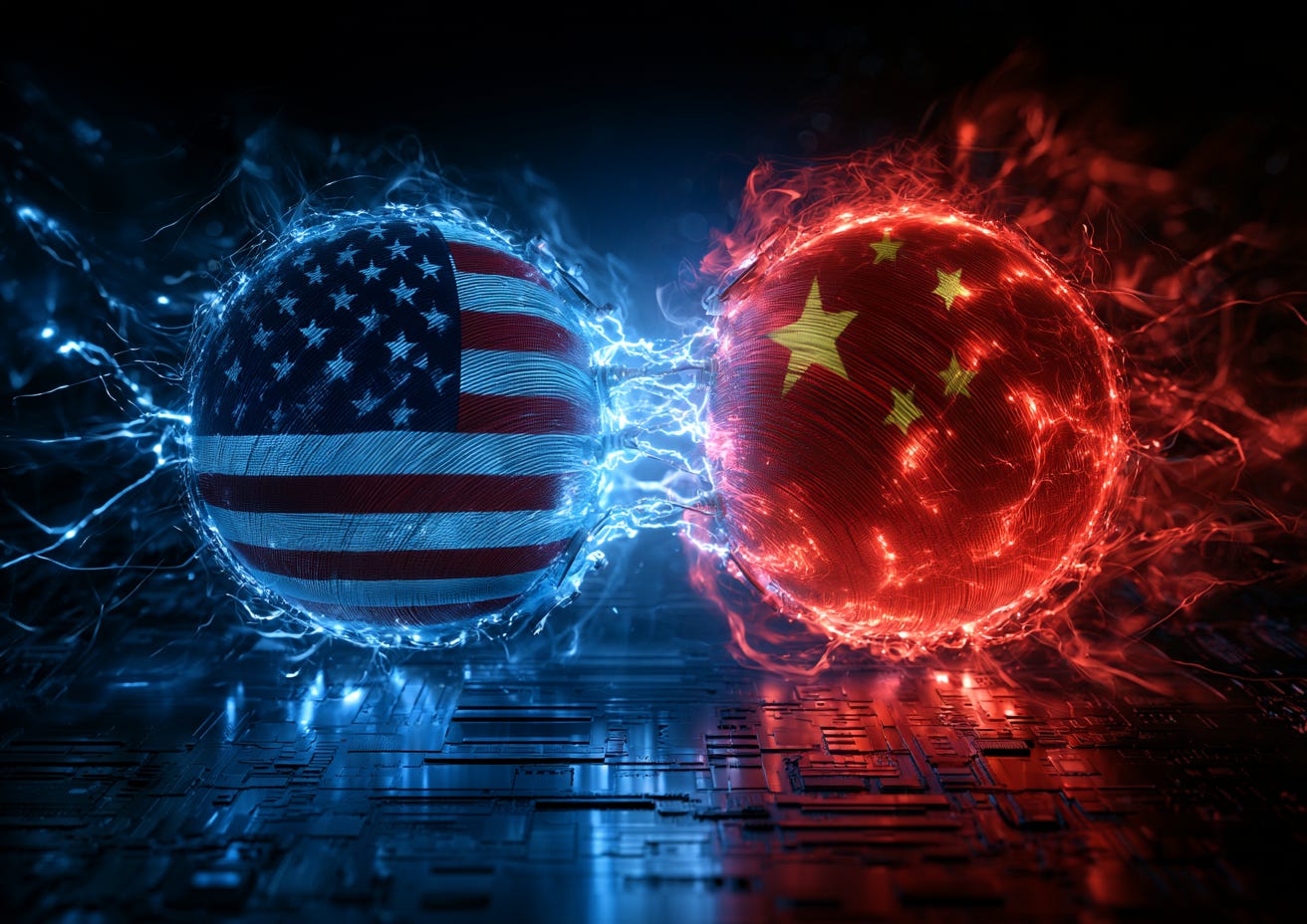
The modern quantum race is harder to see.
There is no beeping object overhead, or footprint on the moon. Instead, the competition is playing out inside dilution refrigerators, photonics laboratories, secure communications networks, national research centers and cloud-accessible computers. The United States and China are spending billions of dollars, recruiting scarce scientific talent and pursuing machines that could eventually produce two very different prizes.
The first is commercial advantage: the ability to solve an economically valuable problem such as new drug design, better battery life, more efficient logistics or investment portfolios, etc., versus what can be done with classical computers.
The second is cryptographic advantage: a cryptographically relevant quantum computer, sometimes called a CRQC, capable of running Shor’s algorithm at the scale required to break encryption such as RSA-2048 or widely deployed elliptic-curve cryptography, the public-key encryption systems that protect much of the world’s sensitive data. A fully functioning quantum internet could also allow laws-of-physics secure (i.e., un-hackable) communications, providing substantial military and tactical advantage.
And that is the first thing to understand about the quantum space race: there is more than one finish line. In the context of the broad quantum information science industry, let’s now drill down on some discrete resource buckets and focused projects, recognizing that it’s very difficult to compare apples-to-apples with the US and China for a variety of reasons.
First, let’s look at respective government capital commitments to quantum. China’s 15th Five-Year-Plan (FYP), adopted earlier this year, ranked “quantum” as the top future industry, ahead of both AI and Semiconductors, and includes a $17.5 billion allocation. In the prior 14th FYP, the investment flowed mainly through university grants and basic research, whereas the 15th FYP instead flows through manufacturing subsidies and mandated application deployments. A few caveats on this “$17.5 billion” headline: 1) This is a targeted goal, not necessarily a firm allocation of funds; and, 2) It is split among various technologies.
On the US side, federal agencies including the Department of Energy, National Science Foundation, National Institute of Standards and Technology, Department of Defense/War and various intelligence agencies each fund quantum research and infrastructure projects. This is augmented by a large variety of universities and other research organizations. According to the official National Quantum Initiative budget report, US federal expenditures and enacted budget authority for quantum information science totaled $5.1 billion from 2019 through 2024.
So on the surface, China has committed something in the $17.5 billion range, and if we generously assume a bit more than half of that (let’s say 60%) will be focused on quantum, we’re estimating this to be about $10 billion, whereas the US’s equivalent commitment is about half of that.
However, government funding is not the only source of quantum investment in the US, where a significant amount of added capital comes from the private sector. For the period of 2012-2024, more than 150 US quantum companies attracted $4.9 billion in venture capital. On top of that, large US-based corporations including IBM, Google, Microsoft and Amazon each funded significant internal quantum programs. So if we assume China’s ~5 year quantum investment commitment is $10m and we have $5.1 billion in direct US government funding, plus $4.9 billion in private capital formation, plus the added quantum investment of some of the larger US tech companies, an argument can be made that the relative investment levels between the two countries is roughly equivalent.
The patent and publication data suggest that China has built enormous scale in quantum research. By one commonly cited measure, patent applications filed through China’s national patent office, the numbers of filings rose from roughly 5,000 in 2021 to more than 7,300 in 2024, compared with approximately 1,450 to 2,300 in the United States, highlighted in the chart below:
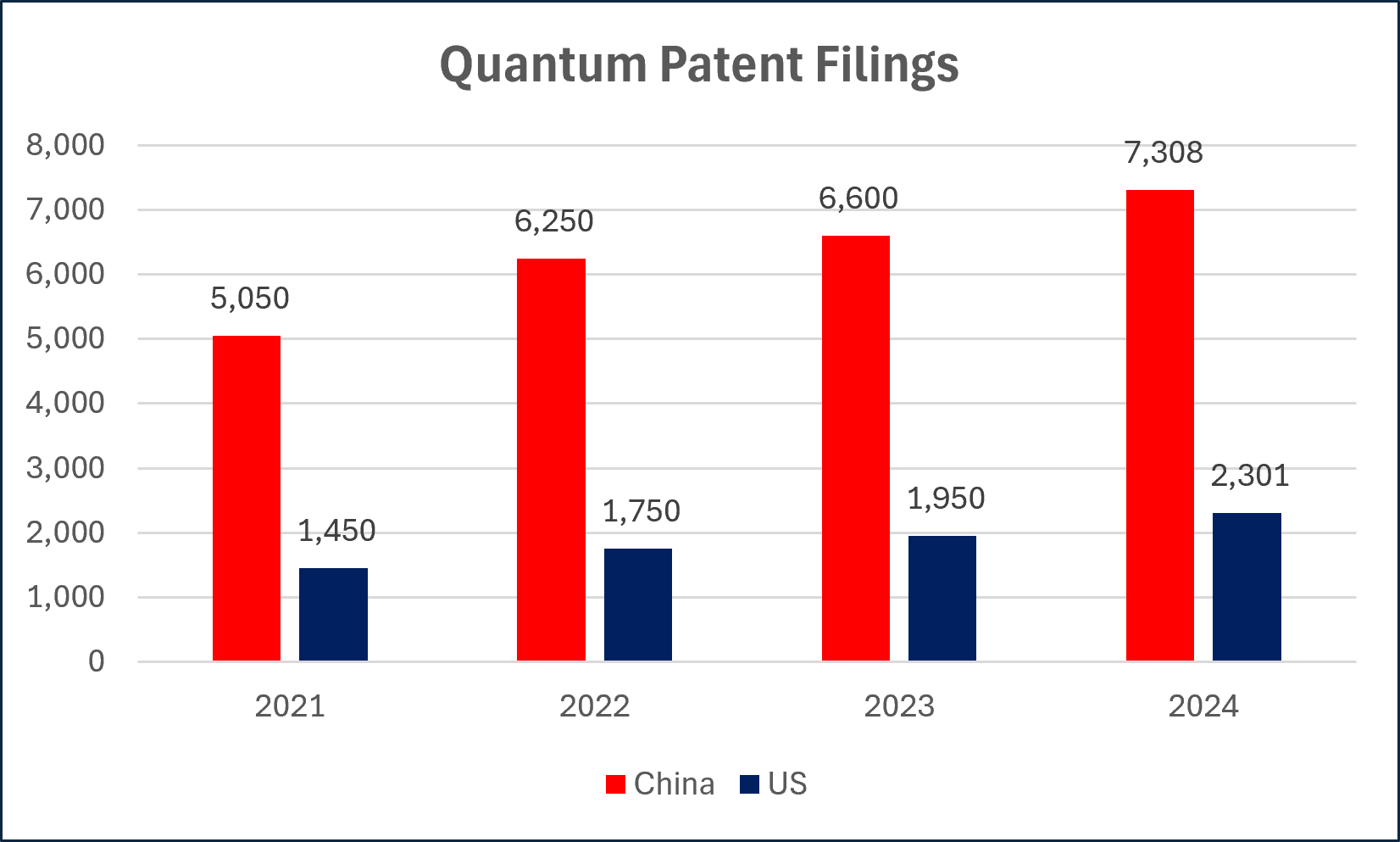
Academic-publication counts tell a similar, although less lopsided, story: China moved from roughly matching the United States in annual quantum papers in 2021 to publishing materially more by 2022 and 2023. On the surface, China therefore appears to have a commanding lead in the volume of patent activity and a growing lead in scientific output.
Those figures should not, however, be mistaken for a definitive measure of technological leadership. Some publication databases combine mainland China with Hong Kong, while others classify papers according to author affiliations, institutional addresses or international collaborations in slightly different ways. Patent comparisons can be even more slippery: a study may count applications, grants, patent families, filing offices or the nationality of the inventors, each of which produces a different result. China also has policy incentives that can encourage universities and companies to file large numbers of patents, while the U.S. system may produce fewer but more internationally filed or commercially valuable patent families. In any case, it is clear that China has achieved extraordinary scale in quantum technological advances.
Now let’s drill down on specific technological achievements in two broad areas within quantum: Networking and Computing.
China’s “Sputnik” Moment was also in Space
China has already planted a quantum flag…in orbit.
In 2016, China launched Micius, the world’s first satellite designed specifically for quantum-science experiments. In 2017, researchers reported satellite-to-ground quantum key distribution over distances of as much as 1,200 kilometers—roughly the distance from New York City to Chicago. That was enormously farther than would have been practical through an uninterrupted optical fiber, where photons are gradually lost as they travel.
The following year, Micius helped establish encryption keys between China and Austria, whose ground stations were separated by approximately 7,600 kilometers. Researchers transmitted encrypted images and conducted a quantum-secured video conference between the Chinese and Austrian academies of sciences.
More recently, A peer-reviewed 2025 description of the China Quantum Communication Network reported an operational trusted-relay network extending more than 10,000 kilometers, with 145 fiber-backbone nodes, 20 metropolitan networks, coverage across 17 provinces and 80 cities, and six ground stations linked to a quantum microsatellite. Combined with the earlier Beijing-Shanghai backbone, the reported fiber mileage exceeds 12,000 kilometers (~7,500 miles).
China has therefore proven it can integrate satellites, telescopes, ground stations, optical systems, key-management technology and conventional communications infrastructure into a working international demonstration.
On the US side, there are a few regional quantum networking testbeds of note. The strongest U.S. comparison is probably the Chicago-area network operated by institutions including Argonne National Laboratory and the University of Chicago. It spans roughly 200 kilometers (~125 miles) of optical fiber and six nodes and has operated quantum-security protocols at key-distribution rates above 80,000 quantum bits per second. That is a real deployed network, but it remains a regional research testbed rather than a national operational backbone.
New York City’s GothamQ network, developed by Brooklyn-based Qunnect, is one of the strongest U.S. demonstrations of quantum networking over ordinary commercial telecommunications fiber. Qunnect initially operated entangled-photon links over a 34-kilometer loop beneath Brooklyn and Queens, demonstrating sustained distribution at rates as high as 500,000 entangled pairs per second and reported uptime above 99%—important evidence that fragile quantum signals can survive the noise and instability of a real urban network rather than a protected laboratory. More recently, Qunnect, Cisco and NYU expanded the testbed into a three-node, hub-and-spoke network spanning 17.6 kilometers between Brooklyn and Manhattan, using a commercial data center at 60 Hudson Street as the central hub. The team demonstrated high-fidelity entanglement swapping, a foundational capability that allows two distant nodes to become entangled even though their particles never interacted directly. GothamQ is still a metropolitan testbed rather than a broadly available quantum internet, but it represents a meaningful step beyond simple point-to-point QKD: it shows that entanglement can be generated, stabilized, routed and managed continuously across the same messy fiber infrastructure used by today’s internet.
Again, it’s difficult to compare apples-to-apples between the US and China but So I would characterize China as well ahead in the quantum network that can be deployed today, while the United States remains highly competitive in researching the quantum network that scientists ultimately want to build. However, it’s useful to note that neither country has demonstrated consistently reliable quantum repeaters or a true quantum internet so this race is still being run.
It would be a mistake to look at China’s potential lead in quantum communication and assume it is not competitive in quantum computing. Chinese teams have produced some impressive quantum computing benchmark results.
The superconducting Zuchongzhi 3.0 processor contains 105 physical qubits with researchers using 83 of them to perform a random-circuit-sampling experiment which resulted generated one million samples in a few hundred seconds. Their estimate suggested that reproducing the exact exercise on a Frontier supercomputer would require billions of years under the classical methods used for the comparison.
More recently, in May 2026, Chinese researchers published results from Jiuzhang 4.0, a large photonic processor using 1,024 squeezed-light inputs in an 8,176-mode optical circuit and detecting events involving as many as 3,050 photons. The experiment pushed Gaussian boson sampling into a region the authors concluded was beyond the reach of existing classical simulation techniques.
Those numbers are impressive, but they need translation. Zuchongzhi’s random-circuit sampling and Jiuzhang’s boson sampling are specialized benchmark problems. They are designed in part to test the boundary between quantum and classical computation and are not examples of commercial quantum advantage. This does not erase the quantum achievement, but it means claims of a billion-year or trillion-year advantage should be read as comparisons with particular classical methods at a particular point in time, not permanent laws of nature quantum achievement.
On the US side, Google’s 105-qubit Willow superconducting processor completed a random-circuit-sampling benchmark in under five minutes. Google estimated that reproducing the calculation on the Frontier supercomputer would take approximately 10^25 years. That is conceptually the closest U.S. comparison to Zuchongzhi 3.0: both use deliberately difficult sampling problems to demonstrate a widening gap between quantum hardware and known classical simulation methods. As with the Chinese claims, the classical-runtime estimate is model-dependent, will probably fall as simulation algorithms improve and does not represent a useful commercial application.
Quantinuum’s 56-qubit H2-1 trapped-ion machine performed random-circuit-sampling experiments using highly connected circuits. The research team reported approximately 99.843% two-qubit-gate fidelity and argued that the resulting circuits were beyond the capabilities of state-of-the-art classical simulation methods. This is a smaller physical-qubit count than Zuchongzhi 3.0, but the trapped-ion system’s high fidelity and all-to-all connectivity allow it to generate substantial entanglement without the large routing overhead required by some superconducting machines.
A QuEra–Harvard team used as many as 280 neutral-atom physical qubits to operate 48 encoded logical qubits, executing 228 logical two-qubit gates and 48 logical three-qubit CCZ gates. The team also demonstrated that error detection improved the performance of the encoded computation compared with operating the underlying physical qubits directly. This is not a claim of classical computational advantage comparable to Jiuzhang’s boson sampling. It addresses a different and arguably more important question: can a quantum computer encode, entangle and manipulate a meaningful number of logical qubits while obtaining a real benefit from the encoding?
Again, the inability to have apples-to-apples metrics makes direct comparisons difficult, but the broader conclusion is unavoidable: China is not merely copying Western quantum research. It is operating at the scientific frontier in several areas, particularly photonic computation and quantum communications.
They say that beauty is in the eye of the beholder, so objectively determining which country is “leading the quantum race” is impossible to determine at this stage. It seems that both countries are taking quantum advancement quite seriously at the national level (for good reason), both are dedicating substantial financial resources (directly and indirectly) and both have achieved certain meaningful performance milestones in quantum networking and quantum computing.
And while the stakes involved in the US-Russia space race were more centered on bragging rights than specific military or political advantage, in the latest US-China quantum race, the stakes couldn’t be more serious. Having unhackable quantum networks to relay essential encoded information provide a true military and political advantage, and developing a powerful enough quantum computer to break RSA-2048 encryption or design powerful new drugs, materials (or dare I say weapons) would do the same. So there is a lot more at stake than bragging rights and I expect both countries will continue to push resources to win this race. I look forward to watching and reporting on the progress.
Disclosure: The author is a venture investor with investment interests in quantum and may have an interest in companies discussed in this post. The views expressed herein are solely the views of the author and are not necessarily the views of Corporate Fuel Partners or any of its affiliates or any companies it has investment interests in. Views are not intended to provide and should not be relied upon for investment advice.

Chen, Hao-Ze, et al., “Implementation of Carrier-Grade Quantum Communication Networks Over 10,000 km”, npj Quantum Information, August 8, 2025.
European Patent Office and Organisation for Economic Co-operation and Development, “Mapping the Global Quantum Ecosystem”, 2025.
Executive Office of the President, “Ushering in the Next Frontier of Quantum Innovation”, Federal Register, June 25, 2026.
Federici, Joseph, “Vying for Quantum Supremacy: U.S.-China Competition in Quantum Technologies”, U.S.-China Economic and Security Review Commission, November 18, 2025.
Gao, Dongxin, et al., “Establishing a New Benchmark in Quantum Computational Advantage with 105-Qubit Zuchongzhi 3.0 Processor”, Physical Review Letters, March 3, 2025.
Gidney, Craig, and Ekerå, Martin, “How to Factor 2048-Bit RSA Integers in 8 Hours Using 20 Million Noisy Qubits”, Quantum, April 15, 2021.
Google Quantum AI and Collaborators, “Quantum Error Correction Below the Surface Code Threshold”, Nature, December 9, 2024.
Hmaidi, Antonia, and Groenewegen-Lau, Jeroen, “China’s Long View on Quantum Tech Has the US and EU Playing Catch-Up”, Mercator Institute for China Studies, December 12, 2024.
Liao, Sheng-Kai, et al., “Satellite-to-Ground Quantum Key Distribution”, Nature, August 9, 2017.
Liao, Sheng-Kai, et al., “Satellite-Relayed Intercontinental Quantum Network”, Physical Review Letters, January 19, 2018.
Liu, Hao-Long, et al., “Gaussian Boson Sampling with 1,024 Squeezed States in 8,176 Modes”, Nature, May 13, 2026.
National Institute of Standards and Technology, “NIST Releases First 3 Finalized Post-Quantum Encryption Standards”, August 13, 2024.
National Science and Technology Council, “National Quantum Initiative Supplement to the President’s FY 2025 Budget”, Executive Office of the President, December 2024.
Tomoshige, Hideki, and Singerman, Phillip, “Understanding China’s Quest for Quantum Advancement”, Center for Strategic and International Studies, January 29, 2026.
U.S. Department of Energy, “Energy Department Announces Initiative to Create and Deploy the World’s First Scientifically Relevant, Fault-Tolerant Quantum Computers”, June 23, 2026.
Xinhua, “What to Watch at China’s ‘Two Sessions’ as New Five-Year Plan Begins”, State Council of the People’s Republic of China, March 3, 2026.
Zebelin, Dimitri, “Bit by Qubit: Global Quantum Computing Funding Hits New Records and Is Accelerating,” PitchBook, June 25, 2026 [Subscription may be required]
No posts
Comments
Nothing yet. Say the first thing.
Sign in to join the conversation.